AI Chip Startups Raised Over $6 Billion in Q2 2026 — Here's Where the Money Went

The second quarter of 2026 has rewritten the record books for AI chip startups and the broader semiconductor startup funding landscape. More than 80 AI chip and semiconductor startups collectively raised over $6 billion between April and June — a figure that underscores just how seriously investors are betting on silicon as the foundation of the next wave of AI infrastructure. Eighteen companies closed rounds of $100 million or more, and two startups — Etched and Acrab — emerged from stealth with nine-figure war chests already in hand.
But beneath the headline number lies a more nuanced story. The AI chip funding landscape in Q2 2026 is bifurcating along a clear axis: massive, infrastructure-scale rounds for data center inference accelerators on one side, and a surprising resurgence of interest in edge AI chips on the other. Both streams are substantial. Both are growing. And understanding their different theses is essential for anyone tracking where AI compute is headed.
The Data Center Wave: Inference ASICs Take Center Stage
The largest single category of funding this quarter went to companies building chips optimized for AI inference — the computationally intensive process of running trained models in production. This is a marked shift from the training-chip dominance of 2023–2024, and it reflects a maturing market where enterprises are no longer just building foundation models but deploying them at scale.
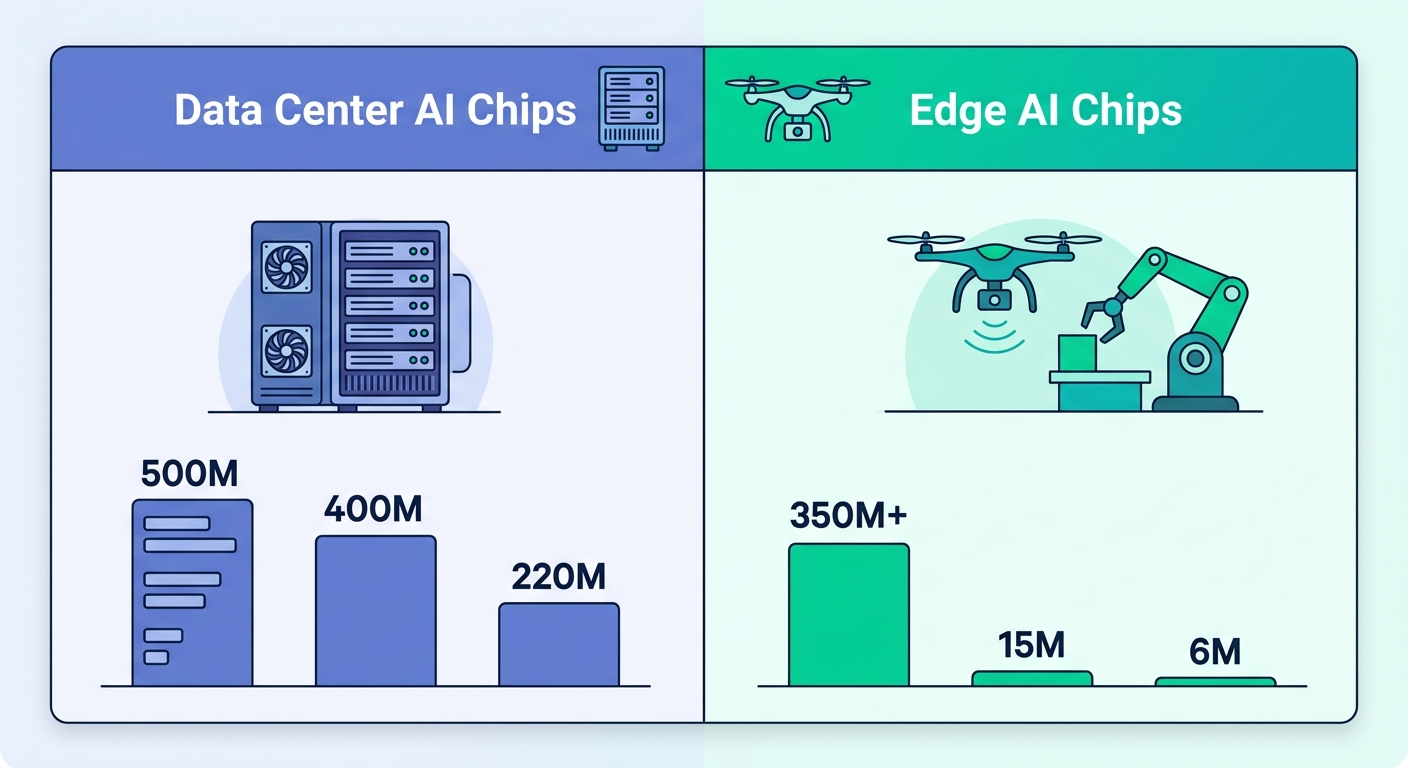
The most dramatic story of the quarter came from Etched, which emerged from stealth in June with $500 million in funding and over $1 billion in customer contracts already signed. The San Jose–based startup has designed an inference-specific architecture capable of operating math blocks at reduced voltage, allowing it to run trillion-parameter sparse mixture-of-experts models at 80%+ of peak FLOPs without thermal throttling. Etched pairs its chip design with a hybrid HBM/SRAM memory architecture and plans to ship rack-scale systems in summer 2026. The company has now raised $800 million total.
SiFive, a pioneer in RISC-V processor intellectual property, closed a $400 million Series G led by Atreides Management, with participation from NVIDIA, Apollo Global Management, and Sutter Hill Ventures. The funds will accelerate development of RISC-V CPU and AI IP solutions specifically targeting the data center. SiFive's portfolio spans high-performance application processors with dedicated vector and matrix engines — hardware building blocks that are increasingly being customized for AI workloads.
London-based Fractile raised $220 million to build what it describes as inference chips where memory and compute are physically interleaved. The architecture is designed to enable longer context windows and serve thousands of tokens per second to thousands of concurrent users within a realistic power envelope — a critical challenge as AI applications move from demo to production deployment.
Upscale AI added $190 million to its Series A, bringing total funding to $500 million. The company is building an ultra-low-latency AI networking fabric for data centers, operating around open standards including Ultra Accelerator Link and Ultra Ethernet. By unifying GPUs, accelerators, memory, storage, and networking into a single synchronized AI engine, Upscale AI is positioning itself at the intersection of AI compute and networking infrastructure — a space that received remarkably little attention until this year.
Edge AI's Comeback: Physical AI Drives Silicon Resurgence
If the data center story is about scale, the edge AI story is about speed, locality, and physical presence. After several quarters where the most significant AI chip investment flowed almost exclusively toward hyperscale infrastructure, Q2 2026 saw a notable resurgence of funding for startups building silicon for on-device, real-time AI applications.
The largest single edge AI round of the quarter came from Acrab, a Singapore-based startup that emerged from stealth with over $350 million in funding from Vertex Ventures SEA & India and others. Acrab is developing a full-stack compute architecture for edge agentic AI that spans AI silicon, local LLM inference, an operating system, multimodal human-machine interfaces, and agent orchestration. Its SoC is designed for on-device inference with a specific focus on heterogeneous CPU+NPU coordination — an engineering challenge that has become one of the central problems in mobile and edge AI.
The renewed investor interest in edge AI is being driven by what the industry calls "physical AI" — AI systems that interact with the physical world in real time, including autonomous drones, robots, and industrial systems. HYFIX, a Santa Clara–based startup designing an SoC for drones and robotics, raised $15 million in seed funding from Craft Ventures, Multicoin Capital, and others. The chip integrates flight control, high-accuracy positioning, secure wireless communications, and onboard intelligence, and is designed to operate in GPS-degraded or denied environments. HYFIX's chip supports open-source ecosystems including ROS 2, ArduPilot, and PX4 — a signal that the edge AI software stack is maturing alongside the hardware.
BigEndian Semiconductors, based in Bengaluru, India, raised $6 million to develop high-performance surveillance camera SoCs with a focus on enterprise and consumer applications. The startup recently taped out its first chip and will use the funds to move from test silicon to real-world deployments — a milestone that few early-stage semiconductor startups reach.
The Infrastructure Layer: Where the Real Bottlenecks Are
Beyond the compute chips themselves, Q2 2026 saw significant funding directed at the infrastructure that makes AI systems function — memory architectures, networking interconnects, and even the AI-powered tools used to design the next generation of chips.
XCENA (formerly MetisX) raised $135 million in Series B funding to develop computational memory architectures that reduce data bottlenecks in AI infrastructure. Built on the CXL 3.2 standard, XCENA's approach pools high-capacity DDR5 memory with near-data processing — thousands of custom RISC-V cores and vector processing engines that handle data orchestration tasks including KV cache management and preprocessing directly where the data lives. This is a critical bottleneck in large-scale AI deployments, and CXL-based memory pooling is emerging as one of the key architectural solutions.
AttoTude, meanwhile, closed a $52 million Series C for an interconnect platform targeting AI and hyperscale infrastructure. The company's approach combines advanced ASIC signal generation with low-loss dielectric waveguides to enable 200G, 400G, and 800G per-lane data rates — a technological bet that AI networking will increasingly move beyond both copper and optical solutions toward new physical-layer approaches.
Cognichip raised $60 million for what it describes as a physics-informed AI foundation model for AI-driven chip design. Rather than using traditional EDA tools, Cognichip fuses logic and physics-based reasoning to navigate complex design spaces, claim dramatic reductions in design cycles and development costs, and optimize designs for power, performance, and area simultaneously. If the claims hold, it represents an AI-disrupted approach to the very tools used to design AI chips — a recursive loop worth watching.
Geographic Distribution: The World's AI Silicon Map
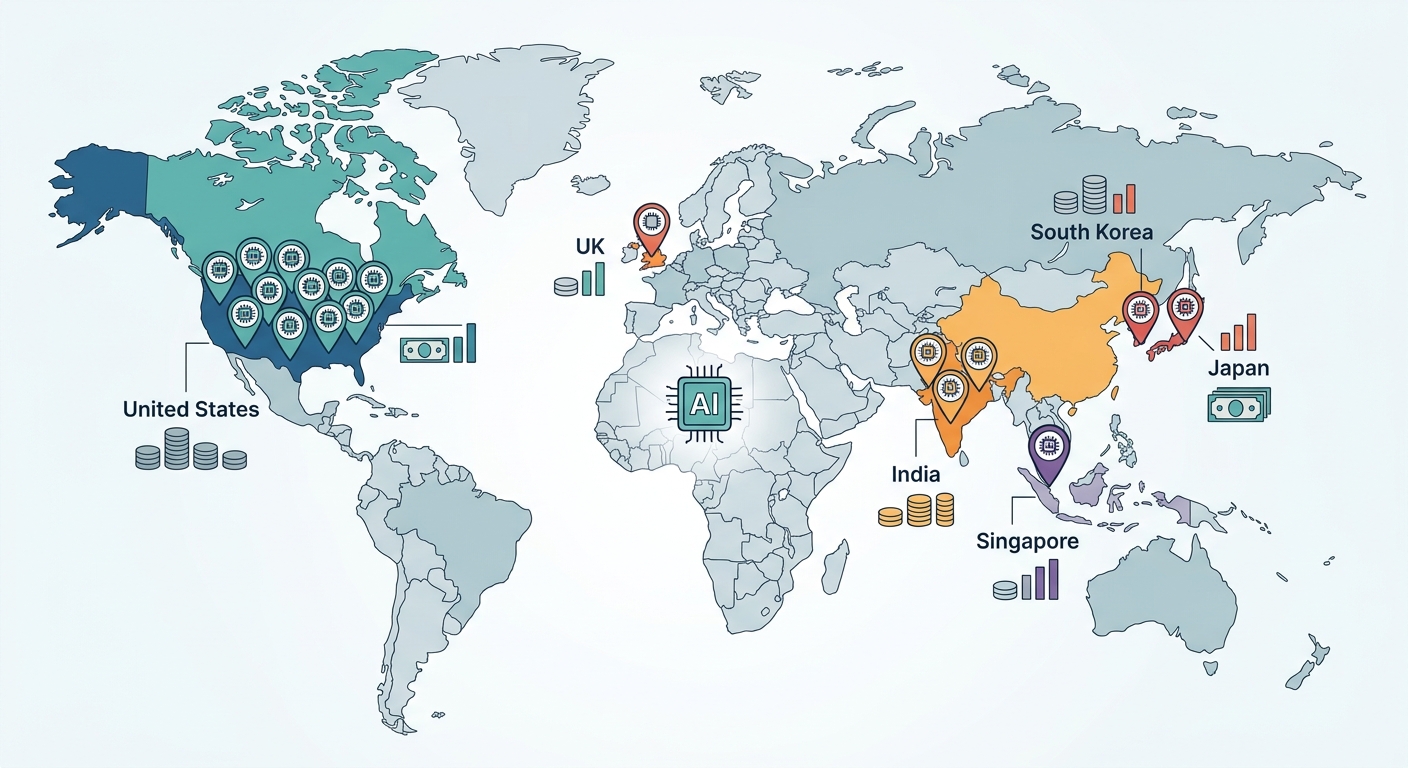
Q2 2026 AI chip funding remains heavily concentrated in the United States, particularly in California. But the global distribution tells an increasingly nuanced story.
Singapore has emerged as a legitimate edge AI hub. Acrab's $350 million stealth exit puts it among the largest rounds of the quarter from any geography, and the city-state's combination of talent, capital, and manufacturing access continues to attract serious semiconductor ventures.
South Korea showed strength in memory and storage-adjacent AI infrastructure. XCENA's $135 million round and Dnotitia's $61.2 million Series A (for a vector database and vector data processing unit) both reflect Korean startups targeting the data movement and storage bottlenecks that become critical at AI scale.
India saw multiple early-stage rounds — BigEndian ($6M), Morphing Machines ($4.4M), and HrdWyr ($13M) — suggesting a growing domestic ecosystem for semiconductor design at the chip level. HrdWyr is developing domain-specific AI SoCs targeting consumer electronics, white goods, electric vehicles, and data centers, with an architecture that combines real-time processing with adaptive on-chip learning.
The United Kingdom had a notable quarter with Fractile's $220 million raise, positioning London as a center for frontier inference hardware. Meanwhile, Japan continues to attract government support for domestic semiconductor manufacturing, with Rapidus receiving fresh infusions of public funding.
A separate but noteworthy trend: quantum computing startups raised funds at a record pace, with 21 companies closing rounds in Q2 2026, six of which reached $100 million or more. Superconducting, spin-based, neural atom, and ion trap qubit modalities were all represented, along with funding for cryogenic control electronics and quantum networking — a reminder that the AI chip landscape extends well beyond classical silicon.
What Comes Next: Q3–Q4 2026 Outlook
The funding data from Q2 2026 points to several clear trajectories for the second half of the year and beyond.
First, the inference ASIC wave is moving from architecture definition to silicon delivery. Companies like Etched and Fractile have their architectures defined and are now executing on tape-outs and system integration. Expect more stealth exits as startups approach production readiness, and watch for benchmarks comparing inference throughput, latency, and power efficiency across the new generation of specialized hardware.
Second, edge AI is transitioning from proof-of-concept to production silicon. Acrab, HYFIX, and others are no longer building PowerPoint decks — they are taping out chips and establishing supply chains. The physical AI thesis will be tested in real deployments in drones, robots, and industrial systems over the next 12 to 18 months.
Third, the infrastructure layer — memory, networking, and EDA — is attracting serious capital precisely because it is where the next generation of bottlenecks will emerge. As AI models grow and deployment scales, the components that move, store, and organize data become as important as the compute itself. CXL 3.2, Ultra Ethernet, and AI-augmented design tools are all areas to watch closely.
Finally, the geographic diversification of AI chip funding is real and accelerating. While the United States remains dominant, South Korea, Singapore, India, and the UK are producing globally competitive startups with meaningful rounds. The era of AI silicon being a single-country story is over.
Q2 2026 will be remembered as the quarter when AI chip investment matured from a single narrative — build bigger GPUs for training — into a multi-vector bet on the entire compute stack, from rack-scale inference systems to millimeter-scale SoCs for drones. Investors are not just funding chips anymore. They are funding the full architecture of the AI era.
This article is based on funding data reported by Semiconductor Engineering, Crunchbase, and Seeking Alpha for Q2 2026 (April–June). Company funding figures are as reported at time of announcement. Some rounds may include participation from strategic investors, and totals may not reflect full closings.