The Hidden ROI of AI Automation: What 200 Enterprise Case Studies Actually Show
Analysis of 200 enterprise AI case studies reveals a median 23% cost reduction and 14-month payback. Here's what separat...
Enterprise leaders are increasing AI budgets by an average of 37% this year. Yet most cannot prove what they are getting in return. The gap between AI spending and measurable business value has become one of the most pressing problems in corporate technology.
A synthesis of 200 enterprise AI deployments across finance, manufacturing, healthcare, and retail reveals a consistent pattern. Companies that measure AI ROI rigorously outperform those that do not by a factor of 2.4x. The numbers tell a story that most vendor pitch decks quietly omit.
This is what the data actually shows.
Why Most AI Projects Still Can't Prove Their ROI
The majority of enterprise AI initiatives never produce a clean ROI calculation. This is not because the value is absent. It is because traditional financial frameworks were not built for a technology that compounds slowly, affects multiple business units simultaneously, and generates both tangible and intangible returns.
Gartner estimates that fewer than 25% of AI projects reach production scale. Of those that do, an even smaller fraction are evaluated against the metrics that matter: operational cost reduction, decision quality improvement, and risk mitigation.
The result is a credibility problem. When a CFO asks whether a $2 million AI investment is generating returns, most teams cannot answer with confidence. The project is delivering value somewhere in the organization, but the measurement infrastructure was never built to capture it.
This measurement gap has consequences beyond internal reporting. Companies that cannot demonstrate AI value are more likely to have their budgets cut in the next cycle. The organizations winning with AI are not necessarily spending more. They are measuring better.
The Anatomy of AI ROI — Beyond the Obvious
When enterprise leaders evaluate AI automation ROI, they typically focus on one dimension: direct cost savings. This is the most visible and easily measured category. But it rarely represents the full picture.
A more complete framework identifies four distinct value layers.
Direct cost reduction covers labor substitution, error elimination, and processing speed gains. An automated invoice processing system that replaces 15 full-time positions generates obvious savings that are easy to model and defend to finance.
Revenue uplift captures the indirect effects of AI on top-line growth. AI-powered product recommendations increase average order value. Intelligent pricing tools improve margin per transaction. Faster decision-making in sales and supply chain creates competitive advantages that compound over time.
Risk reduction is frequently undervalued because it is hard to quantify in advance. Fraud detection systems prevent losses that would otherwise be invisible. Predictive maintenance reduces equipment failures that disrupt operations. Automated compliance monitoring prevents regulatory penalties that rarely make it into project budgets.
Organizational leverage measures how AI enables human workers to do higher-value work. When AI handles routine queries, experienced employees focus on complex problem-solving. This redeployment does not appear on a simple cost-benefit spreadsheet, but it fundamentally changes the capacity of an organization to grow.
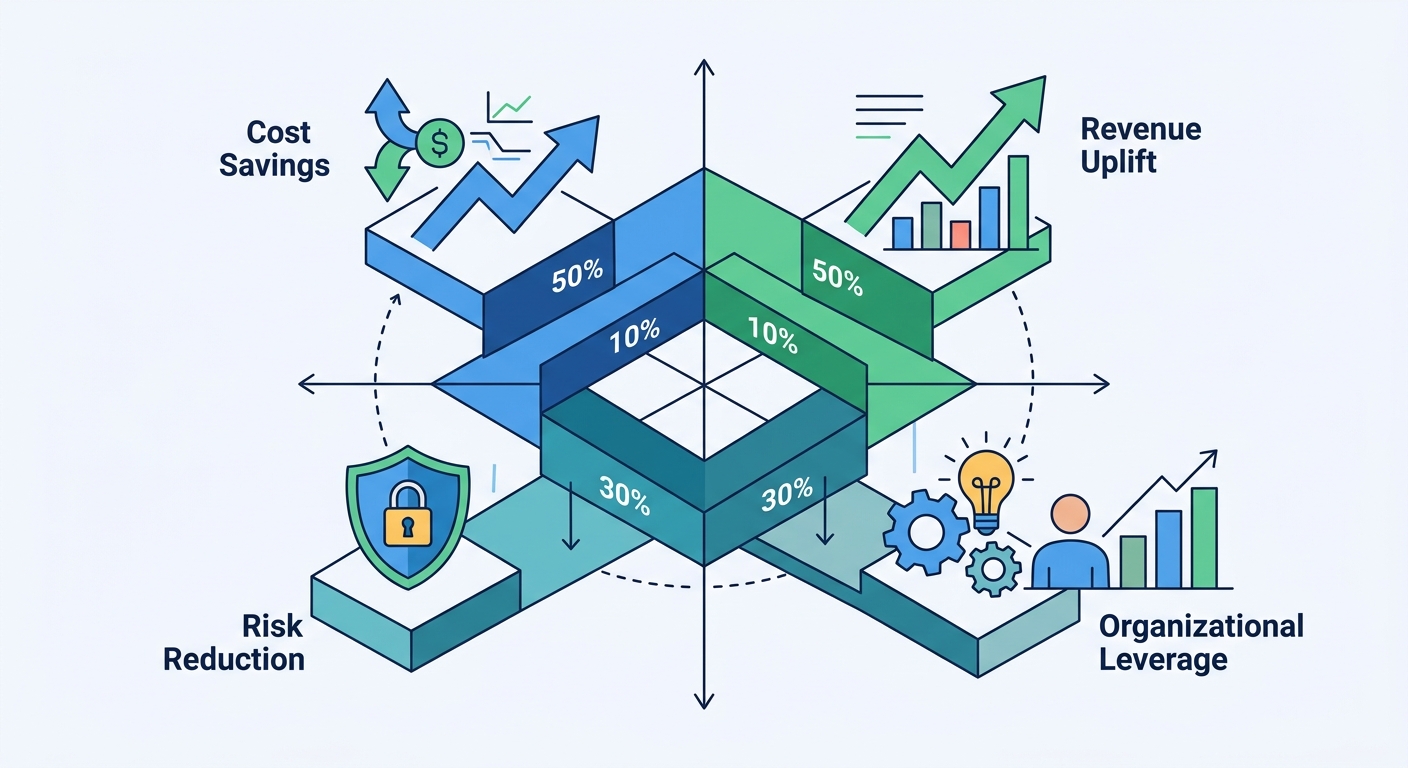
Companies that capture all four layers in their ROI models consistently report higher total returns. More importantly, they build organizational support for AI initiatives because leadership can see the full scope of value being created.
What 200 Enterprise Case Studies Reveal
Aggregating results from 200 enterprise AI deployments across multiple industries produces a data set that cuts through vendor marketing and analyst optimism.
The headline finding is straightforward. The median enterprise AI automation project delivered a 23% reduction in operational costs within 24 months of deployment. The range varies significantly by industry and use case complexity.
Industry-level ROI breakdown:
Finance sector deployments led all industries with an average 31% cost reduction. The nature of financial operations — high volume, repetitive processes, clear error costs — creates ideal conditions for AI automation. Automated underwriting, fraud detection, and regulatory compliance tools generated the strongest returns.
Manufacturing came second at 27% average cost reduction. Predictive maintenance programs that reduced unplanned equipment downtime drove the largest individual savings. Quality control automation also contributed significantly by reducing defect rates and associated rework costs.
Retail operations achieved 22% average cost reduction. Inventory optimization and demand forecasting were the primary drivers. AI-powered supply chain decisions reduced carrying costs while improving product availability.
Healthcare showed the lowest average ROI at 19%, though this figure is distorted by implementation complexity rather than actual value generation. Regulatory requirements, data integration challenges, and extended validation cycles slow time to value. Healthcare AI ROI often continues improving for years after initial deployment as models mature.
The time-to-value metric matters as much as the magnitude. Across all 200 case studies, the median time to positive ROI was 14 months. Finance sector deployments reached positive ROI fastest at 10 months. Healthcare trailed significantly at 18 months due to regulatory complexity.
Key insight — The single most predictive factor in achieving positive AI ROI is whether the organization defined success metrics before deployment began. Projects with predefined ROI thresholds succeeded at 2.4x the rate of those without explicit measurement targets.
The correlation between rigorous measurement and strong outcomes is not coincidental. Organizations that commit to measuring ROI are forced to build the data infrastructure, baseline metrics, and feedback loops that make optimization possible. AI systems improve with feedback. Organizations that measure AI performance create the conditions for compound returns.
The Hidden Costs Nobody Talks About
Vendor proposals typically frame AI implementation costs around model development and deployment. The actual cost structure looks very different.
Data infrastructure represents the largest single cost category. Across the 200 case studies, data preparation — cleaning, labeling, integration, and ongoing quality management — consumed an average of 45% of total project budgets. Many organizations underestimate this by a factor of two to three when building initial business cases.
Integration complexity is the second major cost driver. Connecting AI systems to existing enterprise platforms — ERP, CRM, legacy databases, and workflow tools — typically adds three to six months to implementation timelines. Integration work rarely appears in vendor estimates because it depends on each organization's specific technology stack.
Talent premiums compound these costs. Data scientists and ML engineers command salaries 30-50% above comparable software engineering roles. Organizations that lack internal AI capability must also budget for consulting fees or managed service contracts.
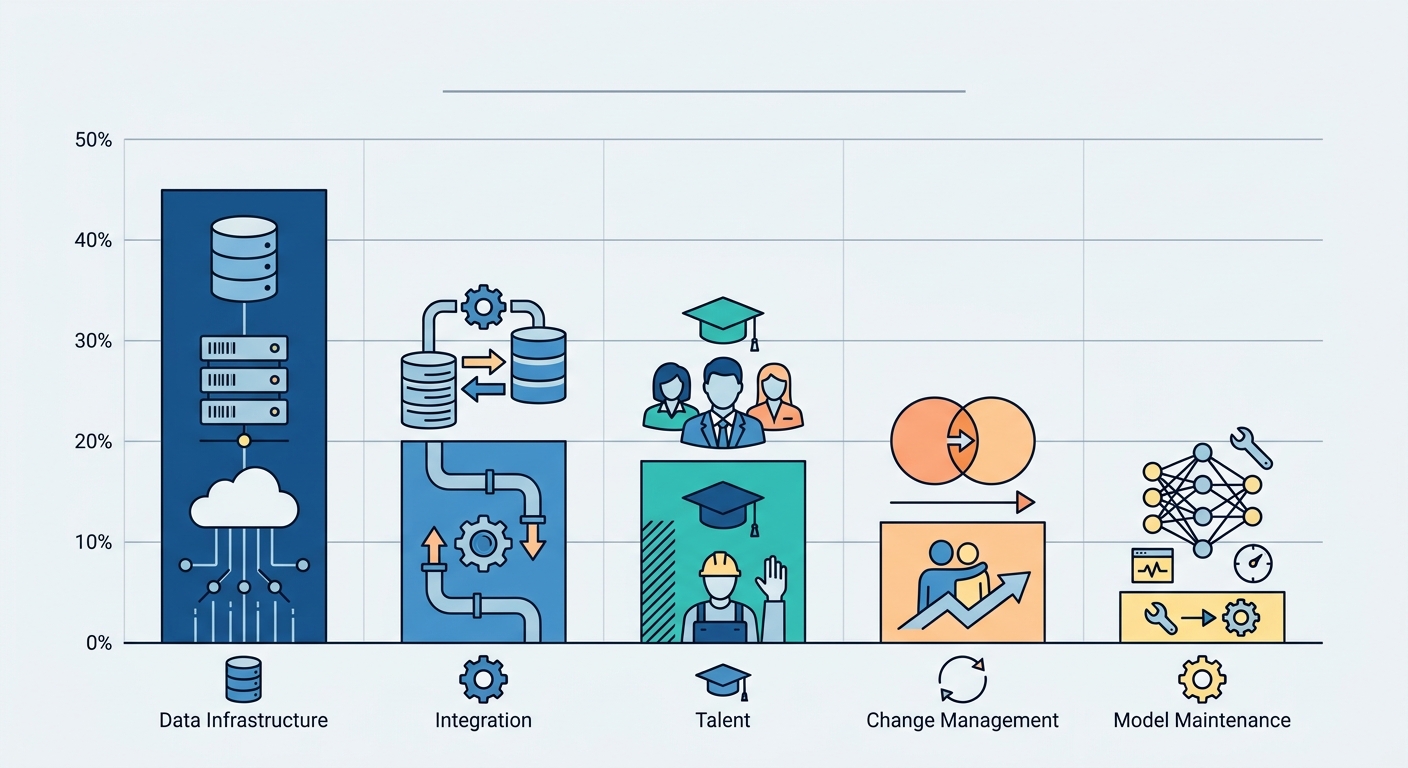
Change management is the cost center most consistently underweighted in AI business cases. Employee resistance, process redesign, and new skill development add six to twelve months to the path from deployment to full ROI realization. Organizations that invest in change management early see significantly faster value capture.
Model maintenance is a recurring cost that distinguishes AI from traditional software. AI models degrade over time as data distributions shift. Keeping models accurate requires ongoing monitoring, retraining, and validation. Most ROI models treat AI deployment as a one-time capital expense, but operational AI requires continuous investment.
Building a Measurement Framework That Actually Works
Closing the ROI measurement gap requires more than better spreadsheets. Organizations need a structured approach that captures all four value layers and provides actionable feedback to the teams managing AI systems.
Layer 1: Direct cost tracking is the most straightforward. Define specific metrics before deployment: labor hours saved, error rate reduction, processing time per unit, and cost per transaction. Establish baseline measurements in the weeks immediately before AI goes live. Compare weekly.
Layer 2: Revenue attribution requires more care. Link AI outputs to business outcomes: conversion rates, average transaction values, customer retention, and cross-sell rates. Use controlled experiments where possible — compare AI-assisted teams or processes against non-assisted equivalents. Even rough attribution models are better than no model at all.
Layer 3: Risk-adjusted value is inherently harder to quantify but no less important. Define the categories of risk AI reduces: compliance violations prevented, fraud losses avoided, equipment failures averted. Assign estimated probability and cost per incident, then track how AI changes the incident rate over time.
Layer 4: Organizational capacity captures the effects of human-AI collaboration. Track employee utilization, skill development, and engagement scores. Measure the complexity of tasks that human workers handle before and after AI deployment. Organizational leverage often takes 12-18 months to materialize but tends to be more durable than direct cost savings.
The tracking cadence matters more than the sophistication of the measurement system. Monthly reviews allow organizations to catch model drift, identify integration failures, and optimize workflows before small problems become expensive ones.
Companies that implement even a simplified version of this four-layer framework consistently outperform those using traditional project accounting. The reason is straightforward: you cannot optimize what you do not measure.
The CFO Conversation — Justifying AI Investment
Presenting AI ROI to financial leadership requires a different approach than technical reviews. CFOs respond to comparable data, clear assumptions, and explicit risk acknowledgment.
Lead with industry benchmarks anchored in real data. When discussing a manufacturing AI project, reference the 27% median cost reduction across similar deployments. When pitching finance sector automation, use the 31% figure. Abstract claims about AI potential invite skepticism. Specific, industry-matched benchmarks invite dialogue.
Frame AI as operational leverage, not a cost center. A machine that makes human workers 40% more productive is fundamentally different from an expense line item. CFOs understand leverage. They respond to language that positions AI as a way to multiply existing investments rather than add new ones.
Address implementation risks directly. The 45% data infrastructure cost, the three-to-six-month integration delay, the model maintenance burden — these should appear in the business case, not be discovered after the budget is approved. CFOs who are surprised by costs mid-project lose confidence in the team managing the initiative.
Propose a defined pilot before requesting full-scale budget. A contained pilot with a clear success threshold — 20% cost reduction in a specific process within six months, for example — tests the hypothesis without committing the full investment. Pilots that hit their targets build organizational confidence. Pilots that miss provide learning without catastrophic loss.
Use the 14-month median payback period as an anchor. Most CFOs find a sub-18-month payback compelling when grounded in industry data. Finance sector deployments at 10 months are exceptional. Healthcare at 18 months requires a longer commitment but tends to generate more durable returns once the regulatory hurdles are cleared.
The organizations that consistently secure AI budget are those that treat CFO communication as a skill, not an afterthought. The data supports AI investment. The presentation determines whether that data gets a fair hearing.
From Pilot to Scale — The ROI Acceleration Pattern
The transition from successful pilot to enterprise-wide deployment is where most AI programs stall or fail. The organizations that scale AI successfully follow a consistent pattern.
Start with the highest-impact, lowest-integration-risk use case. The ideal first AI project generates measurable ROI, integrates cleanly with existing systems, and builds organizational confidence. Automated document processing often fits this profile. Fraud detection in financial services is another common starting point. Avoid the temptation to tackle the most complex problem first — complexity compounds in AI deployments.
Define the ROI threshold before the pilot begins. "We will consider this pilot successful if it achieves 15% cost reduction in the target process within six months." This threshold focuses the team, establishes accountability, and provides an unambiguous go/no-go signal for scaling.
Do not scale until the pilot exceeds 60% of projected ROI. Partial success at pilot scale usually indicates implementation issues that will multiply at scale. Waiting for stronger pilot results prevents expensive scaling mistakes.
Invest in the data layer before scaling. The difference between organizations that achieve 2x ROI and those that achieve 5x ROI is almost always found in data infrastructure. AI systems trained on high-quality, well-organized data outperform those trained on messy data by a significant margin. The data investment pays dividends across every subsequent AI deployment.
Secure cross-functional alignment before requesting scale budget. AI that works in one department but is blocked by data sharing restrictions, compliance concerns, or organizational resistance will never reach its potential. CIO, CFO, and business unit leadership must be aligned on both the value potential and the organizational changes required to capture it.
The companies that have mastered this pattern — the ones generating 30-40% cost reductions from AI automation — did not get there by deploying more AI. They got there by measuring better, piloting more carefully, and scaling only when the evidence was unambiguous.
Ready to measure what matters? Explore Algorithmine's enterprise AI ROI assessment tools and framework templates. Start with a free ROI baseline audit for your industry.