Multi-Agent AI Orchestration: The Enterprise Playbook for 2026
From experimental chatbots to orchestrated agent systems — how enterprises are moving AI from novelty to operational infrastructure.
In 2023 and 2024, most enterprise AI initiatives looked the same: a single LLM-powered chatbot here, an automated response system there. Isolated. Narrow. Powerful in demo, fragile in production.
2026 is different. The organizations winning with AI aren't just deploying single agents — they're orchestrating entire teams of specialized AI agents that work together, check each other, and handle workflows no single model could manage alone.
This is the shift from AI assistant to AI orchestrator — and it's the defining enterprise AI story of this year.
What Is Multi-Agent AI Orchestration, Exactly?
Single AI agents respond to prompts, complete one task, then stop. Ask them to handle a multi-step process requiring research, validation, decision-making, and output — and they struggle. Context windows fill up. Errors compound. There's no one to catch mistakes.
Multi-agent orchestration solves this by treating AI workflows the way you would treat a team of specialists: each agent has a role, a scope, and a way of communicating with the others.
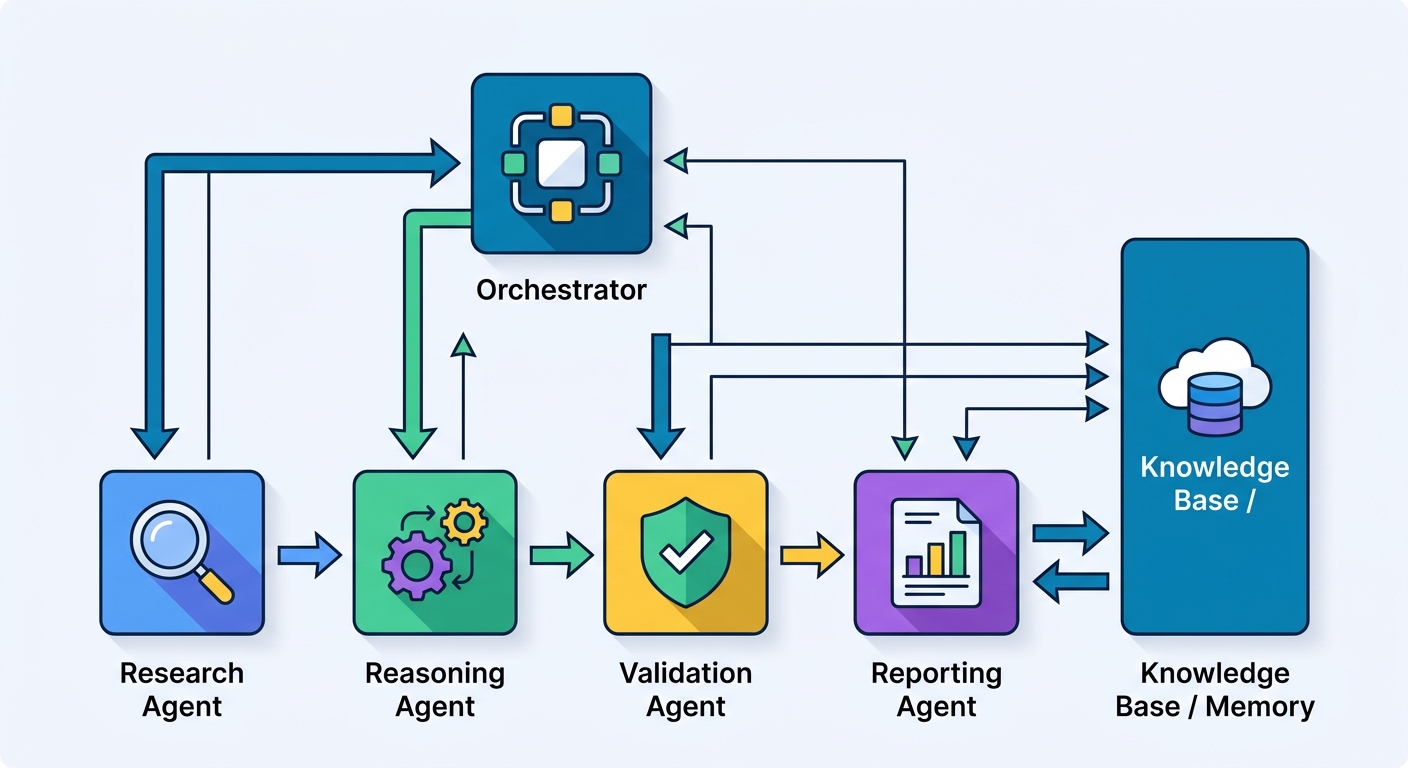
The orchestrator — sometimes called a controller or supervisor — plays the role of a project manager. It interprets user intent, breaks work into tasks, routes those tasks to specialized agents, manages dependencies, and monitors the overall process.
Think of it as an AI assembly line, not an AI chatbot.
A typical enterprise multi-agent system might include:
- A research agent that fetches and filters data from multiple sources
- A reasoning agent that analyzes findings and applies business logic
- A validation agent that checks outputs against rules, compliance requirements, or accuracy criteria
- A reporting agent that formats results into the right output for the end user
- A monitor agent that tracks performance, logs decisions, and escalates when something goes wrong
No single agent does everything. Each agent does one thing well. The orchestrator makes them work as a system.
Key insight — The core architectural principle of multi-agent AI orchestration is role specialization with centralized coordination. This is the same principle that made assembly lines and microservices architectures successful — and it works equally well for AI agent workflows.
Why This Shift Is Happening Now
Three forces are driving multi-agent systems from research labs into enterprise production:
1. Single-agent limitations are becoming deal-breakers. The promise of a general-purpose AI assistant never fully delivered in enterprise contexts because real business workflows are multi-step, context-dependent, and require domain expertise. A single LLM can't simultaneously handle customer data, check inventory, apply pricing rules, and generate a compliant invoice — at least not reliably. Distributed agent systems can.
2. Governance requirements are maturing. The EU AI Act becomes enforceable in August 2026, and it classifies many multi-agent orchestrations in high-impact sectors as "high-risk." That sounds like a barrier, but for many enterprises it's actually an accelerant: organizations that build governance in from the start are moving faster, not slower, because they've already solved the compliance problem that stops others cold.
3. The tooling is ready. Platforms like LangChain, CrewAI, AutoGen, and Microsoft's Agent Framework have matured from experimental libraries into production-grade infrastructure. The Model Context Protocol (MCP) is emerging as a universal agent-to-tool interface, dramatically reducing integration costs and vendor lock-in risk. Gartner predicts 40% of enterprise applications will embed AI agents by the end of 2026 — with MCP as a core enabler.
Key insight — The EU AI Act enforcement deadline of August 2026 is creating a "governance first" imperative for enterprises. Organizations that built compliance infrastructure into their agent architecture in 2025 now have a significant competitive advantage over those racing to retrofit governance in 2026.
The Three Dominant Platforms: A 2026 Comparison
Choosing an orchestration platform is the first major decision an enterprise makes on this journey. Here's how the three leading options stack up.
LangChain and LangGraph
LangChain remains the most widely adopted open-source framework for AI agent development — over 1,300 verified companies use it across sectors including finance, healthcare, and software. Its strength is versatility: you can build simple tool-calling agents in an afternoon, or design complex multi-step workflows with persistent memory and loops.
LangGraph — LangChain's sibling for stateful, cyclic workflows — is where things get interesting for enterprise orchestration. It models agent interactions as a graph, which means you can define explicit loops (a validation agent that routes back to a reasoning agent if output fails quality checks), conditional branches, and long-running processes with checkpointing.
The ecosystem is another advantage: LangSmith provides observability and evaluation throughout the application lifecycle, and the ability to swap model providers with minimal code changes means you're not locked in.
Best for: Engineering-led teams that need flexibility, fast iteration, and broad model provider support.
CrewAI
CrewAI has been the surprise story of enterprise AI agent adoption. Nearly half of the Fortune 500 were using it by 2024, and by early 2026 it was powering approximately 2 billion agentic system executions per year.
What makes CrewAI distinctive is its role-based agent model and its balance between code-first control and no-code accessibility. Its visual workflow editor is exportable to Python, which means business analysts can prototype and engineers can productize — without a complete tool change.
Enterprise-grade features are built in: role-based access control (RBAC), real-time tracing, audit trails, and human-in-the-loop approval gates. A 2026 CrewAI survey found that 65% of enterprises already use AI agents, 81% are scaling their deployments, and 100% plan to expand further.
Best for: Large organizations that want strong governance and a spectrum from citizen developer to professional engineer, without sacrificing production reliability.
AutoGen and Microsoft Agent Framework
AutoGen, developed by Microsoft, excels at collaborative multi-agent scenarios — situations where agents with different roles debate, iterate, and refine outputs together. Code review agents, exploratory research workflows, and creative ideation pipelines are common enterprise use cases.
After its version 0.4 release in January 2025, AutoGen crossed the threshold from R&D prototype tool to production-ready framework. But Microsoft's guidance for high-stakes enterprise deployments is increasingly toward the Microsoft Agent Framework (MAF) — which provides explicit, graph-based workflows similar to LangGraph, but with the enterprise predictability, audit trails, and Microsoft ecosystem integration that demanding regulated environments require.
The tradeoff: AutoGen offers more flexibility and creative autonomy; MAF offers more control and predictability. For mission-critical workflows in finance, legal, or healthcare, MAF is increasingly the default choice.
Best for: Enterprises deeply invested in the Microsoft ecosystem, or use cases that require deterministic workflows with strict audit trails.
From Pilot to Production: The Deployment Roadmap
The gap between "our agents work in a demo" and "our agents work in production" is where most enterprise AI initiatives stall. Here's how to cross it.
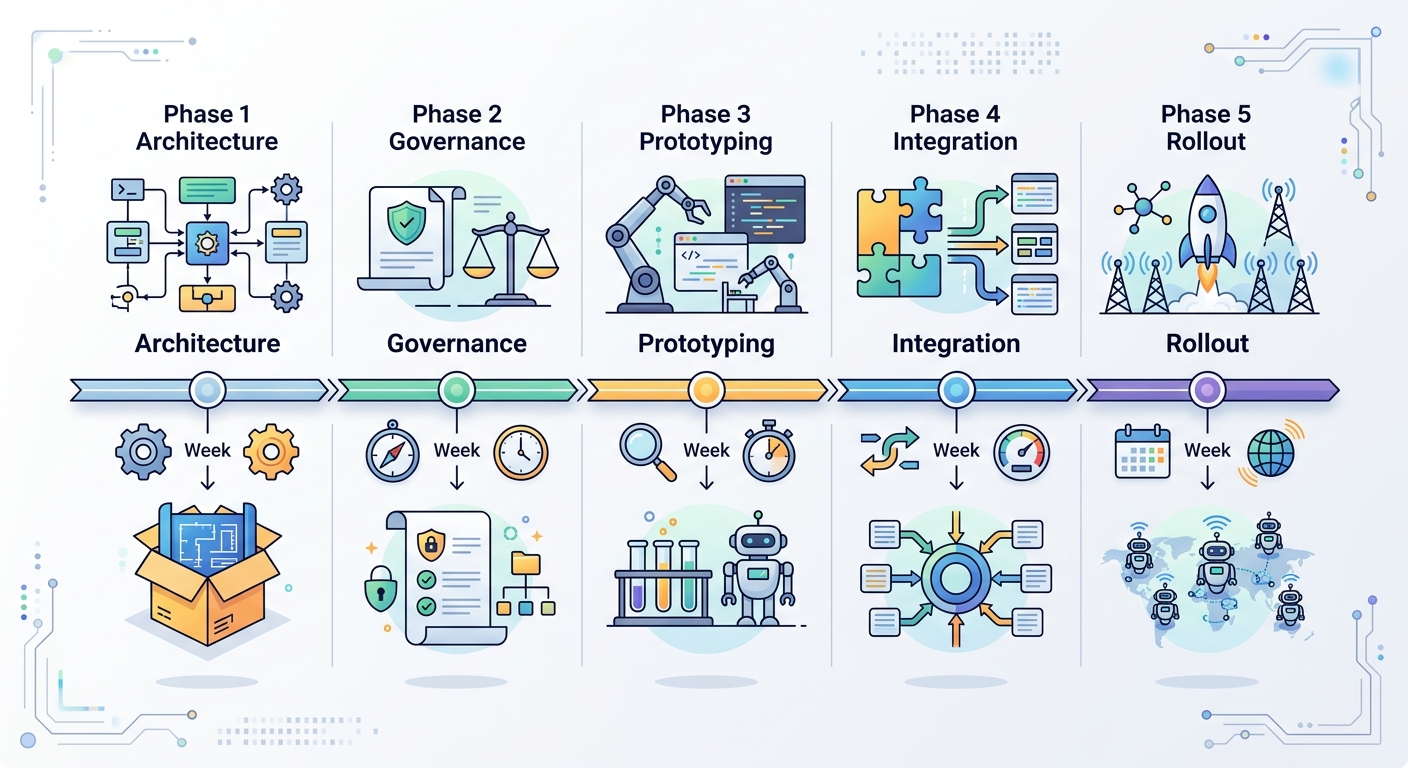
Phase 1: Architecture Design (Weeks 1–4)
Before writing any code, map the workflow you're trying to automate. Identify:
- The entry point — what triggers the multi-agent system? (an API call, an email, a scheduled event?)
- The agent roles — what distinct tasks need to happen, and what skills does each require?
- The decision points — where does the workflow branch based on outputs?
- The failure modes — what can go wrong at each stage, and how does the system recover?
- The human touchpoints — where does a human need to approve, override, or intervene?
This phase produces an architecture document that serves as the blueprint for everything that follows.
Phase 2: Governance Design (Weeks 2–5, overlapping with Phase 1)
Governance isn't a later phase — it shapes architecture from day one. Design:
- Permission boundaries for each agent (what can it read, write, call, approve?)
- Decision logging — every significant agent action should produce a log entry with timestamp, input, output, and rationale
- Human approval checkpoints — define which actions require human sign-off before execution
- Alerting and monitoring — what conditions trigger an alert, and who receives it?
The EU AI Act adds specific requirements here: if your multi-agent system affects decisions in hiring, credit, healthcare, or critical infrastructure, you need documented risk assessments, transparency measures, and human oversight mechanisms. Build this documentation as you build the system, not after.
Phase 3: Platform Selection and Prototyping (Weeks 4–8)
With architecture and governance documented, select your platform and build a prototype that handles a real (but bounded) workflow. Resist the temptation to automate everything immediately. Choose one high-value, well-scoped workflow — something like contract review, B2B lead enrichment, or customer issue classification — and get it working end-to-end.
Validate against real data, real edge cases, and real users. Iterate fast.
Phase 4: Integration and Testing (Weeks 8–14)
Integrate with existing enterprise systems: CRM, ERP, HRIS, data warehouses, communication tools. This is where event-driven architectures (EDA) shine — treating AI agents as reactive components that consume and produce events through a message bus (Kafka, Kinesis, etc.) enables loose coupling and elastic scaling that point-to-point integrations can't match.
Run load testing, security testing, and compliance testing in parallel. This phase also includes building the operational runbook: how do operations teams monitor, restart, and escalate when agent systems behave unexpectedly?
Phase 5: Rollout and Optimization (Weeks 14+)
Start with a controlled rollout — a single business unit, a single workflow, clear success metrics. Measure accuracy, latency, cost per transaction, and user satisfaction. Build feedback loops so real-world performance data flows back into agent prompt and architecture improvements.
Plan for continuous optimization: agent systems are not "deploy and done." They're infrastructure that needs tuning as business requirements evolve, models improve, and new integration points emerge.
The Hidden Challenge: Agent Cost and Observability
Enterprises consistently underestimate two costs in multi-agent systems: token consumption and operational observability.
Every inter-agent communication consumes tokens. In a system with five agents having a back-and-forth conversation, token costs can be 5–10x higher than a single-agent interaction that achieves the same result. Multiply across thousands of daily transactions and the economics change.
Observability is equally challenging. Traditional application monitoring doesn't map well to agent systems. You need to track not just whether a system worked, but why each agent made each decision — and whether those decisions were correct. Tools like LangSmith, CrewAI's tracing, and Azure Application Insights provide this, but they require deliberate setup.
Key insight — The most mature enterprise AI teams are building "agent cost centers" to track token spend per workflow, per team, and per customer — treating AI agent optimization the same way they treated cloud cost optimization five years ago.
The enterprises getting this right are treating multi-agent cost management as a first-class engineering discipline, not an afterthought.
What the Next 18 Months Look Like
The trajectory is clear:
From reactive to proactive. Today's agent systems react to prompts and events. The next generation will work from goals — "achieve X outcome by Y time" — and plan their own task decomposition and execution.
From single-platform to hybrid environments. Most large enterprises are already running two or more orchestration platforms simultaneously, matching platform to use case rather than forcing everything into one tool. This hybrid approach will accelerate.
From chat to infrastructure. AI agents are increasingly embedded in enterprise systems as invisible infrastructure — not a chat interface, but a backend process that handles document processing, decision support, and workflow automation without human-initiated prompts.
MCP becomes the connective tissue. The Model Context Protocol won't be the only integration standard, but it will be the dominant one for agent-to-tool communication within enterprises, significantly reducing the integration burden that's currently one of the biggest friction points.
The Bottom Line
Multi-agent AI orchestration is no longer a research topic or a future vision. It's a present enterprise infrastructure decision — one that determines how quickly your organization can automate complex workflows, maintain governance and compliance, and scale AI beyond the limits of single-agent systems.
The question isn't whether to adopt multi-agent orchestration. The question is whether to build the capability now, from a position of strategic choice, or to be forced into it later by competitive pressure or regulatory deadline.
The enterprises building in 2026 will have a significant advantage: they understand the patterns, they've built the governance, they've learned the failure modes, and they have the operational muscle to run agent systems reliably.
The window to build that advantage is open right now.
Expert Q&A
Q: What's the biggest mistake enterprises make when moving from a single-agent prototype to a multi-agent production system?
A: The most common failure is treating the orchestrator as an afterthought. Teams build two or three specialized agents that work well independently, then bolt on a simple "supervisor" that just routes messages between them. This creates a brittle system with no error recovery, no visibility into what each agent is doing, and no way to handle partial failures. A production-grade orchestrator needs three things: (1) explicit error handling for each agent — what happens when Agent A fails mid-workflow? (2) a shared memory or state store so agents don't lose context when handing off work, and (3) a decision log that records the reasoning behind each routing decision. Without these, you're not running a multi-agent system — you're running several single agents that happen to talk to each other.
Q: LangChain, CrewAI, and AutoGen all look capable on paper. How should an enterprise actually choose between them?
A: The honest answer is: it depends heavily on your team's composition and your existing tech stack. If your team is strong in Python and values flexibility, LangChain (with LangGraph for stateful workflows) is the most powerful and flexible choice — but it requires the most engineering investment to get right. If you're a larger organization that needs governance, audit trails, and RBAC out of the box, and you have both citizen developers and engineers, CrewAI's opinionated enterprise features will save you months of building infrastructure that others give you for free. If you're in the Microsoft ecosystem and need predictable, auditable workflows for regulated industries, start with the Microsoft Agent Framework rather than raw AutoGen. The biggest risk is choosing a platform based on its feature list rather than a realistic assessment of your team's ability to implement and maintain it.
Q: The article mentions token costs can be 5–10x higher in multi-agent systems. How do you actually bring that cost down?
A: Cost reduction happens at three levels. First, architecture: design your agent handoffs to minimize back-and-forth. If your reasoning agent needs to ask the research agent three times for additional data, that's wasted tokens. Use structured output schemas (JSON mode) so agents pass compact data rather than natural language summaries. Second, caching: implement a semantic or exact-match cache between agent interactions — if the same research query has been run in the last hour, the research agent should return a cached result. Third, model routing: not every agent in your pipeline needs the most expensive model. A routing agent that classifies an incoming request might run on a small, fast model; a reasoning agent doing complex analysis needs a frontier model; a formatting agent just needs instruction-following capability. Matching model size to task complexity can cut costs by 60–70% without sacrificing quality.
Q: How does the EU AI Act actually affect multi-agent system design in practice? Is this just paperwork or does it change architecture?
A: For enterprises operating in the EU or handling EU citizen data, it materially changes architecture in several ways. First, high-risk classifications under the EU AI Act Annex III include AI systems used in employment decisions, credit scoring, and critical infrastructure — if your agents touch any of these, you need conformity assessments, technical documentation, and human oversight mechanisms before deployment. Second, transparency obligations mean your agents need to be identifiable as AI systems in their outputs, and users need to be informed when they're interacting with an automated decision system. Third, and most architecturally significant, the Act's data governance requirements mean you need documented provenance for the data your agents use — which affects how you design your research agent's data sourcing pipeline. This isn't theoretical: the August 2026 enforcement date is real, and EU market access depends on compliance. The good news is that building these requirements in from the start produces better systems — the documentation discipline forces you to think through failure modes and decision accountability that you'd otherwise skip.
Q: The article mentions event-driven architectures for agent communication. Is that actually better than direct agent-to-agent messaging?
A: For production enterprise systems, yes — with a caveat. Direct messaging (Agent A calls Agent B directly) is simpler to implement and fine for prototypes with two or three agents. But it creates tight coupling: if Agent B changes its interface, Agent A breaks. It also creates a debugging nightmare — you can't easily replay or audit the sequence of messages. An event-driven approach where agents publish to and subscribe from a message bus (Kafka, AWS EventBridge, etc.) adds initial complexity but gives you three things direct messaging can't: (1) replayability — you can re-run a workflow from a checkpoint, (2) observability — every event is logged and traceable, and (3) elasticity — you can add or remove agents without disrupting the workflow. The caveat: event-driven architectures add latency (messages don't travel as fast as a direct function call), so for latency-sensitive workflows with only two agents, direct messaging may still be appropriate. The moment you have more than three agents or need to scale, event-driven pays for itself.
Ready to explore how multi-agent systems could transform your workflows? Start with a single, well-scoped use case — and build from there.