AI Workflow Automation: Expert Q&A — The 40% Cost Reduction Deconstructed
Expert Q&A on enterprise LLM workflow automation: 40% cost reduction broken down — where the savings come from, which patterns deliver highest ROI, and realistic implementation timelines....
AI Workflow Automation: Expert Q&A — The 40% Cost Reduction Deconstructed
Published: August 18, 2026 · Estimated read time: 14 minutes
The 40% operational cost reduction headline has become something of a benchmark claim in enterprise AI circles — cited in vendor pitches, analyst reports, and board presentations. But what's actually driving those numbers, which enterprises are genuinely hitting them, and where do implementations consistently stall? We break it down in expert Q&A format.
The Fundamentals
Q: Is the 40% cost reduction figure from LLM workflow automation real, or is it marketing?
A: It's real — but it's a lagging indicator, not a starting point. The enterprises reporting 40% reductions are typically 18–24 months into systematic deployment. Year-one savings cluster around 10–20%, and those gains are often counterbalanced by integration development costs, change management investment, and the learning curve of building internal automation capability. The 40% figure compounds over time as reusable components accumulate and process standardization pays dividends across subsequent automation waves. Treating it as a first-year outcome leads to disappointment and discredited initiatives.
Q: What distinguishes LLM-powered automation from the RPA wave of the 2010s?
A: Traditional RPA operated on rigid, rule-based logic — if field A equals value B, perform action C. This worked for highly structured, repetitive tasks but broke down whenever processes required judgment, context interpretation, or unstructured data handling. LLM-powered automation introduces four capabilities RPA couldn't match:
- Interpretation of unstructured inputs — emails, PDFs, contracts, free-text fields — without pre-defined extraction templates
- Contextual decision-making — routing requests based on intent, urgency, or policy rather than static conditional branches
- Dynamic response generation — drafting replies, summaries, or instructions on the fly rather than pulling from pre-written script libraries
- Cross-domain reasoning — connecting information across disparate systems to complete a single workflow step
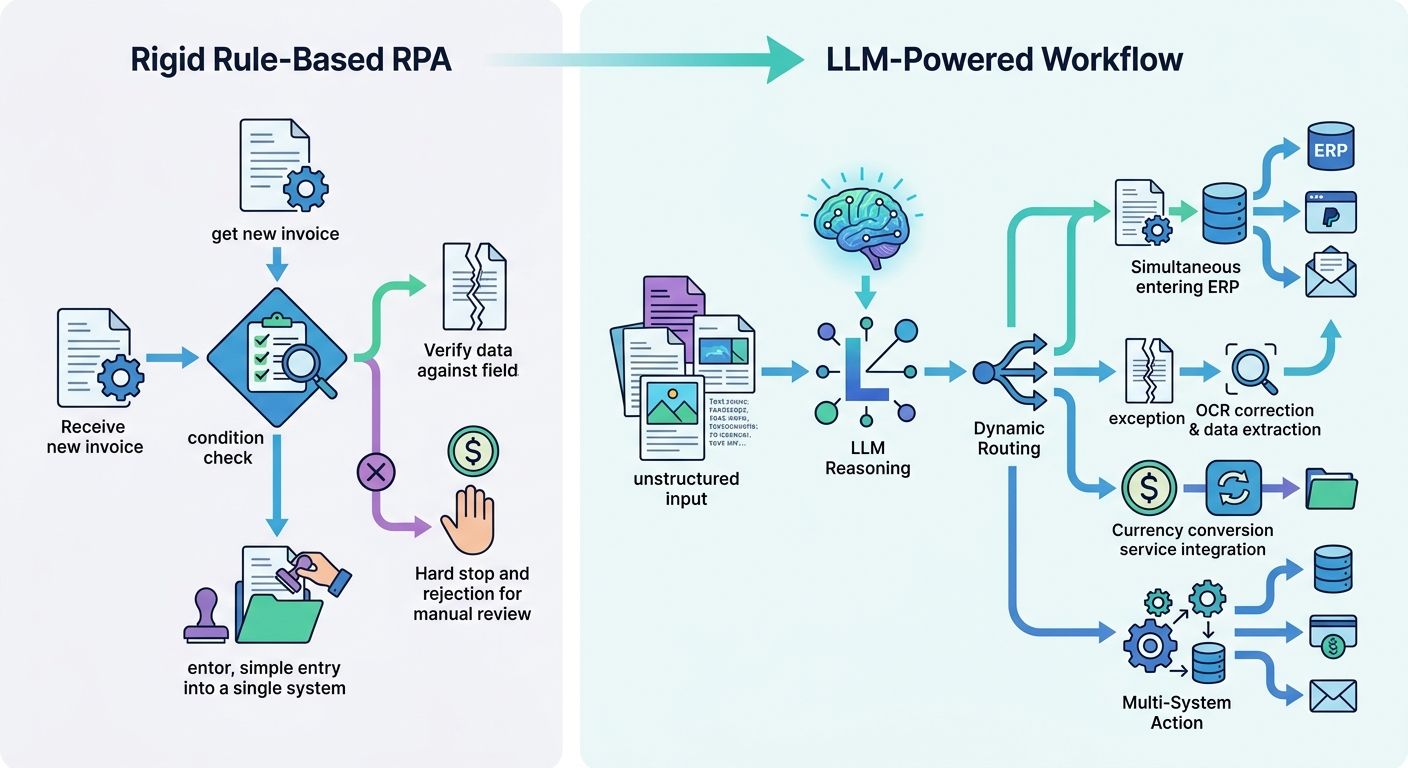
The practical implication: RPA automated tasks. LLM-powered automation automates work — the difference being that work often involves ambiguity, exceptions, and unstructured inputs that RPA simply couldn't process.
Where the Savings Actually Come From
Q: You mentioned the 40% figure isn't derived from a single mechanism. Walk through the components.
A: The reduction is an emergent property of four overlapping improvements that compound across operations:
1. Labor arbitrage, the next chapter. The first wave of enterprise cost optimization moved repetitive tasks offshore — lower labor costs, but still subject to management overhead, shift scheduling, quality variance, and attrition. LLM automation eliminates the unit cost of that labor entirely for qualifying tasks. A single automation agent can handle volumes that previously required dozens of offshore processors, without the structural overhead.
2. Error rate elimination. Human error in repetitive operational tasks typically runs 2–5% depending on complexity and fatigue factors. Each error carries cascading costs: correction labor, downstream impacts (delayed shipments, incorrect billing, compliance violations, customer dissatisfaction). Properly designed LLM systems operate at error rates approaching zero for the tasks they handle. One logistics company deploying LLM automation for customs documentation reported that eliminating manual data-entry errors reduced penalty fines and rework costs enough to recover their entire automation investment within eight months.
3. Throughput consistency. LLMs don't experience cognitive load degradation over the course of a workday. They process the first invoice of the morning and the five-hundredth with identical accuracy and speed. For operations facing volume spikes — seasonal retail fulfillment, end-of-quarter financial closes, regulatory reporting windows — this consistency translates to capacity without proportional headcount increases.
4. Integration cost reduction. One of the least-discussed cost components in enterprise operations is the friction of moving information between systems. A customer service ticket needs to update the CRM, trigger a shipping hold in the ERP, and flag the fraud detection system — tasks that previously required either expensive middleware integration or manual re-keying. LLM-powered agents increasingly function as intelligent middleware layers, handling translation and routing work that would have required significant custom engineering. This reduces time-to-automation for new workflows from months to days.
The Four High-ROI Automation Patterns
Q: Which automation patterns are enterprises finding highest ROI on first?
A: Four patterns dominate early adoption across industries:
Pattern 1: Intelligent Document Processing (IDP)
Enterprise operations are drowning in documents — contracts, invoices, purchase orders, insurance claims, medical records, regulatory filings. IDP uses LLM capabilities to extract, classify, validate, and act on information buried in unstructured or semi-structured documents.
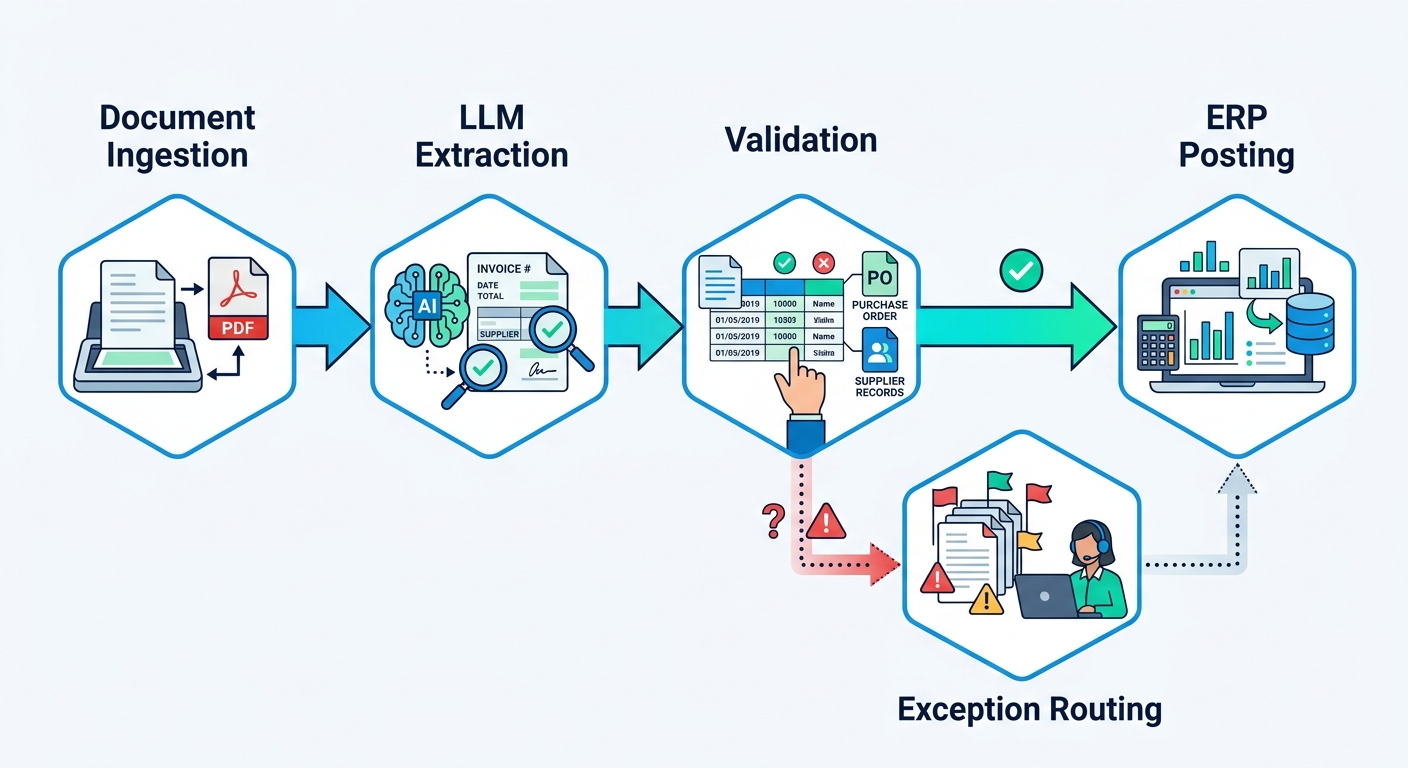
Concrete example: A global manufacturing company receiving 50,000 supplier invoices monthly across multiple formats (PDF, scanned documents, email attachments, EDI feeds) deployed an IDP system that:
- Ingests all invoice formats automatically
- Extracts line-item detail using AI interpretation
- Matches against purchase orders in real time
- Flags discrepancies for exception handling
- Posts approved transactions to the ERP
- Routes complex exceptions to human reviewers
The team handling this previously numbered 35 FTEs. After deployment, it numbers 4 — with those four handling only complex exceptions the model flags for review.
Pattern 2: Conversational Customer Operations
This goes well beyond the scripted decision-tree chatbots of the previous generation. LLM-powered customer operations agents can access customer history across multiple systems in real time, compose responses referencing specific policy provisions or account details, initiate backend actions (refunds, address changes, service modifications) without human intervention, and detect sentiment and urgency to escalate appropriately.
The ROI calculation is unusually clean: call handle time, escalation rate, first-contact resolution, and customer satisfaction scores all move simultaneously, making it easier to build a business case than for more diffuse operational improvements.
Pattern 3: Compliance and Control Automation
Regulated industries — financial services, healthcare, legal, defense — carry heavy operational overhead from compliance requirements: audit trails for every transaction, documentation for every exception, process updates for every regulatory change that historically took months to implement.
LLM-powered compliance automation can monitor transactions in real time, generate audit-ready documentation automatically, flag potential violations with explanatory context, and — critically — update compliance logic when regulations change, rather than requiring manual process rewrites.
Pattern 4: Autonomous Workflow Orchestration
The most advanced enterprises are moving beyond automating individual tasks to deploying AI agents that orchestrate multi-step workflows spanning multiple systems and decision points. An order-to-cash workflow, for instance, might involve checking inventory across warehouses, verifying customer credit terms, determining optimal shipping routes, generating region-appropriate invoices, applying promotional discounts, updating the CRM in real time, triggering downstream procurement if inventory drops below threshold, and alerting finance if revenue recognition criteria are met — all managed by an LLM-powered orchestrator escalating to humans only when decisions fall outside defined authority or confidence thresholds.
Implementation Reality
Q: What's a realistic deployment timeline?
A: Most enterprises hitting the 40% benchmark follow a three-phase progression:
| Phase | Timeline | Typical Savings | Key Activities |
|---|---|---|---|
| Pilot | Months 1–6 | 10–15% | Select 1–2 high-volume workflows, build integration layer, establish evaluation framework |
| Foundation | Months 6–12 | 15–25% | Scale to 5–10 workflows, build reusable components, develop internal expertise |
| Compound | Months 12–24 | 30–40%+ | Systematic deployment across departments, cross-workflow orchestration, continuous optimization |
Year one is characterized by pilot programs — selecting well-defined high-volume workflows, building the integration layer, establishing evaluation frameworks, and learning operational patterns. Savings are typically modest (10–20%) as organizations invest in foundation.
Years two and three are where compounding kicks in. Organizations that have built reusable components, established data pipelines, and developed internal expertise find subsequent automation deployments take a fraction of the time and investment of the first.
Q: What consistently predicts success versus failure?
A: Four characteristics appear in enterprises hitting their targets:
- Clean, accessible data infrastructure. LLM-powered automation is only as good as the systems it pulls from. Organizations with fragmented, poorly documented, or inconsistently structured data find initiatives stalled regardless of how sophisticated the automation layer is.
- Process standardization before automation. Automating a chaotic process just makes chaos faster. The highest-performing automation teams spend significant time standardizing before automating.
- Human oversight calibration. Finding the right threshold for when a system should escalate to human review is an ongoing discipline, not a one-time configuration. Set it too permissive and you don't capture savings; set it too restrictive and you create new risk vectors.
- Change management investment. Operations teams that treat automation as purely a technology project — rather than a workforce transformation — consistently underperform. The automation technology is often the easier part.
Q: What's the biggest technical risk in these implementations?
A: Data quality is the most common blocker. LLM-powered automation is only as effective as the systems and data it accesses. Organizations with fragmented, poorly structured, or inconsistently formatted data will struggle to achieve expected returns regardless of how sophisticated the automation layer is. The fix is unglamorous — data governance, schema standardization, API modernization — but skipping it is where automation initiatives die.
Workforce and ROI Questions
Q: Do these systems actually replace human workers?
A: In most cases, automation shifts human roles from primary processors to exception handlers and overseers. Rather than eliminating headcount outright, organizations typically redeploy staff to higher-value activities requiring judgment, relationship management, and strategic thinking — tasks where human capability remains superior. The more accurate framing is reskilling rather than replacement, though the reskilling investment is frequently underestimated in initial business cases.
Q: How do you actually measure ROI on these deployments?
A: Track volume-processed metrics (documents handled, transactions completed, inquiries resolved), error rates, processing time per unit, escalation rates, and ultimately cost-per-transaction. The strongest ROI indicators are:
- Cost-per-transaction trending downward over time as automation scales
- Sustained error rate reduction approaching zero
- Escalation rate stabilizing at a level that indicates appropriate human oversight thresholds
Avoid conflating efficiency metrics with financial outcomes — faster processing is only valuable if it's also cheaper processing. The board-level conversation should center on cost-per-transaction and headcount productivity ratios, not throughput velocity.
Q: What's the competitive risk of not acting?
A: Perhaps the most underappreciated dynamic in enterprise operations right now is the cost of competitive inertia. Organizations that delay AI workflow automation aren't simply forgoing efficiency gains — they're accumulating technical and organizational debt. Every manual process maintained is a process competitors may be automating now, building advantages in cost structure, response speed, and service quality that compound quarter over quarter. In industries where margins are thin and customer expectations are rising, the gap between automation leaders and laggards is widening.
The Near-Term Trajectory
Q: Where is this headed over the next 2–3 years?
A: The trajectory points toward full autonomous operations for well-defined workflows, with humans serving as overseers and exception handlers rather than primary processors. The current generation of models is already capable of this for a much broader range of enterprise tasks than was possible two years ago.
The enterprises capturing the full 40% — and pushing beyond it — are those building automation capability as a core organizational competency, not a one-time technology project. The window to build that competency is open now. It won't stay open indefinitely.
Continue Reading
- LLM Enterprise Implementation Guide → — A practical roadmap for deploying language models across enterprise operations
- RPA vs. AI Automation: A Comparative Analysis → — Understanding when traditional RPA and when LLM-powered automation is the right choice
- Enterprise Automation ROI Case Studies → — Real numbers from real deployments across industries
Tags: #EnterpriseAI #WorkflowAutomation #LLM #OperationalEfficiency #DigitalTransformation #AIImplementation