Multi-Agent Systems in 2026: How Autonomous Agents Are Collaborating to Solve Complex Enterprise Problems
A practical guide to multi-agent AI systems in the enterprise — covering architecture patterns, leading frameworks, deployment challenges, and a roadmap from POC to production.
What Are Multi-Agent AI Systems and Why They Matter in 2026
A multi-agent AI system is a coordinated group of specialized autonomous agents, each with a defined role, that work together to accomplish complex business workflows. Rather than one AI handling an entire task from start to finish, multiple narrow-purpose agents divide the work — one researches, another validates, a third executes — communicating through shared context to produce a unified result.
This represents a fundamental shift from single-agent deployments. A single-agent AI system is like asking one person to do every job in a company. A multi-agent system is like running a specialist team where each member owns their domain.
2026 marks the inflection point. Gartner predicts that 40% of enterprise applications will embed task-specific AI agents by the end of 2026, a jump from less than 5% in 2025 (estimated). About 31% of enterprises currently run at least one AI agent in production. The gap between those embedding agents and those successfully operating them in production is the central challenge — and opportunity — of this moment.
The scale of the shift — Enterprise leaders describe moving to multi-agent systems as comparable in magnitude to the transition to cloud computing. The organizational impact, the architectural rethinking, the governance demands — all are similarly transformative.
The drivers are clear. Single-agent systems excel at isolated, well-defined tasks. But modern enterprise workflows are anything but isolated. They span multiple systems, require different types of judgment, involve compliance checkpoints, and generate exceptions that rule-based automation cannot handle. Multi-agent AI systems are designed specifically for this complexity.
The Core Components of Multi-Agent Architecture
Every multi-agent system rests on four foundational components.
The orchestrator agent acts as the conductor. It receives a request, interprets intent, decomposes the task into subtasks, routes each to the appropriate specialist, and synthesizes their outputs into a coherent result. In some architectures, the orchestrator also handles fallback logic when specialist agents produce low-confidence outputs.
Specialist agents are the workhorses. Each is optimized for a narrow role — a researcher agent, a validator agent, a code-execution agent, a data-extraction agent. By staying narrow, each agent can be tuned for reliability and accuracy in its specific domain without the jack-of-all-trades tradeoff that degrades single-agent performance on complex tasks.
Communication protocols govern how agents exchange information. The Agent-to-Agent (A2A) protocol enables peer-to-peer collaboration. The Model Context Protocol (MCP) standardizes how agents access external tools and contextual data. These protocols mean agents from different vendors or frameworks can collaborate — a critical enabler for enterprise-grade deployments.
The shared context layer is the memory infrastructure. It allows agents to pass context, intermediate results, and business state between each other without redundant re-processing. Think of it as a shared workspace where agents leave notes for each other. Without it, agents repeat work or lose track of workflow state.
How Multi-Agent LLM Orchestration Works
AI agent orchestration is the logic layer that manages inter-agent communication across a multi-agent workflow. Here's what happens during a typical multi-step process.
Task routing happens first. The orchestrator classifies the incoming task type and selects the right specialist agents for the job. A customer refund request routes differently than a financial anomaly detection task. Routing logic can be rule-based, LLM-driven, or a hybrid.
Inter-agent communication follows. Specialist agents exchange structured messages, share intermediate results, and in some architectures negotiate on approach. A data-extraction agent might confirm with a compliance agent whether extracted information can be shared with a downstream system before proceeding.
Memory management maintains state across steps. In a 12-step procurement workflow, the agent handling step 7 needs to know what happened in steps 1 through 6. The context layer ensures continuity without reloading the entire conversation history each time.
Tool use extends agents beyond language. Agents invoke APIs, run Python code, query enterprise databases, update CRM records, send emails. Tool use is where multi-agent systems move from generating text to taking real actions in connected systems.
Error handling is built into the orchestration layer. When a specialist agent fails or produces a low-confidence output, the orchestrator can trigger a retry, reassign to a backup agent, or escalate to a human reviewer. Production multi-agent systems treat failure paths as first-class citizens — not afterthoughts.
Human-in-the-loop checkpoints are embedded at decision points where autonomy should be bounded. High-stakes actions like approving a large refund, modifying a customer record, or escalating a compliance issue typically require human confirmation. The key is preserving full agent context during escalation — sending a human reviewer a vague "this needs approval" message defeats the purpose of automation.
Architectural Patterns: Supervisor, Mesh, and Hierarchical
Multi-agent systems follow recognizable orchestration patterns. Each has distinct trade-offs.
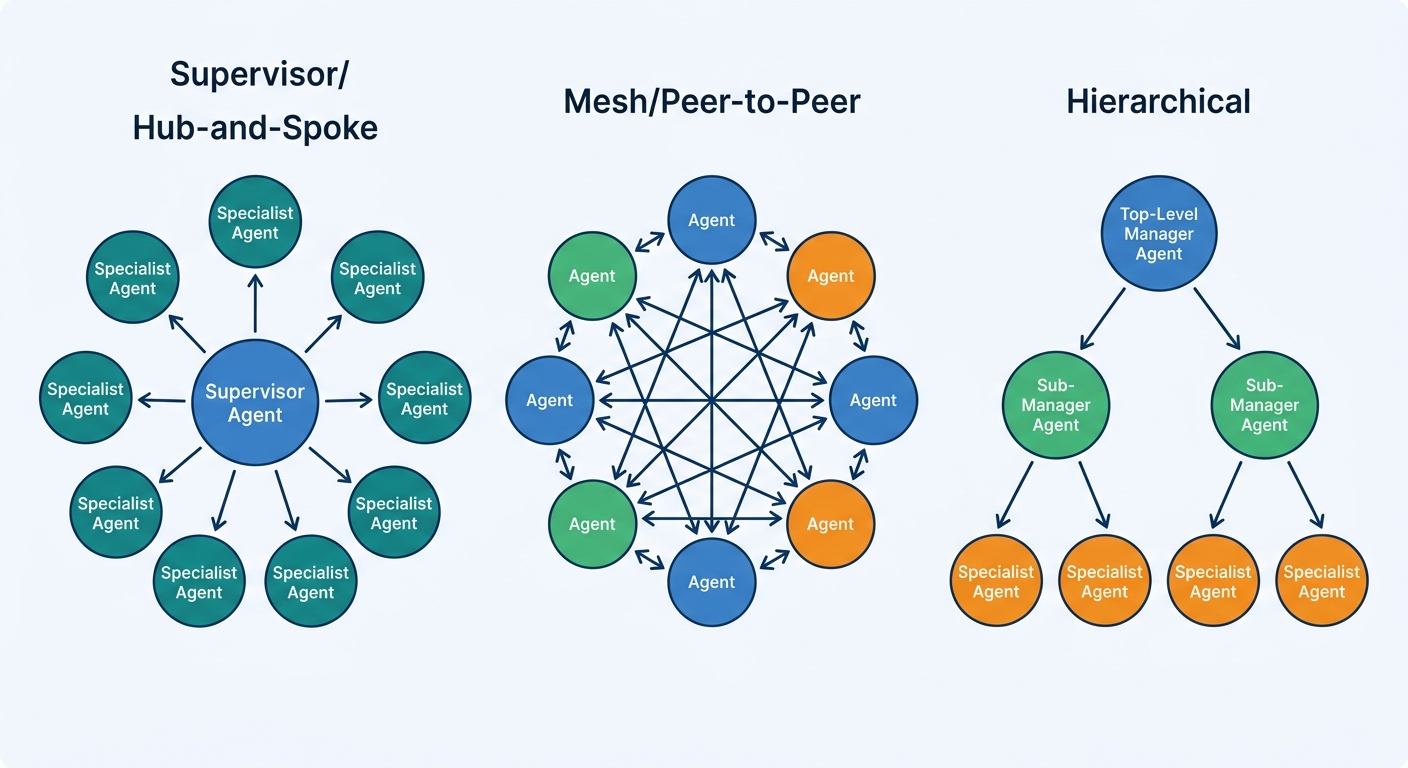
The Supervisor pattern (Hub-Spoke) places a central orchestrator at the hub. All task delegation flows through it, and all results return through it. This pattern is straightforward to trace and debug — every decision passes through a single choke point. The risk is that the supervisor becomes a bottleneck under heavy load, and its failure affects the entire system.
The Mesh pattern (Peer-to-Peer) lets agents communicate directly with each other. No single point of control means the system is more resilient to individual agent failures and better suited for flexible, collaborative workflows. The tradeoff is debugging difficulty — with many agents communicating in parallel, understanding what happened and why requires sophisticated observability tooling.
The Hierarchical pattern organizes agents into layers. A top-level orchestrator delegates to mid-level supervisors, which in turn manage specialist agents. This scales well for complex organizations where business units have their own sub-orchestrators. The overhead is higher coordination complexity and longer communication chains.
Enterprise Use Cases: Where Multi-Agent Systems Are Delivering Value
Multi-agent systems are not theoretical. They are running in production across industries, handling workflows that were previously impossible to automate reliably.
Customer service is one of the most mature deployment areas. A multi-agent customer service system might use one agent to classify incoming tickets by type and urgency, another to look up account history and relevant policies, a third to draft a response, and a fourth to process refunds or updates and confirm resolution. The system handles 24/7 volume without exhausting human agents on routine cases, freeing them for escalations that require empathy and judgment.
IT operations benefit from agents that monitor system performance, detect anomalies, and trigger automated remediation. One agent watches metrics; another investigates when a threshold is breached; a third executes a runbook step; a fourth confirms resolution and documents the incident. This reduces mean time to resolution and lets operations teams manage larger infrastructure without proportional headcount growth.
Finance teams use multi-agent systems for transaction reconciliation, real-time anomaly flagging, invoice processing, and payroll exception handling. The accuracy gains are significant — when one agent prepares calculations and another validates them against compliance rules, errors that slip through single-agent review are caught more reliably.
HR is automating onboarding workflows where one agent collects documents, another validates them against policy, a third sets up system access, and a fourth schedules orientation. Candidate screening at scale — parsing resumes, scoring against criteria, flagging top candidates — is another high-volume use case.
Cybersecurity is seeing autonomous agents that detect, contain, and respond to threats in real time. Speed matters in incident response, and multi-agent systems can execute containment steps in seconds rather than the minutes it takes human analysts to assess and act.
Business process automation spans approvals, request routing, and cross-platform workflows. A multi-agent system handling a vendor onboarding might update the CRM, initiate a procurement workflow, notify the finance team, and create a vendor record in the ERP — all coordinated across systems that would otherwise require manual handoffs.
CrewAI, LangGraph, and AutoGen — Comparing the Leading Frameworks
Three frameworks dominate enterprise multi-agent development in 2026. Each serves different priorities.
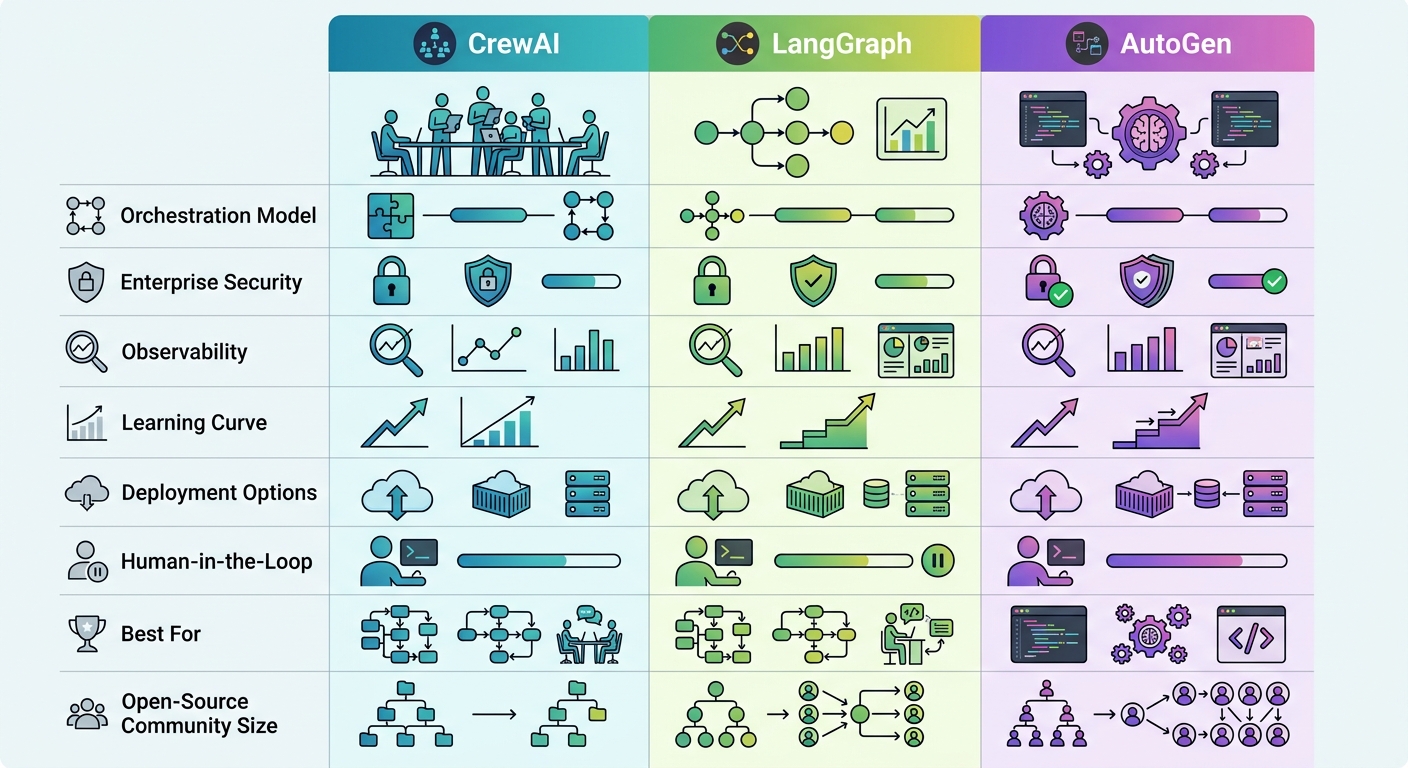
CrewAI is built around the concept of role-based agent development. You define agents with specific roles, goals, and backstories, assign them tools, and compose them into "crews" that tackle defined objectives. Enterprise governance features are a strong suit — SSO, RBAC, PII redaction, and checkpointing come built in. Deployment options include the CrewAI cloud, customer VPC, or on-premise. The platform has hundreds of open-source tools for common enterprise tasks and supports both the A2A and MCP protocols. Its strength is the collaborative, role-based mental model — teams that think in terms of specialist responsibilities find CrewAI's abstractions natural.
LangGraph takes a graph-based, stateful approach built on the LangChain stack. Workflows are defined as graphs where each node is a computation or decision step. This gives precise engineering control — every path through the workflow is explicit and traceable. LangSmith provides end-to-end observability, tracing every node transition, tool call, and LLM invocation. LangGraph is particularly strong for workflows where determinism matters — compliance-heavy industries, regulated workflows, scenarios where you need to prove exactly why the system made a specific decision. The learning curve is steeper for developers unfamiliar with graph mental models, and enterprise features like full RBAC and audit trails may require custom implementation.
AutoGen, originating from Microsoft Research, centers on conversational multi-agent interaction. Agents collaborate through natural language conversation, which makes it especially powerful for workflows that involve significant reasoning-through-dialogue or code generation and execution. Its event-driven, asynchronous architecture supports complex parallel workflows. AutoGen has strong human-in-the-loop support, making it well-suited for scenarios where human reviewers need to participate in agent workflows. It scales from local development to distributed cloud deployments and supports Python and .NET interoperating agents. The trade-off is less opinionation about workflow structure — AutoGen gives you building blocks rather than a framework for how to compose them.
CrewAI, LangGraph, and AutoGen each offer enterprise multi-agent frameworks suited to different priorities. The choice depends on team expertise, governance requirements, and the specific workflow characteristics.
Why 88% of AI Agent Pilots Fail to Reach Production
The most important number in enterprise AI agent deployment is not adoption rate — it is the gap between pilots and production. An estimated 88% of AI agent pilots fail to graduate to production. Understanding why is essential for anyone building a multi-agent system today.
Evaluation gaps are the most cited blocker, cited by 64% of enterprise leaders. Teams build a compelling demo, but the evaluation criteria for production readiness are never clearly defined. Does the system meet accuracy thresholds under real data distribution? Does it degrade gracefully under load? Does it handle exceptions the way the business requires? Without explicit production criteria defined at the pilot stage, projects stall in endless refinement.
Governance friction affects 57% of organizations. When it is unclear who owns agent decisions, who can approve agent actions, and what audit trails are required, production deployment stops. Governance is not a post-development concern — it is an architectural requirement that must be designed alongside the agents themselves.
Model reliability challenges 51% of teams. LLMs produce variable outputs. In a single-agent system, this variability is contained. In a multi-agent system, errors can propagate and amplify across the agent chain. A low-quality output from one specialist agent becomes a bad input for the next, compounding errors across steps.
The data quality amplifier — Multi-agent systems inherit and amplify data quality problems from the systems they connect. Inconsistent or incomplete data fed into one agent propagates as noise through the entire chain. Organizations that deploy agents against messy enterprise data without data quality remediation will see failure rates far higher than in controlled benchmarks.
AI agent project failure often stems from governance gaps and evaluation deficits more than from the technology itself. Over 40% of agentic AI projects are at risk of cancellation by 2027 due to governance and ROI gaps. The organizations that successfully move from pilot to production share a common approach: they define governance and observability requirements at project start, treat data quality as a precondition rather than an assumption, and set explicit success criteria before writing agent code.
Building for Scale: Governance and Security as First-Class Concerns
The fastest path from pilot to production is designing governance into the architecture from day one — not bolting it on after agents are built.
Governance-first design means embedding permission boundaries into architecture from the start. Permission boundaries define what each agent can and cannot do. A data-extraction agent should be able to read specified data sources but not modify them. A document-processing agent should have access to the document store but not the financial system. Scoping permissions per agent means that a compromised or malfunctioning agent has a limited blast radius.
Decision logs capture every significant agent action — what the agent decided, what data it used, what action it took, what the outcome was. Immutable logs are essential for post-incident review, compliance audits, and demonstrating due diligence to regulators.
Approval checkpoints embed human oversight at high-stakes decision points. These are not arbitrary friction — they are targeted controls where the risk of autonomous action outweighs the efficiency gain of automating the decision. Common checkpoint triggers include high monetary value, sensitive data access, compliance-relevant actions, and confidence scores below a defined threshold.
RBAC per agent means access controls are scoped to each agent's role, not to the system as a whole. This is fundamentally different from traditional system access management and requires a purpose-built agent identity and access management layer.
PII masking before inter-agent data sharing protects sensitive information from propagating through the agent chain. Even if agents are authorized to access different data domains, regulated data should be masked at the point of handoff.
Multi-agent security requires a centralized observability layer as a first-class architectural concern. The attack surface expands with each agent added to the system. Prompt injection attacks can propagate across agent chains — a tainted input to one agent becomes a poisoned context for the next. Privilege escalation becomes possible when agents inherit permissions through their interactions. Data leakage through shared context is a real risk when agents from different domain boundaries share a context layer.
Centralized observability — Distributed agent deployments create blind spots without a centralized management layer. Every agent interaction, every tool call, every data access should flow through instrumentation that provides a unified view of system behavior. Without it, you are flying blind.
Aligning governance practices with established frameworks like the NIST AI Risk Management Framework provides a structured starting point. But frameworks designed for traditional software systems require extension for the unique characteristics of multi-agent deployments — specifically, emergent behaviors and inter-agent dependencies that no single system's controls can fully reach.
Measuring ROI — The Business Case for Multi-Agent Systems
Organizations that successfully deploy multi-agent systems see measurable returns. The global AI agents market is projected at $10.9–$12.1 billion in 2026 (estimated). For organizations running agents in production, median time-to-value is approximately 5.1 months (estimated).
Efficiency gains are substantial. Organizations report 3–5x faster task completion in workflows managed by multi-agent systems versus manual processes (estimated, varied sources). Error rates drop 40–60% in workflows where one agent prepares outputs and another validates them (estimated). Some deployments achieve up to 90% cost reduction in specific high-volume, rule-heavy workflows (estimated, context-dependent).
IBM research indicates that autonomous AI agents can reduce process hand-offs and errors significantly — multi-agent orchestration can reduce process hand-offs by 45% — fewer manual transfers between systems and teams mean shorter cycle times and fewer errors introduced at handoff boundaries.
Building a business case requires measuring the right metrics. Track automation rate — what percentage of a workflow is handled end-to-end by agents without human intervention. Monitor error reduction per workflow phase. Measure cycle time from workflow initiation to completion. Calculate cost per transaction before and after deployment. These metrics make the ROI conversation concrete rather than theoretical.
Getting Started — From Proof of Concept to Production
If you are planning a multi-agent system, resist the temptation to automate an entire process from day one. Start with a well-scoped, high-value use case — one that has clear boundaries, measurable success criteria, and a workflow where enterprise AI collaboration can genuinely enable coordinated fleet-level automation beyond what simpler automation can achieve.
Define agent roles and boundaries before writing any agent code. Ambiguity about who owns what part of the workflow is the root cause of most coordination failures. A clear responsibility matrix — which agent handles which step, what data it receives, what it produces — prevents downstream confusion.
Invest in the data and context layer before investing in agent logic. Agents are only as reliable as their access to accurate, timely data. If the enterprise data layer is messy, agent outputs will be unreliable. Remediate data quality as a precondition, not an afterthought.
Build governance infrastructure in parallel with agent development. Define permission boundaries, set up audit logging, instrument observability — all while agents are being built. Retrofitting governance into a running multi-agent system is disruptive and risky.
Instrument everything from the first day of development. Observability is not optional in multi-agent systems. You need distributed tracing across agent interactions, behavioral anomaly detection, and agent-level metrics. Without it, debugging production issues in a multi-agent system is exceptionally difficult.
Move in phases: pilot a well-scoped workflow, measure against defined criteria, learn what breaks, then expand scope incrementally. The organizations that successfully scale multi-agent systems treat this as a disciplined program, not a one-time project.
Subscribe to the Algorithmine Portal
Want practical guides, architecture deep-dives, and implementation lessons for enterprise AI agents — delivered to your inbox every week? Subscribe at algorithmine.com/portal.
Expert Q&A
Q: What is the single biggest mistake enterprises make when deploying their first multi-agent system? A: Trying to automate too much, too fast. Teams build a compelling single-agent demo and assume that scaling to multi-agent means running multiple copies of that agent. In reality, multi-agent systems require upfront investment in agent role design, governance architecture, and data layer quality that single-agent deployments can skip. The failure mode is building the system and then discovering that no one knows who is accountable for its decisions.
Q: How should enterprises handle the conflict between agent autonomy and compliance requirements? A: Build compliance into the agent role definitions, not into the orchestration layer. A compliance-aware agent should know what it can and cannot do at the role level, with architectural enforcement preventing violations rather than a centralized compliance cop that reviews every decision. This preserves the efficiency of distributed autonomy while maintaining controls. Human approval checkpoints should be reserved for high-stakes actions, not routine decisions — otherwise you defeat the purpose of automation.
Q: How do multi-agent systems handle situations where agents disagree? A: Disagreement handling is an architectural decision. Some systems use a voting mechanism where multiple agents independently assess a decision and the majority conclusion prevails. Others use a hierarchical approach where a senior agent breaks ties. Some architectures pass disagreements to human reviewers. The right approach depends on the consequence of being wrong. For low-stakes decisions, automated voting works. For high-consequence outcomes — financial transactions, compliance-relevant actions — escalate to human judgment. Never build a system that can reach a high-stakes outcome without at least the option for human review.
Q: What observability signals are most important for multi-agent production systems? A: Three are non-negotiable. First, end-to-end trace visibility — you must be able to follow a single workflow request through every agent interaction, understanding what each agent received, what it decided, and what it passed forward. Second, agent-level accuracy metrics — not just "did the workflow complete" but "did each agent produce outputs that passed validation." Third, behavioral anomaly detection — systems that alert when an agent begins behaving differently from its historical baseline, even if the output looks reasonable on the surface. Multi-agent systems can produce plausible-but-wrong outputs that look fine until you catch that a validator agent has started approving outputs that should have failed.