AI Agent Orchestration Patterns: Comparing LangGraph, AutoGen, and CrewAI in Production
AI agent orchestration is the coordinated management of multiple AI agents working together toward shared objectives. It is the control layer that sits above individual agents, handling task deleg...
What Is AI Agent Orchestration?
AI agent orchestration is the coordinated management of multiple AI agents working together toward shared objectives. It is the control layer that sits above individual agents, handling task delegation, shared state, inter-agent communication, and error recovery.
Single-agent systems hit walls quickly. Context windows limit how much a model can process. A single agent cannot work in parallel on independent sub-tasks. And for complex workflows, one agent handling everything becomes a bottleneck — it manages too many tools, too much context, and too many responsibilities.
Orchestration frameworks solve these problems. They let you decompose a complex goal into specialized roles or functions, assign each to an agent, and manage the coordination between them.
In production environments, orchestration means more than just launching agents. It means durable execution — workflows that survive crashes, pause for human input, log decisions, and recover cleanly. The difference between a research prototype and a production system is the orchestration layer.
The 2026 Framework Landscape
Three frameworks dominate production multi-agent deployments in 2026:
LangGraph is the graph-based, stateful runtime inside the LangChain ecosystem. It models workflows as explicit state machines. It is the production standard for reliability-critical applications.
Microsoft Agent Framework (MAF) is the successor to Microsoft's AutoGen, which entered maintenance mode in October 2025. MAF reached General Availability in April 2026 for both Python and .NET. It unifies AutoGen's conversational multi-agent patterns with Semantic Kernel's enterprise features.
CrewAI takes a role-task-crew abstraction. Agents have defined roles, goals, backstories, and tool sets. Multiple agents form a crew that collaborates toward an objective. It is the fastest path from zero to a working multi-agent prototype.
Each framework targets a different mix of production requirements. The choice depends on your durability needs, team composition, ecosystem constraints, and governance requirements.
LangGraph — The Production Standard for Stateful Workflows
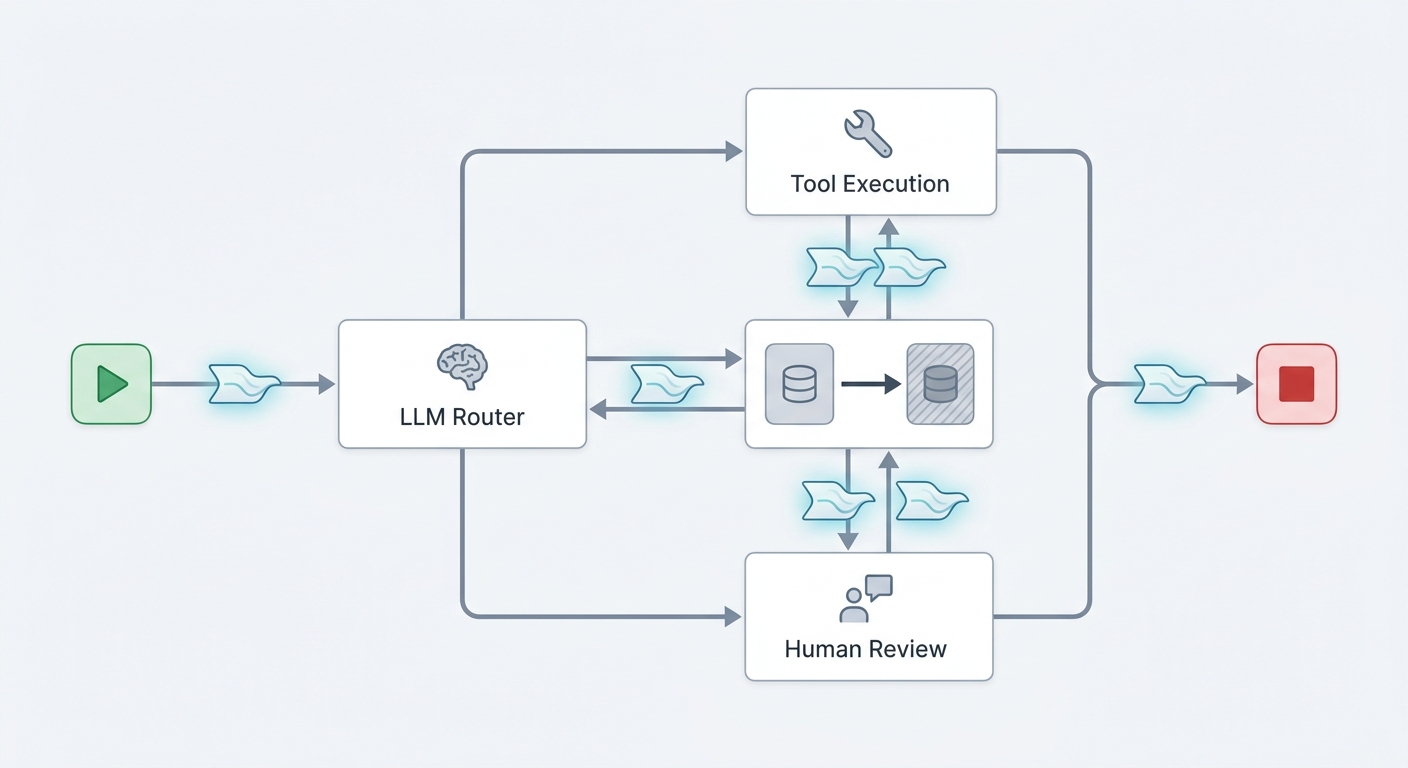
LangGraph implements a graph-as-state-machine model. A workflow is a directed graph. Nodes represent actions — a model call, a tool execution, a conditional check. Edges represent transitions between actions. The shared state is a typed object, often a Python TypedDict, that flows through the graph.
This explicit state model gives LangGraph a structural advantage for production reliability. Every node boundary is a potential checkpoint. When a node finishes, LangGraph can persist the full workflow state before moving to the next edge. If the process crashes, it resumes from the saved checkpoint — not from the beginning.
Checkpointing enables three capabilities that matter in production:
Durable execution. Workflows run for hours or days, not seconds. They call external APIs that time out. They encounter rate limits. LangGraph persists state at every step, so a workflow interrupted by a downstream failure resumes with its context intact.
Human-in-the-loop (HITL). A workflow can pause at any node, preserve its state, wait for human approval or input, and resume. In regulated industries — finance, healthcare, legal — decisions often require human sign-off. LangGraph treats this as a first-class primitive, not an afterthought.
Crash recovery. A server restart mid-workflow does not lose progress. The state is persisted in Postgres, SQLite, or another backend. The workflow picks up exactly where it left off.
LangGraph's graph model also handles cycles naturally. Real-world agent workflows loop — an agent might need to retry a step, gather more information, or revise a plan. Explicit graph edges make these cycles visible and controllable. This contrasts with implicit loop detection in conversational systems, where cycles can be harder to identify and interrupt.
LangGraph streams token outputs, tool call progress, and state transitions in real time. Built-in middleware provides automatic retries with exponential backoff. LangGraph Platform (Generally Available May 2025; renamed LangSmith Deployment in October 2025) adds 1-click deployment, horizontal scaling, and a visual debugger called LangGraph Studio.
On benchmark data (aggregated from multiple sources, estimated): LangGraph achieves 76% success on medium-complexity tasks — defined as 3–5 tool calls with some state tracking. For complex tasks — 8 or more steps with planning, backtracking, and branching — it achieves 62% success.
Key benchmark data — All performance figures in this article are aggregated from multiple sources and marked as estimated. Framework benchmarks vary significantly in task definitions, model versions, and evaluation criteria. Treat the relative ordering as more meaningful than the absolute percentages.
Microsoft Agent Framework — AutoGen's Successor Enters GA
AutoGen, Microsoft's open-source multi-agent framework, entered maintenance mode in October 2025. The project is community-managed and receives bug and security fixes but no new features. If you are starting a new Microsoft-stack project in 2026, AutoGen is no longer the recommended path.
Microsoft Agent Framework reached General Availability in April 2026. It unifies the conversational multi-agent patterns pioneered in AutoGen with Semantic Kernel's graph-based workflow engine and enterprise features. MAF is available for both Python and .NET.
The core model is conversation-first. Agents exchange structured messages through the framework, which persists and logs the conversation. This is a more implicit state model than LangGraph's explicit state machine. State lives in the message history, not in a dedicated state object.
MAF integrates natively with Azure AI Foundry, Azure OpenAI, and Azure AI Content Safety. For organizations already in the Microsoft ecosystem, this tight integration reduces deployment friction. You get authentication, content moderation, and observability through existing Azure tooling.
MAF's strengths are conversational scenarios: code generation with iterative refinement, document extraction, support ticket triage, and multi-agent analysis where agents debate or build on each other's output. The conversational model maps naturally to these use cases — agents argue, revise, and escalate through chat-like exchanges.
On benchmark data (estimated from aggregated sources): MAF achieves 68% success on medium-complexity tasks and 58% on complex tasks. The slightly lower score on complex tasks reflects the challenge of managing implicit state across extended multi-agent conversations.
Existing AutoGen users have a migration path. Microsoft provides migration guides for common patterns. The AutoGen conversation API maps directly to MAF's agent messaging model. There are no breaking changes in AutoGen, and workloads continue to run, but new development should target MAF.
CrewAI — Role-Based Teams for Rapid Development
CrewAI takes a different abstraction: agents are team members, not graph nodes. Each agent has a defined role, a specific goal, a backstory that shapes its behavior, and a set of tools. Agents collaborate in a crew, following a process — either sequential (ordered steps) or hierarchical (a manager agent delegates to specialist agents).
This role-task-crew model is the fastest way to build a working multi-agent system. You define agents declaratively, assign them tasks, and run the crew. The framework handles delegation, output passing, and result aggregation. For a team building a first prototype, this is significantly quicker than designing a graph structure.
CrewAI's production traction is notable. By January 2026, the platform reported approximately 2 billion agentic workflow executions in the preceding 12 months (estimated from CrewAI-sourced data). A CrewAI survey from early 2026 found that 65% of senior executive respondents had AI agents in production, with 81% reporting that adoption was scaling or fully deployed. Approximately 60% of Fortune 500 companies were using CrewAI by mid-2026 (estimated from CrewAI-sourced data).
CrewAI Enterprise adds an observability dashboard, job scheduling, and role-based access control for team deployments. The open-source version runs on an MIT license.
The tradeoff is fine-grained control. CrewAI's role-based abstraction is higher-level than LangGraph's graph model. For simple structured workflows — researcher retrieves data, analyst processes it, writer produces a report — this abstraction is a feature. For complex workflows with conditional branching, stateful checkpoints, and long-running interruptions, teams often find they need to layer additional workflow logic on top of CrewAI, or combine it with LangGraph for the complex components.
On benchmark data (estimated): CrewAI achieves 71% success on medium-complexity tasks and 54% on complex tasks. The lower complex-task score reflects the challenge of delegation chains and implicit state in extended multi-agent executions.
Head-to-Head Performance Comparison
Comparing frameworks requires acknowledging the measurement challenges. Published benchmarks vary in task definition, model quality, and evaluation criteria. The following numbers are aggregated from multiple sources and marked as estimated.
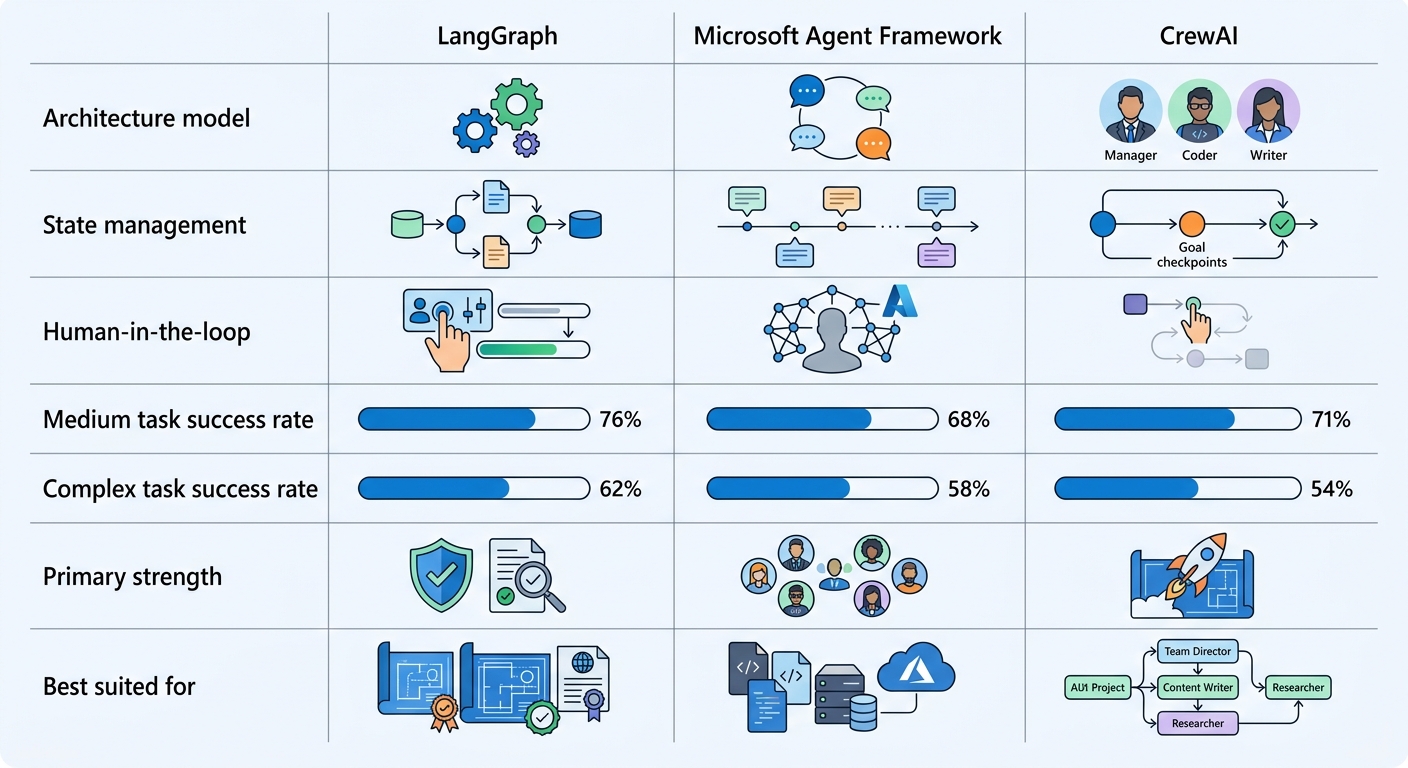
| Dimension | LangGraph | Microsoft Agent Framework | CrewAI |
|---|---|---|---|
| Architecture model | Graph state machine | Conversation-first | Role-task-crew |
| State management | Explicit, typed state object | Implicit, message history | Implicit, agent goal tracking |
| Human-in-the-loop | First-class primitive | Via Azure integration | Limited native support |
| Medium task success rate | 76% (est.) | 68% (est.) | 71% (est.) |
| Complex task success rate | 62% (est.) | 58% (est.) | 54% (est.) |
| Primary strength | Reliability and auditability | Conversational multi-agent | Rapid prototyping |
| Best suited for | Regulated, long-running, auditable workflows | Azure-native, code-centric agents | Structured role-based workflows |
LangGraph's explicit state machine catches failures at node boundaries. When a tool call fails, LangGraph knows precisely where in the workflow it occurred and can retry or escalate. This contributes to its higher completion rate on complex tasks.
CrewAI's role-based delegation adds overhead for simple tasks but helps in structured workflows where agents have clear, non-overlapping responsibilities. The abstraction breaks down when responsibilities are ambiguous or when a task requires dynamic re-planning mid-execution.
MAF's conversational flexibility enables creative multi-agent interactions but can produce unpredictable loops in poorly designed conversation patterns. Structured conversation templates and explicit termination conditions help, but they require more design care than LangGraph's explicit edges.
Production Considerations — What Frameworks Do Not Solve
Choosing an orchestration framework is not the whole production decision. Three operational concerns are consistently under-addressed in framework comparisons.
Token cost management. Multi-agent systems can cost 10–100x more than equivalent single-agent workflows. Each agent carries its own context. Delegation passes context between agents. Loops compound costs. In LangGraph, cycles accumulate context unless you explicitly summarize or truncate. In MAF, long conversation histories grow token counts. In CrewAI, delegation chains pass full outputs between agents. Production deployments need token budgets, usage monitoring, and circuit breakers to prevent runaway costs.
The control plane. Orchestration frameworks execute workflows. They do not inherently govern them. A production agent system needs policy enforcement — who can trigger what actions, which decisions require human approval, which data can agents access. It needs audit logging — every decision, every tool call, every human input. It needs security boundaries. These capabilities sit above the orchestration layer. Most enterprises build or buy a separate control plane. The frameworks do not provide this out of the box.
Observability. Debugging a multi-agent system is harder than debugging a single-agent system. LangGraph's LangSmith provides per-node tracing. MAF integrates with Azure AI Foundry's monitoring. CrewAI Enterprise provides a dashboard. DIY deployments need to instrument their own tracing — ideally OpenTelemetry per node — and set up alerting for failure rates, latency percentiles, and token consumption spikes.
How to Choose — Decision Framework
Use this to match your situation to the right framework.
Choose LangGraph when you need:
- Durable, long-running workflows with crash recovery
- Explicit audit trails and checkpoint history
- Human-in-the-loop approval gates
- Complex branching with cycles and conditional logic
- High reliability in regulated environments (finance, healthcare, legal)
- Fine-grained observability with LangSmith
Choose Microsoft Agent Framework when you need:
- A path from an existing AutoGen codebase
- Deep Azure ecosystem integration (Azure OpenAI, AI Foundry, Content Safety)
- Conversational multi-agent patterns (code generation, document extraction, support triage)
- .NET ecosystem compatibility
- Iterative reasoning through agent debate or refinement
Choose CrewAI when you need:
- Fastest path to a working multi-agent prototype
- Structured role-based workflows (researcher → analyst → writer pipeline)
- Mixed teams with both engineers and product managers
- Content generation, research synthesis, or document processing pipelines
- Quick iteration on agent team design without graph architecture expertise
In practice, hybrid approaches are increasingly common. A CrewAI crew handles a structured sub-workflow. A LangGraph graph manages the complex, stateful core. An MAF agent orchestrates a code review pipeline. These combinations are supported by all three frameworks' open APIs and integration ecosystems.
Migration Path for AutoGen Users
If you have an existing AutoGen codebase, here is the current situation and path forward.
AutoGen is in maintenance mode. Bug fixes and security patches continue. There are no planned breaking changes. Your existing workloads are stable.
Microsoft Agent Framework is the recommended target for new development. Key changes in migration:
- MAF uses Semantic Kernel's graph-based workflow engine. AutoGen's conversation patterns map to MAF agents, but the orchestration layer is different.
- The AgentChat API in AutoGen 0.4 is the closest model to MAF's agent messaging.
- Azure integration moves from the standalone AutoGen Azure connectors to MAF's native Azure AI Foundry integration.
- Microsoft provides migration guides at the Azure AI Foundry documentation portal.
The practical recommendation: start new projects on MAF. For existing AutoGen projects, evaluate migration cost vs continued maintenance. AutoGen will not disappear, but it will not gain new capabilities.
Expert Q&A
Q: We are building a customer support system that routes tickets, gathers context, drafts responses, and requires a human to review before sending. Which framework should we use?
A: LangGraph is the strongest fit here. You need human-in-the-loop for the final approval step. You need durable state — if the reviewer is offline for hours, the workflow must preserve its context and resume when they return. You need branching — certain ticket types might skip the drafting step and go straight to escalation. LangGraph's checkpointing and HITL primitives handle all three requirements natively. MAF could work if you are already in Azure, but LangGraph's explicit state machine gives you more predictable control over the review gate.
Q: Multi-agent costs are spiraling in our production system. What are the highest-leverage fixes?
A: Start with three interventions. First, add context truncation or summarization at delegation boundaries — do not pass full conversation histories between agents. Second, set explicit token budgets and hard limits on loop counts — all three frameworks support recursion limits or equivalent guards. Third, audit your delegation depth. If you have a manager agent delegating to three workers, each calling tools, token costs multiply quickly. Flat hierarchies with clear termination conditions cost less than deep delegation chains.
Q: When does it make sense to combine frameworks rather than pick one?
A: Combine when different parts of your system have genuinely different requirements. If you have a structured content pipeline (researcher retrieves, writer drafts, editor reviews) running dozens of times per day, CrewAI's role-based model is faster to design and iterate on than LangGraph. But if that pipeline feeds into a complex analysis that requires stateful checkpoints and human review, a LangGraph graph handles the downstream logic better. The integration point is usually at the API boundary — one framework outputs a structured result, the other consumes it.
Q: We need to deploy AI agents in a regulated financial environment. What production requirements should we prioritize?
A: Prioritize auditability, HITL checkpoints, and data residency. Every agent decision needs to be traceable — which agent acted, what context it had, what tool it called, what output it produced. LangGraph's checkpointing gives you this history by default. HITL approval gates ensure that certain actions (large fund transfers, customer data access, policy exceptions) require human sign-off before execution. Data residency means your state backend — Postgres, for example — should be in your target jurisdiction. All three frameworks support self-hosted state backends, which matters for compliance.
Q: Should we wait for the framework ecosystem to mature before committing to production?
A: LangGraph and MAF are production-mature as of 2026. LangGraph's 1.0 release and LangGraph Platform GA in 2025 stabilized the API and deployment model. MAF's GA in April 2026 signals Microsoft's commitment to the production path. CrewAI has 2 billion executions of production workload evidence. Waiting carries its own risk: AI-assisted workflow automation is a competitive capability. The frameworks are stable enough for production. Your production readiness also depends on your control plane, observability stack, and governance processes — and those need to be built regardless of which framework you choose.
Image URLs
| # | Alt | URL |
|---|---|---|
| 1 | LangGraph state machine architecture flowchart | /api/images/c9e582b059344e9eb7c27ba1a05b70dc |
| 2 | Comparison table of LangGraph, MAF, CrewAI | /api/images/9190b6b75add43e68603c1619060d89e |
Total: 2 images uploaded