Agent Memory Architecture: How Long-Running Agents Actually Remember
Learn how long-running AI agents actually remember: episodic, semantic, and procedural memory, plus the write-store-retrieve-consolidate loop.
Why Memory Is the Hardest Part of Long-Running AI Agents
Ask an agent to summarize a document and it looks brilliant. Ask it to manage a customer account for three weeks, and the cracks appear fast. It forgets a commitment it made on day two. It re-asks for information it already has. It contradicts a decision logged last Tuesday. The model didn't get dumber — the architecture failed to give it a reliable way to remember.
A large share of the failures that look like reasoning failures in production are, on inspection, memory failures. A single-turn chatbot can get away with cramming everything into the context window. A long-running agent cannot. It accumulates history, decisions, tool outputs, and user preferences faster than any window can hold, and every token you carry forward costs money and latency while competing for the model's attention.
The thesis of this article is simple: memory is an architecture decision, not a context-window feature. If you treat remembering as a matter of stuffing more tokens into the prompt, you will hit a wall. If you design a deliberate write-store-retrieve-consolidate loop, you can build agents that stay coherent for days, weeks, or longer. Here's how that architecture actually works.
What Memory Actually Means for AI Agents
The word memory gets used loosely, and that ambiguity hides real design choices. It helps to separate two very different things: what the model sees right now, and what the system knows over time.
Working Context vs. Persistent Memory
Working context is everything inside the model's context window on a given call: the system prompt, recent turns, retrieved facts, tool results. It is volatile. When the call ends, it evaporates unless something externalized it.
Persistent memory is state stored outside the model — in a database, vector index, or file — that survives across calls and sessions. Each inference call is stateless; the model never holds this memory between calls. Instead, the system retrieves relevant slices into working context on demand. This distinction is the foundation of every serious agent memory design. The model is stateless. The system around it provides continuity.
The Three Memory Tiers (Episodic, Semantic, Procedural)
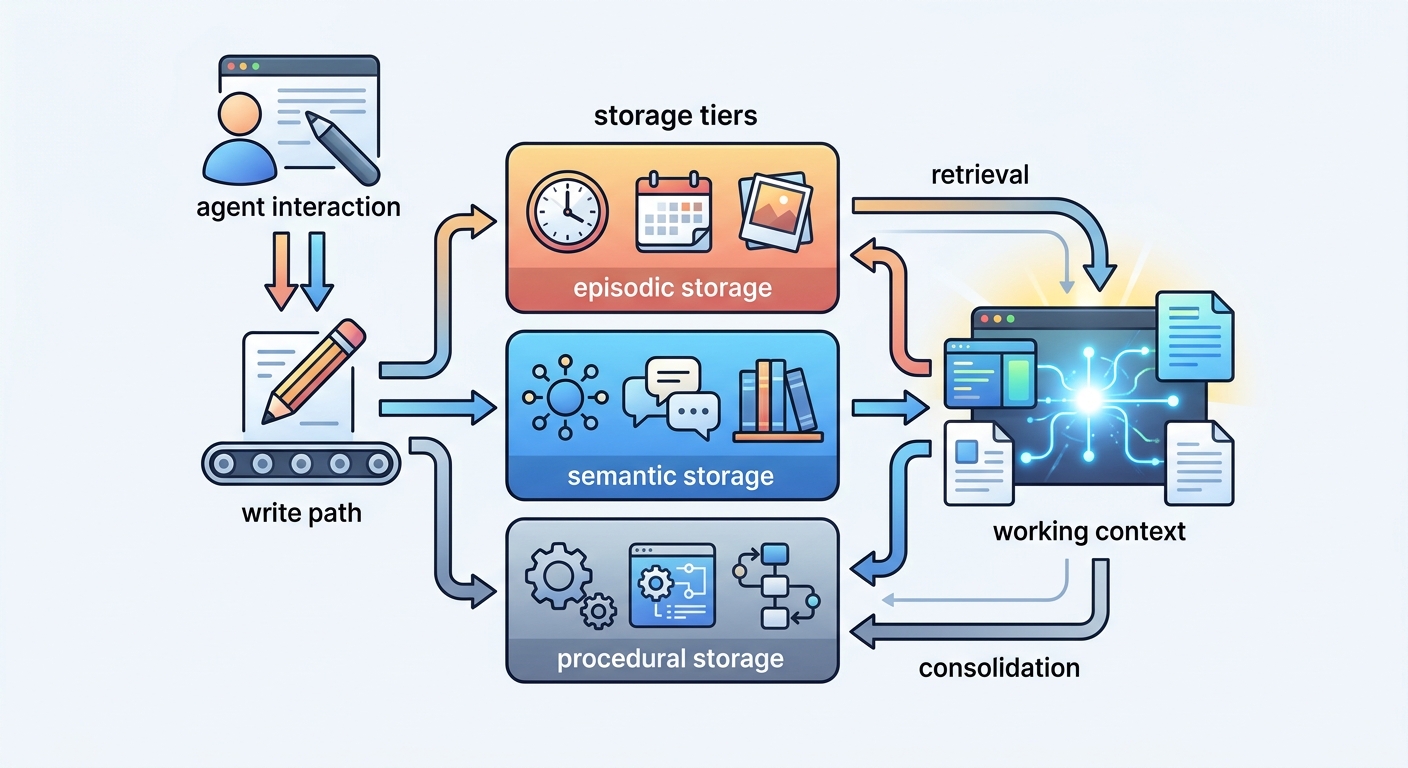
Borrowing from cognitive science, agent memory usually splits into three tiers, and teams routinely conflate them:
- Episodic memory — the record of specific past events and interactions: what the user said, what the agent did, what the outcome was. Time-stamped and sequential.
- Semantic memory — durable facts and knowledge extracted from those events: "the customer's contract renews in March," "this API returns paginated results." Distilled from episodes.
- Procedural memory — learned workflows and how-to knowledge: "to file a refund, first verify the order, then check policy, then submit." Often encoded as tools, prompts, or playbooks.
The conflation problem is real: teams build a vector store of raw chat logs and call it memory, when what they actually need is semantic facts extracted from those logs plus a way to recall specific episodes. Treating all memory as one undifferentiated blob is the most common architectural mistake.
One clarification on procedural memory: it is the tier most often implicit. Workflows frequently live in the system prompt, in tool definitions, or in code rather than in a dedicated store. Don't build a separate procedural store just to have three tiers — build one only when the agent needs to learn and update procedures at runtime.
Why Context Windows Are Not Memory
It is tempting to believe that ever-larger context windows solve memory. They don't. They raise the ceiling on a fundamentally broken approach.
The Context Management Problem
Every token in the window has three costs: money (you pay per token, every call), latency (longer prompts, slower responses), and degraded recall (models are less reliable at retrieving information buried mid-context — the "lost in the middle" effect documented by Liu et al., 2023). A 200K-token window doesn't mean 200K tokens of dependable recall. It means 200K tokens of cost with uneven reliability, and the reliability gap widens with distance from the prompt edges. Newer long-context models have narrowed this gap but not closed it; treat "it fits in the window" as a cost decision, never a correctness guarantee.
Failure Modes of Naive Memory Approaches
Three patterns show up again and again in early agent builds:
- Context stuffing — appending the full history to every call. It works for a demo and collapses at scale: cost explodes, latency climbs, and the model starts ignoring the middle of the transcript.
- Hard truncation — dropping the oldest turns when you hit a limit. Cheap, but it silently discards the one fact that mattered — the deadline, the constraint, the commitment — with no record it ever existed.
- Summary drift — periodically summarizing history to compress it. Reasonable in principle, but repeated compression is lossy. Each pass erodes fidelity, and by the tenth summary the agent's memory of an early decision may be a distorted paraphrase of a paraphrase.
The context window is a workbench, not a warehouse. You put on it only what the current task needs — and you clear it when the task changes.
A well-designed agent treats the window as scarce working space and keeps the warehouse external.
The Core Components of an Agent Memory Architecture
Every memory system, however elaborate, executes the same loop: write → store → retrieve → consolidate. Getting each stage right is what separates agents that remember from agents that merely appear to. (See our related guide on agent orchestration patterns for how these components fit into a full agent stack.)
Write Path: What Gets Stored and How
The write path decides what deserves to become memory. Dumping every token is a recipe for noise. Good write paths apply salience scoring — is this a durable fact, a decision, a user preference, a commitment? — plus deduplication (don't store the same fact ten times) and a schema (structured fields for entity, timestamp, source, and confidence). Extracting semantic facts from raw episodes at write time is what makes later retrieval precise. (For schema design details, see designing memory schemas for AI agents.)
Two write-path rules carry outsized weight:
- Provenance. Every memory record should record where it came from — which session, which tool, which user turn. Provenance is what lets you audit a bad decision and revoke a poisoned memory later.
- Trust boundaries. Content from untrusted sources (web pages, third-party tool output, user-supplied documents) must not be promoted to persistent memory without validation. Otherwise a single injected instruction can become a durable belief the agent acts on for weeks. Treat memory as a privileged write, not a log sink.
Store: Choosing Where Memory Lives
Storage choice follows from access pattern, not fashion. Episodic memory wants an append-only, time-ordered store you can query by recency and session. Semantic memory wants a structured store — relational tables for facts with identity, or a vector index for fuzzy recall — often both. The practical pattern is hybrid: structured fields for filtering (entity, time, confidence) plus embeddings for semantic search. Keep the raw episode and the distilled fact linked so you can always trace a fact back to its evidence.
Retrieve: Getting the Right Slice Into Working Context
Retrieval is the load-bearing stage, and the one most often under-built. A plain top-k vector search over all memory is a weak default; it over-weights surface similarity and ignores recency and importance. Three techniques do most of the work:
- Hybrid retrieval. Combine dense (embedding) search with lexical search (BM25 or equivalent). Dense search catches paraphrase; lexical search catches exact identifiers — account numbers, error codes, names — that embeddings blur. Run both and merge.
- Recency and importance weighting. Score candidates on more than similarity: how recent is the memory, how important was it judged at write time, and does it match the current task? A weighted combination of relevance, recency, and salience consistently beats similarity alone for long-horizon agents.
- Reranking. Retrieve a generous candidate set cheaply, then rerank with a cross-encoder or a model call before injecting the top few into context. This trades a little latency for a large gain in precision — and precision is what keeps the window small.
Budget retrieval explicitly: decide how many tokens of memory the current task is allowed, and fill that budget with the highest-value slices rather than whatever search happened to return.
Consolidate: Distillation, Conflict Resolution, and Forgetting
Consolidation is where episodic memory becomes semantic memory and where the system stays coherent over time. It runs on a schedule or a threshold, not on every turn, and it does three jobs:
- Distillation. Summarize clusters of related episodes into durable facts and update the semantic store. Condense the episodes; never overwrite the raw record, so distillation stays reversible.
- Deduplication and merge. Collapse near-duplicate facts and merge records that describe the same entity.
- Conflict resolution. When new information contradicts old memory, decide precedence by timestamp and confidence, and mark the superseded record rather than deleting it. "The customer moved to the Enterprise tier" should retire the old tier fact, not sit beside it.
Forgetting is a feature, not a bug. Stale facts, superseded decisions, and low-salience noise degrade retrieval quality and invite contradictions. Give memory a decay policy — time-based expiry for ephemeral facts, explicit invalidation for superseded ones — and keep an audit trail so "forgotten" means "deprioritized," not "unrecoverable."
The Consistency Problem in Multi-Session Agents
Long-running agents rarely run one session at a time. Two concurrent sessions can write conflicting memory; a retrieval can return a fact that was invalidated seconds ago. Handle it deliberately: version memory records, write with timestamps and optimistic concurrency, and prefer last-write-wins only where conflicts are genuinely harmless. For decisions with real consequences, resolve conflicts at consolidation time with an explicit rule rather than letting race order decide.
Putting the Loop Together
The architecture that holds up in production is unglamorous: a disciplined write path that scores salience and records provenance, a hybrid store that separates episodes from distilled facts, a retrieval layer that weights relevance against recency and importance and reranks before spending context budget, and a consolidation pass that distills, deduplicates, resolves conflicts, and forgets on purpose. None of these stages is exotic. What separates agents that remember from agents that appear to is that every stage is designed, budgeted, and auditable — not left to the context window to absorb.
The model is stateless. Continuity is something you build.