Multi-Agent Handoffs in Production: Orchestration Patterns That Survive Real Workloads
Four multi-agent handoff patterns that survive real production workloads—sequential contracts, supervisors, blackboards, and human escalation—plus reliability primitives.
Why Multi-Agent Handoffs Break in Production
A support automation stack that clears every demo scenario starts looping at 2 a.m. A research pipeline that looked flawless in staging stalls because two agents each believe the other owns the next step. A billing workflow quietly retries a failed charge four times because those retries aren't idempotent—each attempt creates a new charge. None of these are model failures. They are handoff failures—the seams where one agent's output becomes another agent's input, and where production systems live or die.
The uncomfortable truth about multi-agent systems is that, for reliability and cost, the plumbing between agents dominates: a brilliant agent that hands off ambiguous context to a mediocre one produces mediocre results at scale, while a modest agent with a rigorous handoff contract produces predictable, auditable outcomes. Capability still sets the ceiling—but the handoff decides whether you ever reach it consistently.
This guide covers the four multi-agent handoff patterns that hold up under real workloads, the reliability primitives every handoff needs, and how to instrument orchestration so failures surface before your users find them. (Related: [agent orchestration architecture fundamentals])
The Demo-to-Production Gap
Demos run at low variance: one input shape, one happy path, a human watching. Production is high variance—malformed inputs, concurrent requests competing for shared state, partial downstream failures, and tasks that run for hours rather than seconds. Demos test agent capability; production tests the boundaries between agents. When a downstream API times out mid-workflow, the question is not whether your agent is smart. It is whether the handoff carries enough state to resume, retry safely, or fail cleanly.
Where Multi-Agent Handoffs Fail: State, Context, and Trust
Most production incidents trace to a handful of root causes:
- Context loss — the receiving agent gets a summary that drops a critical constraint the sender had in working memory.
- Ambiguous state ownership — two agents both write to the same record; last write wins silently.
- Unbounded retries and loops — Agent A hands to B, B hands back to A, and nothing counts the round trips.
- Unsafe retries — a retried side-effecting action (a charge, a send, a ticket creation) executes twice because the retry isn't idempotent.
- Silent failures — an agent returns a plausible-looking response that is actually a degraded fallback.
- Trust boundary confusion — a low-privilege agent's output is treated as authoritative by a high-privilege one.
Every multi-agent handoff pattern below exists to close one or more of these gaps. The reliability primitives section maps each cause to a concrete mechanism.
The Four Handoff Patterns That Survive Real Workloads
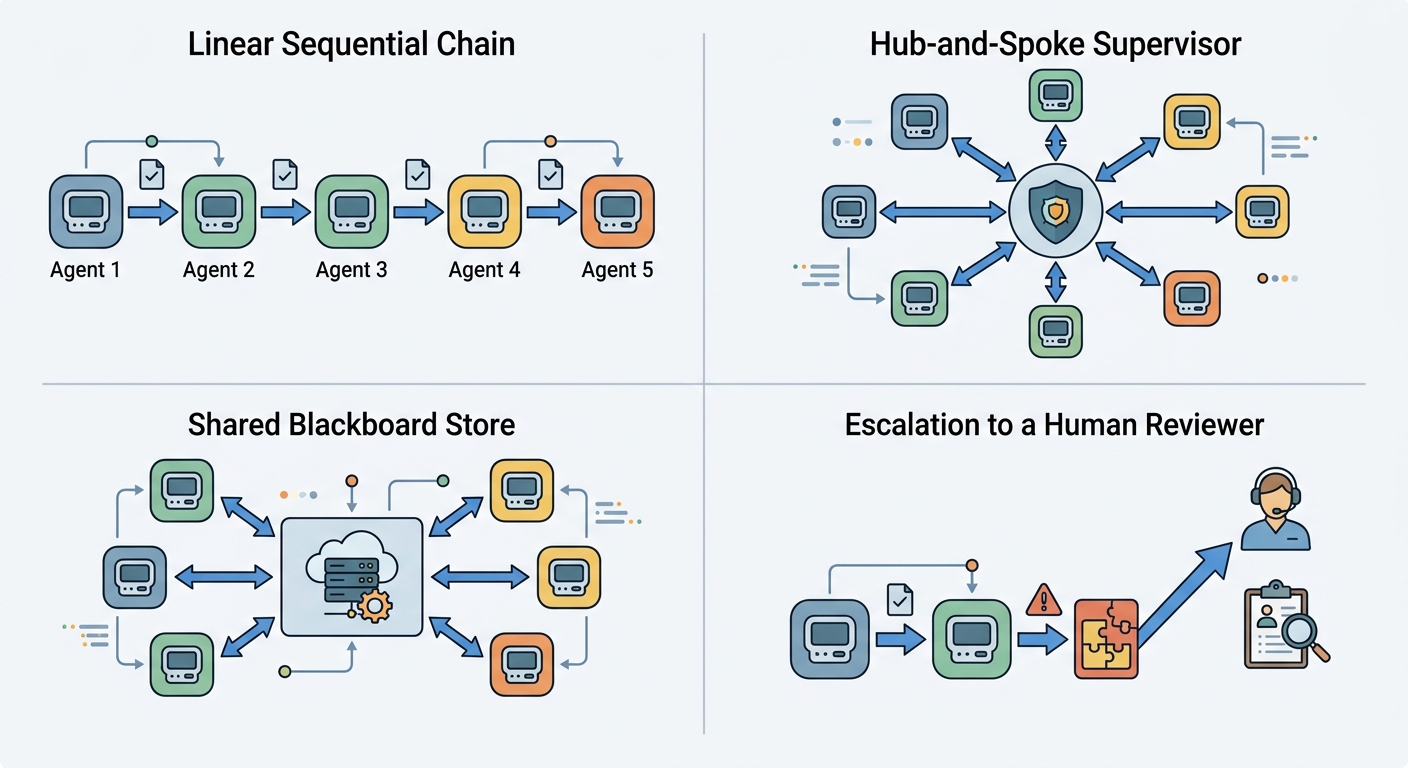
Pattern 1 — Sequential Handoff with Explicit Contracts
The simplest pattern: Agent A completes a task, validates its output against a schema, and passes a typed payload to Agent B. The contract—not the prompt—is the interface. Define input and output schemas for every agent, validate at each boundary, and reject malformed payloads before they propagate.
Use when the workflow is a predictable pipeline: extract → classify → draft → review.
Failure mode: schema drift. An upstream agent adds a field or changes a type, and downstream validation starts rejecting everything.
Mitigation: version your contracts, run consumer-driven contract tests in CI, and treat schema changes as breaking changes requiring coordinated rollout. Prefer backward-compatible evolution where possible—additive optional fields and discriminated unions let producers ship without breaking consumers. (See: [schema validation and contract testing for LLM pipelines])
Pattern 2 — Supervisor/Router Handoff
A coordinator agent inspects the request and delegates to the right specialist—billing agent, technical agent, escalation agent. The router holds the plan; specialists hold the skills. This is the most common production topology because it keeps routing logic in one auditable place.
Use when you have heterogeneous tasks and clear specialist boundaries.
Failure mode: the router becomes a single point of failure. A misroute sends a refund request to the technical agent, which confidently does the wrong thing. Worse, a router that hallucinates a specialist name can drop the request entirely.
Mitigation: constrain routing to an enumerated set of valid destinations, add a fallback path for low-confidence routing, and log every routing decision with its rationale. Never let the router invent a destination. (Related: [supervisor agent routing and delegation strategies])
Pattern 3 — Blackboard (Shared-State) Handoff
Agents don't message each other directly; they read from and write to a shared store—a "blackboard"—and coordinate through it. This decouples agents and lets multiple specialists contribute to one artifact. It is also the pattern that most directly resolves ambiguous state ownership, provided the store enforces concurrency control.
Use when work is genuinely collaborative and parallel: multiple analysts enriching one case file, or several agents contributing findings to a shared investigation.
Failure mode: concurrency conflicts and stale reads. Two agents read version 3, both write version 4, and one contribution vanishes. Without versioning, you also lose the ability to explain how the final state was reached.
Mitigation: enforce optimistic concurrency with version checks, require writes to declare the version they read, and define conflict resolution rules up front (last-write-wins is rarely the right default). Treat the blackboard as an append-only log with a materialized current view. (See: [shared memory and state management for multi-agent systems])
Pattern 4 — Escalation Handoff to Human
Not every decision should be automated. Escalation hands control to a human when confidence drops below a threshold, when the action is high-stakes (refunds above a limit, contract changes, anything irreversible), or when an agent detects it is out of its competence.
Use when actions are consequential, ambiguous, or regulated.
Failure mode: escalation fatigue—so many low-value escalations that reviewers rubber-stamp everything, and the one that mattered gets waved through. A second failure mode is the context-free escalation: the agent hands over a bare "needs review" with no decision framing, forcing the human to reconstruct state from scratch.
Mitigation: escalate with a structured handoff packet—the decision required, the options considered, the agent's recommendation and confidence, and links to supporting evidence. Attach a bounded SLA and route by expertise. Tier your thresholds so only genuinely consequential or low-confidence cases escalate; auto-resolve reversible low-stakes actions and reserve human review for the rest. Finally, capture the human's decision as a labeled outcome so it feeds back into evals and threshold tuning—escalation should be a learning signal, not a dead end.
The Reliability Primitives Every Handoff Needs
Patterns define topology; primitives make them survive. Every handoff—regardless of pattern—should carry these:
- Idempotency keys, scoped to the logical operation. Generate a stable key per business operation (not per retry) and enforce it at the side-effecting boundary—the payment gateway, the email sender, the ticket system. A retry with the same key is a no-op, not a second charge. This is the concrete fix for the billing example above.
- Bounded retries with backoff and circuit breakers. Retries must have a ceiling, exponential backoff with jitter, and a circuit breaker that fails fast when a downstream dependency is degraded rather than piling on load. Distinguish retryable from terminal errors explicitly.
- A hop counter with a hard ceiling. Every handoff increments a counter carried in the payload; exceeding the ceiling terminates the workflow and routes to escalation. This is what stops A→B→A loops before they burn budget.
- Correlation and trace IDs propagated across every handoff. One trace ID per logical request, threaded through every agent, tool call, and downstream service, so you can reconstruct the full path of a failure.
- Explicit confidence and provenance on every output. Agents should emit a confidence signal and a source reference with their result. Downstream agents and routers use it to decide whether to proceed, retry, or escalate—and it is what prevents a degraded fallback from being treated as authoritative.
- Trust-tier tagging. Tag payloads with the privilege level of the producing agent so a high-privilege consumer can refuse to act on low-privilege output without explicit validation.
Instrumenting Orchestration So Failures Surface Early
Instrumentation is not optional telemetry—it is how you find handoff failures before users do. Track, at minimum:
- Handoff success/failure rate per edge (A→B), not just per agent. A healthy agent can sit on a failing edge.
- Loop and retry counts per workflow, with alerts on the p95 and on any workflow that hits the hop ceiling.
- Schema validation rejection rate, which spikes during schema drift and coordinated rollouts.
- Escalation volume and rubber-stamp rate (escalations resolved in under N seconds), the leading indicator of escalation fatigue.
- End-to-end latency decomposed by hop, so you can see which seam is slow.
Alert on the seams, not the nodes. A dashboard that shows every agent green while the A→B edge silently fails 30% of the time is worse than no dashboard.
The Takeaway
Multi-agent reliability is an integration problem, not a model problem. Pick the pattern that matches your workflow's topology, make the contract the interface, carry idempotency and trace IDs through every handoff, bound your retries and loops, and instrument the edges. Do that, and your system fails loudly and recoverably instead of quietly and expensively.