Autonomous AI Agents in 2026: How Multi-Agent Systems Are Replacing Traditional Workflows
In 2026, multi-agent AI systems are shifting from experiment to enterprise infrastructure. Here is how coordinated AI agent teams are replacing traditional workflows and what it means for your organiz
In 2025, deploying a single AI assistant felt cutting-edge. In 2026, enterprises that once marveled at chatbot demos are running coordinated teams of AI agents that handle loan origination, IT incident response, and customer service interactions — autonomously, at scale, around the clock. The shift is not incremental. It is architectural.
More than 57% of enterprises have already deployed AI agents in production environments. Gartner projects that by the end of 2026, 40% of enterprise applications will incorporate task-specific AI agents — up from less than 5% in 2025. The question is no longer whether to adopt multi-agent AI systems. It is where autonomous agents will deliver the most value, and where human oversight remains essential.
This is the practical guide to that decision.
The Shift from Single Agents to Coordinated Multi-Agent Systems
The first wave of enterprise AI brought us chatbots, copilots, and assistants that respond to individual prompts. These tools are useful. They are also fundamentally reactive — a human asks, AI answers.
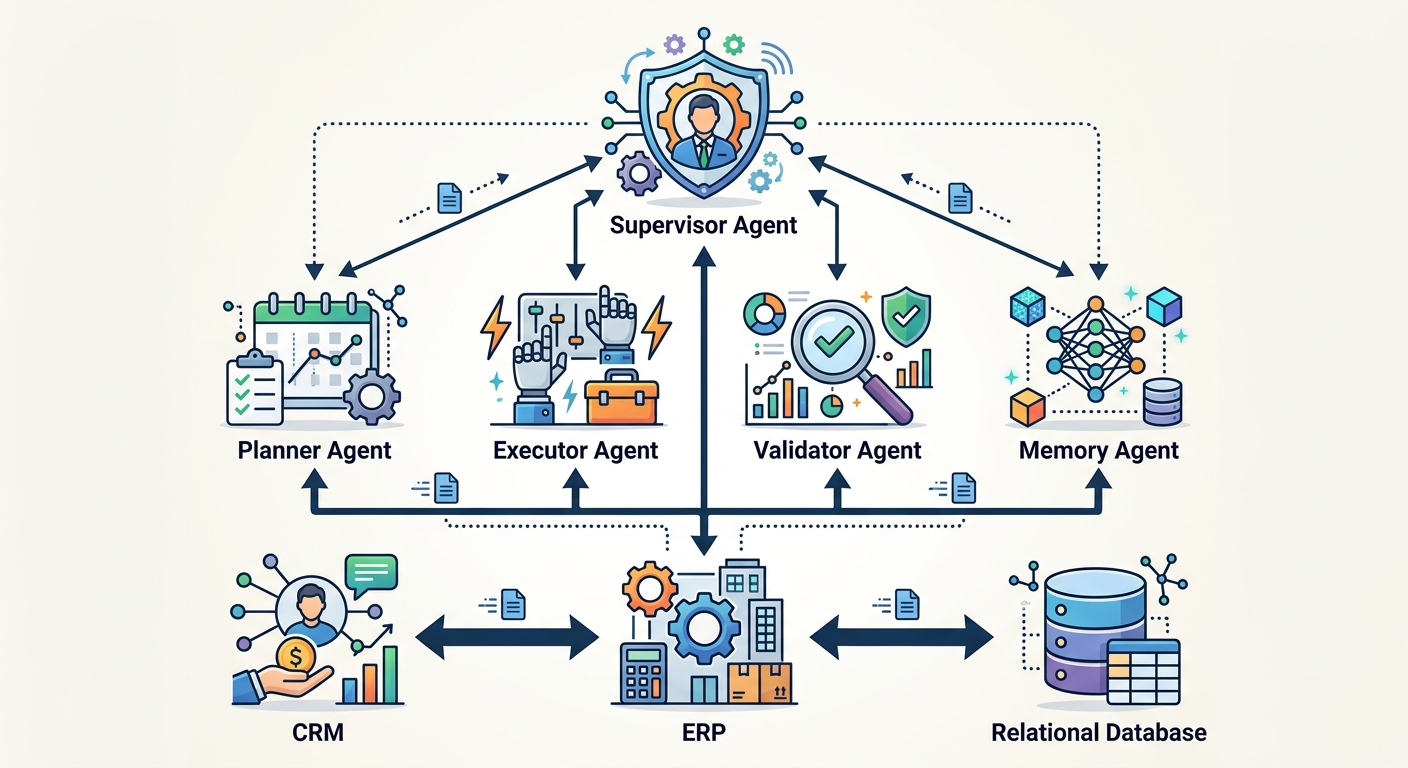
Multi-agent AI systems work differently. They deploy teams of specialized agents that collaborate autonomously across complex, multi-step workflows. Each agent has a defined role: one plans, another executes, a third validates, a fourth maintains memory and context. Together, they handle processes that previously required teams of humans reading tickets, making decisions, and updating systems.
This is not science fiction. In financial services, multi-agent systems now handle loan origination end-to-end — from document intake through risk assessment to compliance verification. In healthcare, they manage patient service interactions with containment rates of 80–99.5% across various industries. In IT operations, enterprises report 76% faster incident response times.
The practical implication: if your AI strategy centers on a single chatbot, you are already behind.
How Multi-Agent AI Systems Actually Work
Understanding the mechanics helps you evaluate vendors, design integrations, and scope deployments realistically. The most common enterprise architecture is the supervisor model. A top-level orchestrator agent receives a task, decomposes it into subtasks, assigns them to specialized agents, and validates results before moving to the next step. Think of it as an AI project manager that never sleeps.
A second pattern is peer-to-peer coordination, where agents share a common goal and negotiate who handles each subtask based on their capabilities and current workload. This model scales well but requires more sophisticated governance.
The critical components in any architecture are:
- Planner agent: decomposes objectives into executable steps
- Executor agent: performs actions in enterprise systems (APIs, databases, UIs)
- Validator agent: checks outputs against business rules and quality thresholds
- Memory agent: maintains context across sessions, learning preferences and previous outcomes
Enterprise integration is what separates a demo from production. Multi-agent AI systems connect to your CRM, ERP, IT service management tools, and databases. They read and write data, trigger workflows, and escalate edge cases to human operators.
Enterprise Use Cases: Where Multi-Agent Systems Are Replacing Workflows
The breadth of deployment is widening. These are the highest-impact enterprise use cases as of mid-2026.
Finance and Compliance. Multi-agent systems automate loan origination by running credit analysis, document verification, and compliance checks in parallel. The result is faster decisioning and reduced manual review backlog. Compliance monitoring agents flag regulatory changes and assess exposure across portfolios automatically.
IT Operations. AI agents handle tier-1 and tier-2 incident response autonomously — gathering diagnostics, cross-referencing knowledge bases, and initiating remediation steps. Human engineers handle escalations only when confidence thresholds are breached. Enterprises report 76% faster mean time to resolution.
Customer Service. Rather than routing tickets to human agents, multi-agent systems handle the full customer interaction — understanding intent, pulling context from multiple systems, generating responses, and updating records. Containment rates of 80–99.5% mean most customers never wait in queue.
Human Resources. Agents manage employee Q&A, benefits administration, and onboarding workflows. Recruiters receive pre-screened candidate summaries. New hires interact with onboarding agents that guide them through paperwork, system access, and training paths.
Sales and Revenue Operations. Multi-agent systems qualify leads, update CRM records, draft personalized outreach, and schedule meetings — all while maintaining conversation context across email, chat, and calendar.
The 2026 inflection point — Over 57% of enterprises are already running AI agents in production, up from under 5% in 2025. The window for early-mover advantage is closing.
Measuring the ROI of Multi-Agent AI Deployments
Enterprise leaders want hard numbers, not vendor pitch decks. Here is what the data actually shows.
IDC research indicates an average ROI of 171% for agentic AI deployments — higher than traditional automation approaches. Individual productivity gains of 30–35% are commonly reported by enterprises that have moved beyond pilot programs.
The global AI agents market is estimated at $10.9 billion in 2026, with the majority of growth driven by enterprise adoption. By the end of the year, IDC expects 70% of G2000 chief executives to have redirected their AI ROI focus from cost reduction toward growth-oriented outcomes.
The productivity gains come from several sources:
- Round-the-clock operation: AI agents work nights, weekends, and holidays without fatigue
- Parallel processing: multiple workflows execute simultaneously rather than sequentially
- Error reduction: automated validation catches mistakes that human review misses
- Faster escalation: agents route complex cases to specialists immediately, cutting delay
The caveat: 40% of agentic AI projects remain at risk of cancellation by 2027 due to unclear ROI or improper application of autonomy. The difference between successful and failed deployments is governance, integration planning, and realistic scoping.
Looking to quantify these gains for your organization? Algorithmine's AI portal tracks the latest enterprise benchmarks and ROI frameworks — subscribe for monthly data briefs on autonomous AI deployment.
The Human-AI Collaboration Shift
When AI agents take over execution, what do human employees do?
The answer matters because workforce transition is where many AI programs stall — or fail. Only 32% of organizations report having achieved at least one of their primary AI objectives. Investment in AI tools and infrastructure is surging (global AI spending is projected at $2.52 trillion in 2026), but workforce preparedness is not keeping pace.
The shift is real. Human employees are moving from execution to oversight, strategy, and judgment. Instead of processing invoices, finance analysts review AI recommendations on exception cases. Instead of triaging tickets, IT managers design agent workflows and set autonomy boundaries.
Two new roles are emerging as critical:
Agent Orchestrators design, deploy, and monitor multi-agent workflows. They define which processes get automated, set escalation thresholds, and intervene when agents encounter novel situations.
AI Security Engineers govern the security posture of AI agent ecosystems. As the attack surface expands with agent autonomy, someone must design guardrails, monitor for adversarial inputs, and audit agent actions for policy compliance.
The organizations succeeding at this transition invest in upskilling alongside tool deployment. They treat AI agent rollout as a change management problem, not just a technology problem.
Governance, Security, and the Autonomy Paradox
Here is the uncomfortable truth: governance is the primary barrier to enterprise AI agent adoption, and most organizations are behind.
Only 21–22% of organizations have a mature governance model for autonomous AI agents. Yet 88% of organizations have experienced AI-related security incidents. The gap between deployment ambition and governance capability is exposing enterprises to risk.
The risks are not theoretical. Autonomous agents can rapidly escalate errors. An agent making faulty decisions at 3 AM across thousands of transactions can cause damage that takes days to undo. Over-automation — letting agents proceed without adequate checkpoints — has already led to costly mistakes in early enterprise deployments.
Effective governance frameworks for AI agents include:
- Clear autonomy boundaries: which decisions can agents make independently vs. which require human approval
- Explicit escalation procedures: what triggers a handoff to a human operator, and how does the handoff work
- Transparent validation: how agents explain their reasoning, and how that reasoning is logged and auditable
- Continuous monitoring: real-time dashboards tracking agent performance, error rates, and policy compliance
- Adversarial hardening: defenses against prompt injection, data poisoning, and other attacks targeting agent systems
Cybersecurity teams need to treat AI agent infrastructure like any critical enterprise system — with access controls, patching cadences, and incident response plans. The difference is that AI agents are dynamic and adaptive, which means traditional static controls are insufficient.
Building Your Multi-Agent AI Roadmap
How do you move from awareness to implementation? A phased approach reduces risk and builds organizational muscle.
Phase 1: Proof of Value (Months 1–3). Start with one high-volume, low-risk workflow. IT helpdesk ticket triage is a common entry point — the data is structured, failure modes are understood, and human backup is readily available. Measure containment rate, escalation accuracy, and user satisfaction before expanding.
Phase 2: Governance Foundation (Months 2–4). Before scaling, build your governance framework. Define autonomy boundaries, escalation paths, and audit logging. Run red-team exercises on your agent workflows. Document your AI acceptable use policy and get stakeholder sign-off.
Phase 3: Integration and Scaling (Months 4–8). Connect agents to your core enterprise systems — CRM, ERP, IT service management. Extend coverage to additional workflows in finance, HR, or customer service. This phase typically reveals integration complexity that was invisible in pilots.
Phase 4: Enterprise-Wide Deployment (Months 8–12). Roll out multi-agent automation across business units with a Center of Excellence model. Agent Orchestrators in each business unit govern local deployments while a central team maintains platform standards and governance.
Low-code and no-code platforms are accelerating timelines for Phase 1. Business analysts can now build and modify agent workflows without waiting for engineering resources — though governance oversight remains essential.
The Road Ahead: From Reactive Tools to Proactive AI Partners
The multi-agent AI systems of 2026 are reactive by default. You give them a task, they execute. The next generation is different.
AI agents are beginning to anticipate needs and suggest next-best actions before being asked. A customer service agent might proactively flag a potential churn risk based on interaction patterns. An IT agent might initiate remediation before a user reports an outage.
This shift — from reactive tool to proactive partner — is what makes AI-first operating models possible. Rather than layering AI onto existing processes, leading enterprises are redesigning operations around agent capabilities — breaking workflows into modular steps that specialized agents handle, forming a digital assembly line that crosses organizational boundaries.
2026 is the year multi-agent AI systems stop being experiments and start being critical enterprise infrastructure. The window to shape that infrastructure thoughtfully — with proper governance, realistic ROI expectations, and genuine attention to human workforce transition — is open now. It will not stay open forever.
Expert Q&A
Q: How do multi-agent AI systems differ fundamentally from single AI assistants like standard chatbots? A: Single AI assistants respond to one query at a time in isolation. Multi-agent AI systems deploy coordinated teams of specialized agents that collaborate autonomously across complex, multi-step workflows — with planner, executor, validator, and memory roles working in parallel toward shared objectives. The coordination layer is what separates a multi-agent system from a collection of individual AI tools.
Q: What is the realistic ROI for enterprise multi-agent AI deployment, and how long until payback? A: IDC research points to an average ROI of 171% for agentic AI deployments, with individual enterprises reporting 30–35% productivity gains. Payback timelines vary: proof-of-value phases (3–6 months) often show containment rate improvements before hard cost savings materialize. Full ROI realization typically aligns with Phase 3 integration and scaling (months 4–8). The critical caveat is that 40% of agentic AI projects face cancellation risks due to governance failures and unclear scoping — not technical failures.
Q: What is the single biggest barrier to enterprise multi-agent AI adoption? A: Governance. Only 21–22% of organizations have mature AI governance frameworks for autonomous agents, while 88% have already experienced AI-related security incidents. Most enterprises are deploying faster than their governance capabilities can mature. Building guardrails, approval checkpoints, and audit trails before scaling autonomy is the most important first investment — not the last.
Q: How do human roles change when AI agents take over workflow execution, and how should organizations manage the transition? A: Human employees shift from execution to oversight, strategy, and judgment roles. This is a genuine change management challenge — not a technology challenge. Organizations that succeed invest in upskilling programs alongside tool deployment, treat the transition as an organizational design problem, and create new roles (Agent Orchestrators, AI Security Engineers) alongside existing teams rather than expecting organic adaptation. The 32% of organizations that have achieved primary AI objectives did so because they invested in people, not just tools.
Q: Can multi-agent AI replace existing RPA systems, or do they coexist? A: In many cases, multi-agent AI can replace or absorb existing RPA workloads — particularly for processes involving unstructured data, adaptive decision-making, or cross-system integration. Rule-based RPA still has a role for highly stable, structured, low-variance processes where the logic never changes. The enterprise trend is toward hybrid approaches: RPA handles steady-state automation while multi-agent systems handle exception handling, complex routing, and cross-application orchestration. Over time, the boundary shifts toward more agentic approaches as governance matures.