Multi-Agent Orchestration in the Enterprise: Frameworks, Trade-offs, and ROI in 2026
A practical 2026 guide to multi-agent orchestration: topologies, framework trade-offs, and a cost-per-task model to measure real ROI before you scale agentic systems.
The Case for Multi-Agent Orchestration in the Enterprise
Most teams started with a single agent. It answered questions, called a tool or two, and shipped a demo quickly. Then the workload outgrew it. A single agent tried to do research, write code, verify results, and file the output — all in one context window. Quality dropped, latency climbed, and the whole thing became hard to reason about.
Multi-agent orchestration — the layer that coordinates specialized agents toward a shared result — is the answer that teams keep arriving at. It splits a complex job into smaller, specialized agents, each with a clear role and a narrow set of tools. A coordinator, or a sequence of stages, keeps them moving toward a shared outcome.
Let me be clear about what orchestration actually is. It decides which agent does what, in what order, and how partial results flow between them. It is the difference between a handful of independent bots and a single, coordinated system. That layer brings real benefits: parallel work, better context isolation, and a modular design that is easier to test and govern.
But it also brings real costs. Every agent call spends tokens. Every handoff can fail. Every stage needs observability. In 2026, orchestration is no longer a novelty — it is a cost and governance decision that engineering leaders make deliberately.
Key insight — Multi-agent orchestration should be treated as an architecture decision with measurable cost and governance implications, not as a default for every AI feature.
Orchestration Topologies: Supervisor, Pipeline, and Mesh
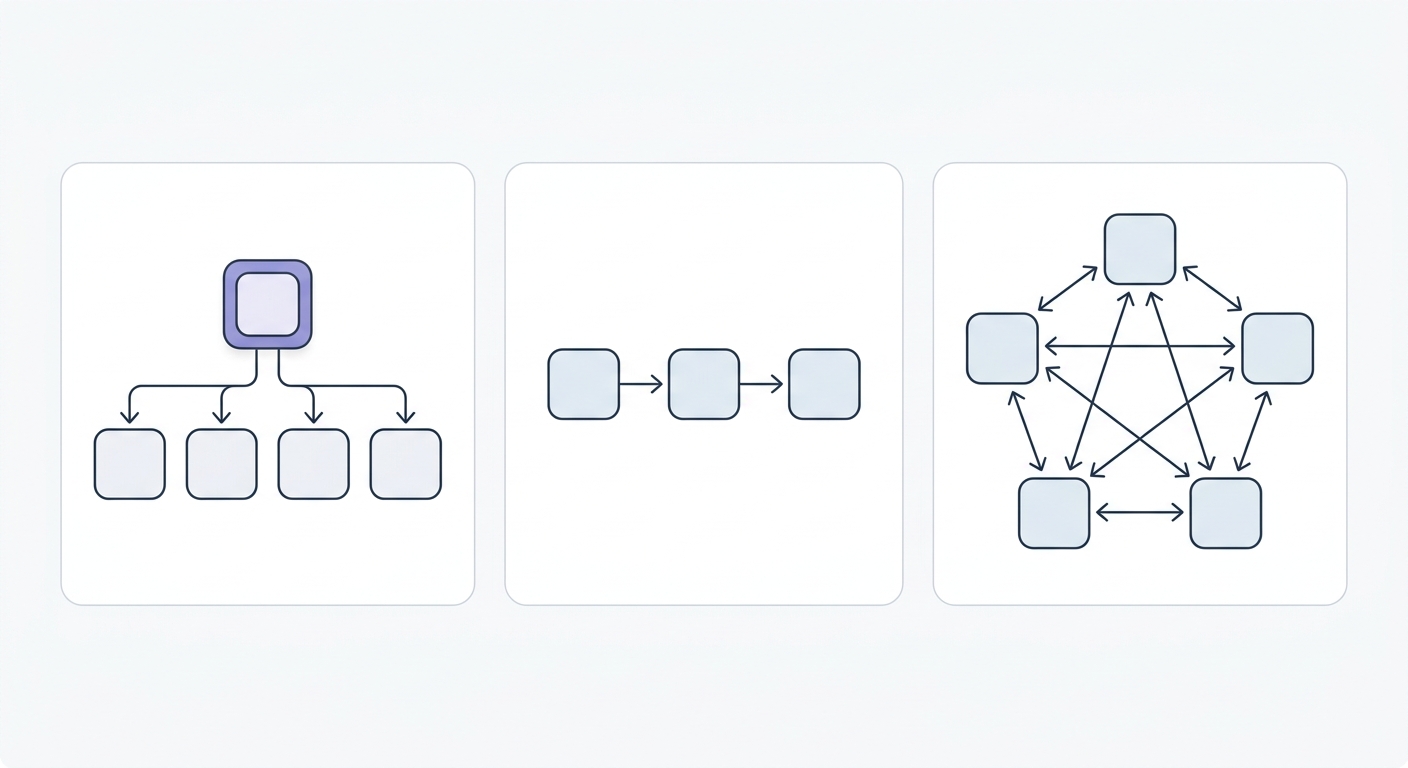
Before you pick a framework, decide how your agents will coordinate. Three dominant patterns exist, and each one trades off control, cost, and reliability differently.
Supervisor (Router) Pattern
A central supervisor agent receives the request, breaks it into sub-tasks, and delegates each one to a specialist agent. The supervisor collects results and assembles the final answer. This works well for open-ended, multi-branch tasks where the path is not known ahead of time.
The strength is flexibility. You can add specialists without rewriting the whole system. The weakness is that the supervisor becomes a single point of failure — and a token and latency bottleneck. If the supervisor misroutes a task, the error propagates to everything downstream.
Pipeline (Sequential) Pattern
In a pipeline, tasks flow through agents in a fixed order. Stage one completes, hands its output to stage two, and so on. Each agent has a narrow, well-defined job. This pattern is highly deterministic and easy to audit, which makes it a strong fit for regulated workflows.
The trade-off is rigidity. You cannot easily reorder stages at runtime, and a slow stage blocks everything behind it. Pipelines also struggle with any task that needs to branch or revisit an earlier step.
Mesh (Decentralized) Pattern
In a mesh, peer agents negotiate directly with each other toward an outcome. There is no central planner. This is the most flexible but the hardest to control. It shines for research-like or negotiation-heavy tasks, and it is the riskiest in production because behavior is emergent.
My general rule: start with a supervisor or a pipeline, and treat the mesh as a carefully contained exception. Emergent coordination is impressive in a demo and expensive to operate at scale.
Choosing a Topology for Your Workload
Match the topology to the nature of the work.
- Deterministic, regulated tasks → pipeline. You get auditability and predictable cost.
- Open-ended, multi-branch tasks → supervisor. You get flexibility without emergent behavior.
- Negotiation-heavy, research-like tasks → mesh, but only with strong guardrails.
Keep in mind that topology and reliability go together. A pipeline is easier to make reliable than a mesh, simply because there is less free-form behavior to debug.
Framework Trade-offs: LangGraph, CrewAI, and the Microsoft Agent Framework
Once you know the topology, you choose a framework. In 2026 the landscape is clearer than it was a year ago. Three names dominate enterprise conversations: LangGraph, CrewAI, and the Microsoft Agent Framework (the successor to AutoGen).
LangGraph: Control and Durability
LangGraph models agent logic as a graph with explicit state and checkpoints. That design gives you durable execution, meaning a long-running task can survive a crash and resume from the last checkpoint. It also provides first-class human-in-the-loop support and audit trails.
These properties make LangGraph the strongest choice for compliance-sensitive and high-throughput workloads. The trade-offs are real: a steeper learning curve, longer setup time, and higher operational cost as you pay for graph nodes and tracing at scale.
CrewAI: Speed and Developer Experience
CrewAI organizes agents around roles, goals, and backstories. It is the fastest way to build a working multi-agent demo and iterate on a proof of concept. Its developer experience is excellent, and it is very approachable for teams new to orchestration.
The trade-offs: it is weaker than LangGraph at graceful recovery from partial failures, and it carries more framework risk for a long-term enterprise commitment. CrewAI accelerates role-based prototyping and is a reasonable production tool for simpler workflows.
Microsoft Agent Framework: Azure-Native Conversational Agents
The Microsoft Agent Framework merges AutoGen's multi-agent abstractions with Semantic Kernel's enterprise features. It is the natural fit for teams deeply invested in the Microsoft ecosystem, with native compatibility with Azure OpenAI and Azure AI Foundry, and full .NET parity.
It is well suited to conversational agents and collaborative workflows, especially where agent dialogue is the core of the product. For teams outside the Microsoft stack, it is less compelling than the alternatives.
What This Comparison Actually Tells You
These frameworks are not strictly alternatives. A common production pattern uses CrewAI for research and synthesis and LangGraph for deterministic execution. Think of the choice as context-driven — control, ecosystem, and governance requirements should drive it, not framework hype.
| Trade-off | LangGraph | CrewAI | Microsoft Agent Framework |
|---|---|---|---|
| Control & auditability | High | Medium | Medium-High |
| Developer speed | Medium | High | Medium |
| Ecosystem stability | High | Medium | High (MSFT stack) |
| Partial-failure recovery | Strong | Weaker | Medium |
| Best fit | Regulated, durable, high-throughput | Rapid prototyping, role-based automations | Azure-native conversational agents |
The Real Cost of Orchestration: Modeling ROI Per Task
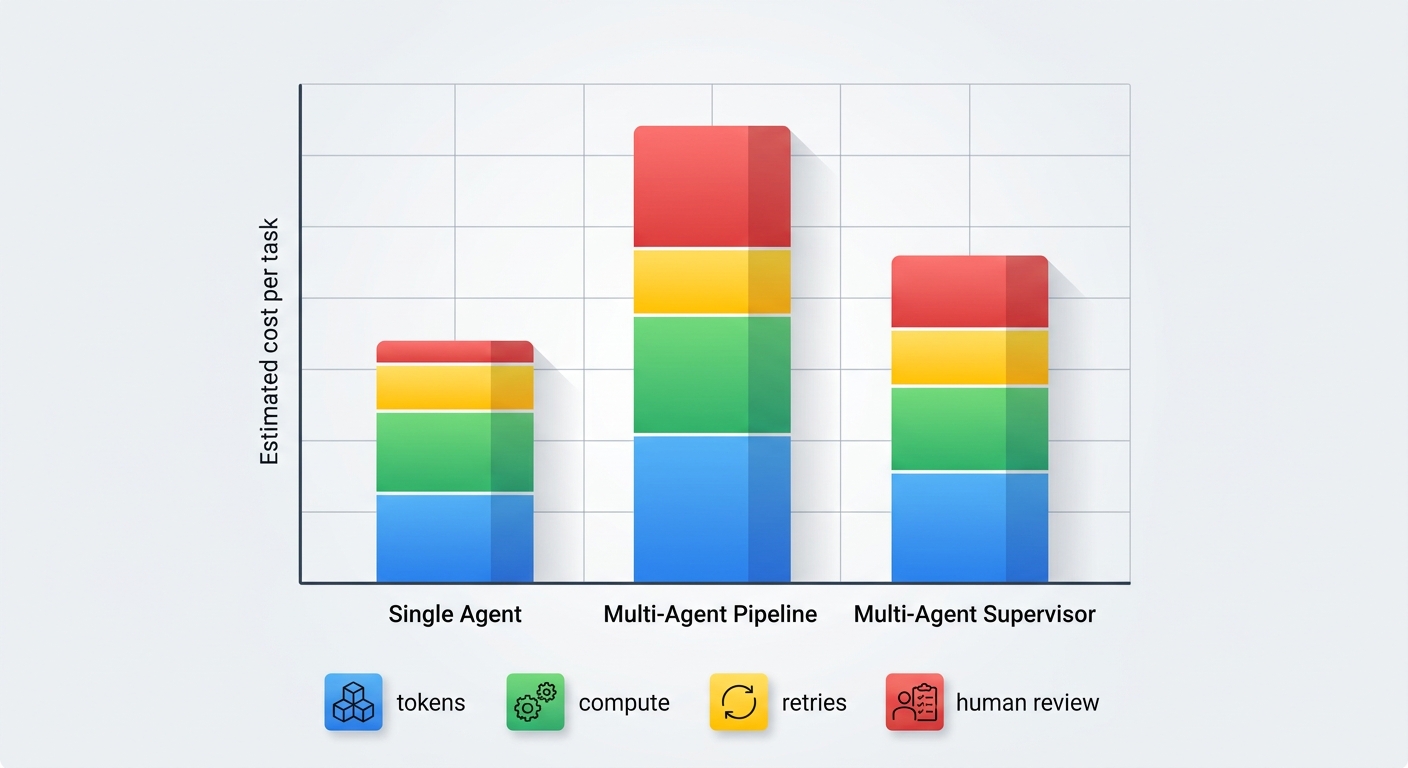
Here is where most framework comparisons stop — and where your budget conversation actually happens. The ROI of orchestration comes down to a single number you can defend: cost per task — the fully loaded spend of tokens, compute, retries, observability, and human review for one completed unit of work.
Let me lay out the cost components that add up in production:
- Tokens. Every agent call consumes input and output tokens. Multi-agent systems multiply this.
- Compute. Graph runtimes, tool executions, and sandboxed code execution cost money.
- Retries. Failed steps get retried, and each retry spends tokens and time.
- Tracing and observability. Agent platforms and tracing seats add recurring cost.
- Human review. Approval gates and human-in-the-loop checks cost staff time, often the largest hidden line item.
A concrete (estimated) example: a supervisor-style task with three specialist calls and one review gate might spend roughly 60,000 to 120,000 tokens end to end, plus minutes of human review. Against a manual baseline — where the same task costs a specialist twenty minutes — the break-even point is often reached at surprisingly low volumes.
The formula I use is simple: value per task equals the manual cost of the task, minus the automated cost per task. ROI is positive once cumulative automated volume covers the build, infrastructure, and review investment. Instrument cost per task from the first week in production, because it drifts upward as you add capabilities and context.
Key insight — ROI is a per-task equation, not a framework feature. Teams that do not track cost per task cannot defend their orchestration investment in a budget review.
Reliability, Observability, and Governance
Production multi-agent systems fail in predictable ways, and most of them are silent. An agent returns a plausible but wrong result, and the error flows downstream. Because each agent trusts the last one's output, small errors compound.
Three controls keep this manageable.
Checkpointing and tracing. Your orchestration layer should record every stage, every input, and every output. Observability tooling surfaces silent partial failures before they reach the user. That trace is how you find where a wrong answer entered the chain, and it is the foundation of auditability.
Human-in-the-loop gates. For regulated or high-stakes steps, insert an explicit approval point before an action is taken. This is standard practice in finance and healthcare workflows. Human-in-the-loop gates enforce compliance and catch the worst errors before they become externally visible.
Least-privilege tool scoping. Each agent should only be able to call the tools it needs, on the data it needs. This limits blast radius and reduces the surface for cross-agent prompt injection, where a malicious document injected into one stage influences the behavior of a later, privileged agent.
None of these are optional add-ons. They are part of how you design the orchestration layer, not features you bolt on afterward.
When to Skip Multi-Agent Orchestration
It is worth stating plainly: not everything needs orchestration.
If a single agent with good tools completes the task reliably, keep it. If the task is deterministic and rule-based, use a plain workflow engine, not agents at all. Orchestration adds latency, token cost, and failure surface. When the simplest thing works, the simplest thing is the right architecture.
I see overengineering constantly. A team builds a four-agent mesh to file a spreadsheet, when a single script would have done it. The honest question to ask before building any agent system: does this task genuinely need judgment, coordination, or parallel specialization? If the answer is no, do not orchestrate.
The 2026 Adoption Playbook
If you are convinced orchestration is warranted, here is the path I recommend.
Start with one high-value workflow. Pick a task with clear, measurable success criteria. Keep the scope narrow.
Measure cost and quality from day one. Instrument cost per task and an evaluation score before you scale. This gives you a baseline and a regression guardrail.
Build an eval harness early. A small golden set of representative inputs, with expected outputs, catches regressions every time you change a prompt, a model, or a graph edge. Without it, you are flying blind.
Expand deliberately. Add specialists and topologies only when measurement justifies them. Scale volume once reliability holds across the eval set.
This sequencing keeps the risk small and the evidence strong. It is how orchestration becomes a repeatable pattern instead of a pilot that never ships.
Conclusion
Multi-agent orchestration is a genuine architectural upgrade for the right workloads. It delivers parallelization, context isolation, and modularity — if you choose the topology, framework, and controls deliberately.
The deciding factors in 2026 are measurable: cost per task, reliability under load, and governance surface. Teams that instrument these numbers early turn orchestration into an investment with defensible ROI. Teams that skip the measurement turn it into an expensive experiment.
If you are building or scaling agentic systems, the practical guidance does not end here. Subscribe to the Algorithmine portal for ongoing, engineering-focused coverage of multi-agent patterns, cost optimization, and production best practices.