Multi-Agent Orchestration at Scale: Patterns for Coordinating LLM Workforces in Production
A practical guide to multi-agent orchestration patterns — orchestrator-worker, sequential pipelines, graph-based flows, and role-based crews — with cost control, observability, and security for production LLM workforces.
A single AI agent can answer questions and call tools. But one agent hits a ceiling fast. It runs out of context, drifts off task, and struggles with complex, multi-step workflows.
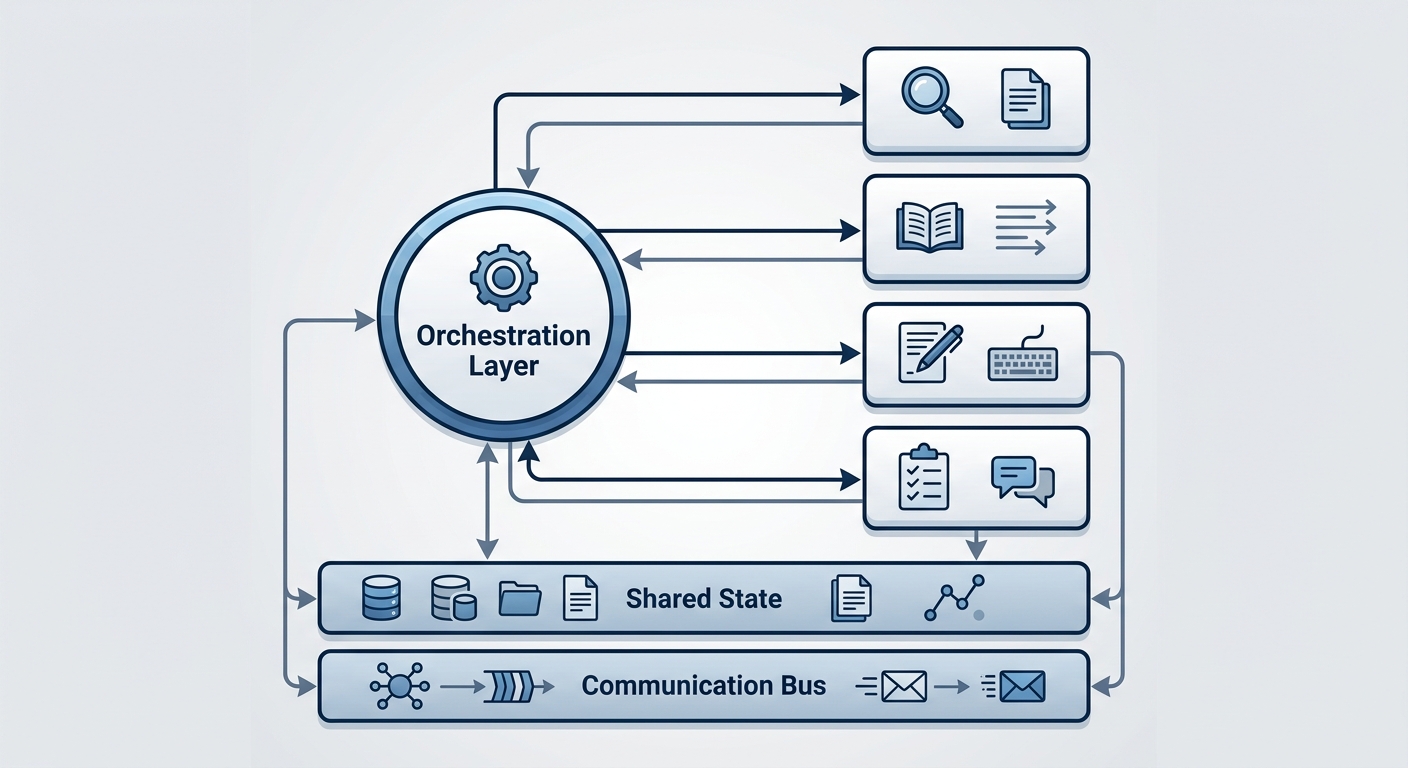
That is why production teams now build multi-agent systems. Instead of one model doing everything, they coordinate a workforce of specialized agents. Each agent does one job well. An orchestration layer decides who works, in what order, and how results combine.
We have shipped agent systems at production scale. The patterns below come from real deployments, not marketing slides. This guide covers the core multi-agent orchestration patterns, when each fits, and how to control cost and keep the system observable and safe.
What Is Multi-Agent Orchestration?
A multi-agent system is a set of autonomous AI agents that solve a task together. An agent is an LLM-driven program that plans, uses tools, and acts toward a goal.
multi-agent orchestration is the layer that coordinates these agents. It handles four core jobs:
- Agent registry — a catalog of every agent, its capabilities, and its limits.
- State manager — keeps workflow context across agent handoffs, enabling recovery.
- Execution engine — runs workflows, handling branching, parallelism, timeouts, and limits.
- Communication bus — routes messages between agents and logs their interactions.
This differs from a monolithic design. In a monolith, one prompt handles every step. That leads to prompt bloat and unreliable outputs. In an orchestrated design, each agent stays focused, and coordination logic lives outside the prompts.
coordinating LLM agents in production is an engineering discipline. It combines distributed-systems thinking with prompt design. Treat it like building a reliable distributed service, not a chatbot.
Why Coordinating Agents Is Hard
Multi-agent systems are powerful but fragile. The hardest part is not building agents. It is coordinating them safely and predictably.
Several pain points recur in production:
- Non-determinism — the same task can produce different paths on each run.
- Context accumulation — agents pass growing context between each other, risking overflow.
- Failure — one failing agent can cascade through the whole workflow.
- Cost runaway — loops and chained calls burn tokens quickly.
- Debugging — tracing which agent caused a wrong output is hard without good tooling.
We saw all five in our first production rollout. The fix was not smarter prompts. It was a stronger coordination layer with limits, checkpoints, and tracing from day one.
Multi-agent orchestration is fundamentally an operations problem. Teams that treat it as pure prompt engineering fail in production. Build the coordination layer first.
Core Orchestration Patterns for LLM Workforces
Four patterns dominate production multi-agent design. Each fits a different workload. Let us walk through them.
Orchestrator-Worker Pattern
The orchestrator-worker pattern uses a lead agent that plans and delegates. The orchestrator receives a task, breaks it into subtasks, and assigns each to a worker agent. It then aggregates the results.
This strategy is called task decomposition. You split a large task into smaller, well-defined pieces that specialists can each handle.
The main benefit is cost. Teams report 40-60% savings because workers can use cheap, task-specific models. A small model handles a narrow rewrite task. A large model only handles planning and review.
The trade-off is reliability. The orchestrator is a single point of failure. If it fails, the whole team stops. Context window overflow is another risk as results accumulate from many workers.
Use this pattern for cross-functional workflows with clear decomposition, such as customer service routing or multi-step content generation.
Sequential Pipeline
The sequential pipeline runs agents in a fixed order. Each agent processes the output of the previous one. They share a state object that travels through the chain.
This pattern is deterministic. The order is defined at design time, not at runtime. That predictability makes it easy to reason about and test.
A typical example is a document pipeline. An extractor reads raw input. A cleaner normalizes it. A formatter and a reviewer follow in order.
Use the sequential pipeline when each step depends on the previous one and the flow is mostly linear.
Graph-Based Orchestration
Graph-based orchestration models workflows as directed graphs. Nodes represent agents or functions. Edges define how control flows between them.
This pattern supports loops, conditional routing, and parallelism. A node can route to different paths based on a decision. This flexibility makes it the most powerful pattern.
Graph-based systems also support checkpointing. The system saves state at each step. If a run fails, it resumes from the last checkpoint instead of restarting. This also enables human-in-the-loop pauses — the workflow stops and waits for human approval.
LangGraph is the leading production framework here. It provides durable execution and stateful graphs. Companies like Anthropic, Replit, and Uber use it at scale. Durable execution means your workflow survives process crashes and retries.
Use graph-based orchestration for complex, branching, or regulated workflows where reliability matters most.
Role-Based Crews
Role-based crews assign each agent a distinct role. Every agent gets a persona, a goal, and a limited toolset. A manager agent delegates tasks to specialists.
This pattern maps well to business processes. It is intuitive because it mirrors human teams.
CrewAI popularized this approach. Its agents think in terms of roles, backstories, and goals. It is excellent for rapid prototyping.
The limitation is scaling. As systems grow complex, many teams find CrewAI crews harder to control than explicit graphs. Some migrate to LangGraph for production reliability. Evaluate this migration point early if you expect heavy growth.
Use role-based crews when the workflow is understandable as a team of specialists and you need development speed.
Structured Handoffs
Between any two agents, you must decide how they communicate. The best production choice is a structured handoff.
A structured handoff passes typed data with defined metadata. This makes workflows easy to score, audit, and debug. Open-ended chat between agents is reserved for early exploration.
Treat a handoff as a typed contract. Each field is defined and validated. This prevents the ambiguity that freeform messages introduce. Signed handoffs also support security, which we cover later.
Frameworks for Production Orchestration
Several frameworks help you build and run orchestrated systems. Here is how the main ones compare in 2026.
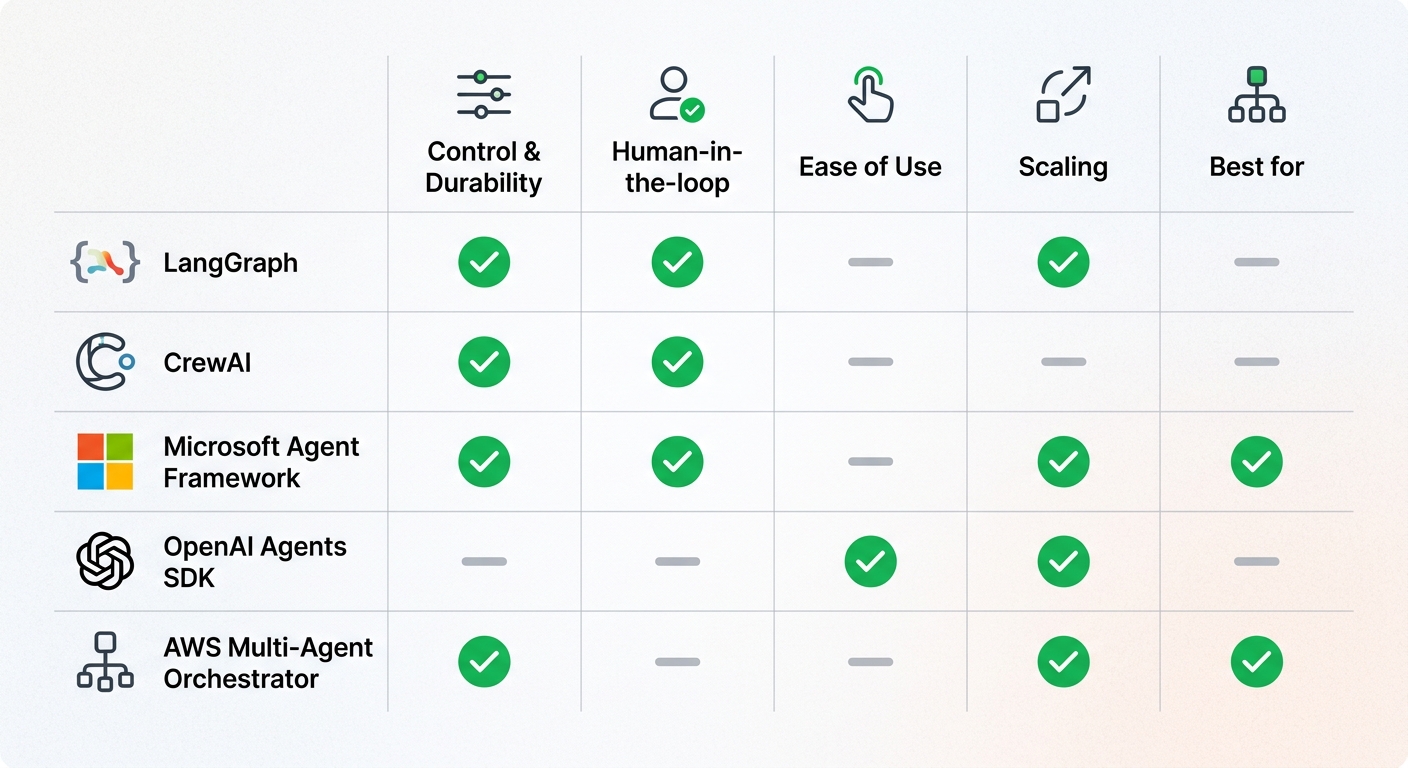
- LangGraph — the gold standard for production stateful graphs. Strong control, durability, and human-in-the-loop.
- CrewAI — fastest path to role-based crews. Great for prototypes. Watch scaling limits.
- Microsoft Agent Framework — the successor to AutoGen. Best for Azure-native enterprises and conversational research.
- OpenAI Agents SDK — lightweight handoffs. Ideal when you are embedded in the OpenAI ecosystem.
- AWS Multi-Agent Orchestrator — tailored to AWS stacks using Bedrock and Lambda.
There is no single best framework. Your choice depends on your cloud, your control needs, and your team skills. In our experience, teams that need reliability and long-running workflows converge on graph-based tools.
Cost Control and Model Routing
Multi-agent systems can burn money fast. Chained calls multiply token usage. Unbounded loops make it worse.
Set hard limits early. Use a maximum iteration count, called max_iter, on every agent. A limit of five to eight iterations prevents runaway loops.
Adopt multi-model routing. Route each subtask to the cheapest model that can do the job. This is a core strategy. Teams report up to 40-60% lower LLM spend with smart routing.
Track cost per step and per run. Observability platforms give you token and dollar counts. Watch for hidden growth across agent handoffs. A small conversion issue in one agent can multiply costs across the whole team.
Observability and Evaluation
Observability means capturing every step an agent takes for inspection. You need structured traces of LLM calls, tool use, retrievals, and control decisions.
For multi-agent systems, tracing works like a tree. The orchestrator creates a root trace. Each agent and tool creates a child span. This parent-child structure reveals which step failed and why.
agent observability with OpenTelemetry is the industry standard. It is framework-agnostic. Tools like Langfuse and LangSmith provide ready-made dashboards on top of the traces.
Evaluation is equally important. Do not rely on pass or fail checks. Use fine-grained metrics on the reasoning chain to pinpoint issues.
Two techniques stand out:
- LLM-as-judge — one model scores another model's output on defined criteria.
- Golden task sets — a fixed set of tasks with known-good outputs, run automatically to catch regressions.
We run both continuously in a CI/CD pipeline. Every code change to an agent triggers a full evaluation against the golden set. This catches regressions before they reach users.
Build observability and evaluation from day one. You cannot improve what you cannot see. Teams that add it later pay double.
Security and Governance
Multi-agent systems expand your attack surface. Each agent is a potential vector. Treat them with zero-trust principles.
A zero-trust design means no agent trusts another by default. Every handoff is verified and signed. This prevents one compromised agent from corrupting the whole workflow.
Apply role-based access control, called RBAC, so each agent only reaches what it needs. Mask personally identifiable information, or PII, in shared context. Keep detailed audit logs of every action for compliance.
Align with frameworks like the NIST AI Risk Management framework. This gives you a structured way to assess and mitigate agent risks. agent governance is not a checkbox. It is an ongoing practice as your workforce grows.
Choosing the Right Pattern
There is no universal pattern. Your workload decides the fit.
- Small, linear jobs → sequential pipeline.
- Cross-functional tasks with clear steps → orchestrator-worker.
- Complex, branching, or regulated flows → graph-based orchestration.
- Fast team-like prototyping → role-based crews.
Start simple. Ship a sequential pipeline first. Add complexity only when reliability or control demands it. Then introduce graph-based orchestration where needed.
Whatever you choose, pair it with strong state management, observability, and evaluation. These are the foundation for a reliable LLM workforce.
Conclusion
Multi-agent orchestration turns a collection of agents into a coordinated workforce. The patterns — orchestrator-worker, sequential pipelines, graph-based flows, and role-based crews — give you the building blocks.
Success depends on more than patterns. You need cost control, observability, security, and evaluation. Nail those, and your agent workforce scales reliably.
If you are building production agent systems, keep learning. Subscribe to the Algorithmine newsletter for practical guides on LLM engineering, agent orchestration, and evaluation. New articles land every week.
Published by Algorithmine Editor. Category: AI Agents. Section: Learn.
Expert Q&A
Q: Should I use a graph-based framework even for a simple two-agent workflow? A: Not necessarily. A sequential pipeline is often better for a short, linear task. Graphs add control, durability, and looping, but they also add complexity and overhead. Start linear, then move to a graph only when you need branching, conditional routing, or resumable long-running jobs.
Q: What is the most common mistake teams make with multi-agent orchestration? A: Skipping observability until something breaks. Without parent-child tracing and evaluation, you cannot tell which agent caused a failure or a cost spike. Teams that add observability after a production incident pay far more than those who build it in from the start.
Q: How do I prevent one agent from burning the full budget? A: Set a hard maximum iteration count (max_iter) on every agent, typically five to eight. Then track tokens and cost per step and per run. Add multi-model routing so cheap models handle routine subtasks. These three controls together stop most cost runaway.
Q: Is the orchestrator-worker pattern risky because of the single point of failure? A: Yes, the orchestrator can fail. The fix is not to abandon the pattern. Add a supervision tree and fallbacks, persist state with a checkpointer, and design the orchestrator to be stateless enough that it can restart cleanly. This keeps the cost benefits while reducing the blast radius.
Q: Can role-based crews replace graph-based orchestration at scale? A: For prototyping, yes. At scale, many teams find crews harder to control than explicit graphs. If your workflow grows complex, evaluate migrating to a graph-based tool. The role metaphor stays useful, but the coordination logic benefits from explicit state and edges.