From Pilot to ROI: A Playbook for Deploying Enterprise AI Agents That Actually Pay Off
A six-step playbook to move enterprise AI agents from stalled pilots to measurable production ROI — baseline, instrument, guard, orchestrate, and re-measure.
Most teams I talk to have the same story. They built a brilliant AI agent prototype. It impressed the stakeholders. It got funded. Then it stalled. The pilot worked, but the road to production turned out to be longer and messier than anyone expected.
That pattern is not unique to your organization. In March 2026, 78% of enterprises reported running active AI agent pilots. Only 14% had reached production scale. The gap between those two numbers is where ROI goes to die.
This playbook is the route I've watched work. It is not about picking a better model. It is about treating ROI as a discipline — a sequence of deliberate steps you take before, during, and after deployment. Let me walk you through the six that matter most.
The Scaling Gap Is Not a Technology Problem
Here's the uncomfortable truth: the blocker is rarely the AI. It's everything around it.
Surveys from early 2026 consistently point to operational causes. Integration with legacy systems. Inconsistent output quality at volume. Missing monitoring tooling. Diffused ownership across departments. Data that was never made AI-ready — 57% of organizations admit their internal data is not prepared for agent workloads.
Gartner forecasts the cancellation of more than 40% of agentic projects by 2027, largely on the strength of these reliability and safety gaps.
The pattern is clear. A proof-of-concept proves a model can do a task. Production proves an organization can manage that task at scale, safely, and at a price that makes sense. Those are two very different problems.
Define the Payoff Before You Build the Agent
The single most common mistake is building first and defining success later. Flip that around.
Start by capturing a baseline. Pick the business process, not the model. Measure it for 30 to 60 days before you deploy anything. If it's a customer-service process, capture current cost per resolution, cycle time, error rate, and CSAT. If it's a back-office process, capture handling time and rework.
Your payoff needs a number attached. ROI should map to one of three things: cost removed, revenue added, or risk avoided. If you cannot say which of those three your agent produces, you do not have a business case yet.
Different stakeholders need different proof. A CFO wants dollar outcomes. A COO wants evidence of added capacity. A CIO wants reassurance that the agent integrates cleanly. Frame your payoff for each audience.
This is also the moment to be honest about data. If your internal data is not clean and accessible, the agent will inherit that mess. Assess data readiness up front, before you spend engineering hours on top of a weak foundation.
Pick the Use Case Where Payback Is Fastest
Not all agent use cases pay back equally. Start where the payoff is shortest and the baseline is strongest.
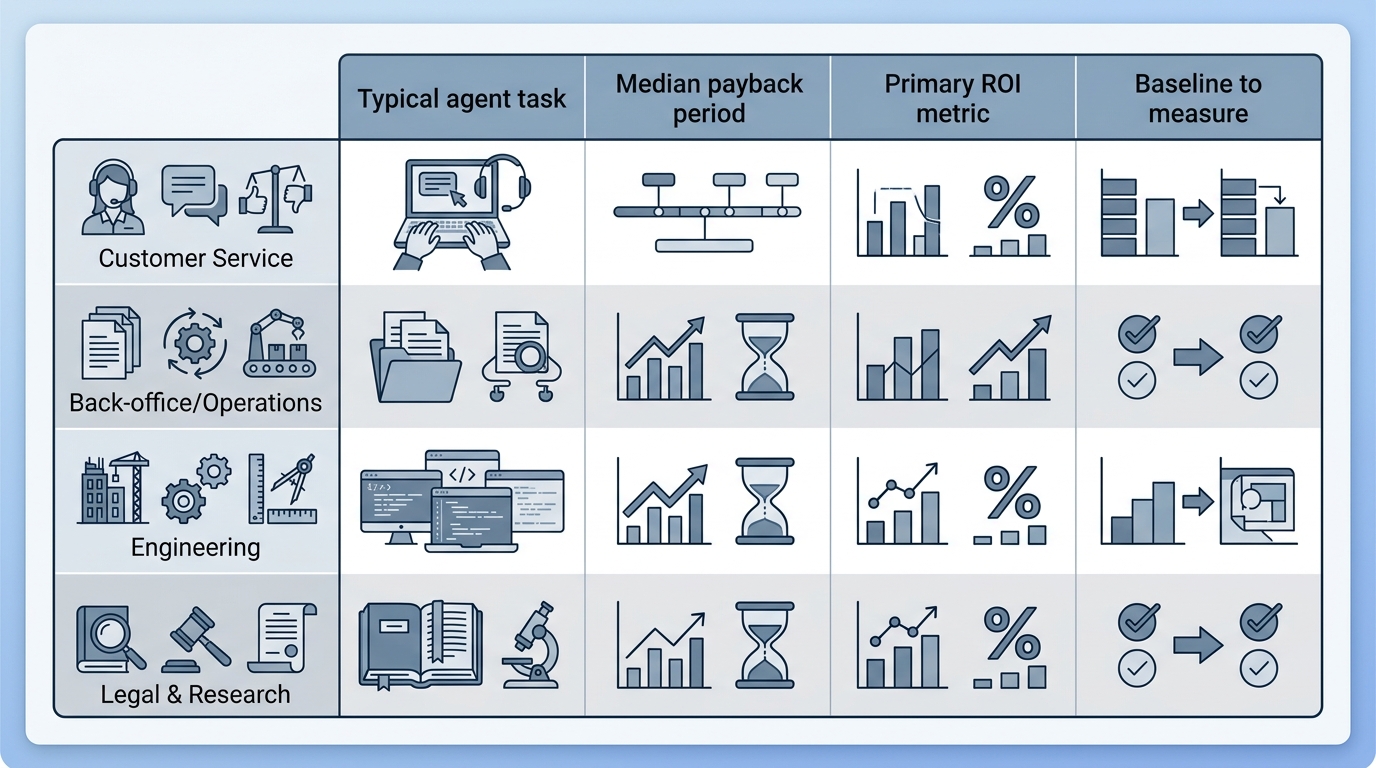
Key insight — Back-office agents cut routine handling time by 60% to 80%. Customer-service agents resolve tickets at roughly 9x lower cost than a human agent. Engineering agents offer the deepest savings but the longest payback.
The median payback periods reported in 2026 tell the story. Customer service comes in around 4.1 months. Back-office and operations follow closely. Engineering lands closer to 9.3 months. Legal and research synthesis land somewhere in between. Treat these as medians from industry surveys, not promises for your specific environment.
Choose use cases that are high-volume, repetitive, and already measurable. The classic targets are invoice handling, claims triage, ticket deflection, contract review, research synthesis, and code review. Each of these has a baseline you can capture today — which means each has a payoff you can defend to the CFO.
Instrument for ROI from Day One
A production agent without observability is a cost you cannot see. Instrument before you scale, not after.
Track the fundamentals at the transaction level: task success rate, throughput, latency, and cost per completed task. Add quality signals such as hallucination rate and error-recovery rate. Together these tell you whether the agent is getting the job done at the price you planned.
One metric deserves special attention. Effective Context Utilization (ECU) combines task success, accuracy, and cost into a single view. It flags agents that are spending too much per successful outcome. When ECU drops, you are probably over-provisioning — a faster or smaller model might do the same job for less. Think of it as a budget-aware signal, not an absolute quality score.
Do not just watch aggregate numbers. Run full execution-trace analysis on a sample. Look at the request, the agent's plan, the tool calls it made, the context it retrieved, and the final result. This is where hidden quality problems — and hidden cost — actually live.
Set up continuous monitoring once you are in production. Then re-evaluate the whole thing quarterly.
Put Guardrails Where ROI Leaks
Governance is not a compliance afterthought. It is a direct line item in your ROI math.
Here is the ugly arithmetic: only 41% of agent deployments keep a positive ROI through the first year, and roughly 19% never reach payback at all. The culprits are evaluation drift, governance gaps, and unmeasured rework. Every incident, every piece of shadow AI, every low-quality output is money leaking out of the business case.
Low-quality AI output has a name now: workslop. It costs an estimated $186 per employee per month in lost productivity, because people have to find and fix it. That is a real, line-item cost. Guardrails reduce that rework.
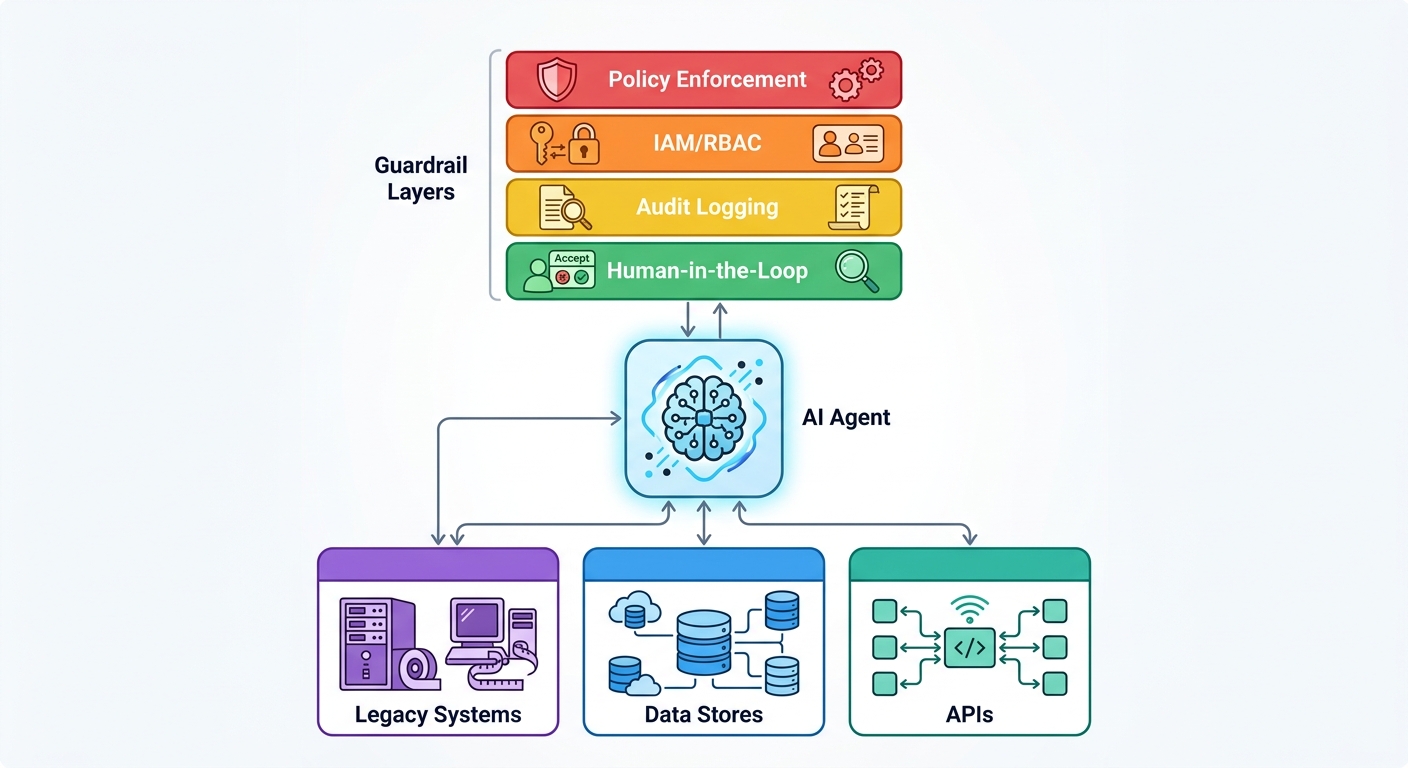
At minimum, put these controls in place:
- Data protection — keep proprietary data out of third-party training; encrypt at rest and in transit
- Identity and access — give each agent a unique identity and apply least privilege, instead of sharing human credentials
- Policy enforcement — limit what agents may do, such as financial approvals that require human sign-off
- Sandboxing — isolate agents so a misconfigured one cannot reach other infrastructure
- Audit logging — log every agent action and wire it into your SIEM
- Human-in-the-loop — keep humans reviewing high-risk or ambiguous decisions
Each of these maps to money. Fewer incidents. Less rework. Faster recovery. Those are ROI protections, not overhead.
Build for Orchestration, Not One-Off Pilots
A single agent is a pilot. A system of coordinated agents is a product.
Isolated agents rarely compound. They run in their own corners, duplicating effort and missing the leverage of shared context. Orchestration compounds returns across multiple agents. When agents coordinate and share state, the returns multiply instead of adding up one-by-one.
AI harnesses are the practical way to get here. A harness coordinates multiple agents and applies the guardrails we just talked about at the transaction level — deciding which agent runs, what it may touch, and what gets logged.
Architecture choice also shifts your time-to-value. Vendor-deployed agents tend to reach positive ROI about 2.4x faster than custom builds, with an average 38 days to first value versus 94 days for in-house development. That difference matters if speed to payback is your priority. Custom builds still make sense when you need deep integration, control, or differentiation — just price in the extra time.
Think of your agent portfolio the way a fund manager thinks about risk. Roughly 70% should go to proven workflows, 20% to expansion into adjacent processes, and 10% to experimental bets. That structure keeps ROI compounding without betting the whole budget on an unproven idea.
Re-Measure, Re-Baseline, Report
ROI is not a one-time calculation. It decays.
Evaluation drift creeps in and erodes agent ROI as models change, data shifts, and processes evolve. The agent that looked profitable in month three can look like a loss by month nine. The only defense is a steady cadence.
Recompute your numbers quarterly after the first 90 days. Watch the same dashboards a CFO would: financial, productivity, adoption, and governance KPIs in one view. Adoption tells its own story — track weekly active users and six-month retention, not just raw usage spikes.
Keep your escalation paths healthy. A well-placed human review at a high-risk step protects quality without erasing the automation gains. The goal is not zero human involvement. It is the right amount, in the right places, so the automation that remains is the profitable part.
From Pilot to Payback, Step by Step
If you are starting fresh, here is the whole playbook as a checklist:
- Baseline. Measure the process for 30–60 days before building.
- Pick a fast-payback use case. Start where volume is high and the baseline already exists.
- Instrument. Wire observability before scale, and track cost per task.
- Guard. Apply the ten controls where they protect specific ROI line items.
- Orchestrate. Connect agents into a system so returns compound.
- Re-measure. Recompute quarterly and watch for evaluation drift.
The honest benchmark is sobering. Today only 5% to 8% of enterprises report measurable, at-scale financial returns from AI, even though adoption is near-universal. The organizations that clear that bar do not have better models. They have a process — one that treats ROI as something you build and maintain, step by step, on purpose.
The pilots were never the hard part. The discipline after them is. Get that right, and your next pilot becomes your first production win.
If you are building agents that need to prove their value, the Algorithmine portal bundles practical guides on agent architecture, observability, and governance — worth a follow so you do not miss the next playbook.