Building Enterprise-Grade AI Agents That Actually Ship: A 2026 ROI-First Blueprint
A 2026 ROI-first blueprint for shipping enterprise AI agents to production: architecture, total cost of ownership, guardrails, and a 90-day rollout plan.
What "Enterprise-Grade" Actually Means in 2026
Every team can build a demo. Few can ship a system that holds up in production. Enterprise AI agents deliver measurable value only when discipline leads the way. The gap is rarely the model. It is operational rigor.
Enterprise-grade means more than a clever model. It means reliability, security, auditability, and cost control. These four properties decide whether an AI agent becomes a daily workhorse or a retired experiment. From my work on production agent systems, the teams that succeed treat these as design constraints, not afterthoughts.
The core shift in 2026 — the industry is moving from pilot theater to production economics. Leaders no longer ask "what can an agent do?" They ask "what can an agent do dependably, at a known cost, within our guardrails?"
From Chatbot to Agent: A Quick Framing
The word "agent" gets thrown around loosely. Let me define it clearly.
An AI agent combines a language model with tools, memory, and a loop that works toward a goal. A chatbot answers questions. An agent takes actions and iterates until the task completes.
The difference shapes how you design, test, and pay for the system. In enterprise use, scope and control matter more than raw capability.
The ROI-First Mindset: Why Most Pilots Fail to Ship
Most agent pilots stall. The reasons are rarely technical. Failure of agent pilots stems from undefined value and weak operations. Pilots fail because the value was never defined upfront.
A pilot is not a goal. A goal is a bounded task with a baseline and a target. Without all three, there is no way to declare success. Teams build, demos impress, budgets run out, and nothing ships.
The ROI-first mindset reverses this. You define the value before you write a line of code. You pick one task. You measure today's cost and quality. You set a target and a payback period.
This small shift changes everything downstream. It forces sharp scoping. It makes evaluation concrete. It gives finance a story they can approve.
The pattern behind dead pilots — undefined value plus weak operations, not hard technology. When you anchor every decision to a measurable outcome, the path to production becomes visible.
The most common failure is scope creep dressed as ambition. Teams start with one agent and end up with an unmanaged platform. Everything becomes everyone's problem, and nothing ships.
The 2026 Production Architecture Blueprint
A reliable agent system needs more than a model. It needs structure. Production agent architecture combines orchestration, memory, guardrails, and observability. Here is a reference architecture that works in production.
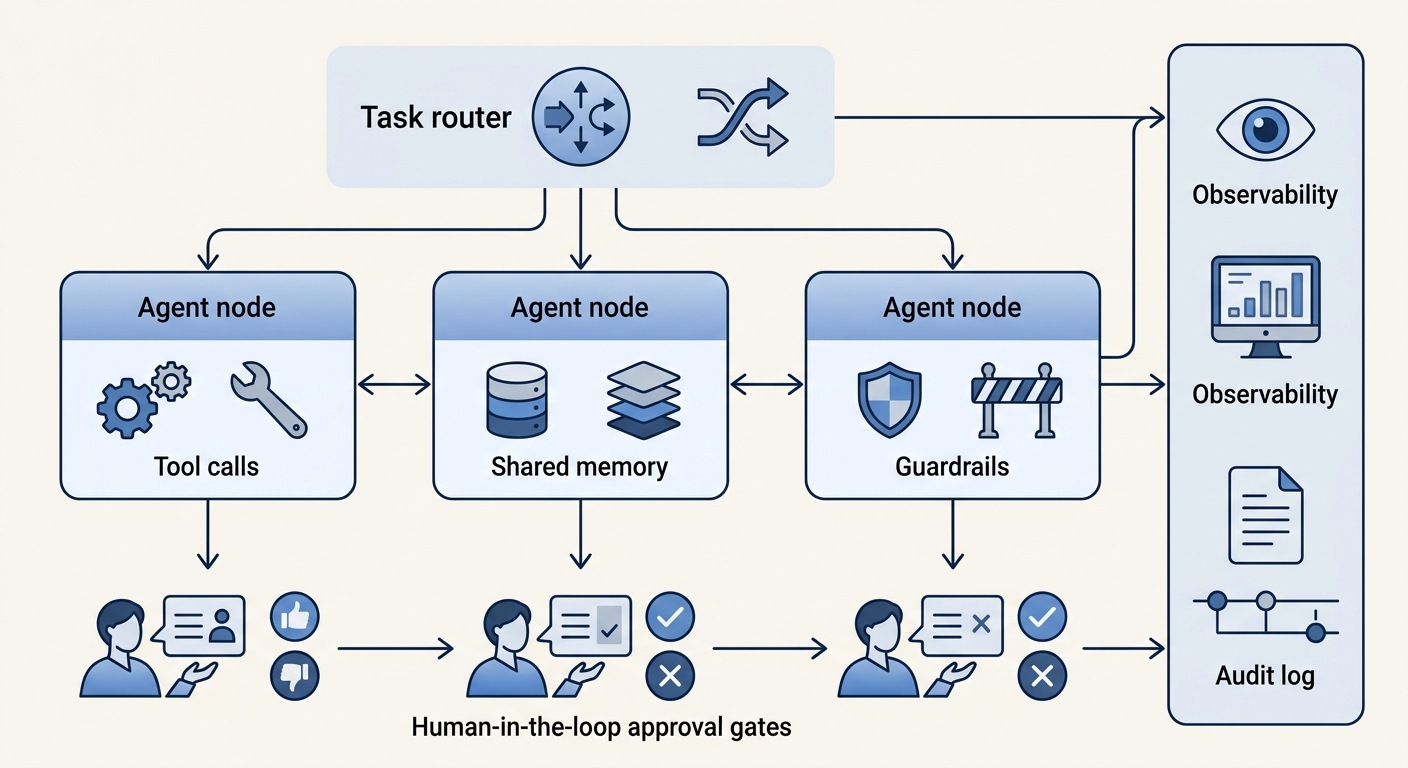
The orchestration layer sits on top. It receives a task, routes it to the right agent, and tracks progress. It is the single control point for policy, retries, and timeouts.
Below it sit the agents themselves. Each agent is scoped to one domain. Narrow scope improves reliability. A focused agent makes fewer mistakes than a jack-of-all-trades.
Shared memory lets agents pass context without re-explaining everything. It reduces token waste and keeps long workflows coherent.
Guardrails sit between the model and the outside world. They validate inputs, enforce permissions, and block unsafe actions before they happen.
Observability and audit logging run alongside everything. Every step is recorded. Every decision can be replayed and inspected. This is not optional when the system touches customer data.
Tools and Contracts That Keep Agents Honest
Agents act through typed tool contracts, not free text. A tool is a controlled interface to an API, database, or internal system.
Structured contracts make behavior predictable. The model can only call allowed operations with validated arguments. This eliminates a whole class of unpredictable behavior.
Error handling matters as much as the happy path. Every tool call needs retries, timeouts, and a fallback. A robust agent fails cleanly and reports the failure instead of improvising.
A Cost Model That Survives Contact with Finance
Tokens are the visible cost. They are not the whole story. Total cost of ownership includes tokens, evaluation, security, and maintenance. A production budget has many line items.
Evaluation costs come from building test sets and running regressions. Security costs come from permissions, isolation, and review. Maintenance costs come from model updates and prompt tuning. Governance costs come from audits and compliance work.
The number finance actually cares about is cost per completed task. This unifies all line items into a single figure. It lets you compare an agent against the human or legacy process it replaces.
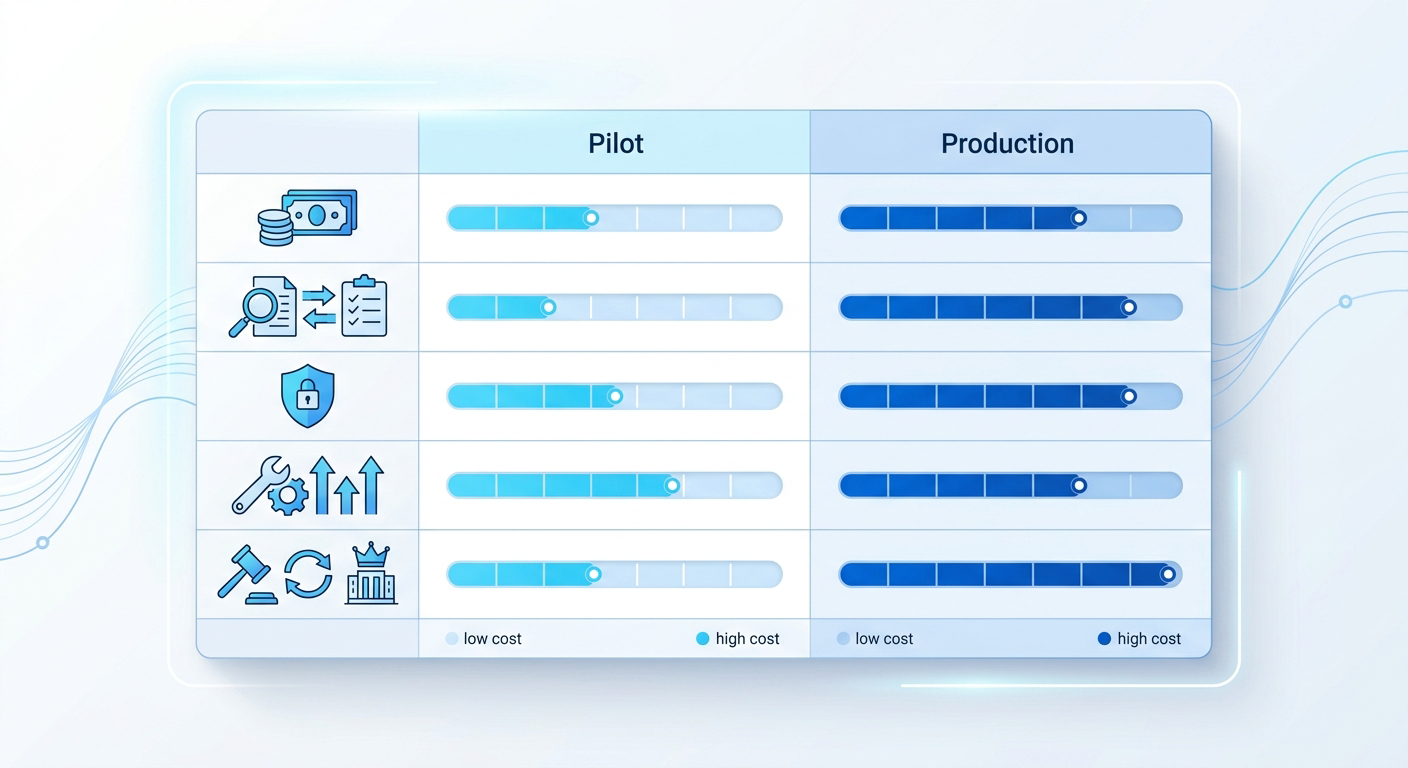
Pilot cost and production cost differ sharply. In a pilot, you skip half these line items. In production, they all arrive. Budget accordingly, or the surprise will be unpleasant.
Cost reality check — token spend is often a minority of the true total. Evaluation, security, and governance typically dominate as a system matures. Plan for the whole figure, not the headline.
Quality, Guardrails, and Security: The Non-Negotiables
Trust is earned through testing. AI agent quality depends on continuous evaluation and regression testing. An enterprise agent needs a testing doctrine before it ships.
Start with a golden set of tasks with known-good outputs. Add trajectory evaluation, which checks how the agent reached an answer, not just the answer itself. Then add regression testing to catch drift after model updates.
AI agent security is about boundaries. Grant the least privilege needed. Isolate data so one agent cannot reach another's context. Log every action for audit.
Human-in-the-loop gates ensure accountability and compliance. High-risk actions require human approval before execution. This is not a limitation. It is a feature that lets you scale with confidence.
For compliance-heavy industries, the audit trail is the product. If you cannot show exactly what an agent did and why, you cannot defend the system to a regulator.
A Practical 90-Day Ship Plan
Theory only helps when it becomes a plan. Teams ship agents by starting small and expanding with proven unit economics. Here is a rollout path that works.
Days 1-10: Pick one high-value, low-risk task. Measure today's baseline cost and quality. Define the target and payback period.
Days 11-30: Build a narrow agent for that single task. Add guardrails, observability, and human review from day one. Run it on real but contained data.
Days 31-60: Put a human in the loop for every action. Measure cost per completed task against your baseline. Fix accuracy, latency, and failure paths.
Days 61-90: Expand task by task as each proves its unit economics. Scale only what earns its seat. Keep the review gates until confidence is real.
This sequence ships value early and de-risks expansion. It turns an abstract initiative into a repeatable operating model.
The 90-day principle — start small, prove unit economics, then expand. Teams that ship agents do not boil the ocean. They win one task at a time and compound.
Conclusion: Ship Something That Earns Its Seat
The goal is not to build impressive agents. It is to build agents that earn their place in the workflow. ROI comes before flash.
Define the value. Build with guardrails. Measure honestly. Expand patiently. That sequence turns a promising demo into a production system your team actually depends on.
I write practical guides like this every week. If you want more field-tested advice on shipping AI that works, subscribe — new insights land in your inbox, not your spam folder.
Enterprise AI agents deliver real value when discipline leads and hype follows. Start with one task, prove the economics, and let the results sell the rest of the roadmap.