MLflow vs Vertex AI vs SageMaker: The Definitive 2026 Enterprise Comparison
A practical comparison of MLflow, Vertex AI, and SageMaker for enterprise ML — covering features, GenAI readiness, TCO, governance, and platform selection guidance for 2026.
Meta description: A practical comparison of MLflow, Vertex AI, and SageMaker for enterprise ML — covering features, GenAI readiness, TCO, governance, and platform selection guidance for 2026.
The machine learning platform you choose in 2026 will shape your team's velocity, cost structure, and GenAI readiness for the next three to five years. Three platforms dominate enterprise evaluations: MLflow, the open-source standard; Google Cloud Vertex AI, the GCP-native powerhouse; and AWS SageMaker, the most comprehensive managed MLOps suite on the market.
These aren't just tooling choices. They're architectural commitments that determine how fast you ship models, how much you pay at scale, and how easily you can pivot when the next platform wave arrives. This article cuts through the marketing to give you a practical comparison built for ML engineering leaders making real decisions.
Understanding the Three Platforms — Architecture and Philosophy
Before comparing features, it helps to understand what each platform is actually designed to do.
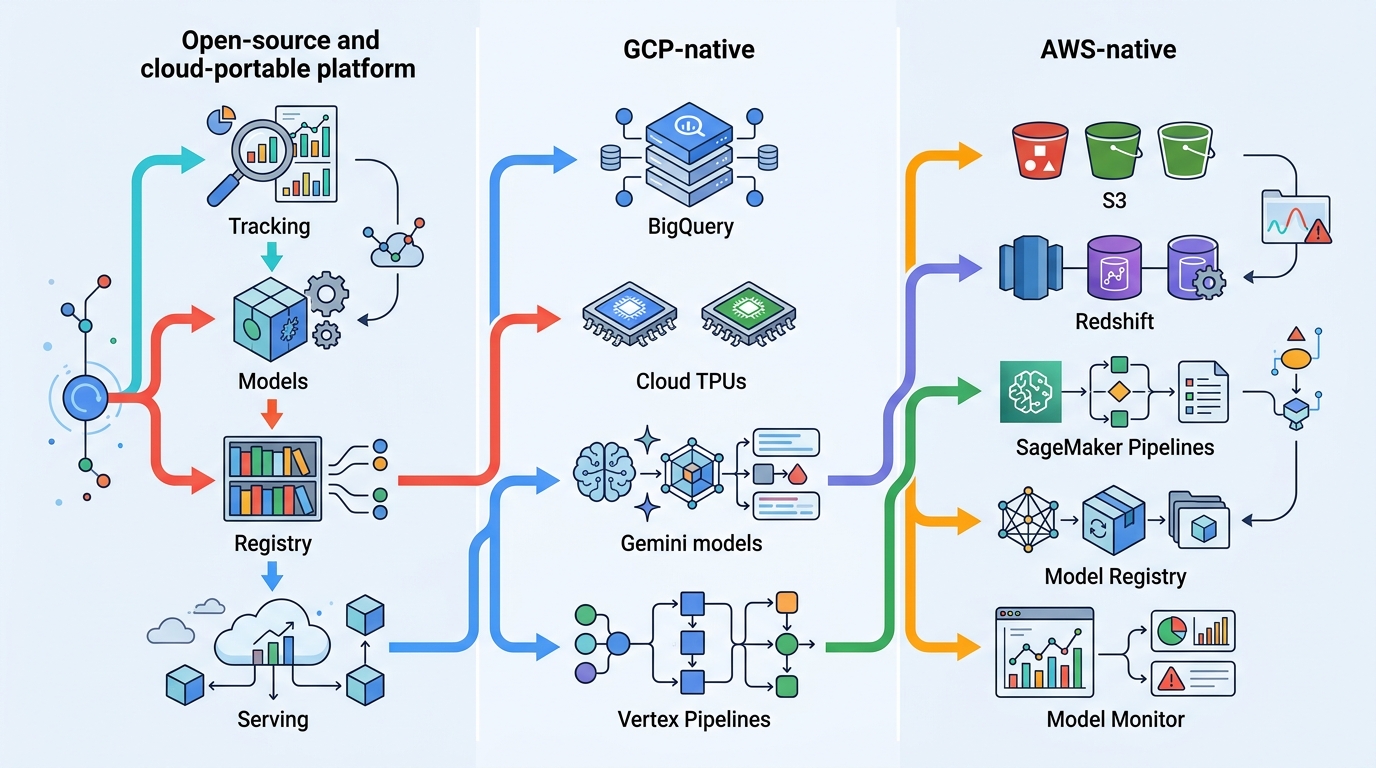
MLflow is an open-source, modular MLOps platform with four core components: Tracking (experiment logging), Models (model packaging and inference), Registry (model versioning and lifecycle management), and Serving (lightweight model deployment). It runs anywhere — on-premises, in AWS, in GCP, in Azure, or on a laptop. The philosophy is "portable infrastructure layer," not "full managed service." It solves the experiment tracking problem better than anything else in the ecosystem and leaves pipeline orchestration, compute provisioning, and governance to you or your other tools.
Vertex AI is Google Cloud's unified ML platform. It covers the full ML lifecycle: data preparation with BigQuery, training (including TPU support), AutoML, pipeline orchestration with Vertex AI Pipelines, managed inference endpoints, and monitoring. The philosophy is "everything Google learned about AI, delivered as a managed service." Gemini model access, grounding with Google Search, and Vertex AI Agent Builder make it the strongest option for teams building LLM-powered applications on GCP.
SageMaker is AWS's comprehensive ML platform. It provides the broadest built-in algorithm library, SageMaker Pipelines for orchestration, SageMaker Model Registry with approval workflows, SageMaker Model Monitor for production drift detection, and deep integration with S3, Redshift, Lake Formation, and the broader AWS ecosystem. The philosophy is "AWS-first enterprise MLOps with maximum managed coverage." It is the most mature platform for regulated industries that need deep audit trails and governance controls.
Feature-for-Feature Comparison
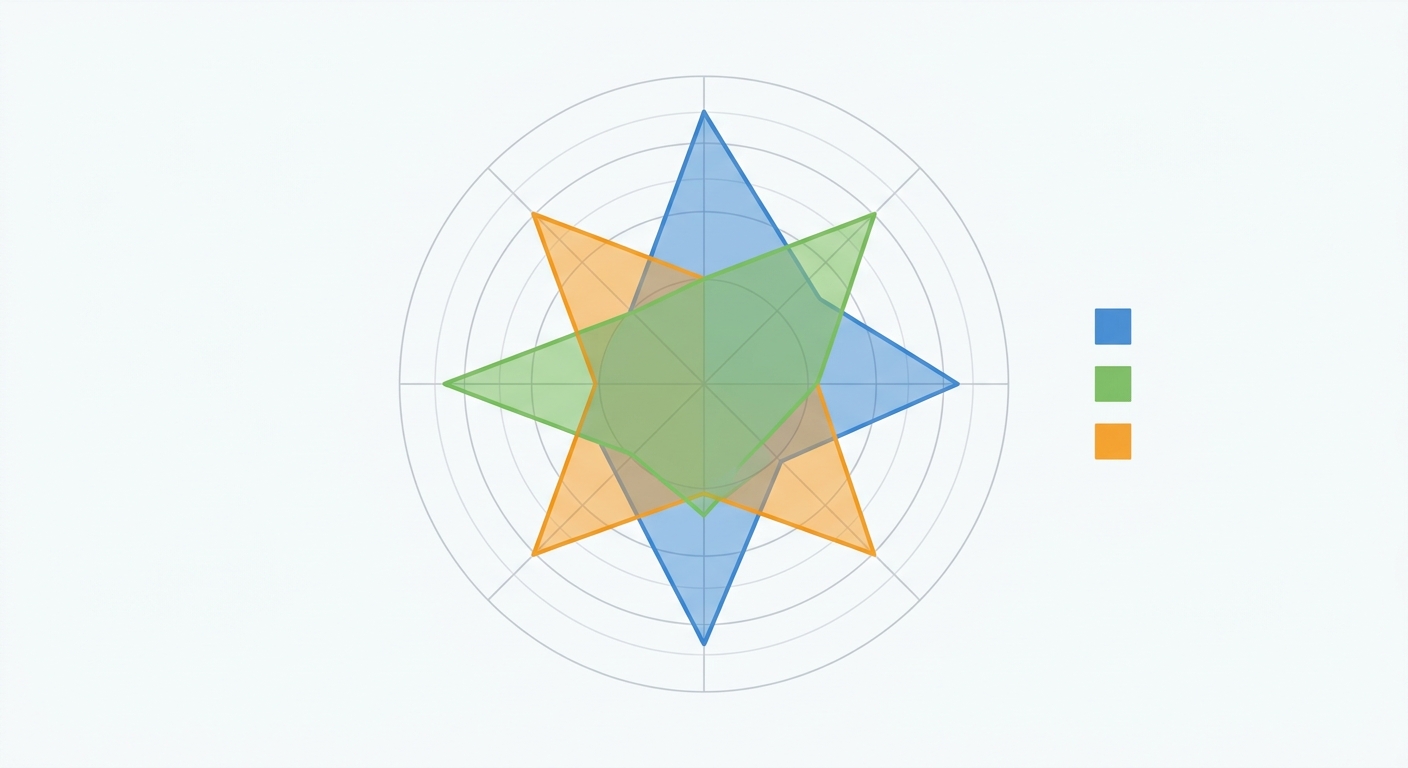
The table below captures how each platform rates across the eight dimensions that matter most for enterprise ML teams in 2026.
| Capability | MLflow | Vertex AI | SageMaker |
|---|---|---|---|
| Experiment Tracking | ★★★★★ | ★★★★☆ | ★★★★☆ |
| Model Registry | ★★★★★ | ★★★★☆ | ★★★★★ |
| AutoML | ★★☆☆☆ | ★★★★★ | ★★★★☆ |
| GenAI / LLMOps | ★★★☆☆ | ★★★★★ | ★★★★☆ |
| Pipeline Orchestration | ★★☆☆☆ | ★★★★☆ | ★★★★★ |
| Model Serving | ★★★☆☆ | ★★★★☆ | ★★★★★ |
| Monitoring | ★★☆☆☆ | ★★★★☆ | ★★★★★ |
| Governance / Audit | ★★☆☆☆ | ★★★★☆ | ★★★★★ |
Key reading: MLflow leads on the two capabilities it was purpose-built for — tracking and registry. SageMaker leads on governance and pipeline orchestration. Vertex AI leads on AutoML and GenAI capabilities. The gaps in MLflow's matrix are where you need complementary tools.
Experiment Tracking and Model Registry — Core Capabilities
Experiment tracking is where MLflow's dominance is most undeniable. It is the de facto standard for logging parameters, metrics, and artifacts across any ML framework — TensorFlow, PyTorch, scikit-learn, XGBoost, and others. Its open format means you can query experiments from any tool, export to any system, and never worry about vendor lock-in on your experiment data. The MLflow Tracking Server can be self-hosted or used via managed providers like Databricks.
Vertex AI Experiments provides a managed alternative that is compatible with the MLflow tracking API — you can point existing MLflow code at Vertex AI and migrate gradually. Vertex ML Metadata extends this with lineage tracking that connects data inputs to model outputs, which matters for compliance documentation.
SageMaker Experiments integrates tightly with SageMaker training jobs and Pipelines. Its strength is automatic logging — you don't have to instrument code explicitly for most training scenarios. Lineage is automatically captured as part of the SageMaker Pipeline execution history, which regulators find useful.
On model registry capabilities, MLflow's open registry is simple and effective: stage transitions (Staging → Production → Archived), model versioning, and metadata attachments. It lacks approval workflows out of the box, though you can build them with webhooks or external tooling.
Vertex AI Model Registry supports versioning and deployment to endpoints but with less explicit staging workflow support compared to SageMaker. It works well in GCP-native workflows but feels less mature as a standalone registry.
SageMaker Model Registry is the most enterprise-grade: staged model promotion (Staging → Production with optional approval), integration with SageMaker Pipelines for automated model quality gates, and fine-grained IAM permissions per model version. This is the platform's strongest differentiator for regulated industries.
Generative AI and LLMOps — The New Decision Driver
This is where the 2026 comparison diverges most sharply from previous years. Generative AI workloads weren't a factor in enterprise ML platform decisions two years ago. Now they are often the primary factor.
MLflow 3.0 introduced dedicated GenAI support that addresses this new reality. Key capabilities include logging GenAI application behavior (prompt/response pairs, token usage, latency), tracking human feedback on model outputs, and integrating LLM-judge scores for automated evaluation. The MLflow AI Gateway provides a unified API layer for multiple LLM providers (OpenAI, Anthropic, self-hosted). The MLflow.evaluate() function now supports RAG pipeline evaluation with built-in metrics like answer relevance and faithfulness.
The important caveat: MLflow is a tracking and evaluation layer, not an LLM runtime. You still need somewhere to serve the models. For teams building custom LLM infrastructure on top of open-source models, MLflow 3.0 provides the observability layer the ecosystem lacked.
Vertex AI has the strongest LLM story of the three platforms. Gemini 2.0 Flash is directly accessible as a managed API with competitive per-token pricing. Vertex AI Agent Builder provides a low-code interface for building RAG and agentic workflows. Grounding with Google Search lets you reduce hallucination in production RAG systems. The Vertex AI Tuning service supports fine-tuning frontier models without managing training infrastructure. For teams building on GCP, this is the most integrated path to production LLMs.
SageMaker takes a split approach. SageMaker JumpStart provides access to foundation models including Llama, Mistral, and Cohere variants, deployable to managed endpoints. Amazon Bedrock, a separate but complementary AWS service, provides API access to additional foundation models from Anthropic, Meta, AI21, and others — many customers use Bedrock for API-based LLM access and SageMaker for fine-tuned or custom model deployment. The two services are intentionally differentiated; the integration between them is improving.
For LLM-specific operational tooling (evals, tracing, prompt management), SageMaker is catching up but trails Vertex AI's end-to-end story. SageMaker Pipelines can incorporate LLM evaluation steps, but the native evaluation frameworks are less polished than Vertex AI's.
Cost and TCO — The Hidden Reality
Pricing pages never tell the full story. Here's what actually drives costs at each platform.
MLflow is free as open-source software. The real cost is infrastructure (compute for the Tracking Server, model serving endpoints, and any additional tooling you pair with it) and the ops engineering time to maintain the system. Self-hosting MLflow on a Kubernetes cluster with three replicas, object storage for artifacts, and a managed database for metadata typically runs $2,000–$8,000 per month for a mid-sized team, depending on volume. Databricks MLflow adds a platform fee but bundles it with a collaborative workspace, notebook environment, and cluster management. This can be cost-effective or expensive depending on usage — Databricks pricing is complex.
Vertex AI pricing has two main components: training compute and inference endpoints. Training on CPUs or GPUs (NVIDIA A100 or TPU v5p) is billed per second with a one-minute minimum. A100 training on Vertex AI typically runs approximately $3–4 per GPU-hour; TPU v5p pods are more cost-effective for large-scale training but require specific model architectures to benefit. Inference via Vertex AI Endpoints is priced per token for Gemini APIs or per endpoint-hour for custom model serving (approximately $0.10–0.40 per endpoint-hour depending on instance type). The hidden cost is idle endpoint time — endpoints must be running to receive requests, and startup times can be 5-10 minutes cold. Many teams keep endpoints running continuously and pay for idle compute.
The idle endpoint problem — Organizations routinely overspend on Vertex AI by deploying separate endpoints per model variant and leaving them running 24/7. A single production system with five model variants can easily run $3,000–$6,000 per month in endpoint costs alone, regardless of actual request volume.
SageMaker follows a similar pattern with training instances and managed endpoints. SageMaker training is billed by the second with a 60-second minimum. Managed inference endpoints are priced per-second starting around $0.10 per hour for small instances, scaling up significantly for GPU-based endpoints. The cost stacking risk is real: when you add SageMaker Pipelines (orchestration), SageMaker Model Monitor (drift detection), SageMaker Feature Store, and SageMaker Clarify (bias detection), the base cost can approach $1,000–$3,000 per month before training and inference compute.
A practical TCO framework by team size:
-
Small team (fewer than 5 ML engineers): MLflow + a single cloud provider's managed serving. Total cost: $500–3,000/month for a small but growing team. MLflow handles experiment tracking; cloud-managed endpoints handle serving.
-
Mid-size team (5–20 ML engineers): Evaluate Databricks MLflow (if already on Databricks) or Vertex AI (for GCP/Gemini-heavy workloads). Budget $5,000–15,000/month for platform infrastructure at this scale.
-
Large enterprise (20+ ML engineers): Full managed platform — SageMaker or Vertex AI — with dedicated MLOps engineering. Platform costs of $20,000–100,000+ per month are realistic at this scale, justified by governance requirements and team productivity gains.
Governance, Security, and Enterprise Readiness
For regulated industries, platform governance capabilities are often the deciding factor — features and pricing become secondary.
MLflow standalone provides model versioning and stage management, but project isolation, fine-grained access control, and audit trails are not built in. You can log who registered a model and when, but you cannot enforce that a model cannot move to Production without approval from a specific role. Enterprises in finance or healthcare typically wrap MLflow with external governance layers (LDAP integration, ticketing systems for approval workflows, external audit logging). This is workable but requires engineering investment.
Vertex AI on Google Cloud offers strong IAM integration with organization policies, VPC Service Controls for data exfiltration prevention, Binary Authorization for ML model signing, and Cloud Audit Logs for comprehensive activity tracking. Compliance certifications include HIPAA (with BAA), SOC 2, and FedRAMP Moderate (for specific managed services). Data residency options are available per region. The governance story is solid and improving rapidly, but some regulated industries still prefer SageMaker's mature audit trail tooling for financial services use cases.
SageMaker has the most mature governance story of the three. SageMaker Projects provide templated MLOps environments with mandatory code review gates and automated pipeline execution. SageMaker Model Registry enforces staged promotion with mandatory approver roles. SageMaker Pipelines capture complete lineage from data input to deployed model. Audit logs are exported to AWS CloudTrail automatically. The platform carries SOC 2 Type II, HIPAA, GDPR, and FedRAMP High certifications. For financial services, pharmaceutical, and government ML deployments where auditability is non-negotiable, SageMaker is the established choice.
For regulated industries — Finance and insurance organizations with existing SEC or FINRA audit requirements should prioritize SageMaker's mature lineage tracking and approval workflows. Healthcare organizations focused on data residency and HIPAA compliance should evaluate Vertex AI's regional deployment options alongside SageMaker's HIPAA Business Associate Agreement coverage. Government deployments should default to SageMaker FedRAMP High or private Vertex AI deployments.
Integration Ecosystem and Lock-in Risk
MLflow is the most portable platform in this comparison, by design. The MLflow tracking server runs on any infrastructure. Model artifacts are stored in a format any serving infrastructure can consume. MLflow integrations exist for SageMaker (via the SageMaker MLflow estimator), Vertex AI (via Vertex AI's MLflow compatibility mode), Azure ML, and most other ML platforms. If portability is a strategic priority — and for many enterprises it increasingly is — MLflow provides the experiment tracking foundation without creating new lock-in.
Vertex AI integrates most naturally with the Google Cloud data stack: BigQuery for data warehousing, Cloud Storage for artifact storage, Bigtable for high-throughput feature serving, and Cloud Dataflow for preprocessing pipelines. These integrations reduce integration overhead significantly for GCP-native organizations but make it costly to migrate away. Moving a Vertex AI-based ML system to AWS means rearchitecting data pipelines from scratch.
SageMaker is similarly deep with AWS services: S3 for storage, Redshift for data warehousing, Lake Formation for data governance, DynamoDB for feature storage, and EKS for container orchestration. For organizations with large existing AWS infrastructure investments, SageMaker's integration depth is a feature, not a risk. The lock-in calculus depends on how much of your data infrastructure is already AWS-native.
The practical pattern emerging in 2026 is hybrid by design: enterprises use MLflow as the portable experiment tracking layer that spans multiple cloud providers, paired with SageMaker for AWS workloads and Vertex AI for GCP/LLM-heavy workloads. This approach captures best-of-breed capabilities while MLflow provides portability at the tracking and registry layer.
The Verdict — Choosing the Right Platform for Your Context
After comparing these platforms across features, GenAI readiness, cost, governance, and integration depth, the right choice depends on your specific context.
Choose MLflow (self-managed or via Databricks) if portability is paramount, your ML team is fewer than 10 engineers, you have existing serving infrastructure or plan to use a separate managed serving layer, and your budget constraints make free open-source software attractive. The key failure mode to avoid is underestimating the ops overhead of self-management — MLflow's low software cost can be offset by significant engineering time.
Choose Vertex AI if your organization is GCP-native, you are building LLM-powered applications and want tight Gemini integration, your team uses BigQuery for analytics, you want access to Cloud TPUs for large-scale training, or your organization already has Google Cloud infrastructure that would make migration expensive anyway.
Choose SageMaker if your organization is AWS-native, you operate in a regulated industry requiring mature audit trails and approval workflows, you need the most comprehensive managed MLOps suite available, your team is larger and you want to minimize operational complexity, or you have significant existing AWS infrastructure that would be expensive to replicate elsewhere.
Multi-cloud reality: Most enterprises in 2026 are not choosing one platform exclusively. The most common pattern is MLflow for experiment tracking portability plus one managed platform per cloud provider used in production. If you are building on both AWS and GCP, MLflow as the portable layer across both is a legitimate and increasingly common architecture.
The platform that is "best" overall is the wrong question. The right question is: which platform best fits your cloud priorities, team size, regulatory environment, and GenAI ambitions? Use this comparison to answer that question for your specific context — and revisit the decision when your team doubles in size or your GenAI workloads become the majority of your ML compute budget.
Expert Q&A
Q: We already use Databricks. Should we use Databricks MLflow or standalone MLflow?
A: Databricks MLflow is the better choice for most Databricks users. It is included in the platform, runs on managed infrastructure, and integrates natively with Databricks notebooks, jobs, and the Unity Catalog for governance. The main reason to use standalone MLflow instead is if you need to track experiments across multiple cloud providers from a single tracking server — Databricks MLflow is tied to the Databricks workspace. If your organization is already all-in on Databricks, the managed MLflow experience is superior to self-hosting.
Q: What's the most common mistake teams make when migrating from one platform to another?
A: Underestimating the data pipeline dependency. Most migration failures happen not because the new platform can't run training jobs, but because the data lives in a cloud-specific store that the new platform can't access efficiently. Moving a SageMaker system to Vertex AI means moving data from S3 to GCS or building cross-cloud data bridges. Before evaluating platform migration, audit your data storage — S3, Redshift, BigQuery, Snowflake — and factor that into your migration cost estimate. Platform migration is often a data architecture project first and a model deployment project second.
Q: Can we use MLflow alongside SageMaker or Vertex AI rather than choosing just one?
A: Yes, and this is the most common pattern for mid-to-large enterprises. MLflow Tracking Server runs in parallel with managed platforms — your data science team logs experiments to MLflow regardless of where training actually runs. SageMaker or Vertex AI training jobs can emit metrics to both their native experiment services and to MLflow simultaneously. This gives you portability (MLflow as the consistent experiment layer) and managed infrastructure (the cloud platform handles compute and deployment). The operational complexity is higher than using a single platform, but the flexibility benefit often justifies it for organizations with multi-cloud strategies.
Q: For a team just starting with MLOps, which platform should they start with?
A: Start with MLflow (self-hosted or Databricks) if your team is small (1–3 ML engineers), you are building traditional ML models (not GenAI-first), you want to learn MLOps concepts without platform lock-in, and budget is constrained. MLflow's experiment tracking and model registry teach the fundamental MLOps workflows — versioning, staging, lineage — without the operational complexity of a full managed platform. Once your team grows past five engineers or your GenAI workloads demand managed LLM infrastructure, evaluate Databricks MLflow, Vertex AI, or SageMaker based on your cloud provider and specific workload needs.
Q: The article mentions SageMaker and Bedrock as complementary. When would we choose one over the other for LLM workloads on AWS?
A: Choose Bedrock when you want the fastest path to API-based LLM access without managing any infrastructure — Bedrock is fully managed at the model serving layer and provides access to a broad set of foundation models. Choose SageMaker when you need to fine-tune a model on your proprietary data, deploy a model you self-host, or integrate LLM serving deeply into SageMaker Pipelines and MLOps workflows. In practice, many AWS teams use Bedrock for initial LLM prototyping and SageMaker for production workloads that require fine-tuning or more granular control. The two services are not mutually exclusive — an enterprise LLM strategy on AWS typically involves both.
Image URLs
| # | Alt | URL |
|---|---|---|
| 1 | Platform architecture overview — MLflow, Vertex AI, SageMaker comparison | /api/images/5f1b28366cb14128999a2178941082b4 |
| 2 | Radar chart comparison — MLflow vs Vertex AI vs SageMaker across 8 capabilities | /api/images/eb776f41519548e1b964796ca065c518 |
Total: 2 images uploaded