LangGraph vs CrewAI vs OpenAI Agents SDK: Choosing an Agent Framework in 2026
Compare LangGraph, CrewAI, and the OpenAI Agents SDK on control, composition, and operability. A criteria-based framework for choosing your agent stack.
The Framework Decision Is an Architecture Decision
By 2026, the question is no longer whether AI agent frameworks are production-ready. LangGraph, CrewAI, and the OpenAI Agents SDK all run real workloads in regulated, high-volume environments. The real question is which one matches how your team reasons about state, failure, and observability.
That distinction matters because the agent framework you pick shapes more than code style. It determines how explicitly you model control flow, how you trace a failed run at 2 a.m., and how much friction you'll hit when you swap a model provider six months from now. This is an architecture choice, not a popularity contest.
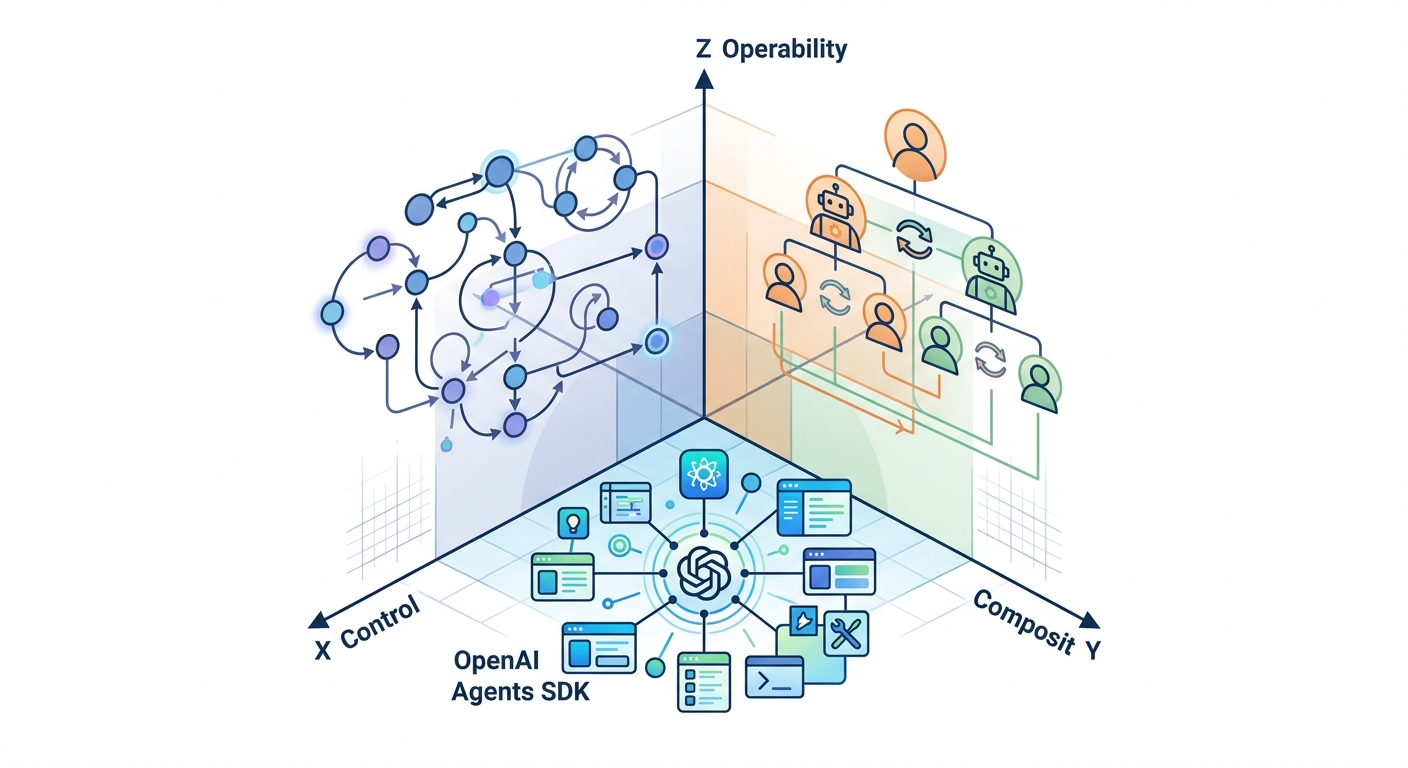
This comparison is written for teams past the prototype stage — you have a working agent, and now you need to decide what carries it into production. We'll evaluate all three frameworks against three axes: control, composition, and operability. No winner is declared. Instead, you get a criteria-based decision framework you can defend in an architecture review. (See also: how to evaluate AI agent frameworks for production)
A note on volatility: these frameworks ship breaking changes on a monthly cadence. Pin versions, read the changelog before you commit, and re-verify the specific APIs cited here against the release you're actually deploying.
The 2026 Agent Framework Landscape
What Changed Since 2024
The frameworks have converged on surface primitives. Tools, handoffs, memory, and guardrails now appear in all three SDKs under different names. Differentiation has shifted away from "who has function calling" toward two harder problems: the orchestration model (how you express flow) and operational maturity (how you debug and deploy it).
This convergence is good news. It means the "which framework is best" debate has been replaced by "which framework fits." The primitives are largely commoditized; the mental model is not. Choosing well now means choosing the abstraction that matches your problem's shape and your team's instincts. (Related: agent orchestration patterns explained)
The Three Evaluation Axes: Control, Composition, and Operability
Every framework trades these off differently, and the tradeoffs are the whole story:
- Control — how explicitly you define execution flow. Low-level frameworks give you a graph or loop you author; high-level ones infer flow from roles and tasks.
- Composition — how agents coordinate. This spans single-agent loops, role-based crews, and explicit multi-node graphs.
- Operability — tracing, deployment, debugging, and cost visibility. The least glamorous axis and the one that bites hardest in production.
LangGraph: Graph-Based Orchestration for Complex State
Architecture and Mental Model
LangGraph models an agent as a state machine. You define nodes (functions that do work), edges (transitions, including conditional ones), and a shared state object threaded through the graph. Cycles are first-class: you can loop, branch, and route based on runtime conditions without fighting the framework.
The mental model is explicit and imperative. If you can draw a flowchart of your agent's behavior, you can build it in LangGraph. That makes it the most transparent of the three — and the most demanding. The framework assumes you want to author control flow, not have it inferred.
Where LangGraph Wins
LangGraph's strength is fine-grained control over long-running, stateful workflows. If your agent needs to pause for human approval, resume days later, and preserve exact state across that gap, the graph model handles it — provided you configure a durable checkpointer backed by persistent storage. Conditional routing and cycles make it a natural fit for iterative research, multi-step approvals, and any workflow where the path isn't known until runtime.
Debugging is also more predictable. Because flow is explicit and state is checkpointed, you can inspect the graph, replay a run node by node from a persisted checkpoint, and pinpoint exactly where state diverged. The orchestration layer is model-agnostic, so swapping providers doesn't force a rewrite of your graph — though tool-calling quality, structured-output reliability, and cost behavior still vary by model and must be re-validated per provider. (See: building stateful agents with LangGraph)
Where LangGraph Costs You
The learning curve is the steepest of the three. Simple tasks that need three lines in a higher-level framework can require dozens of lines of node and edge wiring. Graph design becomes an engineering discipline of its own — you'll spend real time deciding how to decompose state and where to place checkpoints.
For teams without strong platform engineering, that boilerplate is a genuine tax. The framework rewards teams who need the control; it punishes teams who just want a working agent fast.
LangGraph is the right answer when the workflow itself is the hard problem — and the wrong answer when the workflow is trivial and only the model matters.
CrewAI: Role-Based Multi-Agent Collaboration
Architecture and Mental Model
CrewAI organizes agents as a crew of roles. Each agent has a role, a goal, and a backstory; each task has a description and expected output; and agents delegate to one another based on their defined responsibilities. The framework sits one abstraction level above raw orchestration — you describe who does what, and CrewAI figures out the sequencing.
That role-based framing is intuitive for anyone who has managed a team. It maps naturally to research pipelines, content workflows, and any process where collaboration between specialists is the point. You're not drawing a graph; you're staffing a project.
Where CrewAI Wins
Time-to-first-working-crew is CrewAI's killer advantage. Teams new to agents can stand up a functioning multi-agent pipeline in an afternoon, which makes it excellent for prototyping, internal research, and content generation workflows. The mental model is easy to explain to stakeholders who don't write code: "the researcher gathers, the writer drafts, the editor reviews."
CrewAI also supports both a sequential and a hierarchical process model. In hierarchical mode, a manager agent coordinates the crew, which gives you a middle ground between fully inferred sequencing and hand-authored control flow.
Where CrewAI Costs You
The role-based abstraction is a double-edged sword. Because sequencing is partly inferred, debugging a misbehaving crew is harder than debugging an explicit graph: when an agent delegates poorly or a task balloons, the cause can be buried in prompt-level behavior rather than a visible edge. You get less deterministic control over exactly which agent runs when.
Cost and latency are also harder to predict. Free-form delegation between agents can produce more model calls than a tightly authored graph, and multi-agent crews multiply token spend. For high-volume production, budget for observability and per-run cost tracking, not just the happy path. Teams with strict determinism or compliance requirements often find they need finer control than the role model offers.
CrewAI is the right answer when collaboration between specialists is the point and you need a working pipeline this week — and the wrong answer when you need deterministic, auditable control flow.
OpenAI Agents SDK: A Minimal Primitives Layer Around the Model
Architecture and Mental Model
The OpenAI Agents SDK is deliberately small and low-ceremony. Its core primitives are agents (a model plus instructions plus tools), handoffs (transferring control to another agent), and guardrails (input/output validation). Around these sits a runner that executes the agent loop. There is no graph to author and no crew to staff — you compose agents and handoffs, and the runner handles the turn-taking.
The mental model is a loop with handoffs. It's the closest of the three to "just call the model in a loop, but with the boring parts handled." That minimalism is the point: fewer abstractions means less framework to learn and less to fight when your requirements diverge.
Where the OpenAI Agents SDK Wins
The SDK's strength is low friction for single-agent and light multi-agent flows, with first-class tracing built in. Because it is maintained by OpenAI alongside its model APIs, tracing, hosted tools, and structured outputs tend to be tightly integrated and well-documented. If your stack is already OpenAI-centric, the path from prototype to instrumented production is short.
Guardrails are a native primitive rather than an add-on, which matters for teams that need input/output validation as a first-class concern. And the primitive set is small enough that a competent engineer can read the whole surface area in an afternoon — a real advantage for operability.
Where the OpenAI Agents SDK Costs You
The tradeoff is abstraction ceiling. The SDK gives you a loop and handoffs; it does not give you a durable state machine. If you need to pause a run, persist state across days, resume, and replay node by node, you're building that yourself on top of the SDK rather than getting it from the framework. Complex branching and long-running stateful workflows push you toward custom orchestration.
Provider portability is also a consideration. The SDK supports non-OpenAI models through compatible interfaces, but it is optimized around OpenAI's model APIs and hosted tooling; moving to another provider means validating which features (hosted tools, structured outputs, tracing) still behave as expected. Treat it as OpenAI-first with portability as a secondary goal, not a provider-neutral abstraction.
The OpenAI Agents SDK is the right answer when your stack is OpenAI-centric, your flows are single-agent or lightly multi-agent, and you value a small surface area — and the wrong answer when you need durable, replayable, long-running state machines.
Head-to-Head Comparison
| Dimension | LangGraph | CrewAI | OpenAI Agents SDK |
|---|---|---|---|
| Core abstraction | State machine (nodes, edges, shared state) | Crew of roles and tasks | Agents + handoffs + guardrails |
| Control | Highest — explicit, imperative flow | Medium — partly inferred sequencing | Medium-low — loop with handoffs |
| Composition | Explicit multi-node graphs, cycles | Role-based crews (sequential/hierarchical) | Single-agent and handoff chains |
| Durability / resume | Native via checkpointer (needs persistent backend) | Limited; build on top | Build on top |
| Learning curve | Steepest | Lowest | Low |
| Time to first working agent | Slowest | Fastest | Fast |
| Operability / tracing | Strong with LangSmith integration | Improving; budget for custom cost tracking | Strong, tightly integrated tracing |
| Provider portability | Orchestration layer portable; validate per model | Portable; validate per model | OpenAI-first; portability secondary |
| Best fit | Complex, long-running, stateful workflows | Fast multi-agent collaboration pipelines | OpenAI-centric, lower-complexity flows |
The Decision Framework: How to Choose
Don't pick a framework from a feature table. Score your actual workload against the three axes, weighted by what your environment punishes hardest. A defensible rubric:
- Weight the axes for your context. A regulated workflow with human approvals weights control and durability heavily. A content team shipping internal tools weights time-to-first-agent. A platform team standardizing on one vendor weights operability and tracing.
- Score each framework per axis (1–5) against a real task, not a demo. Run the same non-trivial workload — including a failure case — through each candidate.
- Stress the operability axis explicitly. Ask: when this run fails at 2 a.m., what does my on-call engineer see? Can they replay it? Can they attribute cost to a run?
- Test the exit. Estimate the cost of swapping a model provider and of migrating off the framework entirely. Lock-in is an architecture decision too.
Choose by shape of problem
- Choose LangGraph when the workflow is the hard problem: long-running, stateful, human-in-the-loop, or branch-heavy, and you have platform engineering to absorb the learning curve.
- Choose CrewAI when collaboration between specialist agents is the point and you need a working, explainable pipeline fast — and you can tolerate less deterministic control and higher, less predictable token spend.
- Choose the OpenAI Agents SDK when your stack is OpenAI-centric, your flows are single-agent or lightly multi-agent, and you want a small, well-traced surface area over a durable state machine.
Choose none of them (yet) when
Your workflow is a single model call with a couple of tools. A framework adds abstraction you'll pay for in debugging time. Start with the provider's raw API and adopt a framework when orchestration, not the model, becomes the bottleneck.
The through-line: match the abstraction to the problem's shape. LangGraph gives you a flowchart you control. CrewAI gives you a team you staff. The OpenAI Agents SDK gives you a loop you extend. Pick the one whose mental model you can defend in the architecture review — and whose failure modes your on-call engineer can trace at 2 a.m.