CrewAI vs LangGraph vs AutoGen: Choosing Your Agent Framework in 2026
Compare CrewAI, LangGraph, and AutoGen for US teams in 2026. Orchestration, observability, and governance — plus a scenario-based verdict.
The 2026 AI Agent Framework Decision
Multi-agent systems have crossed the line from conference demos to production workloads. In 2026, the question is no longer whether to build AI agents — it's which agent framework will de-risk your next 12–18 months of iteration without forcing a rewrite. That decision now carries real architectural weight: state management, observability, governance, and hiring all hang off it.
The three names that dominate US procurement conversations are CrewAI, LangGraph, and AutoGen. Each has matured substantially since the 2024 hype cycle, and each reflects a fundamentally different mental model of what a multi-agent system is. Picking the wrong one doesn't just cost you developer hours — it shapes how you debug, audit, and scale every workflow you ship.
This article is a decision framework, not a feature dump. We'll compare the three on orchestration control, observability, human-in-the-loop governance, and ecosystem fit — then give you a scenario-based verdict. There is no single winner. There is a right fit for your workflow shape, your compliance posture, and your team's skill set.
A note on precision: these frameworks ship breaking changes quickly. Treat every concrete API detail below as directional, pin your versions, and re-run your evaluation matrix each quarter. Also distinguish two kinds of "determinism": control-flow determinism (who decides the next step — code or a model) and output determinism (whether the model returns the same answer twice). No LLM-backed agent is output-deterministic; the frameworks differ mainly in how much control flow you can pin down.
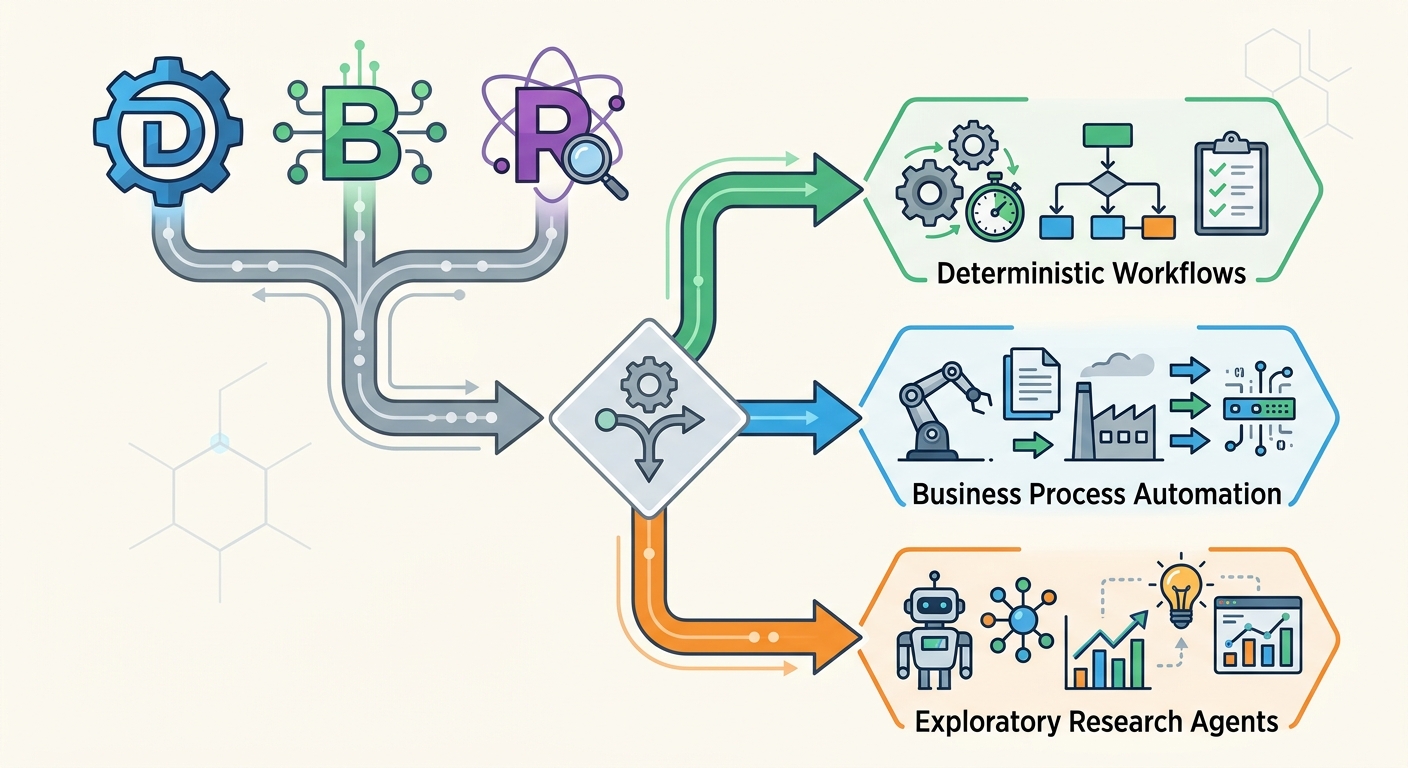
The 2026 AI Agent Framework Landscape at a Glance
What Changed Since the 2024 Hype Cycle
The 2024 conversation was about capability: can AI agents collaborate at all? By 2026, the conversation is about operability. Teams that shipped pilots in 2024 and 2025 are now maintaining them in production, and the pain points are consistent — non-deterministic failures that are hard to reproduce, runaway token costs, and audit trails that don't satisfy compliance. Framework selection has shifted from "what can it do" to "can I run it at 3 a.m. when it breaks."
The Three Contenders and Their Design Philosophies
The real differentiator is the mental model each framework imposes on your team:
- CrewAI — role-based orchestration. You describe agents as team members with roles and goals, and tasks as assignments. The abstraction is a crew.
- LangGraph — graph and state-machine control. You model workflows as nodes and edges over explicit shared state, with checkpointing and interrupts. The abstraction is a graph.
- AutoGen — conversational multi-agent collaboration. Agents talk to each other, often in event-driven or group-chat patterns. The abstraction is a conversation.
That framing predicts almost everything else: how you debug, how you govern, and where each framework starts to hurt. (See also: how to evaluate AI agent observability tools.)
The Decision Axes That Matter in Production
Four axes separate these frameworks in practice. Keep them in mind through the rest of the piece:
- Control-flow ownership — does code decide the next step, or the model?
- Audit artifact — what do you actually have to show a compliance reviewer after a run?
- Human-in-the-loop primitive — is review a first-class pause, or a bolt-on?
- Exit cost — how much of your logic is portable if you switch?
CrewAI — Role-Based Orchestration for Fast Delivery
Architecture and Core Abstractions
CrewAI organizes work around agents, tasks, crews, and flows. An agent has a role, a goal, and a backstory; a task is a unit of work assigned to an agent; a crew is a team of agents collaborating on a set of tasks. The newer Flows layer adds event-driven, structured orchestration on top of autonomous crews — a meaningful distinction. Crews are for open-ended collaboration; Flows give you explicit routing and state so that control flow is code you wrote, even though individual steps still call models.
Where CrewAI Wins
CrewAI's strength is time-to-first-working-system. The team metaphor maps cleanly onto how business stakeholders already think about process, which shortens the gap between requirements and implementation. For business-process automation — intake triage, research synthesis, content pipelines, back-office routing — you can stand up a credible multi-agent workflow in days, not weeks. The Flows abstraction also gives you a credible answer when a stakeholder asks, "But what if the agent goes off-script?" Because control flow in a Flow is explicit, you can gate, branch, and retry on your terms.
Where It Constrains You
The abstraction that makes CrewAI fast also makes it opinionated. When your workflow needs fine-grained control over state transitions, custom persistence semantics, or non-linear branching with complex retry logic, you start fighting the framework's grain. Debugging emergent crew behavior can be opaque — you're inspecting task outputs and conversation logs rather than a state timeline, which makes failure reproduction harder. Teams that outgrow Crews often find themselves reaching for Flows, and eventually for a lower-level orchestration layer.
The Crews-versus-Flows distinction is the single most important thing to understand about CrewAI in 2026. If your workflow is structured, build it as a Flow from day one — don't wait for an autonomous crew to surprise you in production.
LangGraph — Graph Control for Production Systems
State Machines, Checkpointing, and Human-in-the-Loop
LangGraph models your workflow as a graph of nodes over explicit shared state. Most transitions are code you wrote; conditional edges can hand the routing decision to a model, but the branch points themselves are declared in the graph. That explicitness buys you durable execution, checkpointing (resume from any point after a failure), and interrupts — first-class pause points where a human reviews or approves before the graph continues. For long-running workflows, this is the difference between a system you can operate and one you babysit.
Where LangGraph Wins
If your workflow is regulated, auditable, or long-running, LangGraph is the strongest fit of the three. The state model gives you a reproducible trace of exactly what happened and why — the checkpoint history is your audit artifact. Checkpointing means a failed step doesn't restart a twenty-minute process. Interrupts give you human-in-the-loop governance that's built into the architecture rather than bolted on. Financial workflows, healthcare intake, contract review, and any pipeline with an approval gate are natural homes. The LangChain ecosystem also means broad integration coverage out of the box. (Related: choosing an LLM observability stack.)
Where It Constrains You
LangGraph asks more of your team. The learning curve is real: you're writing explicit state schemas and graph wiring, and simple workflows feel heavier than they would in CrewAI. That overhead is the price of control, and it's usually worth it only once a workflow is complex or regulated enough to justify it. For a quick prototype, it can slow you down.
AutoGen — Conversational Multi-Agent Collaboration
Architecture and Core Abstractions
AutoGen models a multi-agent system as agents that exchange messages. Agents are configurable participants — some backed by an LLM, some by code or tools — and they collaborate through conversation patterns such as two-agent dialogues, group chats, and event-driven or actor-style orchestration. A defining feature is code execution: agents can write and run code in a sandboxed executor to complete tasks, which makes AutoGen strong for analysis, computation, and tool-heavy research.
Where AutoGen Wins
AutoGen is the most natural fit for exploratory, emergent, and code-centric work — research agents, data analysis, and problems where the right decomposition isn't known upfront and you want agents to negotiate it. The conversational model is flexible: adding a participant or changing the collaboration pattern is cheap. Its code-execution story is the most direct of the three for tasks that are better solved by running code than by generating prose.
Where It Constrains You
The same flexibility is the risk. Conversational, emergent collaboration is the hardest of the three to make deterministic or auditable — the trace is a message transcript, and reasoning about why a group chat converged where it did is genuinely difficult. Runaway loops and token-cost spikes are a real concern and require deliberate termination conditions and budgets. Treat the code-execution sandbox as a security boundary, not a convenience. AutoGen rewards teams that invest in guardrails and punishes those that don't.
Head-to-Head: The Comparison That Drives the Decision
| Axis | CrewAI | LangGraph | AutoGen |
|---|---|---|---|
| Control-flow ownership | Code in Flows; model in Crews | Code-declared graph; model can drive conditional edges | Model-driven conversation |
| Audit artifact | Task outputs / logs | State + checkpoint history | Message transcript |
| Human-in-the-loop | Step-level gates in Flows | First-class interrupts | Manual insertion into the loop |
| Failure reproduction | Moderate | Strong (resume from checkpoint) | Hard (emergent) |
| Runaway-cost risk | Moderate | Low–moderate | High without guardrails |
| Time to first working system | Fastest | Slower | Fast for prototypes |
| Exit cost | Moderate | Moderate–high (state schema) | Moderate |
Scenario-Based Verdict
- Business-process automation with clear steps and a fast deadline → CrewAI. Build it as a Flow. You'll ship quickly and keep control flow explicit.
- Regulated, auditable, or long-running workflows with approval gates → LangGraph. The checkpoint-and-interrupt model is the closest thing to a compliance-grade audit trail among the three.
- Exploratory research, data analysis, and code-heavy tasks where decomposition is unknown → AutoGen. Budget for guardrails and termination conditions from day one.
- Unsure? Run a bake-off: build the same representative workflow in your top two candidates and measure time-to-first-working-system, p95 latency, cost per run, and mean time to recovery after an induced failure. Two weeks of bake-off beats six months of regret.
How to De-Risk the Decision
- Pin versions and re-run your evaluation matrix quarterly — these frameworks move fast.
- Separate control flow from model calls in your own code so a future migration is a rewrite of wiring, not of business logic.
- Instrument from day one with OpenTelemetry-style tracing so observability isn't framework-locked.
- Set token budgets and termination conditions before you scale any autonomous pattern.
No framework is a three-year guarantee. The right choice is the one whose mental model matches your workflow shape and whose constraints you can live with when it breaks at 3 a.m.