The New ML Stack in 2026: Comparing PyTorch, JAX, and MLX for Production Machine Learning
A practical comparison of PyTorch, JAX, and MLX for production ML workloads in 2026 — covering performance, ecosystem, deployment, and cost.
Why 2026 Marked a Turning Point in Production ML
For years, choosing a production machine learning framework meant making a binary decision. You picked PyTorch or you picked TensorFlow, lived with the trade-offs, and moved on.
2026 is different. Three frameworks now have legitimate, production-viable claims: PyTorch, JAX, and MLX. Each has crossed a threshold of maturity, ecosystem depth, and real-world validation that makes it a serious option for specific workloads.
This is not a "which is best" article — it is a "which is best for what" article. The answer depends heavily on your hardware target, scale requirements, team expertise, and whether you are training from scratch or serving already-trained models.
If you are evaluating ML frameworks for production in 2026, here is the landscape you need to understand.
Architecture and Design Philosophy
The performance and operational differences between these frameworks trace back to their foundational design choices.
PyTorch uses dynamic computation graphs — often called eager execution. Operations run immediately in Python, line by line, which makes debugging intuitive and experimentation fast. PyTorch feels native to Python developers. Starting in 2022, torch.compile() added an XLA-based compilation layer on top, allowing graphs to be optimized before execution — closing much of the performance gap with ahead-of-time compiled frameworks. A dynamic computation graph rebuilds itself on every forward pass, which enables flexible model architectures but requires more runtime overhead.
JAX was built functional-first. Every computation is a pure function with no side effects. JAX applies transformations like just-in-time compilation (jit), automatic differentiation (grad), and parallelization (pmap) as composable primitives. This approach makes JAX exceptionally predictable at scale because the same code behaves the same way whether it is running on one device or a thousand. JAX compiles aggressively via XLA — the linear algebra compiler originally developed for TensorFlow but now used across frameworks. The functional paradigm enforces immutability, which eliminates an entire category of distributed training bugs.
MLX was designed specifically for Apple Silicon. It exploits unified memory architecture — CPU and GPU share the same physical memory on M-series chips, eliminating the overhead of copying data between separate memory pools. This is a fundamentally different hardware assumption than NVIDIA GPUs with discrete VRAM. MLX uses lazy evaluation: operations are queued and fused before execution, reducing memory overhead and maximizing throughput. Its Python API closely mirrors NumPy, making it approachable for developers already familiar with scientific Python tooling.
These architectural differences cascade into every downstream concern: performance characteristics, debugging workflow, deployment patterns, and ultimately which problems each framework solves best.
Performance Benchmarks and Real-World Numbers
Raw performance depends heavily on your hardware and workload type. Here is where the frameworks genuinely diverge.
On NVIDIA GPUs, PyTorch with torch.compile() now runs within 2–6% of JAX on most standard deep learning workloads. The gap that existed three years ago has largely closed for training workloads. JAX retains a measurable edge in large-batch, data-parallel training scenarios where aggressive compilation and minimal Python overhead matter most. For most production teams running on 8–64 GPUs, this gap is not the deciding factor.
On Google Cloud TPUs, JAX is the native framework. PyTorch runs on TPUs via the PyTorch-XLA project, which adds an abstraction layer and typically incurs a 10–15% performance overhead compared to native JAX. For teams running thousands of TPU cores on foundation model training, this gap compounds into significant compute cost differences over weeks-long training runs. Google has signaled a clear organizational commitment to JAX for large-scale production systems.
On Apple Silicon, MLX dominates. On M5-generation chips, MLX runs 30–60% faster than other inference backends on most workloads. For prompt processing — the token-generation phase of autoregressive LLMs — MLX is 3–4 times faster than backends like llama.cpp because it leverages Apple Silicon's Neural Accelerators directly. Unified memory architecture means larger models can fit entirely in memory, avoiding the swaps that plague models on systems with discrete GPUs.
Memory efficiency tells a similar story. MLX's unified memory approach allows a 70-billion-parameter model to run on a MacBook Pro with 64GB of unified memory — something that would require 80GB or more on a system with separate CPU and GPU memory pools. The difference is structural: when the CPU and GPU share a memory pool, there is no bandwidth bottleneck moving activations between memory spaces.
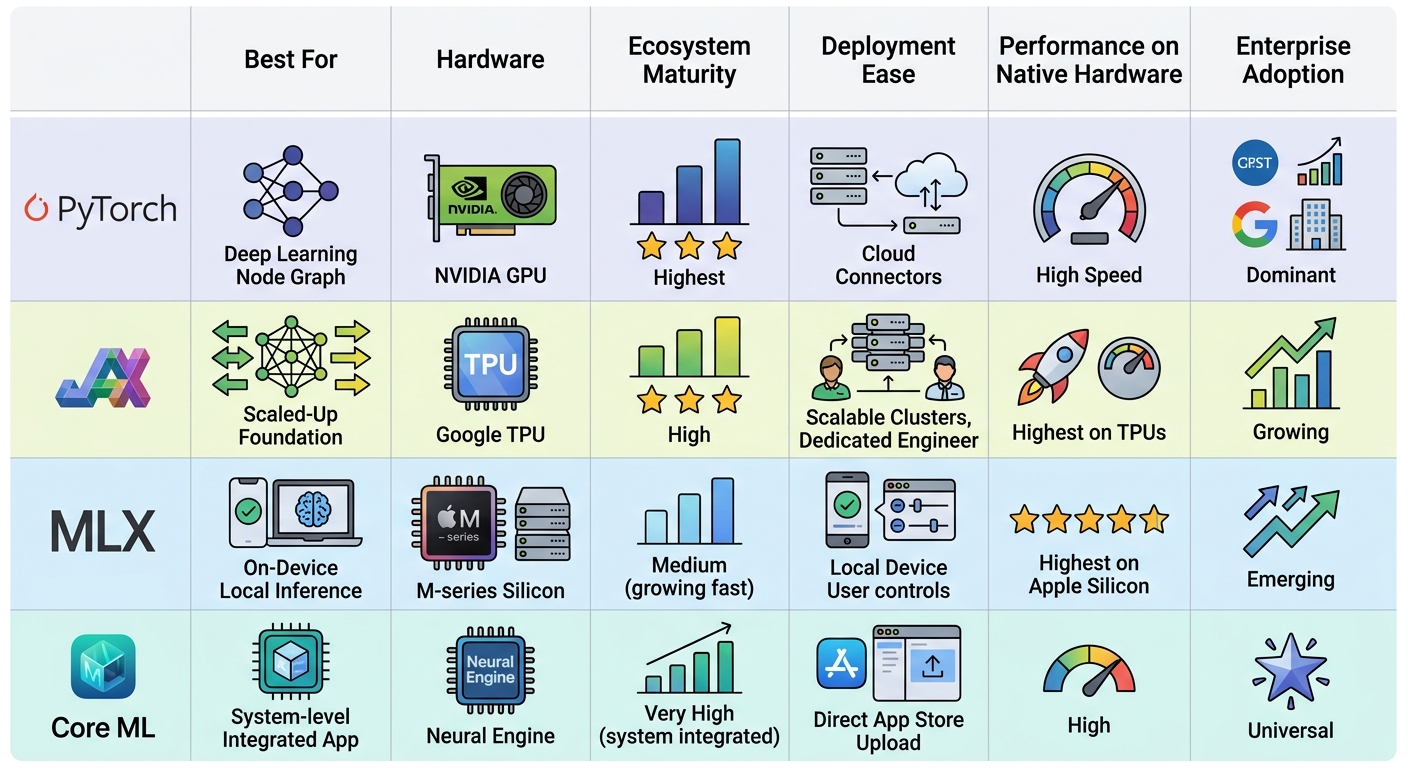
The key takeaway: on GPUs, PyTorch and JAX perform comparably for most workloads. On TPUs, JAX is the natural choice. On Apple Silicon, MLX is in a class of its own.
Ecosystem and Production Tooling
A framework is only as good as the tooling that surrounds it.
PyTorch has the largest and most mature ecosystem for production ML. Hugging Face's Transformers library — the dominant platform for pretrained language models — is built on PyTorch. Inference servers like vLLM and training optimizations like DeepSpeed are PyTorch-native. TorchServe provides model serving with monitoring, batching, and multi-model management. The talent pool is deep: most ML engineers entering the field in the past five years learned PyTorch first, and the majority of open-source model weights on Hugging Face ship with PyTorch checkpoints by default.
JAX has assembled a comprehensive AI stack that, while smaller than PyTorch's, is purpose-built for production at scale. Flax provides neural network layers and model authoring. Optax offers optimization primitives. Grain handles data pipeline construction. MaxText is Google's reference implementation for training large language models on JAX. The JAX serving runtime and vLLM's TPU integration provide deployment paths that did not exist two years ago. Google's migration of large-scale production models from TensorFlow to JAX signals serious organizational commitment to this stack.
MLX has grown faster than critics predicted. The Hugging Face mlx-community organization hosts approximately 4,800 pre-converted models ready for MLX inference — everything from Llama variants to image generation models. Ollama, the popular local LLM tool, switched to an MLX backend for Apple Silicon in March 2026, giving users dramatically faster inference on existing Ollama workflows without changing their model management approach. MLX 0.21, released in 2026, introduced distributed inference primitives that allow multiple Macs to coordinate on very large models: teams have successfully run 400-billion-parameter models across four Mac Studio machines using standard Ethernet networking.
The PyTorch ecosystem is still the most complete. But MLX has closed the gap faster than expected, and JAX's ecosystem is purpose-engineered for the scale where most teams are not yet operating.
Deployment, Inference, and Operational Considerations
Moving from training to production reveals another layer of trade-offs.
PyTorch deployment has matured substantially. TorchServe handles model versioning, monitoring, batching, and autoscaling. Every major cloud provider supports PyTorch model serving natively. The dynamic graph nature of PyTorch makes debugging production issues more intuitive — you can drop into a Python session and reproduce behavior without reconstructing complex distributed setups. The operational story is well-documented, and the community has solved most common deployment problems.
JAX requires more upfront investment in deployment tooling but pays dividends at extreme scale. The JAX serving runtime is designed for TPU and GPU clusters. MaxText and associated deployment pipelines from Google handle the specific challenges of serving billion-parameter models at low latency. Teams using JAX typically have dedicated MLOps engineers who understand the functional paradigm's implications for serving — this is not a framework you deploy without infrastructure experience. The functional paradigm means every serving request must carry all necessary state, which changes how you design inference APIs.
MLX deployment is growing more practical. The distributed inference capabilities introduced in MLX 0.21 are new enough that most teams are still learning best practices, but the core use case — running a model on a single Mac for a privacy-sensitive application — is well-supported. There is no cloud bill for inference when the model runs locally. For teams building applications where data cannot leave the device — medical imaging on local hardware, financial document processing, personal AI assistants — MLX removes an entire category of compliance concern.
For iOS and macOS applications with tightly controlled model deployment, Apple recommends system frameworks like Core ML and Core AI rather than MLX. These system frameworks are optimized for the constraints of the App Store ecosystem and offer deeper integration with the operating system, tighter binary size controls, and more aggressive hardware acceleration through the Neural Engine. MLX is the better choice for developers who want maximum flexibility and are comfortable managing their own deployment pipeline.
Cost, Scalability, and Team Considerations
Business decisions ultimately come down to total cost of ownership and execution risk.
PyTorch wins on talent availability. The probability that a new ML hire knows PyTorch is higher than any other framework. Onboarding time is shorter, and the breadth of available talent means you are less dependent on individual experts. Cloud GPU costs are comparable whether you run PyTorch or JAX code — the differentiator is engineering efficiency and time-to-production. A team that delivers in PyTorch three months faster is cheaper than a team that delivers in JAX with a steeper learning curve.
JAX delivers the best cost profile at extreme scale. A team running 4,000 TPUs on a foundation model training run will pay measurably more in compute time if they use PyTorch-XLA versus native JAX. The functional paradigm also reduces a category of subtle bugs that surface at scale — JAX simply will not let you mutate shared state across distributed workers, which eliminates an entire class of distributed training failures. The trade-off is the learning curve: expect 2–3 months for an experienced PyTorch team to become productive in JAX.
MLX has a hardware cost advantage for inference. A Mac Studio M5 Ultra with 512GB of unified memory costs roughly $10,000 and can run a 70-billion-parameter model locally. The equivalent inference capability on cloud GPUs would cost significantly more over two years of continuous use. For startups and research groups running inference workloads — not training — MLX on Apple Silicon is increasingly competitive on total cost of ownership. There is also a category value argument: running inference locally eliminates data transfer costs and latency for real-time applications.
The talent and learning curve considerations matter more than most framework comparisons acknowledge. A team that knows PyTorch will deliver production results faster in PyTorch, even if JAX is technically superior for their workload. Switching frameworks is a 6–18 month investment depending on team size, and most organizations underestimate the operational complexity of running multiple frameworks in parallel.
Decision Framework — Which Framework Should You Choose?
After evaluating architecture, performance, ecosystem, deployment, and cost — the decision usually comes down to a few concrete factors.
Choose PyTorch if your team is building or fine-tuning LLMs, generative AI models, or general deep learning systems. PyTorch gives you access to the broadest ecosystem of pretrained models, the largest talent pool, and the fastest path from research prototype to production deployment. If you do not have a specific reason to choose otherwise, PyTorch is the correct default for most production ML teams in 2026.
Choose JAX if you are training foundation models at Google Cloud TPU scale, or if your team is already comfortable with functional programming and needs maximum performance per FLOP. JAX is the framework of choice for organizations running thousands of accelerators on a single training job. The upfront investment in learning the functional paradigm pays off when you are optimizing at that scale. Organizations already invested in Google Cloud infrastructure will see the deepest integration benefits.
Choose MLX if your application runs primarily on Apple Silicon hardware, if data privacy prevents cloud inference, or if you are optimizing for cost-effective local inference. MLX has crossed the production-maturity threshold and now supports distributed inference across multi-Mac clusters. The ecosystem is younger, but it grows every month and the hardware advantages for Apple Silicon are structural, not accidental. The Apple Neural Engine integration is improving with each chip generation.
Consider a hybrid approach if you are training on one framework and deploying on another. Many production pipelines train in PyTorch (or JAX at scale) and then export to an inference-optimized format — ONNX for cross-platform deployment, MLX for Apple Silicon inference, TensorRT for NVIDIA GPU inference. This approach lets you choose the best tool for each phase of the ML lifecycle rather than forcing a single framework to handle everything. The export and validation pipeline adds complexity but captures the best of each ecosystem.
The framework you choose shapes your talent strategy, your cloud costs, your deployment infrastructure, and your iteration speed. All three are production-ready in 2026. The question is not which one wins — it is which one wins for your specific problem.
Subscribe to the Algorithmine portal for more practical guides on building production ML systems. New articles ship weekly.
Expert Q&A
Q: We are a 10-person ML team starting to train foundation models. Should we start with PyTorch or JAX?
A: Start with PyTorch. Even if your eventual scale justifies JAX, the ecosystem, debugging tools, and talent availability make PyTorch the right choice for a growing team. You can always migrate individual training jobs to JAX later as your infrastructure matures. Starting with JAX because you might scale is premature optimization — the functional paradigm will slow down your initial prototyping significantly. The risk of losing three months of momentum while your team adapts to a new mental model is rarely worth the hypothetical performance gains at a scale you have not yet reached.
Q: Our application requires running LLMs on customer Macs without sending data to our servers. Is MLX production-ready enough for this?
A: Yes. MLX achieved production maturity in 2025 and MLX 0.21's distributed inference primitives give you room to grow beyond single-machine deployment. The mlx-community hub with 4,800 models means you likely do not need to convert models yourself for common architectures. The main limitation is that MLX only targets Apple Silicon — if your user base includes Windows or Linux users, you will need a separate inference strategy for those platforms. For a pure Apple Silicon user base, MLX is not just production-ready, it offers performance advantages that cloud inference cannot match for latency-sensitive applications.
Q: We run PyTorch in production and are considering migrating to JAX for better performance. What should we know?
A: The performance gains from JAX are most significant at scale — hundreds to thousands of accelerators. If you are running on 8 GPUs or fewer, the gains are marginal and may not justify the migration cost. If you are running on TPUs or at the 100+ accelerator scale, JAX is worth evaluating seriously. Plan for a 6-month migration that includes rewriting your data loading pipelines (JAX's approach is different from PyTorch's), retraining your team on functional programming patterns, and rebuilding your deployment infrastructure. The hardest part is not the code migration — it is the debugging methodology shift, because the interactive Python debugging you rely on in PyTorch works differently in JAX's compiled functional model.
Q: Is torch.compile() finally good enough to use in production?
A: For most production workloads, yes. The 2–6% performance gap versus native JAX compilation has become small enough that other factors — ecosystem, talent, tooling — dominate the decision. The main exceptions are extremely large-batch training jobs where JAX's more aggressive compilation still provides a measurable edge, and workloads that rely heavily on dynamic control flow where torch.compile() can struggle with graph capture. If you are already on PyTorch, torch.compile() is worth enabling in your production workloads to see if it improves throughput on your specific hardware configuration. Start with torch.compile(mode="default") rather than the more aggressive max-autotune mode, and monitor for compilation time regressions in your CI pipeline.
Image URLs
| # | Alt | URL |
|---|---|---|
| 1 | PyTorch vs JAX vs MLX vs Core ML comparison table | /api/images/b3fc41e1576e43cbb34636595502864c |
Total: 1 image uploaded