Fine-Tuning vs RAG vs Prompting: The Decision Framework
Compare fine-tuning, RAG, and prompt engineering. Get our decision framework to choose the right LLM optimization technique for your use case.
Choosing the wrong LLM optimization technique can consume three to six months of engineering effort before you recognize the mistake. Teams routinely invest in fine-tuning a Llama 3 model, only to discover their actual problem was retrieval—incomplete context caused the model to hallucinate answers it never should have. Others build sophisticated RAG pipelines for tasks that a well-crafted system prompt could handle in an afternoon. The cost is not just time; it is compute spend, opportunity cost, and team morale. When comparing fine-tuning vs RAG vs prompt engineering, understanding which problem you actually have determines everything that follows.
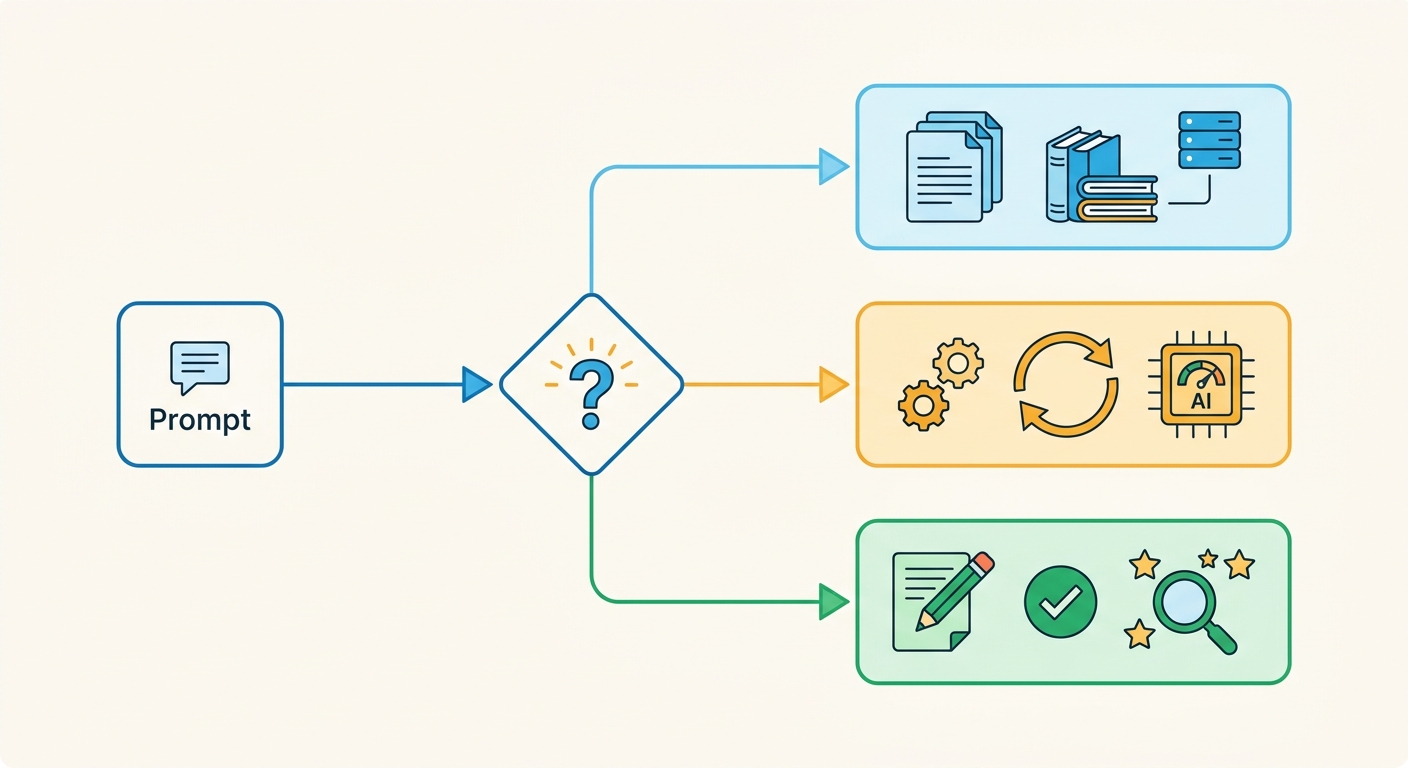
The three primary techniques—fine-tuning, retrieval-augmented generation (RAG), and prompt engineering—address fundamentally different problems.
Understanding the Three Techniques
Fine-Tuning
Fine-tuning adjusts a pre-trained model weights through additional training on a curated dataset. The technique reshapes the model internal representations to adopt specific writing styles, domain terminology, output formats, or task-specific reasoning patterns. When you fine-tune on thousands of labeled examples of legal contract summaries, the resulting model internalizes how contracts are structured and what constitutes an adequate summary—without requiring explicit instructions at inference time.
The trade-offs are substantial. Fine-tuning GPT-4o or Llama 3 70B requires significant GPU compute—typically A100 instances for multi-day training runs. A typical fine-tuning job for a 7B parameter model runs 500 to 2000 dollars on cloud infrastructure. More importantly, fine-tuning cannot inject current information. A model fine-tuned on 2023 medical literature will confidently generate outdated clinical guidance. Fine-tuning also risks catastrophic forgetting if not handled carefully; aggressive training can erode the base model general capabilities.
Fine-tuning excels when you need consistent behavioral changes: a customer service chatbot that must always respond in a specific tone, a code generation model that enforces your team architectural patterns, or a classifier that outputs structured JSON matching your schema precisely.
Retrieval-Augmented Generation
RAG addresses a different failure mode: models that do not know what they should know. A RAG pipeline retrieves relevant documents from an external knowledge base at inference time, then injects this context into the prompt. The model generates answers grounded in retrieved information rather than relying on parametric memory.
RAG reduces hallucinations on factual queries by 40 to 60 percent in production systems when implemented correctly, according to benchmark studies on medical and legal question-answering datasets. It also enables models to reference current information—a RAG system backed by today's document store answers questions about your 2024 product catalog, not last year's.
The infrastructure complexity is the cost. Building a production RAG pipeline requires vector database setup (Pinecone, Weaviate, or Chroma), embedding model selection (text-embedding-3-large, E5, or BGE), chunking strategy decisions, retrieval algorithm tuning, and re-ranking logic. A LangChain or LlamaIndex implementation adds orchestration overhead. For teams with constantly changing knowledge bases, maintenance becomes a significant operational burden.
RAG works when your primary problem is knowledge gaps or outdated information, when you need verifiable source-cited answers, or when regulatory requirements demand transparency about what data informed a response.
Prompt Engineering
Prompt engineering encompasses techniques for eliciting better outputs through prompt design alone. Few-shot examples, chain-of-thought reasoning, system prompts, and output format constraints all fall under this umbrella. The method imposes zero infrastructure cost and zero latency overhead beyond the additional tokens in your prompt.
The ceiling is real. Prompt engineering cannot teach a model to perform a task it fundamentally cannot learn from text. You cannot prompt a model into adopting a consistent domain vocabulary it has never seen, nor can you reliably constrain outputs to formats that conflict with the model training distribution. Prompting is also fragile—subtle wording changes produce unpredictable behavioral shifts.
For rapid iteration and straightforward tasks—summarization, translation, straightforward classification—prompt engineering often suffices. It serves as the correct starting point before investing in heavier interventions.
Decision Criteria by Use Case
The choice hinges on four axes: data freshness requirements, task complexity, domain specificity, and output consistency demands.
Data freshness is the clearest differentiator. If your use case requires current information—stock prices, breaking news, today's inventory levels—RAG becomes mandatory. Fine-tuning cannot help here. If your knowledge base changes weekly, RAG infrastructure costs are unavoidable.
Task complexity determines whether prompting suffices. Simple extraction tasks, straightforward classification, or standard transformations respond well to prompting. Complex reasoning chains, multi-step workflows, or nuanced judgment calls often require either fine-tuning for behavioral consistency or RAG for domain knowledge injection.
Domain specificity favors fine-tuning when generic models produce generic outputs. A financial analyst tool built on GPT-4o with a generic prompt still sounds like it is answering consumer questions. Fine-tuning on finance-specific corpus teaches the model to communicate like a domain expert.
Output consistency requirements also tilt toward fine-tuning. If downstream systems expect JSON matching a strict schema, prompting alone produces fragile behavior. Fine-tuning on thousands of schema-compliant examples produces reliable structural adherence.
When to Fine-Tune an LLM
Fine-tuning becomes the appropriate choice when behavioral consistency outweighs factual accuracy, when domain communication patterns diverge significantly from general training data, or when latency and cost constraints demand deploying a smaller model. Teams should evaluate fine-tuning against alternatives by measuring whether consistent behavioral outputs justify the investment in curated training data and compute resources.
The Hybrid RAG and Fine-Tuning Approach
RAG combined with fine-tuning frequently outperforms either technique alone. Fine-tuning teaches the model how to reason about your domain; RAG provides what to reason about. A legal AI assistant benefits from fine-tuning on legal writing conventions while using RAG to retrieve relevant case law at inference time.
Hybrid deployments are more complex but justified when requirements span multiple dimensions. Implement with LangChain for orchestration, Weights and Biases for monitoring retrieval quality and generation accuracy, and evaluate using domain-specific benchmarks rather than generic benchmarks like MMLU.
Cost, Complexity, and Maintenance
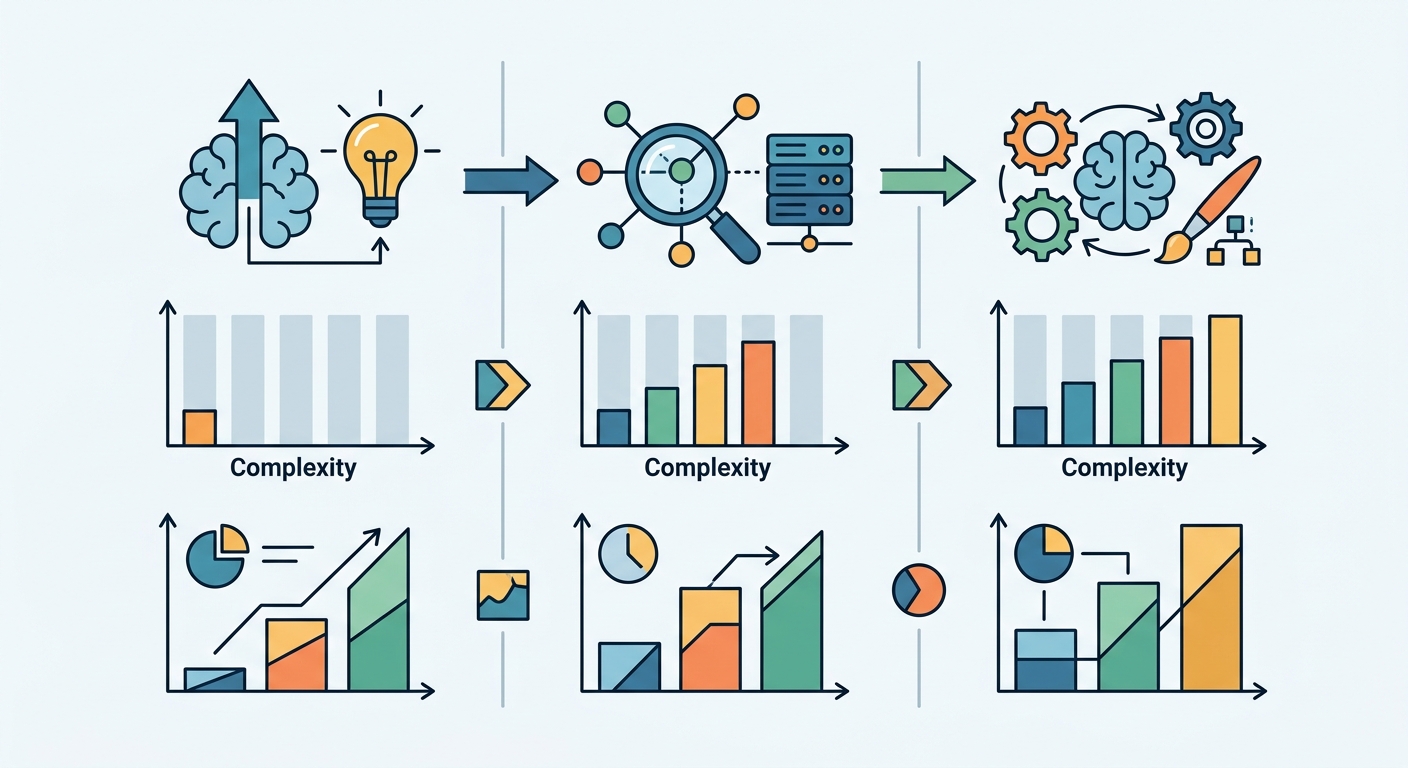
| Technique | Initial Development | Ongoing Cost | Maintenance Burden |
|---|---|---|---|
| Prompt Engineering | Hours | Token cost only | Minimal |
| RAG | 1 to 4 weeks | Compute + storage + embeddings | Document sync, index updates |
| Fine-tuning | 1 to 3 weeks training + data prep | Inference costs (smaller model) | Retraining for distribution shifts |
Fine-tuning total cost often exceeds initial estimates due to data preparation. Curating high-quality training data typically consumes 60 to 70 percent of the total project timeline. Llama 3 fine-tuning on domain-specific data may reduce inference costs if you switch to a smaller model, but the savings must be weighed against training expense.
Implementation Best Practices
Start with prompt engineering. Exhaust prompting before investing in infrastructure. A two-day prompting sprint often reveals whether your problem is solvable through design alone or requires deeper intervention.
Define evaluation metrics upfront. Without clear benchmarks—exact match accuracy for classification, ROUGE scores for summarization, human preference rankings for conversational quality—you cannot objectively compare approaches. Implement evaluation pipelines before building the system.
Build observability from day one. Log prompts, retrieval documents, and generations. Tools like Weights and Biases, PromptLayer, or Phoenix help identify failure modes. Without data, iteration is guesswork.
Plan for retraining cycles. If you fine-tune, model capabilities degrade as the world changes. Budget for quarterly or semi-annual retraining with updated data. RAG systems require monitoring for retrieval quality degradation as your document store evolves.
The Decision Framework Summary
Use prompt engineering when tasks are straightforward, you need speed-to-deployment, and your requirements are unlikely to evolve significantly. The ceiling is low, but the floor is high enough for many production use cases.
Add RAG when factual accuracy on current information matters, when you need source attribution, or when knowledge requirements exceed what fits in a context window. The infrastructure cost is justified by hallucination reduction and freshness guarantees.
Apply fine-tuning when behavioral consistency outweighs the flexibility of prompt engineering. When your use case demands that the model produce outputs in a highly specific tone, format, or reasoning pattern—regardless of how the user phrases their query—fine-tuning becomes the stronger choice. This is particularly relevant for domain-specific applications where the model must internalize industry terminology, regulatory language, or proprietary response structures that cannot be reliably prompted.
Consider fine-tuning when you need the model to exhibit consistent behavioral patterns across thousands of different inputs without degradation. Prompt engineering degrades in reliability as queries become more varied, but fine-tuned models maintain their learned behaviors with far greater robustness. If your application handles diverse user queries that must all receive responses following the same internal logic, fine-tuning provides the consistency your system requires.
Cost efficiency at scale also tips the scales toward fine-tuning. While prompt engineering offers flexibility, it carries ongoing costs tied to token usage. For high-volume applications processing millions of requests, the accumulated prompt tokens become expensive. A fine-tuned model requiring minimal prompt context can dramatically reduce operational costs while maintaining output quality.
Fine-tuning should be the endpoint of careful evaluation and iterative testing, not the first response to performance issues. Organizations often rush to fine-tune prematurely when foundational practices like prompt engineering, RAG implementation, and comprehensive evaluation frameworks would yield better results with less risk and lower costs.
Decision Framework Summary
| Scenario | Primary Approach | When to Escalate |
|---|---|---|
| Knowledge gaps | RAG with updated retrieval | When domain knowledge is static and vast |
| Pattern inconsistency | Few-shot prompting | When examples are reliable and numerous |
| Task complexity | Chain-of-thought decomposition | When reasoning requires explicit steps |
| Style or speaker adaptation | Fine-tuning with validation | After 3 or more other approaches exhausted |
| Foundational capability gaps | Base model upgrade | When current model cannot learn the task |
Key Decision Principles:
- Exhaust alternatives first – Fine-tuning should be considered as a preliminary step in the optimization process. Before committing to the intensive resource requirements and potential overfitting risks that come with fine-tuning, teams should thoroughly explore less complex alternatives that may adequately solve the problem. These alternatives include prompt engineering, retrieval-augmented generation (RAG), and leveraging larger base models with improved prompting strategies. Each approach offers distinct advantages: prompt engineering requires no additional training data or computational resources, RAG provides dynamic knowledge injection without model modification, and larger models often have better in-context learning capabilities that reduce the need for task-specific adaptation. Organizations frequently underestimate these options, jumping directly to fine-tuning based on the assumption that it is the only path to performance improvement. However, studies and practical implementations consistently show that many use cases achieve sufficient results through these alternatives, often with faster iteration cycles and lower maintenance.