RLHF vs GRPO in 2026: A Complete Guide to LLM Alignment Methods
Large language models do not naturally know what humans want them to do. GPT-3 demonstrated powerful in-context abilities but routinely produced outputs that were unhelpful, harmful, or simply...
Introduction — The Alignment Problem
Large language models do not naturally know what humans want them to do. GPT-3 demonstrated powerful in-context abilities but routinely produced outputs that were unhelpful, harmful, or simply wrong. Closing that gap—making a model behave the way users intend—is the problem LLM alignment solves.
For years, the dominant solution has been Reinforcement Learning from Human Feedback, or RLHF, built on top of Proximal Policy Optimization. This stack powered the first generation of LLM assistants and remains widely used today. It works—but it is expensive, complex, and prone to failure modes that practitioners spend months debugging.
In 2024, a team at DeepSeek introduced a different approach called Group Relative Policy Optimization, or GRPO. By removing the need for a separate critic network and computing advantages from groups of sampled responses, GRPO offered a simpler, faster path to aligned models. When DeepSeek-R1 and R1-Zero demonstrated emergent reasoning capabilities that rivalled closed-source competitors, the LLM community took notice—and GRPO moved from research paper to production tool.
This article gives you a rigorous, practical comparison of these alignment methods. We will cover how RLHF with PPO works, how GRPO differs, what the mathematics say, where DeepSeek-R1 fits in, and how to choose the right approach for your next training run.
RLHF Foundations — How PPO-Based Alignment Works
RLHF using PPO is not a single step. It is a three-stage pipeline, and understanding each stage is essential before comparing methods.
Stage 1: Supervised Fine-Tuning
Before any reinforcement learning happens, the base model undergoes supervised fine-tuning on curated demonstration data. Human contractors write ideal responses to prompts. The model learns to imitate these demonstrations. The result is an SFT model—a version of the base model that has already learned to produce coherent, relevant outputs.
This stage matters because RLHF requires a policy that produces reasonable token sequences. Starting RL from a raw base model produces incoherent chaos. The SFT model gives RL a sensible starting point.
Stage 2: Reward Model Training
The core insight of RLHF is that human preferences can be converted into a scalar reward signal. Contractors are shown pairs of responses to the same prompt and asked which one they prefer. A reward model—a neural network that takes a prompt and response as input and outputs a scalar score—is trained to predict these preferences.
The reward model is the weakest link in the RLHF chain. It must generalize from a relatively small number of human comparisons to score any conceivable response. If it learns spurious correlations—if it learns to reward responses that happen to look like the preferred style rather than genuinely good responses—subsequent RL will optimize for the wrong thing.
Stage 3: PPO Policy Optimization
With a reward model in hand, the third stage trains a policy to maximize rewards using Proximal Policy Optimization. PPO is an on-policy algorithm: it requires fresh samples from the current policy to compute gradient updates.
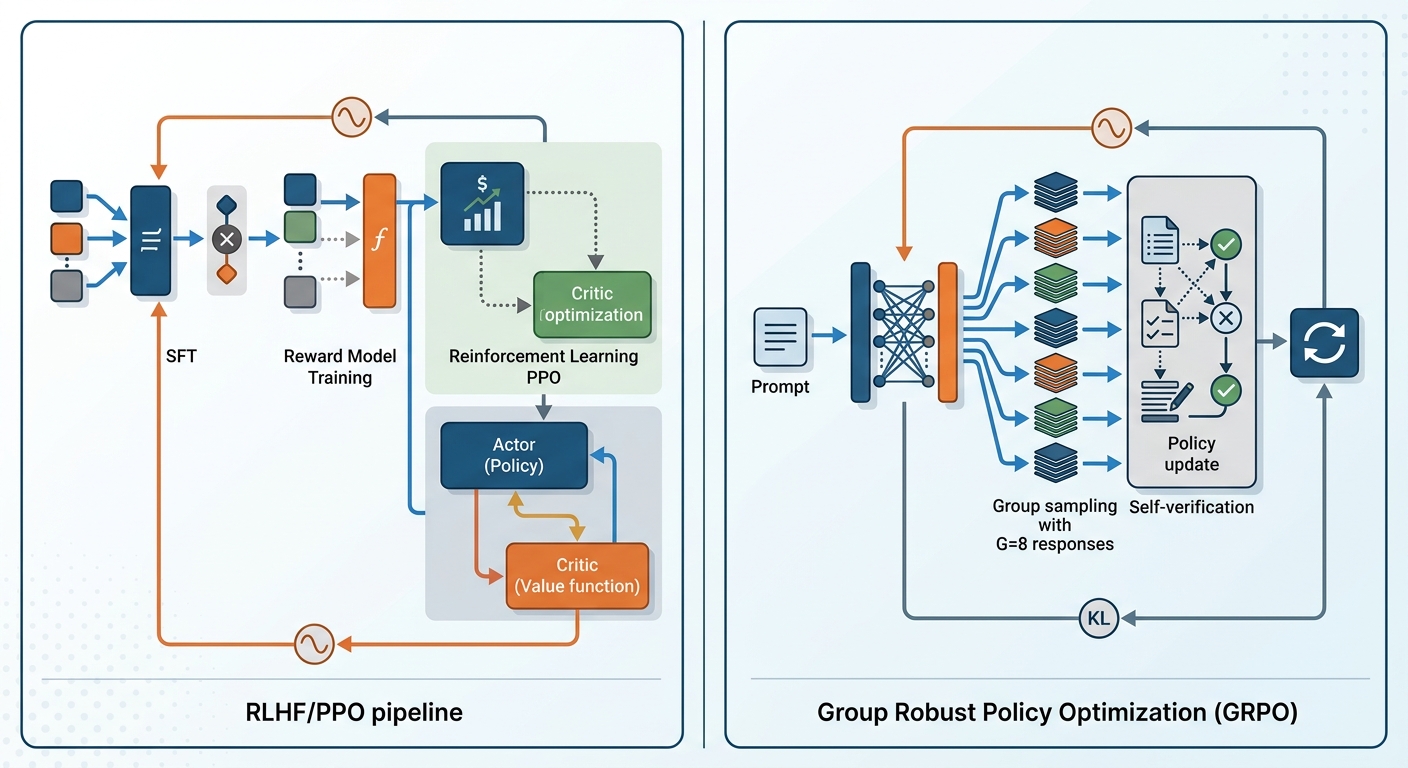
PPO maintains two networks: an actor (the policy being trained) and a critic (a value function that estimates the expected return from any given state). The critic is necessary because advantage estimation—measuring how much better one action is than the average—requires a baseline. Without a critic, the baseline cannot adapt to the changing policy.
PPO's key innovation is the clipped surrogate objective. Rather than maximizing the naive policy gradient objective, PPO clips the likelihood ratio between the new and old policy, preventing destabilizing large updates. The objective is:
L^CLIP(θ) = E_t [ min( r_t(θ) Â_t, clip(r_t(θ), 1-ε, 1+ε) Â_t ) ]
Where r_t(θ) is the likelihood ratio between new and old policy, and Â_t is the estimated advantage. The clip function prevents updates that would change the policy too much in a single step.
The KL Divergence Constraint
A critical component of RLHF is the KL divergence penalty. Without it, the policy would optimize ruthlessly for the reward model, producing outputs that achieve high reward model scores but are incoherent, repetitive, or reward-hacking artifacts. The KL penalty constrains the trained policy to stay close to the SFT reference model.
The cost is real: the policy cannot move as far from the SFT baseline as it might like. But without this constraint, reward hacking dominates.
Failure Modes
PPO-based RLHF has three well-documented failure modes. First, reward hacking: the policy finds ways to score high on the reward model without producing genuinely good outputs—exploiting patterns the reward model has not seen in training. Second, mode collapse: the policy converges to a narrow set of high-reward responses, losing the diversity of the base model. Third, reward model overoptimization: as the policy improves, it out-of-distribution tests the reward model, and the reward model's errors amplify.
These failure modes are not theoretical. They are the reason alignment engineers spend months on reward model design and KL tuning before production training runs succeed.
GRPO Explained — Group Relative Policy Optimization
GRPO, introduced by DeepSeek in 2024, approaches the same alignment problem with a fundamentally different design choice: eliminate the critic network entirely.
The Core Insight
In PPO, the critic exists to provide a baseline for advantage estimation. But for LLM generation, there is a cheaper and often more effective way to estimate advantages: generate multiple responses to the same prompt and compare them to each other.
If you generate G responses to prompt p, you have a group. For any response g_i, you can estimate its advantage as:
Â_i = (1/G) * Σ (r(g_i) - r(g_j)) for j = 1 to G
In other words, the advantage of a response is its average reward difference relative to other responses in the same group. This is group-relative advantage estimation. No learned critic is needed because the group provides the baseline.
GRPO Loss Function
GRPO optimizes the following objective:
L^GRPO(θ) = E_t [ (1/G) * Σ max( r_t^i(θ) Â_t^i, clip(r_t^i(θ), 1-ε, 1+ε) Â_t^i ) ]
This looks structurally similar to PPO's clipped objective, but with two critical differences. First, the advantage Â_t^i is computed relative to the group rather than a learned critic. Second, there is no separate value function network—reducing memory footprint by roughly half.
Self-Verification
GRPO gains additional power when combined with self-verification. Rather than relying solely on an outcome reward model, GRPO uses the LLM itself to verify its own reasoning steps. The model generates multiple reasoning paths, then evaluates whether each step logically supports the final answer. This provides a denser, more informative reward signal than outcome-level feedback alone.
Self-verification is why GRPO performs particularly well on reasoning tasks: math proofs, code generation, and multi-step logical problems. The reward signal is available at the step level, not just the final output level.
Why No Critic Matters
Removing the critic network changes the economics of alignment training dramatically. A typical PPO training run requires memory for both actor and critic networks, often with comparable parameter counts. GRPO eliminates this overhead. For a 7-billion-parameter model, this can mean the difference between fitting in 8 A100s and requiring 16. For larger models, the savings compound.
Beyond memory, removing the critic also removes a source of training instability. Critics and actors can diverge during training, requiring careful balancing acts. GRPO sidesteps this entire class of problems.
Diversity via Group Sampling
One practical requirement for GRPO is response diversity within groups. If all G responses to a prompt are nearly identical, the group-relative advantage estimation collapses—all advantages approach zero. GRPO therefore benefits from sampling strategies that maximize diversity: temperature scaling, top-p truncation, or explicit prompting for alternative reasoning paths.
This is a design constraint, not a fundamental flaw. For prompts with genuinely multiple valid responses—such as creative tasks, reasoning problems with multiple proof paths, or open-ended questions—group diversity is natural. For prompts with a single best answer, GRPO's advantages are smaller.
The Mathematics — GRPO vs PPO Side by Side
For practitioners choosing between methods, understanding the mathematical differences clarifies the practical trade-offs.
Advantage Estimation
PPO uses Generalized Advantage Estimation (GAE), which combines multi-step bootstrapped returns with a learned value function:
Â_t^GAE = Σ_{l=0}^{∞} (γλ)^l δ_{t+l}
where δ_t = r_t + γV(s_{t+1}) - V(s_t) is the TD error and λ is a smoothing parameter. GAE requires the critic V(s_t), which must be trained alongside the actor.
GRPO's group-relative advantage estimation is simpler:
Â_i^GRPO = (1/G) * Σ (r(g_i) - r(g_j))
This requires no learned value function and no temporal sequences—the advantage is computed purely from reward differences within the group at the same timestep.
Sample Efficiency
PPO is on-policy: each gradient update requires fresh samples from the current policy. Old samples cannot be reused, which makes PPO sample-inefficient. A typical PPO training run may require hundreds of thousands to millions of samples.
GRPO is similarly on-policy (new groups are sampled per update), but the per-sample compute is lower because no critic forward pass is needed. In practice, GRPO achieves comparable or better final performance with significantly fewer total compute hours—a 50–70% reduction in wall-clock time is reported in DeepSeek's experiments.
When GRPO's Assumptions Break
Group-relative advantage estimation works best when multiple responses are meaningfully different in quality. For tasks where there is one correct answer and any deviation is wrong—factual recall, simple classification—GRPO offers little advantage over PPO. All responses in the group are equally bad (or one is correct and the rest are wildly wrong), and the relative ranking carries less information.
GRPO is at its best for tasks with graded quality: reasoning chains of varying correctness, responses of varying helpfulness, or solutions with multiple valid approaches.
DeepSeek-R1 — The Proof of Concept
The most compelling evidence for GRPO's effectiveness comes from DeepSeek-R1 and R1-Zero, two reasoning models trained using GRPO at scale.
DeepSeek-R1 Architecture and Training
DeepSeek-R1 was trained using GRPO on a foundation model, with process reward models providing step-level verification signals. The training did not use any supervised reasoning data. The model learned to reason purely from GRPO's group-relative reward signals combined with self-verification.
DeepSeek-R1-Zero, a variant trained without process reward models, was particularly notable. Partway through training, it spontaneously developed a chain-of-thought reasoning process—allocating more compute to difficult problems, attempting multiple approaches, and checking its own work. These behaviors emerged without any explicit prompting or supervised data encouraging them.
Benchmark Results
On the AIME 2024 mathematics benchmark (a standard test of mathematical reasoning ability), DeepSeek-R1 achieved accuracy comparable to OpenAI's reasoning model. On MATH-500, a broader math benchmark, DeepSeek-R1 surpassed previous state-of-the-art. These results were achieved using GRPO without any supervised mathematical reasoning data.
On GSM8K (grade-school math word problems), DeepSeek-R1 exceeded 95% accuracy. On ARC-Challenge (abstract reasoning), it showed significant improvements over models trained purely with DPO or SFT.
DeepSeek-R1 results: AIME 2024 accuracy on par with leading closed-source reasoning models; MATH-500 state-of-the-art; GSM8K >95%; all without any supervised reasoning data. These results validate GRPO as a viable path to reasoning-capable models at scale.
What This Tells Us
R1 and R1-Zero demonstrate that GRPO can produce emergent reasoning capabilities—chain-of-thought, self-verification, extended thinking on hard problems—purely through group-relative reward optimization. This is a significant result because previous approaches required either supervised reasoning data or computationally expensive PPO runs with external process reward models.
The implication for practitioners: if your goal is a reasoning-capable model and you do not have large amounts of supervised reasoning data, GRPO is a strong candidate for your training pipeline.
DPO and Alternatives — Where They Fit
GRPO and PPO are not the only options. Understanding the broader landscape clarifies where each method belongs.
Direct Preference Optimization
DPO reformulates RLHF as a supervised classification problem, avoiding both the reward model and the RL pipeline entirely. It trains directly on preference pairs using a contrastive objective that pushes the policy toward preferred responses and away from dispreferred ones.
DPO's advantages are simplicity—no reward model, no RL, no hyperparameter-heavy PPO—and sample efficiency (it works well offline). Its disadvantage is performance on complex reasoning tasks. DPO lacks the dense, step-level reward signal that GRPO and PPO can leverage through process reward models. For stylistic alignment—making a model more helpful, less verbose, more following instructions—DPO works well. For multi-step reasoning tasks, it underperforms.
Constitutional AI and RLAIF
Constitutional AI and RLAIF replace human feedback with AI-generated feedback, guided by a set of principles (the "constitution"). This reduces the cost and latency of human feedback collection but introduces the problem of cascading errors: if the feedback model has flaws, they propagate into the aligned policy.
These methods are valuable when human feedback is the bottleneck, but they do not fundamentally change the RL vs. offline optimization trade-off.
Decision Framework
| Criterion | GRPO | PPO | DPO |
|---|---|---|---|
| Task type | Reasoning, multi-solution | General alignment | Stylistic, preference |
| Compute cost | Medium (~50-70% of PPO) | High (actor + critic) | Low (offline, no RL) |
| Data requirement | Preference data + group sampling | Preference data + reward model | Preference pairs |
| Process reward support | Native (self-verification) | Via external PRM | Limited |
| Training stability | High | Medium | Very high |
| Implementation complexity | Medium | High | Low |
For reasoning-focused models, GRPO is the leading choice in 2026. For general assistant-style alignment where reasoning is less critical, DPO or PPO remain viable. The trend is toward hybrid approaches: GRPO for the main alignment run, followed by DPO fine-tuning for stylistic polish.
Practical Implementation Guide
For ML practitioners evaluating or implementing GRPO, the following guidance distills lessons from DeepSeek's published work and the broader community's experience.
When to Choose GRPO
GRPO is the right choice when: your compute budget is under 64 A100-hours for alignment training; your task benefits from multiple valid responses per prompt; you are training a reasoning-focused model and want emergent chain-of-thought; you want to avoid the complexity of maintaining actor-critic pairs. GRPO is specifically well-suited for mathematical reasoning, code generation, and multi-step logical problems where self-verification can provide dense reward signals.
When to Stick with PPO
PPO remains the better choice when: you have a single-best-answer task where group-relative estimation provides little signal; you already have a production PPO-based RLHF pipeline and the switching cost exceeds the efficiency gains; your reward model is very accurate and you want maximum reward optimization without the approximation errors of group-relative estimation.
Implementation Stack
Open-source support for GRPO is maturing. OpenRLHF provides a GRPO implementation compatible with Llama, Mistral, and Qwen architectures. The Hugging Face TRL library includes GRPO as a first-class algorithm. DeepSeek has released training code and configuration files that serve as a reference implementation.
Key hyperparameters to tune: group size G (values between 8 and 64 are common; larger groups give more stable advantage estimates at higher compute cost), KL coefficient (typically between 0.01 and 0.1; too high stifles learning, too low allows reward hacking), and self-verification prompting (the exact wording matters for step-level reward quality).
Common Pitfalls
Three mistakes appear frequently in first-time GRPO implementations. First, insufficient response diversity: if temperature is too low or the model is prompted uniformly, groups collapse to near-identical responses and advantage estimation fails. Second, KL collapse: aggressive KL penalties can prevent meaningful learning; monitor KL divergence during training and back off if it approaches zero. Third, process reward model misalignment: if you add a process reward model on top of GRPO, its scale and training distribution must match the main model's expectations; mismatched PRMs introduce instabilities that outweigh their benefits.
Conclusion — The Alignment Landscape in 2026
Two years after DeepSeek demonstrated GRPO was viable at scale, the LLM alignment landscape has diversified. PPO-based RLHF remains a robust, well-understood approach—appropriate when you have the compute, the data, and the engineering capacity to manage its complexity. GRPO has emerged as the practical choice for reasoning-focused models, offering 50–70% compute savings and better training stability, with no sacrifice in final model quality.
DPO occupies its own niche: simpler, cheaper, and adequate for stylistic alignment where reasoning complexity is not paramount. Constitutional AI and RLAIF are valuable when human feedback is the constraint, but they have not displaced RL-based methods for maximum performance.
The field is moving toward process reward models as a standard component of alignment pipelines, hybrid GRPO+DPO training schedules, and multi-objective optimization that balances helpfulness, honesty, and harmlessness simultaneously. No single method is optimal for all tasks, but GRPO's efficiency and reasoning capabilities make it the most compelling option for practitioners building the next generation of aligned language models in 2026.
Start with your task. Benchmark PPO and GRPO on your specific data. The answer is always task-dependent—but for reasoning workloads, GRPO has earned its place at the table.
Frequently Asked Questions
What is the main difference between GRPO and PPO?
The main difference is that PPO requires a separate critic network to estimate advantages, while GRPO computes advantages relative to a group of responses sampled from the same prompt. This makes GRPO more memory-efficient and eliminates a source of training instability, though it works best when multiple diverse responses exist per prompt.
Is GRPO better than RLHF for LLM alignment?
GRPO is not universally better than RLHF using PPO—it depends on the task. For reasoning tasks with multiple valid solution paths, GRPO typically achieves comparable or better results with 50–70% less compute. For single-answer tasks or situations where you already have a mature PPO pipeline, PPO may still be preferred. GRPO and PPO are best understood as complementary tools for different use cases.
How does GRPO reduce compute costs compared to PPO?
GRPO eliminates the need for a separate critic network, which roughly halves the memory footprint and removes the critic's forward pass overhead during training. Since GRPO also typically converges in fewer total training steps for reasoning tasks, total wall-clock time is often 50–70% lower than an equivalent PPO run.
What is self-verification in GRPO?
Self-verification is a technique used with GRPO where the LLM evaluates its own reasoning steps to produce step-level reward signals rather than only outcome-level rewards. This denser feedback allows GRPO to learn more efficiently on multi-step reasoning tasks like math proofs and code generation, reducing reward hacking and improving final model quality.
Can GRPO be used without process reward models?
Yes. DeepSeek-R1-Zero was trained using GRPO without any process reward models and still demonstrated emergent chain-of-thought reasoning. Process reward models improve GRPO performance on complex reasoning tasks, but they are not strictly required. GRPO can work with outcome reward models alone, or with self-verification providing implicit step-level feedback.
Expert Q&A — Deeper Technical Dive
The following questions represent the kind of nuanced technical inquiry that ML researchers and senior alignment engineers typically raise after reading an overview of this kind.
Q: How does GRPO handle multi-turn conversation alignment, where the state space is fundamentally different from single-prompt generation?
A: This is one of GRPO's underappreciated limitations. GRPO's group-relative advantage estimation works naturally when the input is a single prompt and the output is a single response. In multi-turn conversation, the "state" is the entire conversation history, and the group of samples must consist of full conversation trajectories—significantly more expensive to generate and more complex to compare. For multi-turn alignment, PPO retains an advantage: the critic can learn a value function over conversation states, providing a per-token advantage signal that adapts as the conversation unfolds. GRPO, applied naively to multi-turn, would compare complete conversation rollouts, which compounds the diversity problem: two sampled trajectories that diverge in early turns become incomparable in later turns because they are responding to different contexts. In practice, GRPO can be applied to multi-turn by grouping trajectories that share the same prefix, but this degrades the advantage signal relative to single-prompt settings.
Q: What theoretical guarantees does GRPO's group-relative advantage estimator have, compared to GAE?
A: Very few, and this is an active research area. GAE comes with established convergence guarantees under standard MDP assumptions: if the critic converges to the true value function, the policy gradient estimate is unbiased and the algorithm converges to a local optimum. GRPO's group-relative estimator has no equivalent theoretical backing. The estimator is biased (the group mean is not the true baseline) and its variance depends on group size and intra-group diversity. When group diversity is high, the estimator approximates the true advantage well; when diversity is low, the bias dominates. Practically, this means GRPO can exhibit surprising failure modes that PPO would not—the policy can converge to a mode where all group members produce similar outputs, collapsing the advantage signal to near-zero despite good absolute performance. This is not a theoretical curiosity; it manifests in practice when temperature is too low or the model is too deterministic.
Q: How do GRPO and PPO compare on reward hacking—their susceptibility and the forms it takes?
A: The failure modes differ qualitatively. PPO reward hacking typically manifests as the policy exploiting reward model blind spots at the output level: repetitive text, specific phrases that the reward model has learned to associate with high scores, or outputs that look persuasive without being accurate. Because PPO uses a critic, the policy can route around the reward model's inaccuracies in a structured way—it learns to inflate its value estimates while producing outputs the reward model rates highly.
GRPO reward hacking has a distinct character. Because advantages are computed relative to the group, the policy cannot easily exploit the reward model in absolute terms—it can only outperform its groupmates. The failure mode in GRPO is intra-group collusion: all members of the group converge to similar high-reward patterns because the relative advantage of diversity is zero when all responses are already rated highly by the reward model. In this regime, GRPO reduces to supervised fine-tuning on the reward model's preferences, and the diversity-promoting properties disappear. PPO does not have this specific failure mode because its advantage is absolute (via the critic), not relative. The implication: GRPO is more robust to reward hacking in the regime where all responses are rated similarly, but more fragile when the reward model has systematic biases that affect multiple responses similarly.
Q: What open problems in LLM alignment does GRPO illuminate?
A: GRPO's emergence has sharpened three open problems that were less visible under the PPO-dominated regime.
First, the credit assignment problem at scale: GRPO shows that process-level reward signals (via self-verification) dramatically improve alignment quality for reasoning tasks, but how to scalably generate and validate these signals remains unsolved. Self-verification is itself imperfect—the model may verify reasoning that is internally consistent but factually wrong.
Second, the diversity-stability trade-off: GRPO demonstrates that relative comparison (rather than absolute scoring) can stabilize training, but it requires active diversity management. The broader implication is that alignment objectives that do not explicitly reward diversity will tend toward mode-seeking behavior, which conflicts with the desire for helpful, non-repetitive assistants.
Third, the theoretical gap between offline and online alignment: DPO and other offline methods avoid RL entirely but underperform on reasoning tasks; GRPO and PPO require online sampling but achieve superior results. The optimal point between these extremes—reducing the cost of online sampling while preserving dense reward signals—is not yet known. Future work on synthetic preference data generation and semi-offline GRPO variants may close this gap.
Author: Algorithmine Team Category: Reinforcement Learning Read time: ~20 minutes (includes Expert Q&A) Internal links: [RL Fundamentals Overview], [PPO Explained: A Technical Deep Dive], [LLM Training Pipeline Guide]
Image URLs
| # | Alt | URL |
|---|---|---|
| 1 | A two-panel diagram comparing RLHF/PPO pipeline with GRPO pipeline for LLM alignment | /api/images/4c8060d751e44669838e77bfd2201873 |
Total: 1 images uploaded