GRPO in Production: What Group-Relative Policy Optimization Actually Buys You
A clear-eyed look at GRPO in production: how group-relative policy optimization cuts memory, simplifies rewards, and what sampling costs it adds.
The Shift from RLHF to GRPO
Group-relative policy optimization moved from research papers to production post-training pipelines faster than almost any technique in recent memory. DeepSeek introduced GRPO in its DeepSeekMath work (2024) and demonstrated it at scale in DeepSeek-R1-Zero, giving teams a way to train reasoning behavior without the memory tax of a learned critic. Within months it was showing up in internal roadmaps at labs and enterprises alike. The hype, predictably, outpaced operational clarity.
Here's the clear-eyed version. GRPO is a genuine architectural simplification — it removes the critic from the training loop and changes how advantage is estimated. That buys real things: training-graph memory headroom, simpler reward engineering, and faster iteration on verifiable tasks. It also costs real things: rollout throughput, sensitivity to group size and group degeneracy, and a distinct class of reward-hacking failure modes.
This article separates what group-relative policy optimization actually delivers in production from what the demo notebooks promise. (See also: PPO vs. GRPO: choosing a policy optimization method)
What GRPO Is — and What It Isn't
The Core Mechanism: Group-Relative Advantage
GRPO starts with a prompt and samples a group of G outputs from the current policy. Group size is a first-class cost knob: DeepSeek used 64 for its reasoning runs, while many teams run 4–8 to control rollout cost. Each output gets a scalar reward. Instead of comparing that reward to a learned baseline, GRPO normalizes rewards within the group: the advantage for each output is its reward minus the group mean, divided by the group standard deviation (with a small epsilon to avoid division by zero).
That's the whole trick. The group serves as its own baseline. Outputs better than their siblings get positive advantage and are reinforced; worse ones get negative advantage and are suppressed. No separate value network estimates "how good is this state on average," because the group average is the estimate.
This makes the advantage signal comparative rather than absolute — which matters enormously for both what you can reward and how the reward can be gamed. It also creates a failure mode you'll meet in production: when all G rewards are identical (every completion correct, or every one wrong), the group standard deviation is zero, advantage collapses to zero, and the sample contributes no gradient. The compute is spent and nothing is learned. Managing group degeneracy — via difficulty filtering, epsilon on the denominator, or mean-only normalization — is part of running GRPO, not an edge case.
GRPO vs. RLHF and PPO: Where the Value Function Went
Classic RLHF pipelines train a reward model on human preference pairs, then run PPO against it with a learned critic (value function) to reduce variance in advantage estimation. That critic is a full model — often comparable in size to the policy — sitting in memory alongside the policy, the reference model, and the reward model.
GRPO deletes the critic. The training graph shrinks from four models to roughly two (policy plus a frozen reference), and advantage estimation becomes a statistical operation over a batch of samples rather than a forward pass through a value network. The reference model is still there, and still costs full frozen weights in memory, because GRPO applies a KL penalty to keep the policy from drifting too far from its starting point.
Two clarifications that get lost in the discourse:
- GRPO is a policy optimization method, not a reward model. You still need a way to score outputs — a verifier, a reward model, or a rule-based checker.
- It is not a drop-in replacement for the entire RLHF stack. Preference modeling, data curation, and safety tuning still exist. GRPO changes the optimization stage, not the whole pipeline. (Related: RLHF vs. RLVR: a practical comparison)
"GRPO didn't eliminate the hard parts of reinforcement learning. It eliminated the critic — and moved the difficulty into sampling and reward design."
What GRPO Actually Buys You
Dropped Critic, Lower Training-Graph Memory
The most concrete win is training memory. A PPO setup for a 7B policy might hold the policy, a reference model, a reward model, and a 7B critic — four models' worth of weights plus optimizer states and activations. GRPO removes the critic entirely, which can cut training-graph memory substantially and let teams train larger policies on the same hardware.
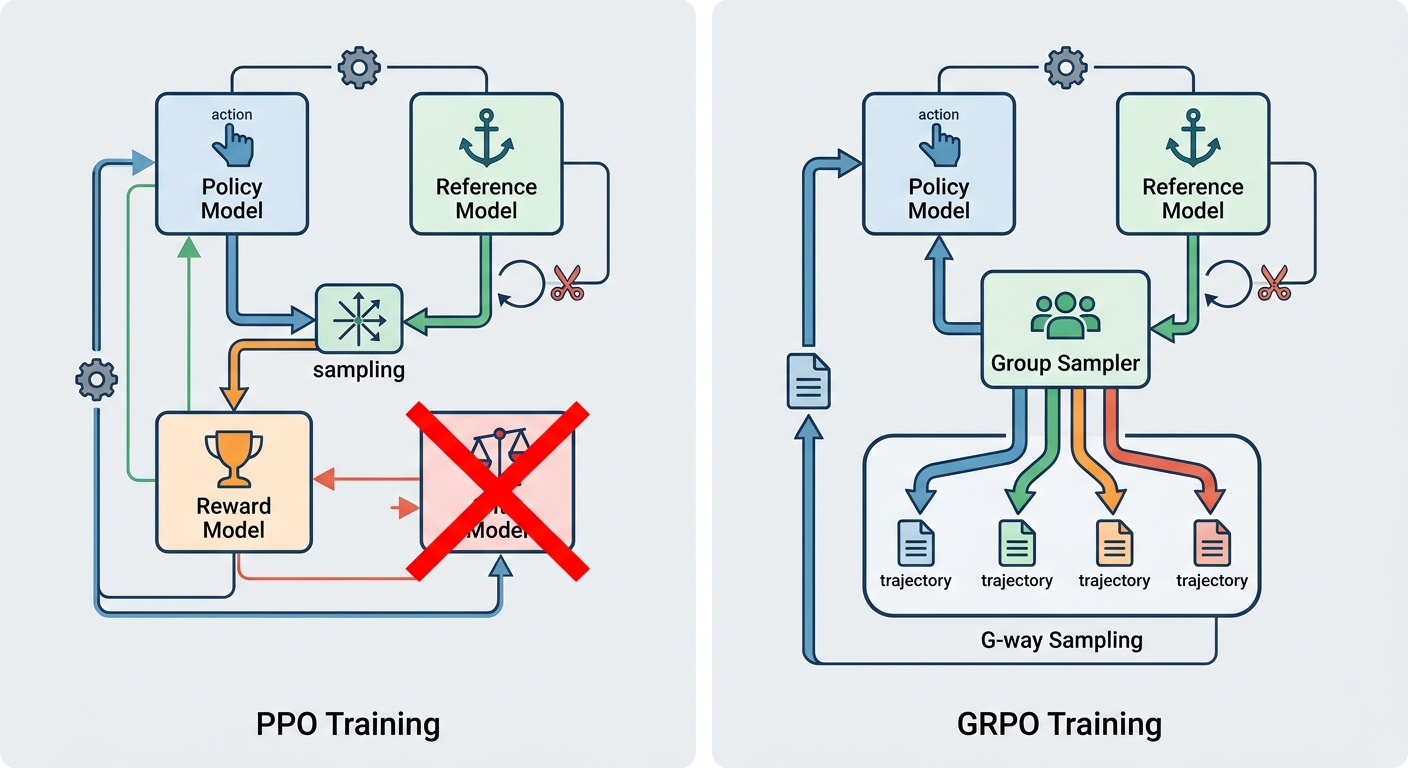
Be precise about where the win lands: the savings are in the training graph, not the rollout graph. GRPO trades a critic for G× generation, which raises inference/KV-cache pressure. The net win is real but it's a shift of cost from training VRAM to rollout throughput, not a free lunch.
There's a second-order benefit: fewer models means a simpler training graph. Fewer synchronization points, fewer failure modes in distributed setups, and less debugging when loss curves go sideways.
Simpler Reward Engineering
With a critic, reward design has to produce signals a value function can learn from — which pushes teams toward dense, shaped rewards and long reward-model training cycles. GRPO's comparative signal tolerates coarser rewards: a binary correct/incorrect check, a unit-test pass, a format validator.
In practice this means less reward-model babysitting. For tasks where correctness is checkable, you can skip the preference-model training stage almost entirely and go straight from a verifier to a training signal. (See: Designing verifiable rewards for reasoning models)
Strong Fit for Reasoning Models
This is where GRPO earns its reputation. Math, code generation, and structured reasoning tasks have verifiable rewards — the answer is right or wrong, the test passes or fails. Group-relative advantage pairs naturally with that: sample G solutions, check them, reinforce the ones that work relative to the ones that don't.
Group sampling also gives the model multiple attempts per prompt, so the comparative signal can reward whichever attempts succeed — which is exactly what you want when training a model to explore solution paths rather than collapse onto one. Note that this is exposure, not an explicit exploration bonus: GRPO samples G i.i.d. completions and adds no diversity term, so mode collapse within a group remains a real risk you have to watch.
Cheaper Iteration on Post-Training
Fewer moving parts means faster experiments. Teams report shorter cycles from "try a new reward" to "see if it worked," because there's no reward model to retrain and no critic to converge. For organizations running many post-training experiments, that iteration velocity compounds. (Related: Building a post-training experiment pipeline)
The Production Costs Nobody Mentions
Sampling Overhead and Throughput Trade-offs
Here's the bill. GRPO requires G completions per prompt — if your group size is eight, you've multiplied generation throughput by eight before you've done any training, and at group size 64 (as in DeepSeek's reasoning runs) by 64. For long-context reasoning workloads, where each completion can run thousands of tokens, rollout generation becomes the dominant cost and the bottleneck. The critic you saved in VRAM is now a bill you pay in inference compute.
This is the central production trade-off: GRPO shifts cost from training memory to rollout throughput. Budget accordingly, and treat group size as a cost/quality knob you tune per task, not a fixed constant.
Group Degeneracy and the Cold-Start Problem
The comparative signal only works when there's variance to compare. Two failure modes follow:
- All-correct groups waste compute and produce zero gradient. Easy prompts stop teaching the model.
- All-wrong groups — the cold-start problem — also produce zero gradient. For hard prompts the policy never solves, GRPO gets no signal at all.
Production teams handle this by filtering or curriculum-ordering prompts by pass rate, keeping the training set in the band where the model sometimes succeeds and sometimes fails. If you skip this, a large fraction of your rollouts are silently wasted.
Reward Hacking Under a Comparative Signal
The comparative signal changes what "gaming the reward" means. Under an absolute reward, a model is pushed toward being correct. Under a group-relative reward, a model only needs to be less wrong than its siblings — relative advantage is sufficient. That opens specific exploits:
- Verifier exploits: format gaming, spurious unit-test passes, and answer-extraction bugs where the checker accepts a wrong answer that matches the expected pattern.
- Length hacking: exploiting length-correlated reward signals or truncation artifacts.
- Sibling exploitation: degenerate strategies that beat the group mean without improving correctness.
Every one of these is a property of the reward, not the optimizer — which is why reward design, not GRPO itself, is where the hard work lives. (See: Designing verifiable rewards for reasoning models)
Sensitivity to Group Size and Hyperparameters
Group size trades rollout cost against advantage-estimate variance: small groups give noisy advantages and frequent degeneracy; large groups give better estimates at steep compute cost. The KL coefficient to the reference model is a second sensitive knob — too loose and the policy drifts and hacks, too tight and it barely moves. Neither has a universal default; both need tuning per task and monitoring in production.
The Bottom Line
GRPO is a real simplification with real costs. It removes the critic and the memory tax that comes with it, makes coarse verifiable rewards practical, and speeds up post-training iteration on reasoning tasks. In exchange it multiplies rollout throughput by your group size, punishes you with zero-gradient samples when groups degenerate, and moves the difficulty squarely into reward design and prompt-difficulty management.
Adopt it when you have checkable rewards and the inference budget for G-way sampling. Tune group size and KL against your actual pass-rate distribution, filter prompts to the learnable band, and audit your verifier for the exploits a comparative signal will find. The teams that get value from GRPO in production are the ones that treat it as a policy-optimization change inside a larger post-training system — not a magic removal of the hard parts.