Process Reward Models: Step-Level RL Is Finally Making LLM Reasoning Reliable
Learn how process reward models use step-level RL to make LLM reasoning reliable—PRMs vs. ORMs, labeling, rollout budgets, and build-vs-buy for teams.
Why Step-Level Reward Changes the Game
Outcome-only RLHF taught language models to produce better final answers. It did not teach them to reason well. A model can land on the right number through a flawed derivation, a lucky guess, or a shortcut that happens to satisfy the reward signal. That gap — between correct outputs and trustworthy reasoning — is exactly where enterprise deployments break down.
Process reward models (PRMs) narrow it. Instead of scoring only the final answer, a PRM assigns credit to each intermediate reasoning step, giving training a denser signal and giving inference a way to rank candidate reasoning paths before committing to an answer. On verifiable domains — competition math, code with unit tests, multi-step tool-use — step-level supervision has measurably improved pass rates and, more importantly, the correlation between a model's stated reasoning and its answer (see Math-Shepherd, Let's Verify Step by Step, and the PRM800K dataset). That correlation is what matters commercially: it determines whether you can ship an autonomous workflow or keep a human in the loop.
The engineering tradeoffs are no longer academic. Label cost, PRM latency, reward over-optimization, and integration with existing RLHF pipelines now decide whether step-level RL pays off in production. This article breaks down what PRMs are, how current production stacks fit together, and how technical buyers should evaluate the build-vs-buy decision. (See also: How to Evaluate LLM Reasoning Reliability in Production)
Why Outcome-Based RL Hits a Ceiling
The sparse-reward problem in reinforcement learning
Standard reinforcement learning from human feedback rewards a model at the end of a trajectory. For a ten-step reasoning chain, that means one signal spread across ten decisions. The model learns that a sequence worked, but not which step carried the weight. This is the classic credit-assignment problem, and it gets worse as chains get longer.
Sparse rewards make training sample-hungry. You need enormous rollout budgets to distinguish a genuinely good reasoning path from a lucky one. They also make learning unstable: policy updates swing on noisy end-of-trajectory signals rather than on the quality of individual moves. (Related: Sparse vs. Dense Rewards in Reinforcement Learning)
Reward hacking and "right answer, wrong reasoning"
Outcome reward models (ORMs) invite a subtler failure. A model that produces the correct final answer — even via invalid logic — receives full credit. Over enough training, the policy learns to optimize for answer-shaped outputs rather than sound derivations. Ask it a slightly different question and the shortcut collapses.
A model rewarded only for the destination learns to fake the journey. Step-level supervision is how you pay for the road, not just the arrival.
This is why teams see models that ace benchmarks and fail in production. The reasoning was never the thing being optimized — the answer was. (Dive deeper: Reward Hacking in LLMs: Detection and Mitigation)
What Process Reward Models Actually Are
A process reward model is a trained scorer that evaluates each intermediate step in a reasoning trace and returns a quality signal for that step. Rather than one number per response, a PRM produces a sequence of judgments: is this step valid, does it follow from prior steps, does it move toward a correct solution?
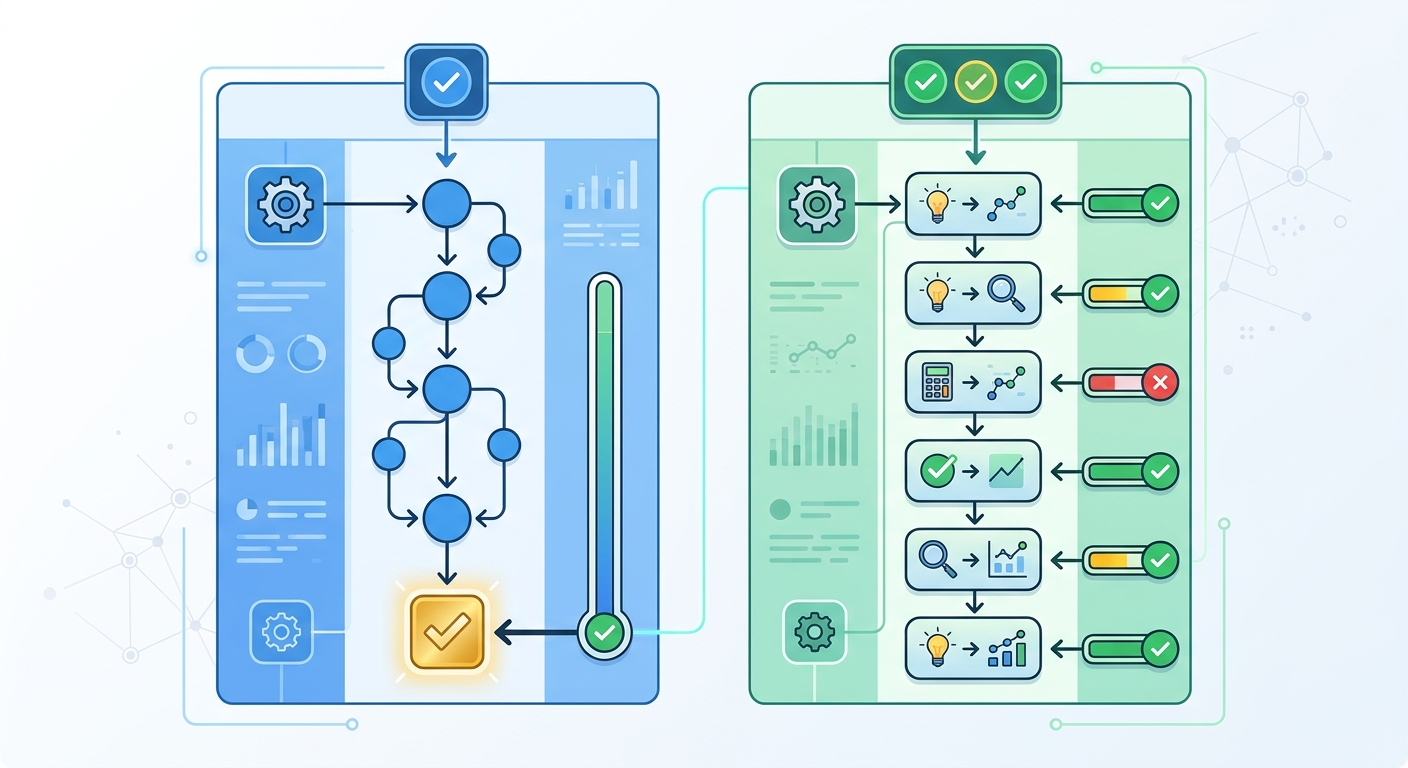
PRMs are used in two distinct modes, and conflating them is a common source of bad architecture decisions:
- As a reward signal in RL. The PRM scores steps during policy training, and the policy is updated to favor high-scoring step sequences. This is the "step-level RL" in the title.
- As a scorer at inference. The PRM ranks candidate partial traces during best-of-N sampling or step-level tree search. No policy update — just a better selection procedure. Many production deployments start here because it requires no RL infrastructure.
PRMs vs. outcome reward models vs. verifier models
These three are often conflated. The distinctions matter for architecture decisions:
- Outcome reward models (ORMs) score the final answer. Cheap to label, but sparse and hackable.
- Process reward models (PRMs) score each step. Dense signal, better credit assignment, higher labeling cost.
- Verifier models check correctness — often programmatically or against a reference. A math verifier confirms a numeric answer; a code verifier runs tests. Verifiers serve three roles: they gate final outputs at inference, they generate training labels for PRMs and ORMs, and they act as the reward in RL with verifiable rewards (RLVR). They are not the same instrument as a PRM.
In practice, strong systems combine all three: PRMs guide training and search, verifiers gate final outputs and supply labels, and ORMs remain a cheap baseline. (Compare: ORMs vs. PRMs vs. Verifiers: Choosing the Right Reward Signal)
How step-level labels are generated
Labeling every step by hand is expensive and slow. Three approaches dominate:
- Human annotation — highest quality, lowest throughput. Used for calibration sets and gold-standard evals. PRM800K is the canonical public example.
- Monte Carlo rollout labeling — for each intermediate step, sample many completions from that prefix and estimate the probability of reaching a correct final answer. Steps that reliably lead to success score higher. This is automatable but compute-heavy, and its labels are noisy on hard problems where even many rollouts rarely succeed.
- Hybrid pipelines — MC rollouts generate candidate labels, humans audit a sample, and the PRM is trained on the merged set. Most production teams land here. (Guide: Monte Carlo Rollout Labeling for Step-Level Reward Models)
A critical detail: production PRMs are usually trained on on-policy traces — reasoning generated by the model being trained, not just human-written solutions. A PRM trained only on clean human data learns to score clean human data and mis-scores the messy traces the policy actually produces.
Where PRMs fail: over-optimization and generalization
A PRM is a learned model, and it can be gamed just like an ORM. Three failure modes to design against:
- PRM reward hacking. If the policy is optimized hard against a fixed PRM, it learns to produce steps the PRM likes rather than steps that are correct. Mitigation: periodically refresh the PRM on policy-generated traces, and hold out a verifier-based check on final answers.
- Out-of-distribution steps. A PRM trained on math traces will mis-score code or agent traces. PRMs do not transfer cleanly across domains; budget for per-domain PRMs or a broad, well-audited training mix.
- Label bias. MC-estimated labels favor steps that look promising under the current policy, which can entrench the policy's existing biases. Human-audited calibration sets are how you detect this.
Step-Level RL in Practice: The Current Production Stack
Training loop — policy model, PRM, and rollout budget
The loop is conceptually simple and operationally demanding:
- The policy model generates full reasoning traces.
- A PRM scores each step in every trace.
- The policy is updated to favor high-scoring step sequences.
- The PRM is periodically refreshed on fresh policy traces to prevent over-optimization.
The binding constraint is the rollout budget. Monte Carlo labeling multiplies your inference cost by the number of samples per step, and completions from later prefixes are shorter — so the naive step-count × samples figure overstates cost, but not by enough to make it cheap. A 20-step chain with 16 rollouts per step is on the order of 320 forward passes per training example before you update anything, and that is a lower bound once you account for completion length. Budget planning — not model architecture — is usually what determines whether a step-level RL program is viable. (See: Estimating Rollout Costs for Step-Level RL Training)
Inference-time search with a PRM
Before committing to full RL, most teams get value from PRM-guided search, which needs no policy training:
- Best-of-N with PRM reranking. Generate N full traces, score each with the PRM (aggregated across steps), and return the top-scoring trace. Cheap, effective, and easy to A/B test.
- Step-level beam / tree search. Expand the top-k partial traces at each step, score with the PRM, and prune. This is where PRMs shine on hard problems — but it multiplies inference cost and adds PRM latency to the critical path.
The tradeoff is explicit: best-of-N buys reliability with compute and latency, not with training. Measure the latency budget before you promise a workflow.
Where PRMs plug into RLHF and RLVR pipelines
PRMs are not a replacement for existing RLHF infrastructure — they are an additional reward source that plugs into it. In practice:
- RLHF pipelines keep their preference model for style, safety, and helpfulness, and add a PRM as a step-level term for reasoning-heavy tasks. The two rewards are combined with weights you tune per task.
- RLVR pipelines already have a verifier (unit tests, a math checker, a schema validator). The PRM sits between the verifier's sparse final signal and the policy, providing dense credit assignment so the policy learns which step broke a failing trace, not just that it failed.
- Serving layer. PRM scoring adds latency. Run it offline for training and reranking, or on a smaller distilled PRM for online search. Do not put a large PRM on the hot path of a latency-sensitive agent.
Build vs. buy: how to evaluate
Technical buyers should pressure-test four things before committing:
- Label provenance. Ask how the vendor's PRM was labeled — human, MC, or hybrid — and what fraction was human-audited. A PRM with no audited calibration set is a black box.
- Domain coverage. Demand held-out evals on your domain. A PRM that tops math benchmarks can be useless on your agent traces.
- Over-optimization controls. Ask how often the PRM is refreshed and whether the vendor measures PRM-policy divergence. A static PRM is a liability.
- Latency and cost profile. Get the PRM's per-step latency and the rollout cost of the full training loop. If the vendor cannot give you a rollout-cost estimate, they have not run it at scale.
Build when you have a narrow, verifiable domain, in-house labeling capacity, and a rollout budget you can defend. Buy when you need cross-domain coverage fast and can accept a managed PRM with audited labels. Most enterprises start with PRM-guided reranking (buy or open-source) and graduate to step-level RL only after the reranking ROI is proven.