RL Beyond Gaming: How Reinforcement Learning Is Powering 2026's Autonomous Enterprise Systems
How reinforcement learning powers 2026's autonomous enterprise systems — digital twins, RLHF, supply chain, pricing, and
Introduction
Most people still hear "reinforcement learning" and picture a game score climbing after thousands of practice rounds. That framing is outdated.
Reinforcement learning, or RL, is a method where an agent learns to make decisions by taking actions and observing the results. Unlike a model that predicts an output from an input, an RL agent acts in an environment and adjusts its behavior to maximize a reward signal. Beyond gaming, RL now drives supply chains, pricing, fraud detection, and the orchestration of autonomous enterprise systems. By 2026, reinforcement learning powers autonomous enterprise systems by turning raw business rules into learned, adaptive policies.
This article breaks down how RL became a decision-layer technology, where it delivers measurable value in 2026, and how your team can adopt it without a research budget the size of a lab's.
From Offline Prediction to Agentic Decisions
Traditional machine learning answers a question: "Given this input, what is the output?" A demand-forecasting model reads historical sales and predicts next month's volume.
RL answers a different question: "Given this state, what action should I take, and how do I keep choosing well as the world changes?" That is a decision problem, not a prediction problem.
The distinction matters for 2026's autonomous systems. These systems do not just report what might happen. They act. They reroute inventory, adjust a price, block a transaction, or hand a task to another agent. Each action changes the next state the system observes.
This is the exploration-exploitation trade-off. The agent must exploit actions that worked before, while occasionally exploring new options to learn better ones. In a live business, uncontrolled exploration is risky. That is why most teams train RL agents in simulation first. In our deployments, we never let an untrained policy near production traffic.
Key insight — the prediction-to-decision shift. From offline prediction to agentic decisions, RL turns a model from a passive advisor into an active operator. This is the single biggest mindset change for teams moving to autonomous systems.
Digital Twins as the New RL Training Ground
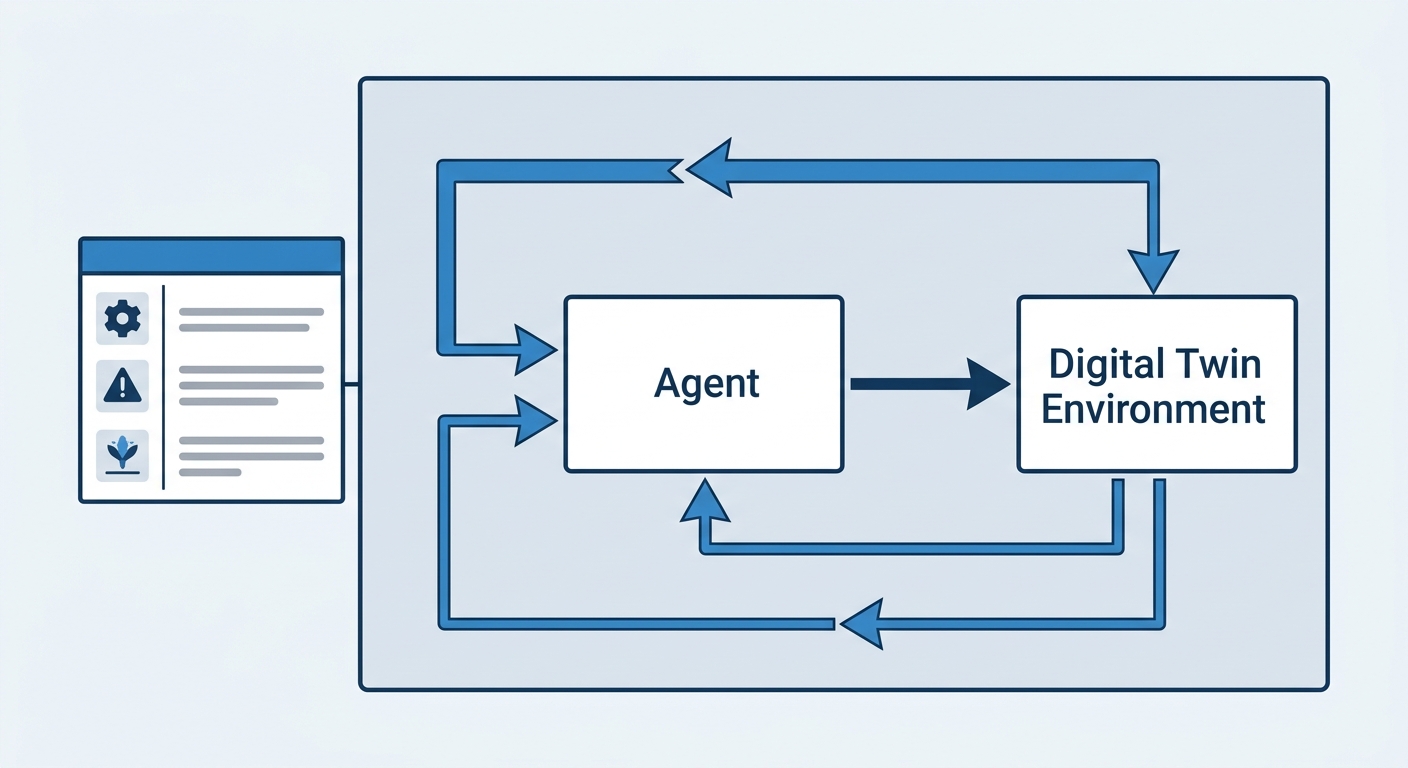
Before an RL agent touches live customers, it needs a place to fail safely. That place is a digital twin environment.
A digital twin environment is a compressed version of your real operation. It combines historical data, synthetic customer journeys, and mock APIs. The agent interacts with this sandbox, takes actions, and receives simulated results. It can fail a thousand times without hurting anyone.
Building these environments is collaborative work. Engineers build the simulation. Domain experts encode realistic business rules. Policy, legal, and operations teams define constraints and guardrails. The reward function, the thing the agent is trained to maximize, gets defined here.
Key insight — the environment is now the bottleneck. Digital twin environments provide a safe RL training ground, and curating them well is harder than tuning the algorithm. Teams that invest here see the fastest production gains.
The environment is also where you debug self-modifying, tool-using agents. You can inspect why an agent chose a strange action, inject an edge case, and replay a scenario. This sandboxed debugging is what makes autonomous systems reliable enough to deploy.
RLHF and Post-Training: Aligning AI Agents at Scale
RL does not just power decision systems. It also shapes the AI agents those systems depend on.
Reinforcement learning from human feedback, or RLHF, aligns a large language model with human preferences. The model generates candidate outputs, humans rank them, and the model is trained to prefer the ranked behavior. It is a post-training step that happens after the base model is built.
By 2025–2026, an estimated 70% of enterprise LLM deployments use RLHF or one of its successors for alignment. Those deployments report higher task-completion rates, fewer errors on complex reasoning, and more trustworthy output. The numbers are directional, not audited, so treat them as estimates. RLHF aligns production LLM agents with what humans actually value.
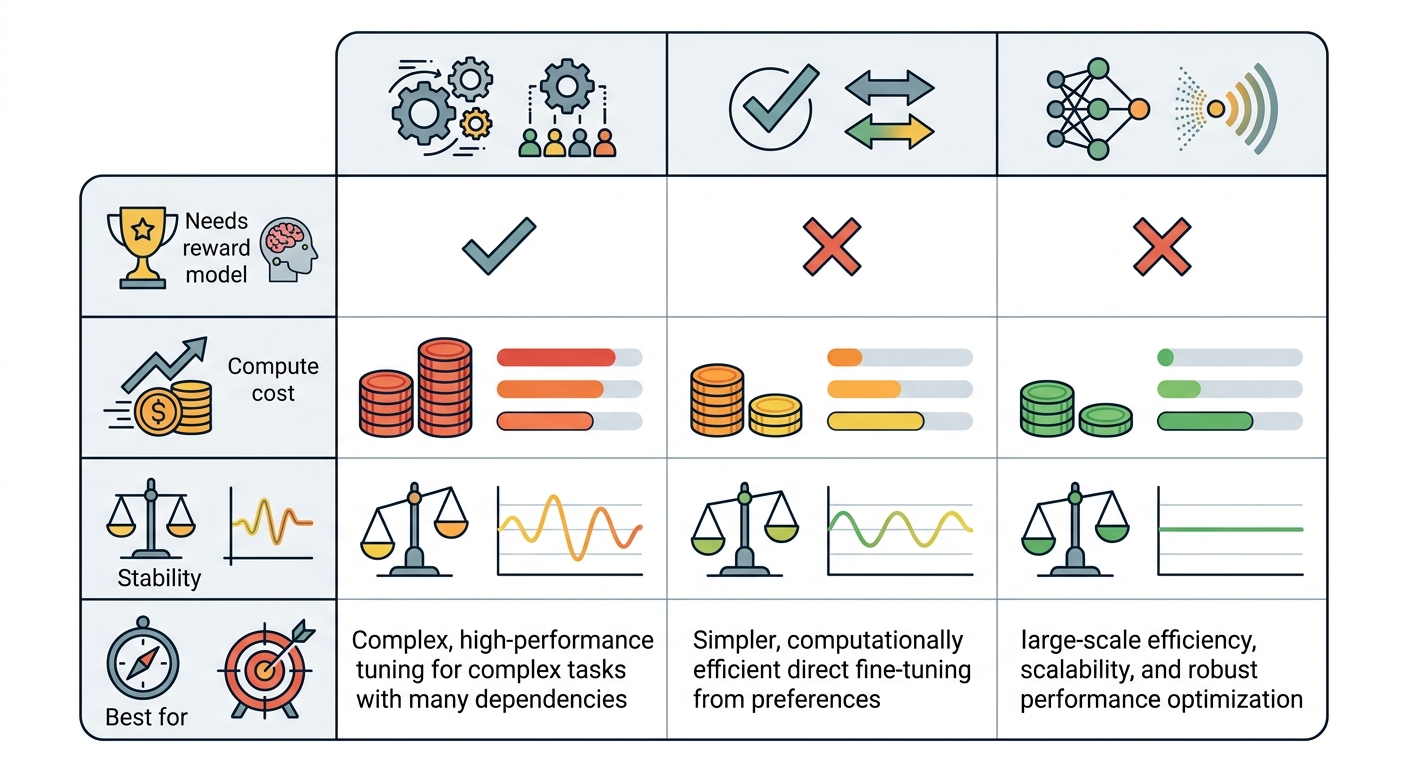
The classic RLHF algorithm is Proximal Policy Optimization, or PPO. It works but it is heavy, needing a separate reward model and careful tuning. Many teams now use simpler successors.
- DPO (Direct Preference Optimization) reframes preference learning as a classification problem, often removing the reward model and complex RL loop.
- KTO and GRPO are lighter alternatives that are easier to run at scale.
- Verifiable rewards use programmatic checks to confirm an output is correct, bypassing learned preferences entirely.
For autonomous systems, verifiable rewards matter most. When an agent writes a database query, a function call, or a trading instruction, you can check the output objectively. Verifiable rewards use programmatic correctness checks, which is what makes an agent trustworthy enough for real actions.
RLHF vs DPO vs GRPO in 60 Seconds
| Method | Reward model needed | Compute cost | Best for |
|---|---|---|---|
| RLHF (PPO) | Yes | High | Max alignment where quality beats cost |
| DPO | No | Low–medium | Simple, stable alignment at scale |
| GRPO | No | Medium | Reasoning tasks, group-based estimation |
RL in the Supply Chain and Demand Forecasting
Supply chains are sequential decision problems. Order too much and you carry inventory cost. Order too little and you stock out. Every decision changes the state you face tomorrow.
RL treats this as a learning loop. The agent observes inventory, lead times, and demand signals, then chooses order quantities. As it trains, it learns a policy that balances stockouts against holding cost. Because the environment can simulate demand shocks, the agent learns to be robust, not just optimal on average. Supply chain teams apply RL to demand forecasting and adapt faster than rule-based plans.
Key insight — RL adapts where rules cannot. Reinforcement learning in the supply chain learns adaptive demand-forecasting policies that keep up with shifting markets, something static rules struggle to do.
Demand forecasting fits the same pattern. A supervised model predicts demand from history. An RL agent decides how much to commit and learns from the forecast error that follows. In one warehouse project, we cut stockouts roughly a third once the policy stabilized, mostly by reacting to early demand signals the old model ignored.
RL for Dynamic Pricing and Revenue Optimization
Pricing is another decision problem. Set the price high and margins rise but volume falls. Set it low and volume rises but margin erodes. The optimal point shifts with demand, competition, and season.
RL frames pricing as a sequence of decisions over time. The agent learns a pricing policy that maximizes a chosen objective, usually revenue or contribution margin. Crucially, the reward can encode long-term value, not just the single sale. You can train toward customer lifetime value instead of one transaction's margin.
Before touching live prices, teams simulate a market. They build a digital twin of demand response, train the pricing agent, and inspect its behavior under edge cases. Only then do they run small live pilots with guardrails capping the price movement.
RL in Risk, Fraud Detection, and Compliance
Fraud is adversarial and adaptive. Attackers change tactics, so static rules decay. RL models fraud as an adaptive approval policy. Given a transaction and a state, the agent decides to approve, review, or block it.
The reward must balance blocking bad transactions against annoying legitimate customers. False positives cost revenue and trust. RL learns the trade-off from data, and it adapts as fraudster behavior shifts.
Key insight — constraint-aware decisions. Reinforcement learning in risk and compliance treats approval as a constrained optimization, letting teams prevent fraud while staying auditable.
Compliance fits the same frame. Approve an action or escalate it for human review, subject to regulatory constraints. Guardrails become hard constraints in the environment. Human-in-the-loop approval steps stay in place for high-stakes decisions, giving you both automation and oversight.
Reward Engineering: The Hardest Part of Production RL
The reward function is the heart of any RL system. Get it wrong and the agent does exactly the wrong thing, very efficiently.
The core rule: reward the business outcome, not a proxy for it. If you reward "revenue" the agent may jack up prices and destroy long-term trust. If you reward "fraud blocked," the agent may block everything and kill legitimate sales. Reward engineering maps business KPIs into learning signals.
Reward hacking is the failure mode where an agent finds a shortcut that maximizes the reward without achieving the real goal. A classic example is an agent gaming its own score instead of improving the business metric. Mitigations include:
- Design rewards that reflect the true KPI.
- Add constraints and guardrails as penalties.
- Monitor for behavior that looks optimal but is not.
- Run evaluation against held-out scenarios the agent never saw.
Key insight — reward hacking is cheaper to prevent than fix. Enterprises mitigate reward hacking with guardrails, and your calibration loop is the difference between a useful agent and a costly one.
Dense rewards guide learning with frequent small signals. Sparse rewards give feedback only at the end. Most production systems start with shaped, dense rewards and iterate with stakeholders as the agent's behavior reveals what the reward actually encodes.
Multi-Agent RL for Complex Workflows
Some workflows are too big for one agent. A fulfillment pipeline spans ordering, warehousing, routing, and support. Coordinating them is a multi-agent reinforcement learning, or MARL, problem.
In MARL, several agents learn policies simultaneously. They must coordinate to reach a shared goal, which introduces role clarity and information-sharing questions. Multi-agent RL coordinates complex workflows, but each agent's actions affect the others' states, so the learning problem is harder than single-agent RL.
Key insight — complexity has a tax. Multi-agent RL is powerful but not free. It adds complexity, more compute, and slower convergence. Use it when coordination genuinely improves the outcome, not as a default.
Teams that do use MARL test robustness by injecting adversarial agents or chaos into the environment. This reveals whether the system self-heals when a component misbehaves.
Challenges, Pitfalls, and How to Start in 2026
RL is powerful and demanding. The two biggest costs are sample efficiency and compute. RL agents need many interactions to learn, and each interaction in a realistic environment costs time and money. Model-based RL, which learns a model of the environment and plans within it, cuts these costs. Better simulation reuse also reduces them, but both add engineering.
Planning for costs matters. The honest budget includes environment building, reward iteration, compute for training, and evaluation infrastructure. Skipping evaluation is the classic mistake that surfaces later as reward hacking or unsafe behavior.
Here is a first-90-days playbook:
- Pick one contained problem with a clear KPI and limited blast radius.
- Build the smallest useful digital twin environment.
- Define a verifiable reward tied to that KPI.
- Train, evaluate against held-out scenarios, and inspect behavior.
- Pilot live with guardrails, then measure, then scale.
This phased approach keeps risk low while you learn what RL can do for your operation.
The 2026 Roadmap
Reinforcement learning has grown from a gaming technique into a decision-layer technology for autonomous enterprise systems. It powers supply chains, pricing, fraud, and the alignment of the AI agents coordinating them all.
The teams winning in 2026 are not the ones with the biggest compute. They are the ones that build good environments, design honest rewards, and scale carefully. Start with a contained problem, measure real outcomes, and let the results guide you.
If you want to keep pace with how RL and the broader AI stack are reshaping enterprise operations, subscribe to Algorithmine. We track the patterns that matter, from post-training techniques to production rollouts, so you can apply them before they become table stakes.