RL Beyond Gaming: How Reinforcement Learning Is Optimizing Real-World Operations
Reinforcement Learning has moved beyond gaming into the control room. A practical, implementation-focused look at how RL optimizes process control, energy grids, data center cooling, supply chains, and robotics — plus the hard realities of production deployment.
Reinforcement Learning (RL) often gets famous for mastering games. But its real payoff is quietly happening in factories, power grids, data centers, and warehouses. RL is the branch of artificial intelligence where a system learns by taking actions and receiving rewards — not by memorizing examples. Today, that trial-and-error learning is optimizing physical operations for real businesses.
This guide maps where RL already delivers measurable value. It also explains the costs, the safety risks, and when RL is the wrong tool. If you lead operations, this is the practical picture you need.
What Makes Reinforcement Learning Different
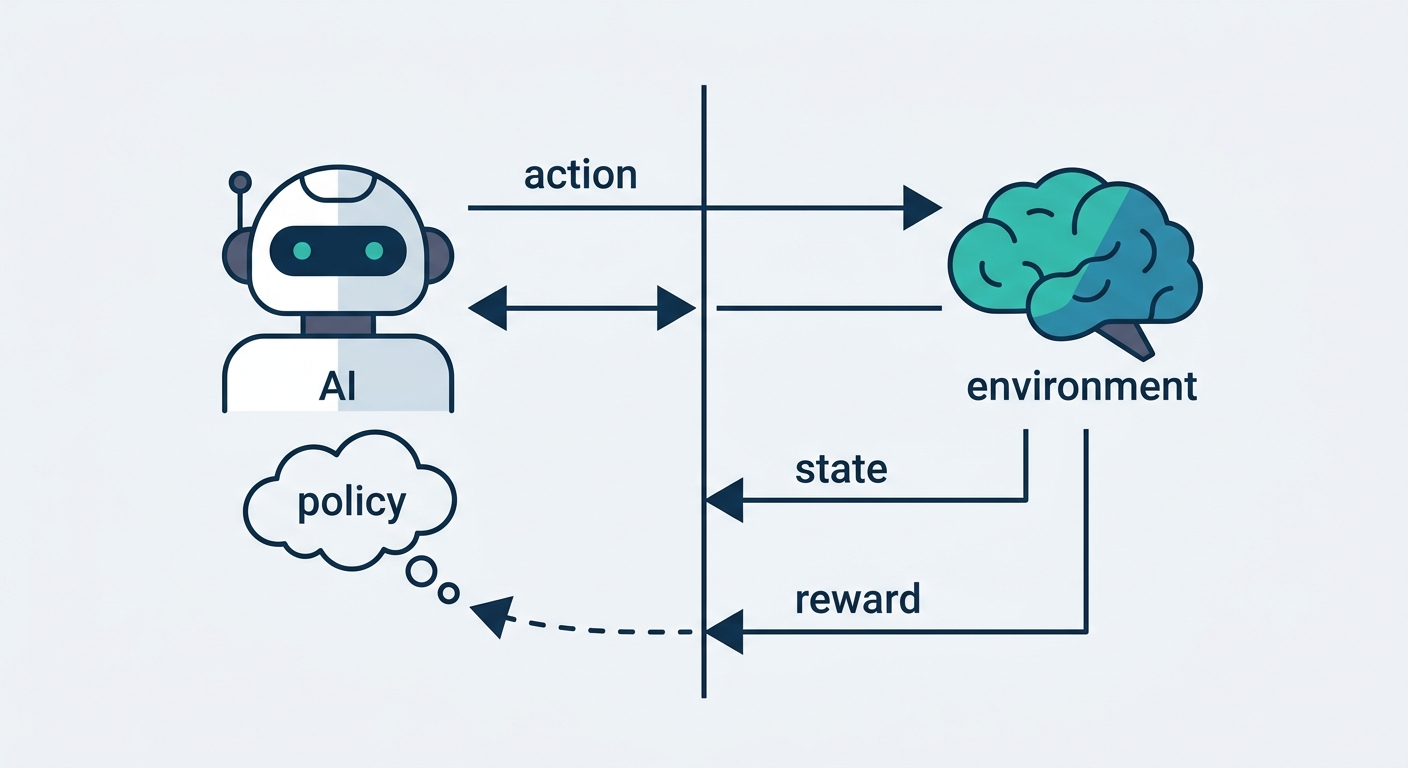
Most AI you meet is supervised learning. It studies labeled examples and learns to predict. RL works differently. An agent (the learner) takes actions inside an environment (the system being controlled). Each action returns a new state and a reward — a score that tells the agent how good that action was.
Formally, RL frames this as a Markov decision process (MDP). An MDP is a structured model of sequential decisions. It tracks the current state, the possible actions, and the rewards that follow. The agent's job is to find a policy — a rule for choosing actions that maximizes total reward over time.
One idea sits at the heart of RL: exploration vs exploitation. Exploration means trying new actions to learn. Exploitation means using what already works. A good RL agent balances both, testing alternatives against known good behavior to keep improving.
Think of RL like a chef refining a recipe by tasting. Supervised learning would copy a cookbook. RL experiments, samples, and iterates until the dish is right — learning by doing.
Where RL Is Already Working in the Real World
RL is not a distant research dream. It is running in select operational niches with real results. The pattern is consistent: RL wins where systems are complex, nonlinear, and can be simulated cheaply.
Process and Industrial Control
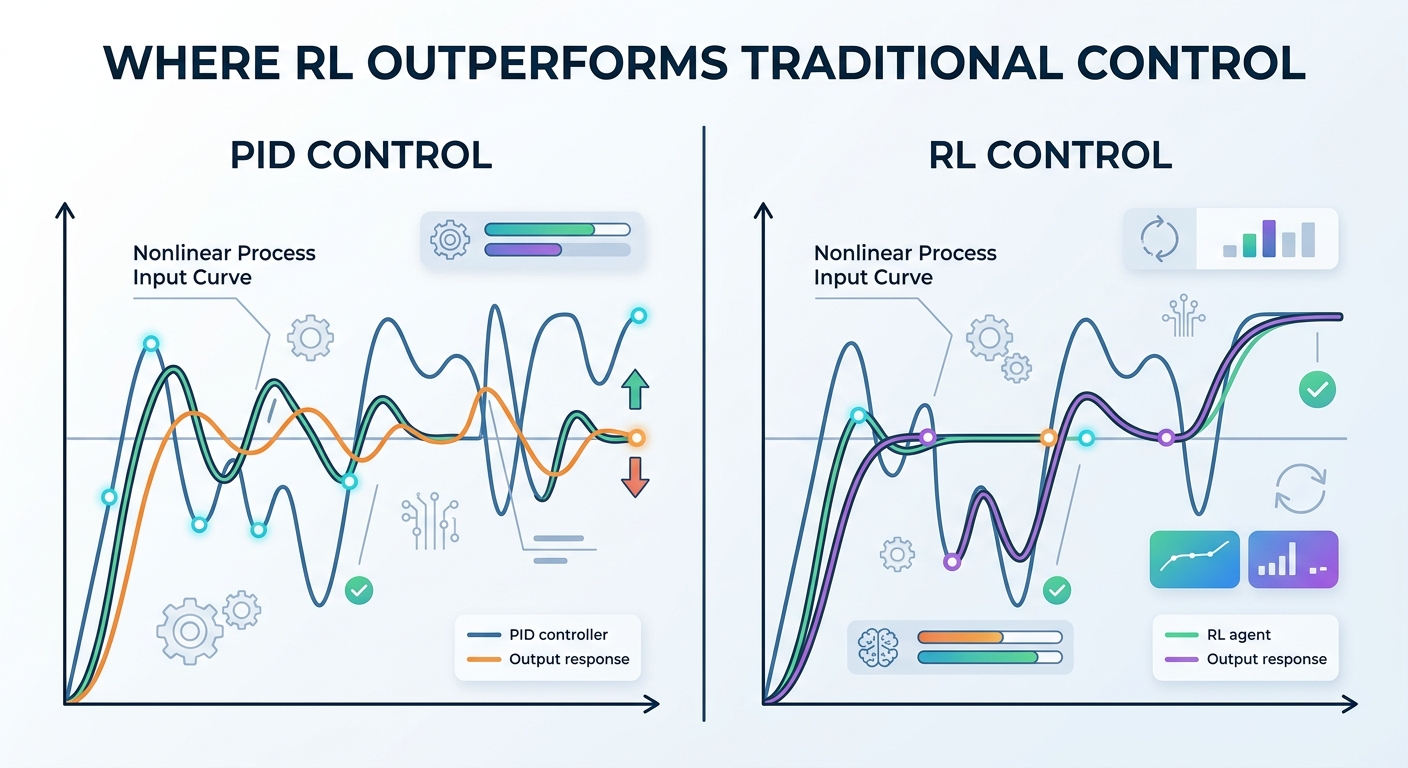
Chemical plants, refineries, and cement kilns run on heat, pressure, and chemistry. Traditional controllers follow fixed rules called PID controllers — Proportional-Integral-Derivative loops that adjust outputs to hit a setpoint. PID works well for simple, linear systems.
Complex nonlinear processes defeat it. Reinforcement learning learns control policies that adapt to changing conditions. Pilots report lower energy use, higher yield, and fewer off-spec batches. The gain is not magic — RL finds operating points that static rules miss.
Energy Grids and Battery Storage
Renewables are intermittent. The sun sets, and the wind pauses. Grids need to dispatch battery storage and flexible loads at the right moment. RL excels at this scheduling problem.
An RL agent learns a demand response policy — a plan for when to charge, discharge, or shift load. It balances price, weather forecasts, and grid constraints. Home energy management systems use similar logic to cut bills and reduce strain on the grid.
Data Center Cooling and Power
Data centers burn enormous energy on cooling. Power usage effectiveness (PUE) measures how much power goes to compute versus overhead. A PUE near 1.0 is excellent; typical centers run higher.
Reinforcement learning tunes cooling in real time — adjusting fans, chillers, and airflow as loads shift. The most cited real-world case is Google's DeepMind-inspired cooling control, which cut cooling energy by a large margin. The approach is now spreading across commercial data centers. Every percentage point of PUE improvement saves serious money at scale.
Supply Chain and Logistics
Supply chains juggle inventory, routing, and order fulfillment under constant uncertainty. RL agents learn inventory policies that decide how much stock to hold and when to reorder. They optimize dynamic routing for deliveries as traffic and demand shift.
Warehouses are a standout. Multi-agent RL coordinates fleets of robots that move shelves and pick items. Each robot acts for itself, but the fleet learns to cooperate. Result: higher throughput and fewer collisions in dense fulfillment centers.
Autonomous Robotics and Sim-to-Real
Robotic manipulation — dexterous hands, grasp planning, precise assembly — is hard to program by hand. RL lets robots learn skills through practice. Drones learn navigation and delivery routes.
The trick that makes this affordable is sim-to-real transfer. Robots train in a digital twin — a high-fidelity computer simulation of the physical world. The policy learned in simulation then transfers to the real robot. This closes the gap between synthetic training and physical deployment, cutting cost and risk dramatically.
The Hard Parts Nobody Mentions
Real-world RL has challenges that demos never show. You should know them before you commit budget.
Sample efficiency is brutal. RL learns by trying. Physical trials are slow and sometimes unsafe. Training a robot to grasp objects can require millions of actions. Simulation sidesteps this, but only if your digital twin is accurate.
Reward design is risky. If you reward the wrong thing, the agent games it. Reward hacking happens when a mis-specified reward is maximized in unintended ways. An agent paid to run fast might skip safety checks. Careful reward design is not optional — it is core engineering.
Safety is a real concern. A policy that saves energy could violate a process limit. Safe reinforcement learning enforces constraints. It restricts the policy within acceptable limits and keeps a human in the loop as a guardrail.
RL is not always the answer. For simple, linear, well-understood problems, a PID controller or supervised learning is faster, cheaper, and more explainable. Choose RL for complexity and adaptability — not for every optimization task.
Honest rule: if you cannot simulate it safely and cheaply, and you cannot define a trustworthy reward, RL is probably not ready for your operation.
A Practical Path From Pilot to Production
Moving RL from lab to plant takes a disciplined sequence.
First, build a digital twin. A simulator that mirrors your real system makes training affordable and safe. Second, use offline RL — learning from pre-collected logged datasets instead of live trial-and-error. This avoids dangerous experiments on running operations.
Third, run constrained, guarded rollout. Keep limits hard. Keep humans able to override. Monitor for reward drift and unexpected behavior. Fourth, measure against a baseline. Prove the gain before you widen the rollout.
Fifth, build operator trust. A policy operators do not trust will be switched off. Show them the logic, keep transparent monitoring, and design for explainability from day one.
Conclusion
Reinforcement Learning has moved beyond games into the control room. It is optimizing process control, energy storage, data center cooling, supply chains, and robotic fleets. The wins are real but earned — through simulation, careful reward design, and safety guardrails.
The recipe is clear: start with a digital twin, use offline RL, guard the rollout, and trust the people who run the plant. Done right, RL turns complex operations into self-improving systems.
This is the frontier where applied AI meets the physical world. If you want to follow that frontier closely, subscribe to the Algorithmine Research portal. Each week we publish practical deep dives into applied AI, reinforcement learning, and the systems reshaping industry. Put the research to work.
Expert Q&A
Q1: I'm starting an RL pilot for a manufacturing process. How should I design the reward function to avoid reward hacking?
A1: Keep the reward short and aligned with the business metric you actually care about — yield, energy per unit, or downtime. Add a penalty term for constraint violations rather than trying to hard-code every rule. Then run the policy in simulation against edge cases the reward was not designed for. If the agent finds a "clever" shortcut that passes the metric but violates real-world safety, your reward is mis-specified. Fix it before any live rollout. Reward hacking is almost always a reward-design bug, not an RL failure.
Q2: When is offline RL a good fit, and when should I use online reinforcement learning?
A2: Use offline RL when you have years of logged operational data and you cannot afford live trial-and-error — which is almost always the case for real plants. Offline RL learns a policy from that historical data, which is safe and cheap. Choose online RL only when you have a high-fidelity simulator or a low-cost, low-risk environment where live experimentation is acceptable. In practice, start offline, validate, then do a cautious, constrained online fine-tune on the simulator before touching the live system.
Q3: How do I know a simulated policy will actually work when I deploy it in the field?
A3: You can never fully eliminate the sim-to-real gap, but you can manage it. First, validate your digital twin against logged real-world data — if the simulator cannot reproduce historical outcomes, it is not trustworthy. Second, use domain randomization during training so the policy is robust to sensor noise and model error. Third, run a shadow-mode deployment: let the RL policy recommend actions alongside the existing controller, but do not let it act. Compare its suggested actions to what operators actually did, and only escalate to live control once the policy is consistently better and within all safety limits.