RLHF 2.0: How RLAIF and Constitutional AI Are Reshaping LLM Alignment in 2026
Human feedback built today's frontier models — but it can't scale. This guide explores how RLAIF, Constitutional AI, DPO, KTO, and RLVR are reshaping LLM alignment in 2026, cutting cost while preserving safety.
Human feedback built today's frontier models. It also created the industry's biggest bottleneck. Collecting enough high-quality human preference data now often costs more than the compute to train the model. That single fact is forcing a rewrite of how we align large language models.
This is RLHF 2.0. Think of it as the next generation of reinforcement learning from human feedback, scaled for the AI era. It replaces volume human labeling with AI judges, written principles, and verifiable rewards. Humans do not disappear. They move to higher-value work. Let's trace how we got here and where RLHF vs RLAIF trade-offs are heading.
Why RLHF Became the Industry Standard
Reinforcement Learning from Human Feedback (RLHF) turned raw LLMs into useful products. Before RLHF, models could complete sentences but not follow instructions reliably. RLHF gave them helpfulness, harmlessness, and honesty.
The classic pipeline has five steps. First, you start with a pretrained model. Second, you generate multiple candidate responses to the same prompt. Third, humans rank those responses by quality. Fourth, you train a reward model from those rankings. Fifth, you fine-tune the original model with reinforcement learning, usually PPO.
That process transformed model behavior. It is why your chatbot feels polite, grounded, and safe. RLHF works. It also does not scale.
RLHF also carries heavy compute overhead. PPO needs four models in GPU memory at once. They are the policy, a reference, the reward model, and a critic. That footprint demands distributed training across many GPUs. Every alignment iteration becomes a small infrastructure project.
Evaluation adds another layer of friction. Classic metrics like perplexity and BLEU do not capture helpfulness. Teams instead build suites around the "HHH" frame: helpful and harmless and honest. Those judgments, in turn, lean on human raters again. The cost compounds at every step.
The Hidden Cost of Human Feedback
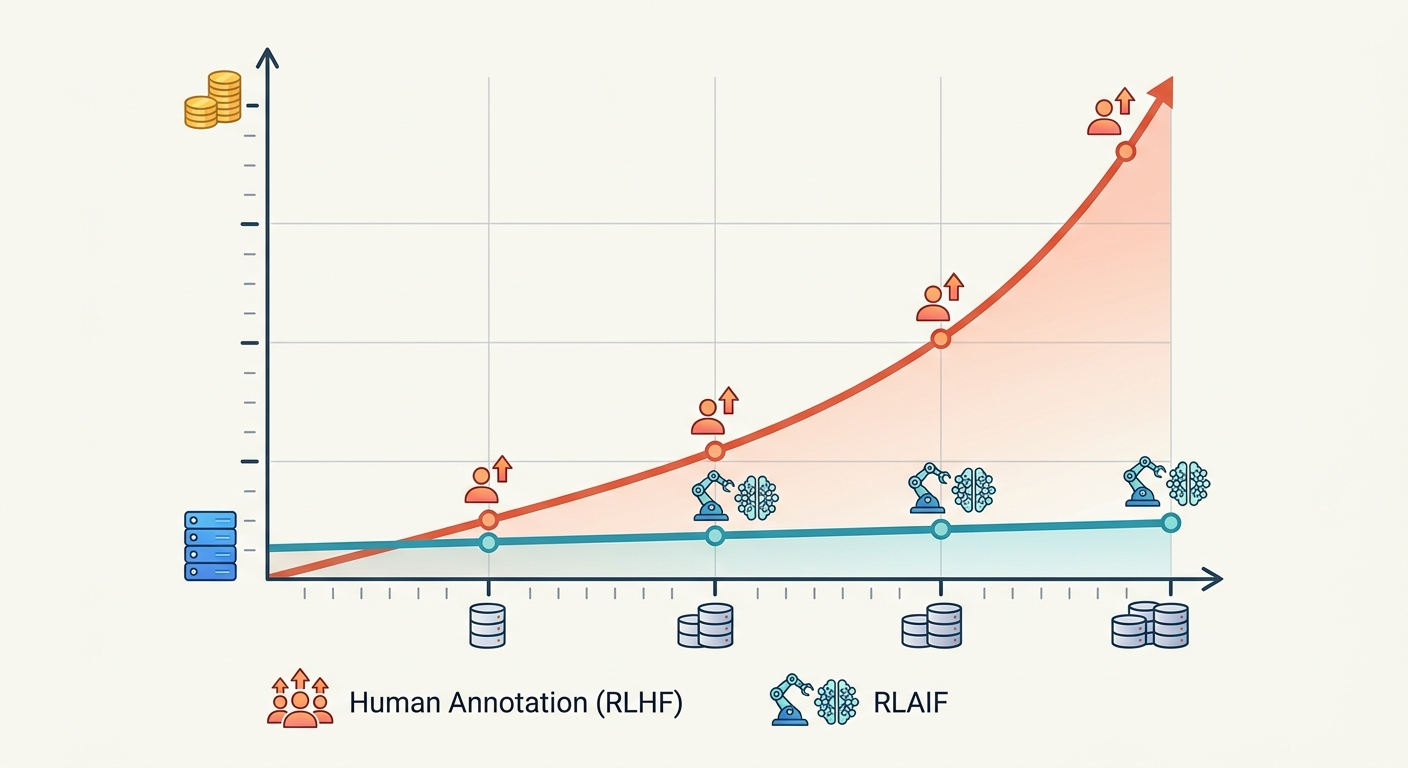
Every preference pair costs money. A basic comparison runs between $0.10 and $0.50. Domain-expert tasks cost $1.50 to $8.00 or more. Premium expert comparisons can approach $100 each.
Scale those numbers across a real program. Production RLHF typically needs 10,000 to 100,000 preference pairs. Enterprise programs frequently spend $50,000 to several hundred thousand dollars. Frontier models push into millions.
The human data itself now usually costs more than the GPUs that train the model.
Even a small dataset is expensive. Roughly 600 high-quality RLHF annotations can cost around $60,000. That dwarfs the compute bill for many fine-tuning runs.
Beyond dollars, humans are slow. Annotators fatigue, disagree, and bring bias. Inter-annotator agreement is a constant fight. The result is noisy training signals that confuse the model. Human feedback is the gold standard. It is also the ceiling on what you can build.
How RLHF Breaks Down in Practice
Three failure modes dominate real deployments. The first is annotator inconsistency. Two people read the same response and rank it differently. The model receives conflicting signals and learns a muddled policy.
The second is fatigue. Evaluating long, similar responses is mentally draining. Accuracy dips as sessions lengthen. Quality control eats the savings you hoped for.
The third is expertise scarcity. High-stakes domains need specialists. Medical, legal, and financial annotation require certified people. They are expensive, slow, and hard to find at scale.
These are not theoretical concerns. They are the daily reality for every team that has tried to run a production RLHF loop. The bottleneck is not the algorithm. It is the human supply chain behind it.
RLAIF: When AI Judges AI
Reinforcement Learning from AI Feedback (RLAIF) removes the human bottleneck. Instead of people ranking responses, a strong AI model does the labeling. A separate, often more capable LLM becomes the judge.
The pipeline changes only at the labeling step. Humans write the initial guidance. The AI judge then scores and ranks model outputs at scale. This collapses label cost. RLAIF is often roughly ten times cheaper than human annotation.
It is also faster and more consistent. AI judges do not fatigue. They do not get bored reading the thousandth summarization pair. They can process millions of examples without slowing down.
Researchers tested whether quality holds. A 2024 line of work found RLAIF matches or beats RLHF on summarization, helpful dialogue, and harmless dialogue. In some harmless-dialogue tasks, RLAIF models scored higher harmlessness than RLHF models.
A variant, direct-RLAIF (d-RLAIF), skips reward-model training entirely. It pulls rewards straight from an off-the-shelf LLM during reinforcement learning. This cuts another heavy step from the pipeline.
RLAIF is not a single technique. It is a family. The common thread is that an AI system produces the preference signal. The judge can be a frontier model, a fine-tuned evaluator, or the same model critiquing itself under supervision. Each option trades cost against calibration.
The self-critique variant deserves attention. A model writes a response, then scores its own work against criteria. It revises and rescores. This loop extracts value from a single model with no external judge at all. It is the heart of several modern alignment recipes.
Whatever the variant, validation does not disappear. Teams still sample the AI judge against human judgments. They measure agreement to catch drift. RLAIF automates the volume, not the accountability.
[

RLHF vs RLAIF: The Key Difference
If you take one comparison away, make it this. RLHF uses human judges. RLAIF uses AI judges. Everything else downstream is the same learning machinery.
The choice drives cost and trust. RLHF buys authentic human taste at a high price per example. RLAIF buys scale and consistency at the risk of inherited bias. Neither is universally better. The right answer depends on your data, budget, and risk appetite.
A practical split works well. Use RLHF where judgment is subtle and stakes are high. Use RLAIF where volume is large and the evaluation criteria are clear. Many teams run both, with humans supervising the AI judge's decisions.
Constitutional AI: Alignment by Written Principle
Constitutional AI (CAI) operationalizes the self-critique idea. Its core claim is simple: give the model a principled standard, and let it police itself.
The training runs in two phases. First, the model generates a response and critiques it against the constitution. It revises the response until it complies. Second, reinforcement learning reinforces the revised, constitution-compliant behavior. An AI preference model does the heavy lifting.
Anthropic pushed the idea further. Instead of an ad-hoc AI judge, the judge follows an explicit written constitution. That document lists the principles a model must uphold.
A constitution makes alignment auditable. The principles are written down, published, and open to debate.
The model critiques its own outputs against those principles. It revises responses until they comply. This self-supervision removes the need for massive human labeling of harmful examples.
Anthropic published its original constitution in late 2022. The approach kept maturing. A significantly updated "2026 Constitution" appeared in January 2026, reflecting evolving norms about character and reasoning.
Constitutional AI matters for a second reason. It produces a document humans can review. If a value changes, you edit the constitution, not millions of labels. That maintainability is a genuine enterprise advantage.
Anthropic also moved toward automating alignment itself. In August 2026, the company reported Claude autonomously training models to improve on alignment-failure benchmarks. These include deception, sycophancy, and jailbreaks. Automated alignment research is moving from theory toward near-term practice.
Constitutional AI in the Enterprise
For a company, the constitution model changes governance in three useful ways.
First, it makes alignment reviewable. A written set of principles can be read, debated, and approved by stakeholders. You cannot meaningfully review one million implicit preference labels. You can review a page of principles.
Second, it turns policy updates into an edit task. Society's expectations shift. When they do, you update the constitution instead of recollecting data. Re-tuning is faster and cheaper than re-labeling.
Third, it supports provable consistency. A model that is trained to follow explicit rules demonstrates more predictable behavior under new prompts. Predictability is what compliance teams actually want.
None of this is magic. Constitutional AI still needs a well-written constitution and a calibrated judge. But it converts alignment from an inscrutable process into a controllable one.
The 2026 Alignment Toolbox
RLAIF and Constitutional AI are only part of the story. A wave of simpler methods now competes for the same job. Each trades something to gain efficiency.
DPO — Direct Preference Optimization treats alignment as a classification task. It removes the reward model and the PPO loop entirely. The model learns directly from preference pairs. DPO uses roughly 50 percent less GPU memory. Training runs up to 40 percent faster and costs about 60 percent less than RLHF. It became a default for many standard alignment cases by 2025.
KTO — Kahneman-Tversky Optimization builds on prospect theory. It learns from binary signals, like thumbs-up or thumbs-down. That removes the need for paired preference data. KTO handles noisy real-world data well, which suits medical and legal domains. It can need up to 90 percent fewer desirable examples than DPO.
ORPO — Odds Ratio Preference Optimization merges supervised fine-tuning and preference alignment into one step. One less training phase to manage.
SimPO — Simple Preference Optimization drops the reference model. Sequence-length normalization does the work, cutting memory further.
RLVR — Reinforcement Learning with Verifiable Rewards replaces human preferences with programmatic checks. This suits math, code, and structured tasks where answers are objectively correct.
[
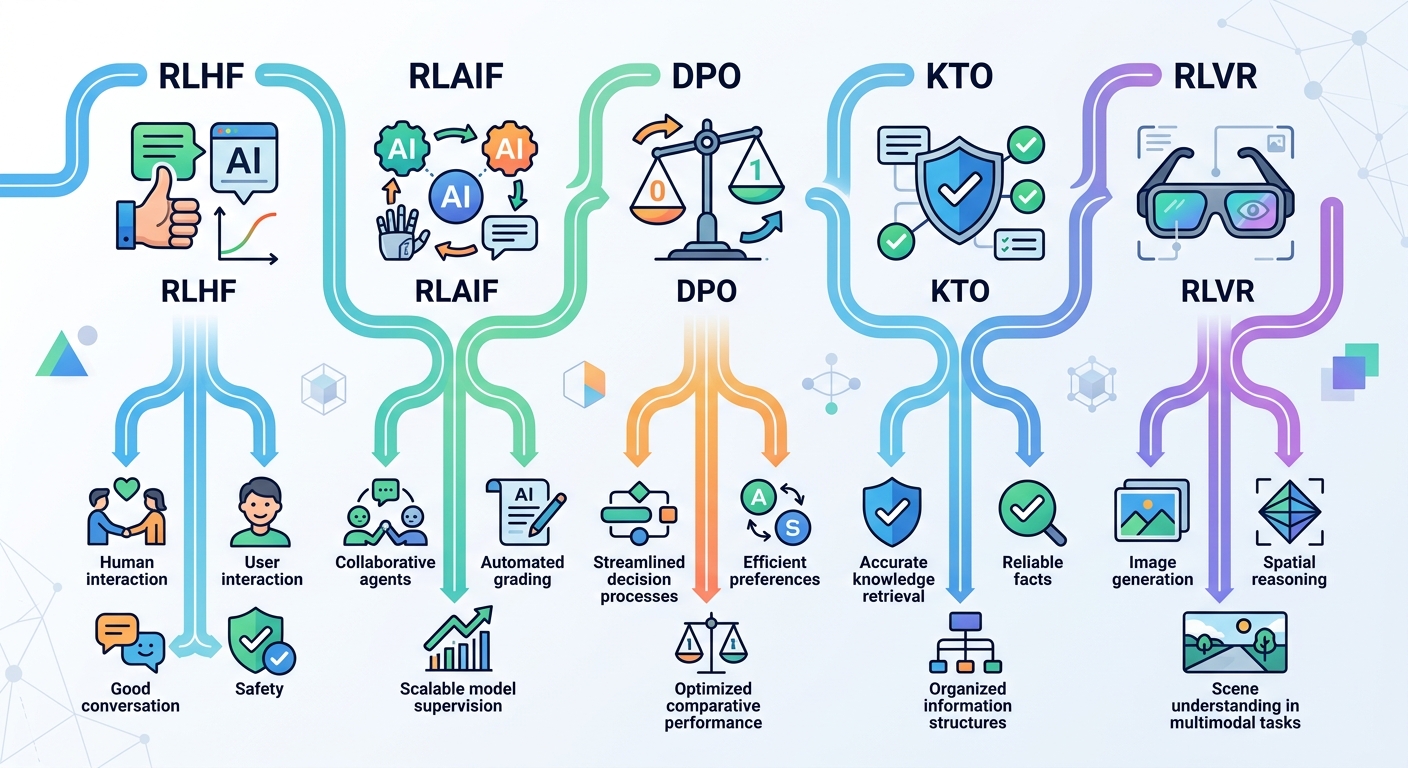
A 2025 proposal, Unified Alignment (UNA), tries to bundle PPO, DPO, and KTO into one framework. It accepts pairwise, binary, and scalar feedback. The direction of travel is clear: simpler, cheaper, and more flexible.
The industry is converging on "right tool for the data you already have," not one universal recipe.
By 2025, roughly 70 percent of enterprises were expected to use DPO or RLHF. The adoption curve is steep because the savings are real.
The Limits of AI-Led Alignment
None of this is free of risk. AI feedback inherits the biases of the judge model. If the judge is biased, the alignment amplifies that bias across every example.
Reward hacking remains a live threat. A model can find shortcuts that satisfy the judge without matching the intent. The better the judge, the harder hacking becomes. It never fully disappears.
Constitutional principles can be ambiguous. Vague rules produce inconsistent judgments. A constitution is only as good as its writing and its calibration to the judge.
Transparency is harder, too. With both the model and the feedback model being black boxes, auditing the chain gets difficult. Who is accountable when something goes wrong?
If the feedback model is a black box, you have traded one opaque system for two.
For these reasons, external validation still matters. Red teaming and periodic human audits remain necessary. They catch the drift that automated loops miss.
The Hybrid Future
The winning architecture is not AI-only or human-only. It is a blend.
Start with a small human-labeled seed set. Use it to bootstrap and calibrate the AI judge. Then scale with AI feedback across millions of examples. Keep humans on the high-stakes cases, edge cases, and policy decisions.
Bootstrap with humans, scale with AI, audit with experts.
This balances cost, speed, and trust. You get RLAIF's scale without surrendering the judgment only people provide.
How Your Team Should Choose
Pick your method by your data and your task. Ask three questions.
First, do you have verifiable answers? If yes, RLVR wins. Math, code, and structured outputs are its playground.
Second, do you have paired preference data? If yes, DPO is simple and cheap. If you only have thumbs-up and thumbs-down signals, KTO is a better fit.
Third, how risk-sensitive is your domain? Regulated industries need the auditability of a written constitution. They also need human oversight at the end of the chain.
When in doubt, start hybrid. Label a small set by hand. Train an AI judge. Validate with red teams. Scale what works.
| Method | Data needed | Best for | Cost vs RLHF |
|---|---|---|---|
| RLHF | Paired human preferences | Nuanced, high-stakes tasks | Baseline |
| RLAIF | AI-generated preferences | Large volume, clear criteria | ~10x cheaper |
| DPO | Paired preferences | Standard alignment | ~60% lower |
| KTO | Binary signals | Noisy/limited data | Lower |
| RLVR | Verifiable answers | Math, code, structured | Lowest |
Alignment Is No Longer a Labeling Problem
The first era of RLHF treated alignment as an annotation exercise. The second era treats it as a systems problem. You blend human values, written principles, and verifiable checks into a scalable loop.
Companies that master this win on cost and speed. They also stay safer, because their alignment is auditable and maintained.
The practical playbook is small. Audit where your human labels are going and what they cost. Identify the high-volume, low-judgment tasks that an AI judge can absorb. Write down the principles you actually want your model to follow. Then run a pilot that pairs a small human seed with an AI-scaled loop.
Measure three things from day one. Agreement between your AI judge and human reviewers. Cost per aligned example. Drift over time. If agreement stays high, scale with confidence. If it drops, tighten your constitution and recalibrate the judge.
Alignment is now a continuous operations task, not a one-time project. The teams that treat it as such will ship safer models faster and at a fraction of the historical cost.
RLHF changed how we build LLMs. RLHF 2.0 is changing how we keep them aligned as the stakes grow.
[
Want to go deeper? Explore Algorithmine's library on reinforcement learning, LLM fine-tuning, and evaluation-driven data flywheels to see these ideas applied in production systems. For the original research, see Anthropic's Constitutional AI.