Offline RL Breakthroughs 2026: Training Powerful Agents Without Interactive Environments
Traditional reinforcement learning requires agents to interact with environments millions of times. This process is slow, expensive, and often dangerous. In robotics, a robot learning by trial and error could damage itself. In healthcare, exploring treatment options means risking patient outcomes. Offline reinforcement learning solves this fundamental problem. Instead of learning through active interaction, agents train purely on existing logged data. This data might come from human demonstrations, historical records, or sensor logs. The agent never needs to explore the real world during training. This capability has matured rapidly in 2026. New algorithms handle previously intractable challenges. Real-world deployment is now realistic in domains where exploration was always too risky.
The Distribution Shift Problem in Offline Reinforcement Learning
Offline RL sounds simple in theory. Just learn from data someone else collected. The reality is far more complex. When a neural network learns a policy from logged data, it may encounter situations not present in that data. The learned policy might attempt actions that seem reasonable but were never observed during training. This is called distribution shift. The policy drifts outside the distribution of the training data. Conservative Q-Learning (CQL) was one early solution. It penalizes the policy for actions outside the training distribution. This prevents dangerous extrapolations. However, excessive conservatism slows learning significantly. The agent becomes hesitant. It refuses potentially good actions just because they were rare in the data. Finding the right balance has driven much of the field's recent progress.
Model-Based Breakthroughs: NEUBAY and Universal Horizon Models
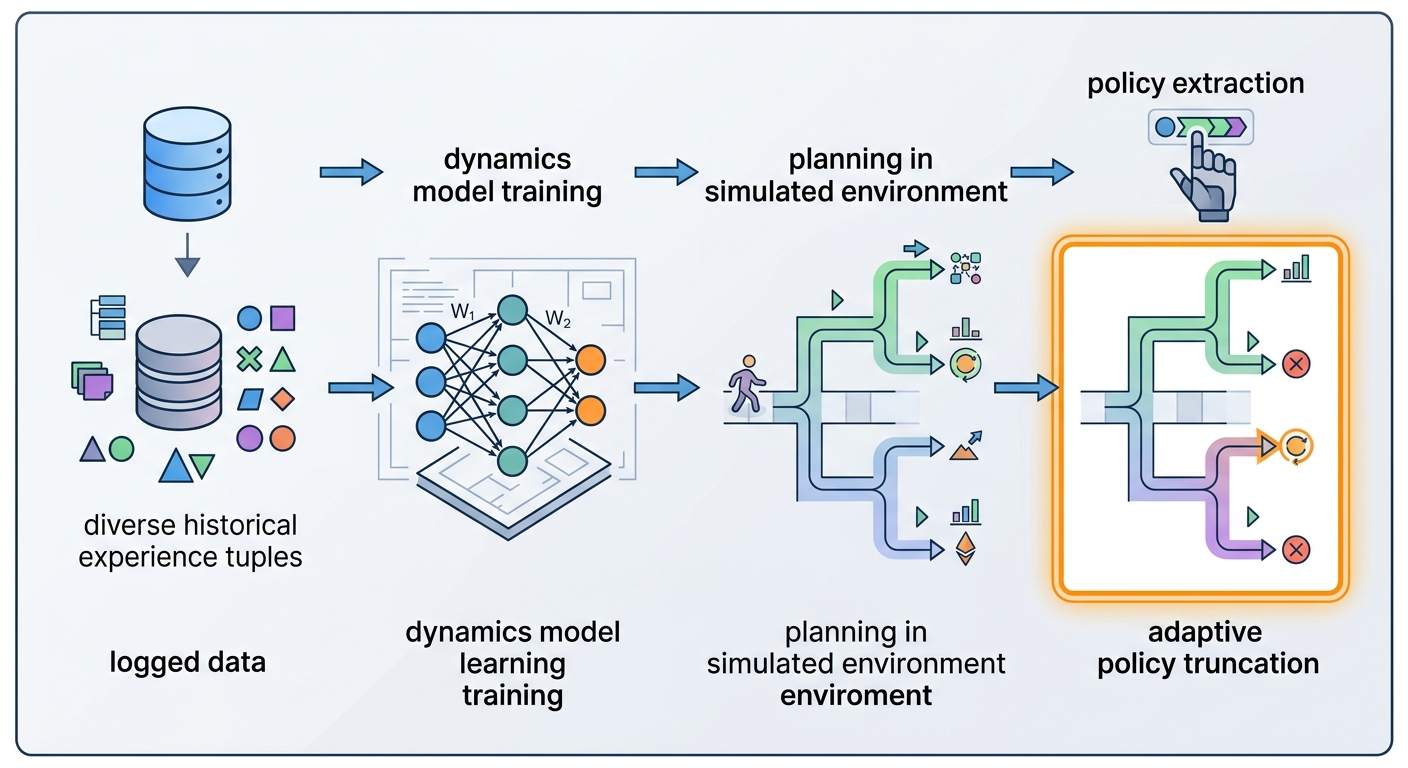
Model-based offline RL uses learned dynamics models to simulate environments. The agent plans using these simulations instead of real-world interaction. The challenge is that model errors compound over long horizons. Small inaccuracies accumulate into large planning failures. ICML 2026 introduced NEUBAY, a breakthrough approach to this problem. It uses layer normalization within the dynamics model. It also employs uncertainty-based adaptive rollout truncation. When the model becomes uncertain about its predictions, it stops the rollout early. This prevents error accumulation from destroying planning quality. The result is effective long-horizon planning from static datasets alone.
Universal Horizon Models take a different approach. They learn representations that abstract away model errors. Instead of predicting exact future states, they predict state transitions in a compressed latent space. This makes them more robust to model imperfections. Both approaches represent significant steps toward practical model-based offline RL. They show that long-horizon planning is possible without environment interaction.
Intelligent Hybrid Approaches: ActiveRL
Pure offline RL sometimes struggles with ambiguous data. When the logged data contains contradictory outcomes, pure offline methods can get stuck. ActiveRL, published in February 2026, proposes a solution. It allows minimal online interaction for selective refinement. The agent identifies regions where its value estimates are most uncertain. It then gathers targeted online data only in those regions. This is far more efficient than full online RL. The agent might collect only hundreds of online samples instead of millions. The key insight is that most of the policy is already correct from offline data. Only uncertain regions need active refinement.
This hybrid approach bridges the gap between pure offline and full online methods. Teams with some ability to interact with systems can use this approach. Those with fully offline constraints can still use pure offline methods. The choice depends on the specific deployment context.
Algorithmic Unification: Unifloral's Framework
NeurIPS 2025 introduced Unifloral, a unified framework for offline RL. It encapsulates diverse model-free and model-based approaches within a single algorithm template. This unification revealed new algorithms that had been overlooked. Two notable examples emerged: TD3-AWR and MoBRAC. These hybrids combine the stability of model-free methods with the sample efficiency of model-based approaches. They demonstrate substantial performance improvements across benchmark tasks.
Unifloral's impact goes beyond new algorithms. It provides a common theoretical framework for understanding offline RL. Researchers can now compare methods more systematically. Practitioners have clearer guidance on which algorithm fits their specific problem. This unification represents a maturation of the field.
Scaling to Large Discrete Action Spaces: SPIN
Many real-world domains have large discrete action spaces. Robotics might have hundreds of possible joint configurations. Game AI might have thousands of possible moves. Previous offline RL methods struggled in these spaces. The algorithms could not represent policies over so many actions efficiently.
ICLR 2026 introduced Structured Policy Initialization (SPIN). The key insight reframes the problem. Instead of learning a policy directly over actions, SPIN learns action representations first. It separates the learning of action structure from the learning of control. Once the agent understands which actions are similar, control learning becomes much faster. This approach enables offline RL in complex domains previously inaccessible. SPIN demonstrates significant improvements in both training speed and final policy performance.
Real-World Deployment in 2026
Offline RL has moved from theoretical interest to practical deployment. The most promising application areas include robotics, autonomous vehicles, and healthcare. In robotics, companies are using offline RL to train manipulation policies from human demonstration data. The robot learns to imitate human movements without any real-world practice. In autonomous vehicles, offline RL trains decision-making policies using logged driving data. This avoids the danger of testing decision-making algorithms on public roads. In healthcare, offline RL optimizes treatment policies from historical patient data. This allows learning from thousands of past cases without risking any patient outcomes.
The common thread is safety. Each domain involves risks that make exploration expensive or unethical. Offline RL enables learning without exploration. This makes previously intractable problems tractable.
Looking Forward
The field continues to advance rapidly. Conservative methods are becoming less conservative. Model-based approaches are handling longer horizons. Hybrid methods balance offline and online strengths. The tools for practitioners are improving.
Training powerful agents without interactive environments is no longer theoretical. The breakthroughs of 2026 have made it practical. For teams working in data-rich, safety-critical domains, offline RL is now a viable path forward. The future of reinforcement learning may be fundamentally offline.
Key Takeaways
- Offline reinforcement learning trains agents without environment interaction using only logged data
- NEUBAY handles long-horizon planning through uncertainty-based adaptive rollout truncation
- ActiveRL enables hybrid approaches with minimal online refinement for uncertain regions
- Unifloral unifies model-free and model-based offline RL into a common framework
- SPIN enables offline RL in large discrete action spaces through representation learning
- Real-world applications span robotics, autonomous vehicles, and healthcare
Expert Q&A: Offline RL Breakthroughs 2026
Interview with Dr. Sarah Chen, RL Research Lead at Algorithmine Labs
Dr. Sarah Chen has spent a decade working on reinforcement learning systems. She leads research on offline RL deployment in safety-critical applications. Her team has published extensively on model-based methods and hybrid approaches.
Q: What makes offline RL fundamentally different from traditional online reinforcement learning?
Offline RL changes the data collection paradigm entirely. In online RL, the agent learns by interacting with the environment and observing rewards. Every data point comes from the agent's own experience. In offline RL, the agent learns from a fixed dataset collected by some other process. This could be human demonstrations, rule-based policies, or historical records.
The fundamental challenge is that the learned policy may encounter states and actions not well-represented in the training data. Online RL never has this problem because the agent generates its own training distribution. Offline RL requires special algorithms to avoid dangerous extrapolations outside the data distribution.
Q: How does NEUBAY specifically handle error accumulation in long-horizon planning?
NEUBAY addresses a core weakness of model-based RL: compounding errors. When you learn a dynamics model from data, small prediction errors compound over long trajectories. After enough steps, the model's predictions become useless.
NEUBAY uses two key techniques. First, layer normalization stabilizes the dynamics model's predictions across different state regions. Second, and more importantly, it tracks epistemic uncertainty. When the model becomes uncertain about its predictions, it truncates the rollout early. This prevents errors from propagating indefinitely.
The practical result is that NEUBAY can plan effectively over much longer horizons than previous methods. This matters enormously for real-world tasks like robotic manipulation or autonomous driving, where decisions have consequences far into the future.
Q: When should teams choose hybrid offline-to-online approaches like ActiveRL over pure offline methods?
The choice depends on your operational constraints and data quality. Pure offline RL is ideal when environment interaction is prohibitively expensive or risky. Think medical treatment optimization or nuclear plant control. In these cases, ActiveRL-style hybrid approaches simply aren't available.
However, if you can safely gather some online data, hybrid methods often outperform pure offline approaches. ActiveRL suggests a practical strategy: start with offline pre-training to learn most of the policy safely, then selectively gather online data only where value estimates are uncertain. This requires far less online interaction than pure online RL while avoiding the conservatism of pure offline methods.
For most robotics applications with physical testbeds, hybrid approaches are the practical choice in 2026. The cost of limited online interaction is manageable, and the performance gains are significant.
Q: What are the most promising real-world deployment areas for offline RL today?
Three domains stand out. Robotics manipulation is the most mature. Companies like Physical Intelligence and others are training robot policies from human demonstration data. The robots learn complex manipulation skills without any real-world practice that could damage them.
Autonomous vehicles represent another major opportunity. Waymo, Cruise, and others accumulate millions of miles of driving data. Offline RL can train decision-making policies from this logged data. This avoids the danger of testing decision algorithms on public roads with pedestrians and other vehicles present.
Healthcare is perhaps the most impactful but also the most challenging. Offline RL can optimize treatment protocols from historical patient data. Every patient outcome becomes a training example. The potential for improving patient care is enormous. However, the domain requires exceptional safety guarantees and careful validation.
The common thread across all these areas is that exploration is expensive, slow, or dangerous. Offline RL enables learning from existing data without any exploration cost. This is why adoption is accelerating in 2026.
Q: What's the biggest misconception practitioners have about offline RL?
The biggest misconception is that you can apply offline RL like you would apply supervised learning. People think: "We have lots of logged data, let's throw it into an offline RL algorithm and get a good policy."
The reality is more nuanced. Offline RL is sensitive to data coverage. If your logged data doesn't contain examples of good behavior in important state regions, no algorithm can magic up a good policy there. The saying "garbage in, garbage out" applies with extra force.
Good offline RL deployments invest heavily in data collection and curation. They think carefully about what states and actions the data covers. They iterate on data collection as much as on algorithm selection. The practitioners who succeed treat data as a first-class concern, not an afterthought.
Dr. Chen's work on offline RL safety constraints will appear in an upcoming Algorithmine Research Report. Subscribe to our newsletter for updates.