Humanoid Robots Hit Commercial Production: Boston Dynamics, Tesla, and Agility in 2026
In 2026, three companies are simultaneously entering or scaling commercial production of humanoid robots: Boston Dynamics with its redesigned electric Atlas, Tesla with Optimus, and Agility Robotics with Digit.
Why 2026 Marks the Commercial Inflection Point for Humanoid Robots
For years, humanoid robots existed primarily in research labs and viral demo videos. In 2026, that changes.
Three companies are simultaneously entering or scaling humanoid robot commercial production: Boston Dynamics with its redesigned electric Atlas, Tesla with Optimus, and Agility Robotics with Digit. This is not coincidence — it reflects converging advances in actuator design, neural network training infrastructure, and enterprise demand for labor automation.
The signals are hard to ignore. First multi-year commercial contracts have been signed with major enterprises including Amazon, GXO Logistics, Toyota Motor Manufacturing Canada, and Schaeffler. Robots-as-a-Service (RaaS) pricing models have emerged, removing the large capital expenditure barrier that kept most enterprises on the sidelines. Industry analysts project an average price decline of 68% by 2030, bringing the typical humanoid robot cost from approximately $115,000 per unit today to around $37,000.
The inflection point is not about any single vendor. It is about the market collectively crossing the threshold from demonstration to operational deployment at commercial scale.
If your organization operates a warehouse, distribution center, or manufacturing facility, the question is no longer whether humanoid robots will become relevant — it is whether to engage now during the early-adoption window or wait for the mass-market economics of 2028+.
Boston Dynamics Atlas — From Research Platform to Production Robot
Boston Dynamics began immediate production of its fully electric Atlas humanoid robot in January 2026. The company retired the earlier hydraulic version and shipped the third commercially available robot in its portfolio, following Spot (quadruped) and Stretch (warehouse arm).
The 2026 production allocation is already committed. Initial units are destined for Hyundai's Robotics Metaplant Application Center (RMAC) and Google DeepMind. Broader availability for additional customers is anticipated in early 2027.
The Hyundai partnership extends beyond deployment. Together, Boston Dynamics and Hyundai are constructing a dedicated manufacturing facility with a production target of 30,000 Atlas units annually by 2028. That scale ambition is aggressive by industry standards and reflects Hyundai's intent to position the Atlas platform as the foundational hardware for next-generation industrial automation.
The electric Atlas is designed for industrial material handling and order fulfillment — tasks that require navigating spaces built for human bodies. Unlike purpose-built warehouse robots, Atlas can climb ladders, traverse stairs, and operate in facilities that were not designed for automation.
Technical Architecture of the New Atlas
The electric redesign addressed the key limitation of the hydraulic predecessor: efficiency. Hydraulic systems deliver high power density but consume significant energy and require complex maintenance. The electric Atlas uses a revised actuator architecture specifically engineered for industrial endurance cycles.
The robot integrates AI-driven locomotion that allows dynamic balance in unpredictable environments — a critical capability for facilities where floor surfaces vary, obstacles appear, and humans and robots share the same aisles. Perception systems provide 360-degree spatial awareness. Safety architectures are designed for ISO collaborative robot standards, though formal certification for dynamically balancing humanoid robots in human-shared environments remains an evolving regulatory area.
Integration with existing warehouse management systems is achieved through standard API connections, enabling task assignment and fleet coordination alongside other automation equipment. Boston Dynamics produces the electric Atlas humanoid robot with a focus on industrial endurance and safety compliance.
Tesla Optimus — Late-Summer Production and the Million-Unit Ambition
Tesla is targeting late summer 2026 for the start of Optimus production. The company completed conversion of its Fremont, California factory for robot production lines in the second quarter of 2026.
The hardware has matured significantly. Optimus Gen 2 stands 173 cm tall and weighs 57 kg — 16 kg lighter than the Gen 1 prototype. Walking speed is 8 km/h with a payload capacity of 20 kg during locomotion. The robot can deadlift up to 68 kg from the ground. Each hand can grip approximately 9 kg.
The Gen 3 hand upgrade, deployed between 2024 and 2026, substantially increased dexterity. Each hand now has 22 degrees of freedom, with 25 actuators per forearm — a biomimetic tendon-pull design that closely mimics human hand capabilities. Tactile fingertip sensors enable precise force control during manipulation tasks.
Battery design reflects Tesla's EV expertise. Optimus uses a 2.3 kWh lithium-ion pack built from the same 4680 format cells as Tesla electric vehicles. For light-to-medium tasks, runtime reaches 8+ hours. Under continuous heavy load, 3–6 hours is more realistic. The robot can self-navigate to charging docks.
The AI stack is perhaps the most distinctive aspect of Optimus. It is built around the same end-to-end neural network architecture that powers Tesla's Full Self-Driving system. The robot processes first-person video from vision cameras — no LiDAR — and learns tasks through imitation learning and reinforcement learning. Training occurs on Tesla's Cortex supercluster, which leverages the same GPU infrastructure used for FSD development. Tesla trains Optimus using an end-to-end FSD neural network that processes raw camera input into motor control outputs.
Price target is $20,000–$30,000 per unit at scale. Tesla's full-scale production ambition is 1 million units per year — a number that, if achieved, would fundamentally reshape the economics of industrial automation. As of March 2026, external sales have not yet opened; Tesla is validating the platform through internal factory deployment first.
Why Tesla's Manufacturing Advantage Is the Key Variable
Tesla is not just building a robot — it is applying vertically integrated manufacturing discipline to a new product category. The 4680 battery cells, motor actuators, and compute infrastructure all draw from existing Tesla supply chains and manufacturing expertise. This is not a startup building from scratch; it is a company adapting proven production systems to a new product line.
If Tesla successfully executes its production ramp, the cost reduction curve could be steeper than competitors because the R&D and manufacturing fixed costs are amortized across a much larger existing production infrastructure. Tesla's manufacturing advantage could drive faster cost reduction than any independent robotics startup.
Agility Robotics Digit — The Commercial Leader with 75+ Units in the Field
Agility Robotics' Digit is currently the most commercially deployed humanoid robot in the world. Approximately 75 units are operational globally as of mid-2026, with active deployments in Amazon fulfillment centers and GXO Logistics warehouses.
Digit's commercial track record dates to late 2023, when both Amazon and GXO began operational deployments. Unlike competitors still in production-ramp or pilot phases, Digit has multi-year operational data from live warehouse environments.
The RaaS contract structure has been key to commercial adoption. Rather than requiring large upfront capital, enterprises subscribe to Digit deployment at approximately $250,000 per year. This package includes the hardware, support contract, software updates, and on-site deployment assistance — a turnkey offering that appeals to operations teams without robotics expertise.
Agility Robotics deploys Digit via a Robots-as-a-Service model that converts CapEx into a predictable operational expense. Agility's RoboFab facility in Oregon maintains production capacity exceeding 10,000 units per year. The company has accumulated over $300 million in multi-year orders for Digit v5, with commercial agreements spanning GXO, Schaeffler, Mercado Libre, and Toyota Motor Manufacturing Canada.
The primary commercial application is logistics manipulation — specifically tote handling. Digit transfers loaded totes from Autonomous Mobile Robots (AMRs) onto fixed conveyors, manages empty totes at putwalls, and handles similar structured pick-and-place workflows that previously required human workers. These are high-frequency, repetitive tasks that generate significant wear on human workers and are well-suited to robotic automation.
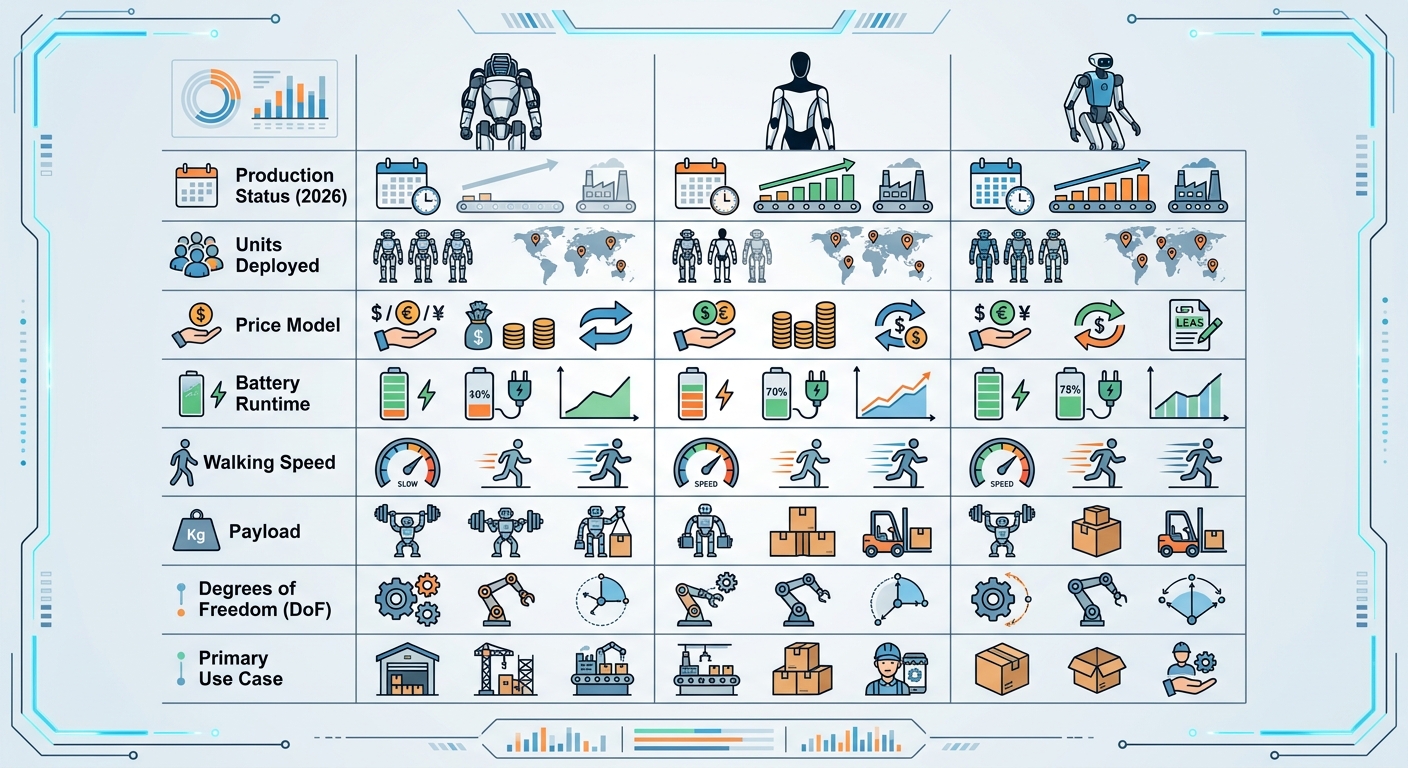
How Digit Integrates with Existing Warehouse Automation
The AMR + humanoid coordination model is central to Digit's value proposition. AMRs efficiently handle point-to-point tote transport across the warehouse floor — a task they perform with high reliability in mapped environments. Digit handles the high-dexterity transfer at fixed stations that requires more flexible manipulation than a conveyor or arm can provide.
Integration works through standard warehouse management system (WMS) APIs. The WMS assigns tasks to the robot fleet, and a fleet orchestration layer coordinates AMRs and Digit units so that tote handoffs occur without human intervention. The workflow typically runs: AMR fleet delivers totes to humanoid robot transfer stations where Digit performs the precision manipulation.
This division of labor — AMRs for transport, humanoids for manipulation — is where the commercial value currently lies. Both systems are more effective together than either is alone. Amazon operates Digit robots in fulfillment center tote workflows as the primary commercial reference deployment.
The Economics of Humanoid Robot Deployment in Warehouses
Enterprise decision-makers evaluating humanoid robots need concrete cost benchmarks. The market currently spans a wide range.
Direct purchase prices start around $16,000 for entry-level research platforms and reach $90,000 or more for industrial-grade units. Tesla's Optimus targets a $20,000–$30,000 price point at scale, though that pricing is not yet available commercially. Enterprise-grade platforms with full support contracts typically fall in the $30,000–$100,000 purchase range.
The RaaS model changes the math. Digit's approximately $250,000 annual lease covers hardware, support, updates, and deployment — effectively converting a capital expense into an operational expense that can be compared directly against loaded labor costs.
A human warehouse worker costs approximately $35,000–$55,000 per year in fully loaded labor costs, and that number rises 3–5% annually. At $250,000 per year, a single Digit unit does not yet compete on direct cost per hour — but it operates up to three shifts (with charging infrastructure), never takes sick leave, and does not turn over.
The financial case currently rests on tasks with labor shortages, high injury rates, or repetitive strain implications — not raw hourly cost arbitrage. As production scales and robot prices decline toward the projected $37,000 average by 2030, the direct cost comparison becomes more favorable.
Actuators represent the largest material cost component in humanoid robots — a reflection of the precision mechanical engineering required for dynamic balancing and dexterous manipulation. Battery packs, compute hardware, and sensor arrays add significant cost. Mass production drives down actuator costs through volume pricing and design standardization. Humanoid robot cost reduction depends heavily on actuator manufacturing scale.
What Humanoid Robots Can and Cannot Do in Warehouses Today
Honest capability assessment matters for enterprise planning.
Proven commercial tasks center on structured tote-handling workflows: moving totes from AMRs onto conveyors, managing empty totes at putwalls, and similar repetitive pick-and-place operations with predefined positions. These tasks work because the environment is controlled, the objects are standardized, and the failure modes are well-understood.
Emerging but not yet proven at commercial scale include individual item picking from bins, complex order packing, and unstructured shelf replenishment. These tasks require the robot to handle novel objects, navigate dynamically changing layouts, and make judgment calls in real time — capabilities that remain challenging for current AI systems.
Current operational limitations deserve attention in any enterprise evaluation:
Battery runtime is the primary barrier. Most humanoid robots operate 1–4 hours before requiring a charge, which requires charging infrastructure and shift scheduling that may not fit existing warehouse operations. Extending runtime to full-shift coverage (8+ hours) requires either battery technology advances or operational redesign around mid-shift charging windows.
Speed relative to human workers remains lower. Humanoid robots are currently slower than both specialized industrial robots and human workers for most tasks — a meaningful factor in high-throughput environments where cycle time directly affects operational capacity.
Reliability expectations in industrial environments run at 95–99% uptime. Current humanoid robots require more frequent maintenance cycles than purpose-built automation, and the operational data from live deployments is still being accumulated.
Safety certification for dynamically balancing humanoid robots in human-shared environments is still developing. ISO standards are not yet finalized for the specific dynamics of walking humanoid systems operating alongside human workers. Enterprises deploying humanoids in shared spaces are operating in a regulatory gray zone that requires internal risk assessment.
Integration complexity is often underestimated. Connecting a humanoid robot to existing WMS and AMR fleets requires software development, testing, and operational tuning that can take months before a robot delivers its first productive unit. RaaS enables enterprise access without large CapEx commitment, reducing the barrier to building internal integration expertise.
The Path Forward — Scalability, Cost Reduction, and Enterprise Market Timing
The three vendors are at different points on their commercial curves, and enterprise timing depends on which vendor's trajectory aligns with your operational needs.
Digit leads commercially today. It has deployed units, signed enterprise contracts, and accumulated operational data. Organizations with immediate tote-handling automation needs and existing AMR infrastructure are the strongest near-term candidates for Digit RaaS engagement.
Atlas scales through 2027. Boston Dynamics and Hyundai are building manufacturing capacity for 30,000 units per year by 2028. Organizations that need a more versatile platform for varied industrial tasks — including tasks beyond tote handling — may find Atlas better suited to their long-term needs, but should plan for 2027+ broader availability.
Optimus is the wildcard. Tesla's manufacturing scale ambition is the largest of any vendor. If Fremont production ramps successfully in late summer 2026, and internal validation proceeds without major setbacks, Optimus could reach external customers in 2027 at price points that reshape the competitive landscape. Hyundai partners with Boston Dynamics to build the manufacturing capacity that could make Atlas the highest-volume industrial humanoid platform.
The 2026–2027 window is the optimal risk-adjusted pilot period. RaaS contracts allow deployment without large upfront capital, and early adopters build operational data advantages before mass-market pricing arrives in 2028+.
Key decision factors for your organization: Does your operation have structured tote-handling or similar repetitive workflows? Is your facility layout compatible with 1–4 hour battery runtime between charges? Do you have existing AMR fleets that could coordinate with a humanoid manipulator? Is your WMS API-accessible for fleet orchestration integration?
Organizations that answer yes to these questions are candidates for near-term engagement. Those with more complex, unstructured environments should monitor Atlas and Optimus development while building internal expertise through RaaS pilot programs.
The humanoid robot market is crossing from demonstration to commercial operation in 2026. The vendors that will matter in your supply chain in 2028 are actively signing contracts today.
Expert Q&A
Q: You mention 75 Digit units deployed globally. How confident should readers be in that number? A: The 75-unit figure is based on Agility Robotics public disclosures as of mid-2026 and represents the most widely cited deployment number in industry reporting. However, exact deployment counts are not independently audited, and Agility has not published granular geographic or customer-level breakdowns. Treat this as a strong directional indicator rather than a precise figure — the key takeaway is that Digit has roughly an order of magnitude more deployed operational units than any direct competitor at this stage of the market.
Q: If Tesla Optimus has not opened external sales as of March 2026, why should logistics operators consider it in planning? A: The relevant consideration is not whether to buy Optimus today, but whether to monitor the production ramp and begin internal evaluation cycles. By the time Optimus reaches external customers — most analysts project late 2026 or 2027 — organizations that have not built any robotics integration competency will face a steeper learning curve than those already running Digit or Atlas pilots. Early awareness is a competitive advantage even when the product is not yet purchasable.
Q: You cite the 68% price decline projection to $37,000 average by 2030. What is the basis for that? A: This projection is widely cited across robotics analyst firms includingInteract Analysis and Goldman Sachs Robotics research as of 2025–2026. It reflects the observed cost reduction curves in other robotics categories (industrial arms, AMRs) as production volumes scale. It is a probabilistic projection, not a guarantee — if actuator costs do not decline as anticipated, or if supply chain pressures persist, the actual decline could be shallower. Organizations should use this projection for scenario planning, not as a firm commitment.
Q: What is the most common mistake enterprises make when starting a humanoid robot pilot? A: Underestimating integration complexity. Most pilot programs underestimate the time required to connect the robot to existing WMS systems, tune AMR coordination protocols, and establish safe operational boundaries with human workers. Organizations that plan for 6–9 months from contract signing to first productive unit — rather than 2–3 months — have significantly better outcomes. The hardware is only one component; the software integration, operational procedures, and staff training are where most pilot friction occurs.
Q: The article mentions safety certification is "still developing." What does that mean practically for an enterprise? A: It means there is no finalized, universally accepted safety standard specifically for dynamically balancing humanoid robots operating in close proximity to human workers. ISO 10218 covers industrial robots, and ISO/TS 15066 covers collaborative robots (which applies to stationary or slow-moving robots), but walking humanoid systems occupy an ambiguous regulatory space. In practice, enterprises deploying humanoids must conduct their own internal risk assessments, often working with third-party robotics safety consultants, and document their safety justifications — there is no "stamp of approval" they can point to from a regulatory body. This is a known risk in the industry and one reason some risk-averse enterprises are waiting for clearer standards.
Q: Why does the article focus on tote handling as the primary commercial application? Is that limiting? A: It reflects commercial reality. Tote handling is the only warehouse task that has demonstrated multi-unit, multi-site commercial deployment at scale with verifiable operational data. Individual item picking, bin picking, and unstructured packing — while theoretically within the robot's capability range — have not yet demonstrated consistent commercial-scale performance. An honest article would be misleading if it presented those capabilities as equally proven. The focus on tote handling is not a limitation of the article; it is a description of the current state of the market.
Q: Is the RaaS model actually cheaper than buying when you factor in multi-year costs? A: At current pricing, a multi-year RaaS contract can exceed outright purchase cost within 3–4 years, depending on the purchase price and RaaS terms. However, RaaS includes support, updates, deployment, and — critically — transfers the maintenance and upgrade burden to the vendor. For organizations without robotics maintenance staff, RaaS is often the economically rational choice even at a higher total cost, because it converts a variable maintenance cost into a fixed predictable one. The purchase vs. RaaS decision should be driven by internal robotics expertise and staffing capacity, not just the raw cost comparison.
Image URLs
| # | Alt | URL |
|---|---|---|
| 1 | Comparison table showing Boston Dynamics Atlas, Tesla Optimus Gen 2, and Agility Robotics Digit across 8 dimensions | /api/images/03f0d00712f344c39a7166ff86632fcc |
Total: 1 images uploaded