From Chatbots to Robots: How Embodied AI and Agentic Autonomy Are Reshaping the Physical Workforce in 2026
How embodied AI and agentic autonomy are moving intelligence from the chat window into factories and warehouses — and what that means for teams planning physica
For the past few years, the most exciting AI lived in a text box. It answered questions, wrote code, and drafted emails. But intelligence that only reasons about words has a ceiling. The work that keeps supply chains moving, plants running, and shelves stocked happens in the physical world. In 2026, that gap is closing.
Two forces are driving the change. The first is embodied AI — intelligence grounded in a body that perceives and acts. The second is agentic autonomy — goal-directed reasoning that lets machines plan and adapt on their own. Together they are turning chatbots into coworkers. This article explains what both mean, who is deploying them, and how to build a roadmap before your competitors do.
What Embodied AI Actually Means (and Why It's Different)
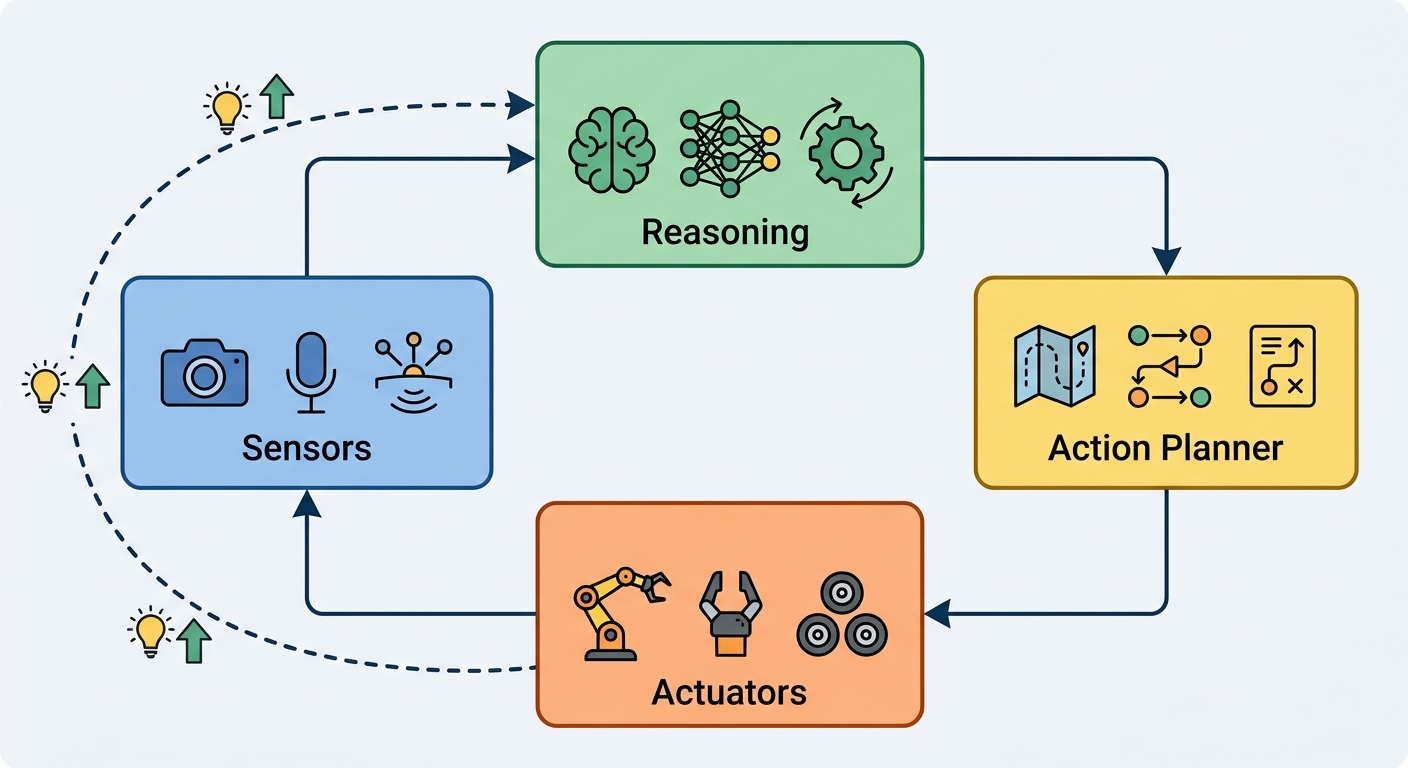
Embodied AI is intelligence that operates through a physical body. It receives input from sensors — cameras, lidar, force-torque sensors, microphones. It acts through actuators — motors, grippers, wheels, legs. And it learns from the results.
This is fundamentally different from a chatbot. A chatbot processes tokens and returns text. An embodied system closes a loop. It perceives the world, decides what to do, acts, observes the outcome, and adjusts.
Think of a robot picking a parcel from a cluttered bin. The sensor data changes every millisecond. Shadows move. Parcels shift. The robot must react in real time. A rule written in advance cannot cover every case. The system has to reason about physics, geometry, and timing — not just semantics.
The core difference: a chatbot interprets language; an embodied agent interprets the world. That closed perception-action loop is the whole game.
This grounding in the physical world is what makes embodied AI differ from software-only models. It is also why agentic autonomy — combining reasoning with perception — defines the next generation of machines. In pilots I have reviewed, teams that treated the perception-action loop as the design center, rather than an accessory, consistently saw the fastest time to a reliable task.
Agentic Autonomy: From Scripted Motion to Goal-Directed Behavior
The second force is agentic autonomy. Traditional industrial robots follow a fixed program. Move to this coordinate. Pick up this part. Put it down there. If the part is missing, or oriented wrong, the robot stops and waits for a human.
Agentic robots work differently. Instead of an exact script, they receive a goal. "Unload this truck and put the boxes on that conveyor." Then they plan, execute, detect problems, and re-plan when something changes. This is the same reasoning loop that powers autonomous software agents, now applied to hardware.
The bridge between the two worlds is the vision-language-action (VLA) model. A VLA model fuses three things: what a robot sees (vision), what it understands about the task (language reasoning), and how it should move (action). Modern VLAs are trained on huge datasets that combine images, instructions, and motor commands.
This is where the chatbot lineage matters. Because robots now understand natural language, a worker can say "stack the blue boxes on the left pallet" and the system figures out the rest. The interface that took generations to master is becoming the robot's interface too. In practice, edge inference — running the model locally rather than in the cloud — enables the sub-second responses that make these natural-language commands safe and practical.
The 2026 Landscape: Who's Deploying and Why
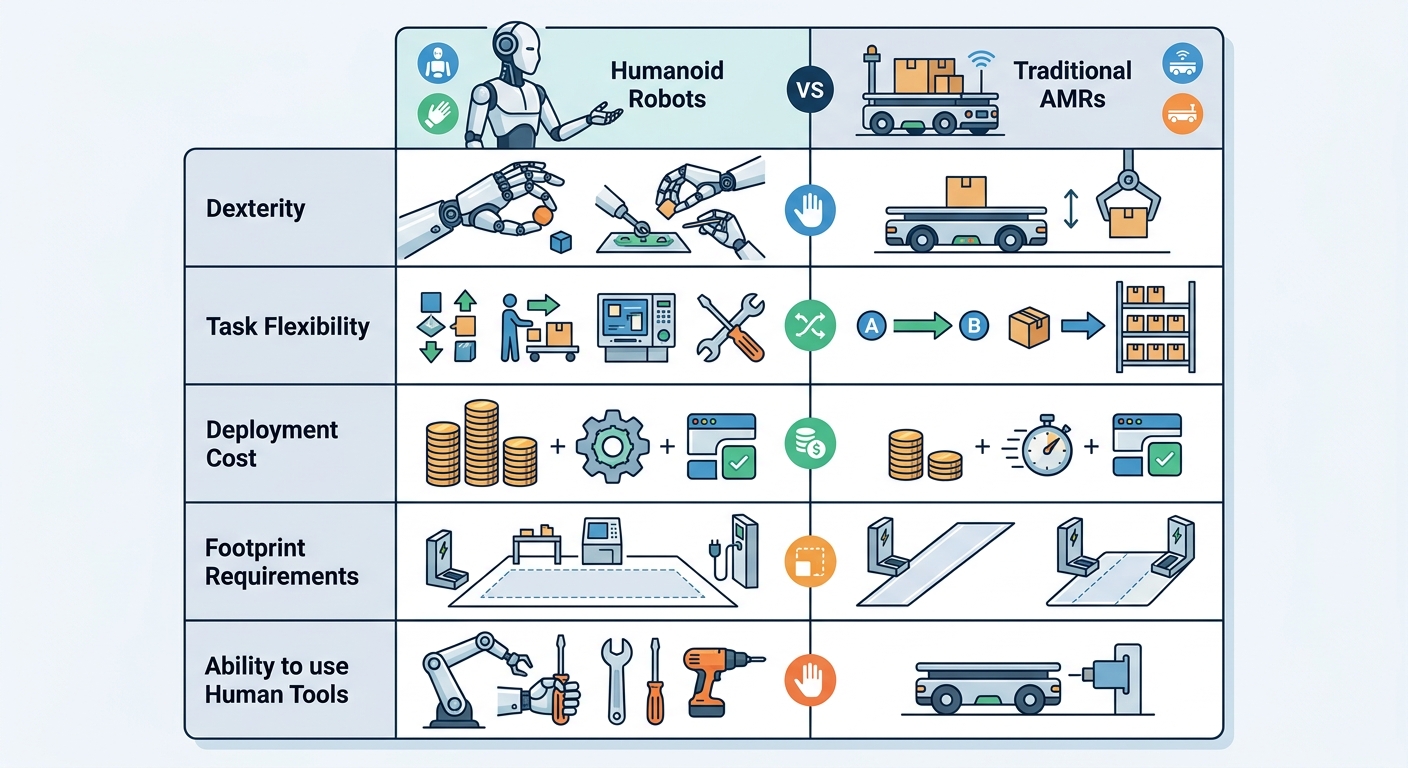
Humanoid robots are the most visible sign of the shift. In 2026 they have moved from research labs into commercial pilots across manufacturing and logistics. Major brands are testing humanoids for heavy lifting, precision assembly, and repetitive handling where hiring is hardest.
The market is growing fast. Estimates put the AI robot market at around $6.25 billion in 2026 (estimated, not an audited figure). The growth is driven by Industry 4.0 initiatives and persistent labor shortages.
Why now: chronic labor shortages in factories and warehouses have made the economic case for physical AI far easier to close. Robots are filling open posts — not just replacing people who had them.
Importantly, the pattern is not mass layoffs. It is restructuring. Humanoid robots — now entering manufacturing and warehouse environments — fill the repetitive, heavy, high-turnover tasks. Humans shift toward supervision, exception handling, and the work that requires judgment. That nuance matters for anyone planning a workforce strategy. Labor shortages in 2026 are a primary driver of physical AI adoption, so the demand is structural, not a fad.
The Economics and Infrastructure of Physical AI
Deploying embodied AI is not just buying hardware. It is an infrastructure project. Three areas matter most.
Edge inference. Robots cannot wait for a round trip to the cloud to decide whether to grab an object. Real-time control demands low latency. That pushes inference onto the device or a nearby edge node. Onboard compute, power, and thermal budgets become first-class design concerns, not afterthoughts.
Sim-to-real training. Teaching a robot in the real world is slow and risky. Dropping a pallet is expensive. Sim-to-real training — rehearsing behavior in simulation — reduces dangerous real-world data collection. This shortens deployment and lets robots practice rare and dangerous cases safely.
Cost models. Humanoid hardware is still expensive. That is why robotics-as-a-service models lease capability per task or per hour instead of forcing six-figure purchases. The total cost of ownership now includes software, retraining, maintenance, and compute — not just the robot.
Human-Robot Collaboration: Redesigning Jobs, Not Just Replacing Them
The phrase "physical workforce" suggests humans and machines competing. The reality in 2026 is collaboration. Robots excel at consistency and endurance. Humans excel at context, judgment, and handling the unexpected. Human-robot collaboration in well-run sites shifts workers to supervision and exception handling while machines absorb the grind.
Good deployments design for both. Define which tasks are high-variance and high-judgment — keep those human. Identify which are repetitive and physically demanding — those are robot targets. Build clear safety boundaries and exception-handling workflows so the two sides coordinate smoothly.
Safety standards are catching up. Teams deploying physical AI need to plan for compliance, incident response, and liability from the start. This is not optional engineering; it is part of responsible rollout.
What This Means for Your Roadmap
If you run operations that touch the physical world, the practical question is where to start. The answer is a disciplined pilot, not a forklift replacement program.
- Pick a bounded task with high turnover and low variance — unloading, palletizing, kitting.
- Define hard metrics before you start: uptime, task success rate, and cost per completed task.
- Plan the IT/OT integration early. Robots need live data from MES systems, the warehouse management system, and shop-floor sensors to decide what to do next.
- Expect an evaluation period. The first month is learning, not ROI.
Rule of thumb: judge a robot pilot on uptime and cost per task, not on demo videos. The demos look great; the economics are earned in the field.
The teams that treat embodied and agentic AI as a roadmap rather than a science project will find themselves with a durable edge. They will also avoid the trap of over-investing in robots that do not fit their workflow.
Conclusion
In 2026, the frontier of AI stopped being a chat window and started being a factory floor. Embodied AI grounds intelligence in a body. Agentic autonomy gives that body the ability to plan and adapt. Together they are reshaping what a physical workforce can do — and who builds it.
The shift is real, but it rewards patient, metric-driven adoption. Start with a narrow pilot, measure honestly, and scale what works.
If you are navigating this transition and want implementation-focused research on embodied AI, agentic systems, and the robotics stack, subscribing to the portal keeps you ahead of the curve. The teams that prepare now will define the standard the rest of the industry follows.