Vision-Language-Action Models: Making Robots Generalize
Vision-language-action models let robots handle new objects, scenes, and instructions. Here is how VLA stacks work, what
Why Robots Fail to Generalize — and What VLA Changes
Classical industrial robots are precise but brittle. A line-clearance robot that sorts one box shape will stall on an unfamiliar one. Each new object, shelf angle, or lighting condition exposes a gap between what the robot was programmed to see and what actually appears.
That brittleness comes from the traditional pipeline. Perception, planning, and control run as separate hand-built modules. Every module encodes assumptions about the world. When the world breaks those assumptions, the whole chain fails.
VLA models unify perception, language, and action into a single learned policy. Instead of wiring modules together, they read pixels, ground a text instruction, and output motor commands directly.
The core shift — a VLA policy does not need a new program for every scenario. It needs training data that covers enough scenarios to generalize.
The result is a robot that can follow an instruction it has never seen, on an object it has never touched, in a scene it has never visited. That capability, not raw accuracy, is why VLA is reshaping applied robotics.
The Three Pillars of a VLA Model
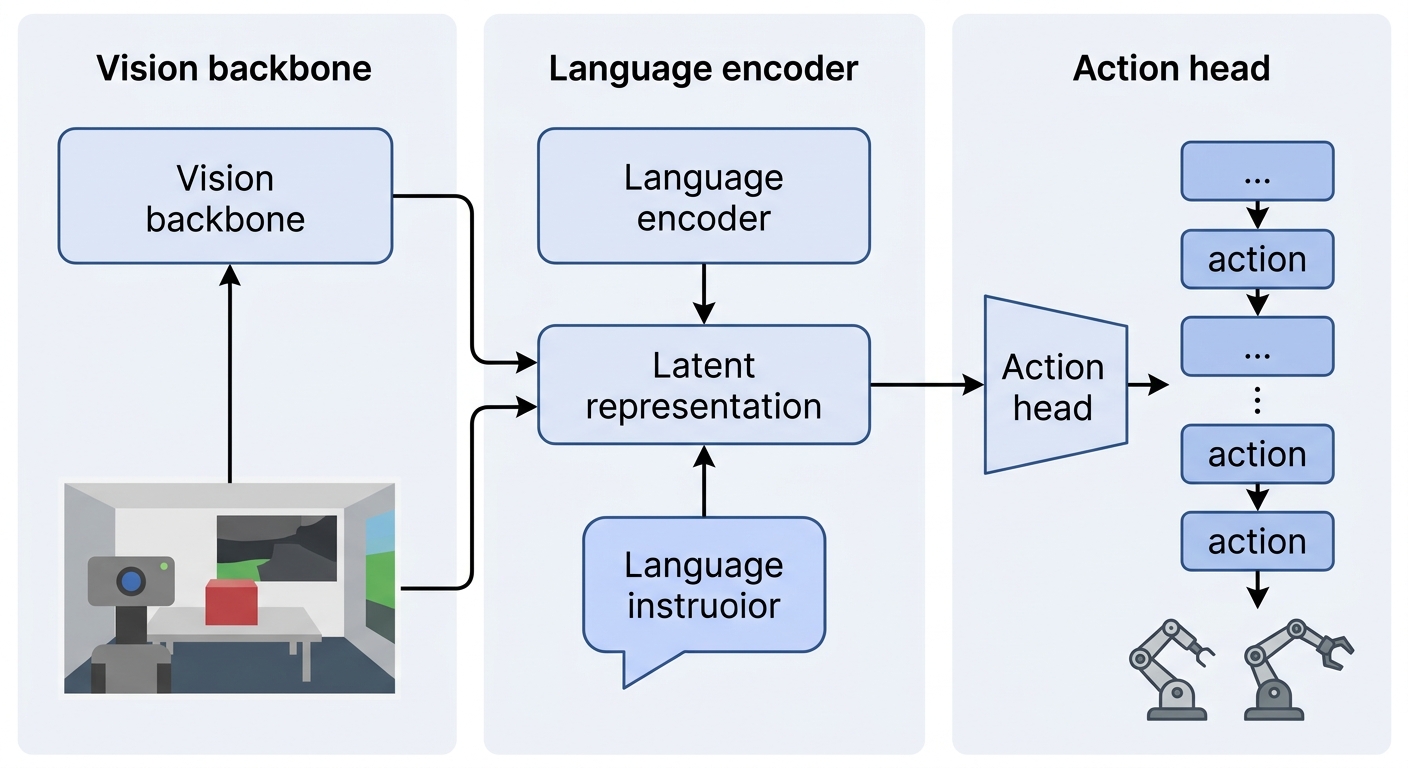
Every VLA model rests on three components. The vision backbone encodes the current scene into a representation. The language encoder turns the natural-language instruction into a grounding signal. The action head converts that combined representation into motor commands.
You can think of the first two as "understanding" and the third as "doing." Understanding must be rich enough to recognize what the object is and what the user wants. Doing must be fast enough to hit the robot's control loop. Both matter, but they place very different demands on the system.
The VLA Stack — From Scene to Motor Command
Under the hood, a VLA stack is a sequence of transformations. A camera frame and a text instruction enter the model. They pass through a shared latent space. An action head turns the latent state into a trajectory the robot can execute.
The action head is where the real engineering lives. Early models decoded one action at a time, which is slow and jittery. Modern stacks use action chunking, which amortizes inference latency across future control steps by predicting a short sequence of actions in a single forward pass.
Two decoding styles dominate. Diffusion policies denoise an action trajectory from random noise, which produces smooth, expressive motion. Flow matching accelerates action generation by learning a smooth interpolation between a noise distribution and the action distribution.
The hard truth is latency. Real-time robot control typically needs control loops running at 50-100Hz. Most VLA models, even on capable edge GPUs, struggle to exceed 10-20Hz of inference. That gap is the single biggest deployment obstacle.
Bridging that gap usually means predicting bigger action chunks and pushing the heavy model to plan offline, while a lightweight executor tracks the high-frequency loop.
The Data Engine: Why Quality Beats Quantity
VLA models are data hungry. A single fine-tuning run may want tens of thousands of demonstrations. The field has responded with shared corpora.
Open X-Embodiment provides 1M+ cross-embodiment demonstration episodes, spanning 22 robot embodiments. It is the standard pretraining corpus for models like OpenVLA and pi0. DROID offers 76,000 high-quality real-world trajectories across 564 scenes and 86 tasks, useful for mid-training. BridgeData V2 adds a lighter, accessible real-world option for fine-tuning.
Data reality — quality and diversity matter more than raw volume. Homogeneous, poorly annotated data can cause negative transfer, actually hurting generalization.
The prevailing 2026 recipe is a three-stage pipeline. First, pretrain on a broad corpus like Open X-Embodiment to build general representations. Second, mid-train on a focused real-world set like DROID to sharpen embodiment-specific control. Third, fine-tune on task-specific teleoperation data collected for your exact robot and workspace.
There is a constant fidelity-cost trade-off. Real teleoperated data is the most reliable but expensive to collect. Synthetic data from simulators and world models scales cheaply but can drift from physical reality. Mature teams blend both. Data costs and yields are estimated from public pipeline notes; treat them as planning ranges.
Benchmarking Generalization — LIBERO, CALVIN, and RoboDojo
You cannot improve what you cannot measure. Robotics benchmarking has matured into a set of standard suites, though reading them requires care.
LIBERO is the de facto standard for lifelong-learning evaluation of VLA policies. It tests whether a model can keep learning new tasks without overwriting old ones. CALVIN stresses long-horizon and compositional generalization — chaining skills the model never saw combined. RoboDojo, introduced in 2026, adds a unified suite of 42 simulation and 18 real-world tasks, probing generalization, memory, precision, and open-vocabulary instruction following.
Benchmark honesty — pick-and-place is largely solved, but long-horizon manipulation still succeeds under 50% on current suites. Treat any headline "human-level" claim with skepticism.
The cautionary note matters. Benchmarks can be gamed. A model tuned to one suite's quirks can top its leaderboard while failing in the field. Read results for the capability they isolate — memory, composition, precision — rather than a single aggregate number.
The Model Landscape in 2026
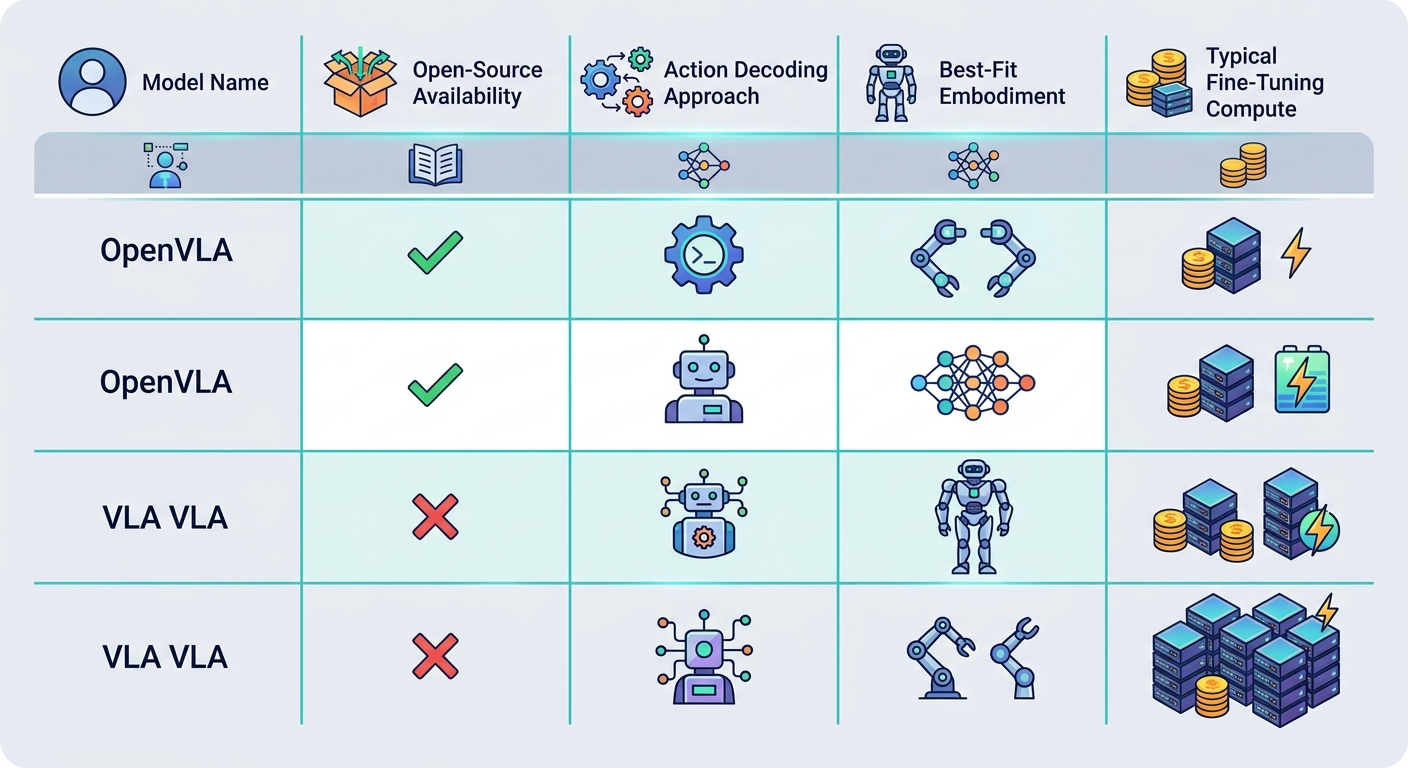
The field now has a credible spread of foundation models, and the right choice depends on your embodiment, budget, and control-frequency needs.
OpenVLA is the open-source default. It is a 7-billion-parameter model built on a LLaMA-based backbone, widely available and fine-tunable on consumer-grade GPUs. OpenVLA fine-tunes on consumer-grade GPUs, which makes it the common entry point for custom policies.
pi0, from Physical Intelligence, introduced flow-matching action generation and leads many dexterous-manipulation benchmarks. Successive releases — pi0.5 and pi0.7 — pushed toward compositional generalization for multi-step tasks.
GR00T N1.x, from NVIDIA, targets humanoid embodiments. GR00T N1 pretrains on human egocentric video (the EgoScale corpus), a data source that scales without physical robot time.
A recurring architectural theme is the dual-system design. A large, slow vision-language model reasons about long-horizon goals. A smaller, faster diffusion policy handles the immediate motor execution. This split mirrors how you would staff a task: a planner and an executor.
Making It Real-Time: Cutting Inference Latency
Latency is the difference between a demo and a deployment. Here are the techniques that shrink the gap.
Action chunking is the first lever. Predicting 8-16 actions per forward pass amortizes model cost across multiple control steps. The robot executes the chunk while the next one is computed.
Teacher-student distillation moves the burden. A large VLA "teacher" plans while a small distilled "student" provides fast, memory-efficient execution. You get the reasoning of the big model with the speed of a small one.
Flow matching changes the decoding math. Compared with autoregressive decoding, it produces actions in fewer steps, lowering generation latency at equivalent quality.
Finally, deployment engineering matters: quantization to reduce memory and bandwidth, and careful GPU scheduling so the policy inference does not starve the control loop of compute.
Where VLA Still Fails — and the Roads Forward
Even the best 2026 VLA models have known weaknesses. Mid-task recovery is the most visible: if a dropped object rolls away or the scene shifts mid-grasp, many policies freeze or repeat the wrong action. Compositional generalization still fails in edge combinations. Long-horizon manipulation remains below 50% success on current benchmark suites.
Active research targets each gap. World models let a robot imagine future states, which supports both planning and faster reaction. Self-supervised and continual-learning methods adapt policies in the field without full retrains. Datasets built from human videos and procedurally generated objects keep expanding the diversity of training signal.
The trajectory is clear. Robots will not fully generalize overnight, but each of these levers pulls capability forward. For engineering teams, the pragmatic move is to pick the lever that attacks your specific bottleneck — data quality, latency, or recovery — and measure it against a benchmark you trust.
If you are evaluating VLA for your own robotics stack, keeping up with the fast-moving model and benchmark landscape pays off. Subscribe to the Algorithmine portal for practical breakdowns of embodied AI, and get the next capability guide before your competitors do.