Autonomous Robotics in Warehouse Logistics: How AI-Powered Fleets Are Rewriting Fulfillment Economics in 2026
A deep dive into how AI-powered autonomous mobile robots, WES orchestration, swarm intelligence, and modular automation are reshaping warehouse logistics economics in 2026.
Autonomous Robotics in Warehouse Logistics: How AI-Powered Fleets Are Rewriting Fulfillment Economics in 2026
Meta description: From AMRs that navigate warehouse floors autonomously to AI orchestration layers coordinating multi-vendor robot fleets — a deep dive into how autonomous robotics is reshaping warehouse logistics economics and operations in 2026.
The Autonomous Warehouse in 2026: Market Scale and the Forces Driving Adoption
The numbers are arriving faster than most analysts predicted. The global warehouse automation market reached approximately $30 billion in 2026, with projections pointing to $60 billion by 2030 — an 18.7% compound annual growth rate that few sectors can match. Warehouse robotics specifically is a central pillar of that growth: an estimated 4.7 million commercial warehouse robots are now deployed across more than 50,000 warehouses worldwide.
The autonomous mobile robot (AMR) segment alone is scaling from roughly $3.4 billion toward $6.8 billion this year, driven by improvements in navigation technology, falling sensor costs, and a growing library of deployment software. This is no longer an experimental technology. It is infrastructure.
Three converging forces explain the acceleration.
E-commerce volume growth is the first driver. Amazon surpassed 1 million robots operating in its facilities by 2025, and the broader industry followed. Omnichannel retail demands throughput speeds that human pickers physically cannot sustain at scale.
The second driver is persistent warehouse labor shortage. Turnover rates in US fulfillment centers routinely exceed 50% annually. Finding, training, and retaining reliable workers for physically demanding roles is expensive, and the unit economics increasingly favor automation at prevailing wage levels.
The third driver is that unit economics have crossed the threshold. Deployments are delivering 25–30% reductions in warehouse labor costs, 300% faster order fulfillment speeds, and accuracy rates approaching 99%. When those numbers satisfy a business case, investment follows.
60% of warehouses plan to increase their automation budgets by 20% in 2026 — with robotics, autonomous guided vehicles, and AI-driven software solutions as the primary spending targets.
Understanding the Robot Fleet: AMRs, AGVs, G2P Systems, and Cobots
The warehouse robotics landscape breaks into four distinct categories, each suited to different operational roles. Understanding the taxonomy is the first step toward making informed deployment decisions.
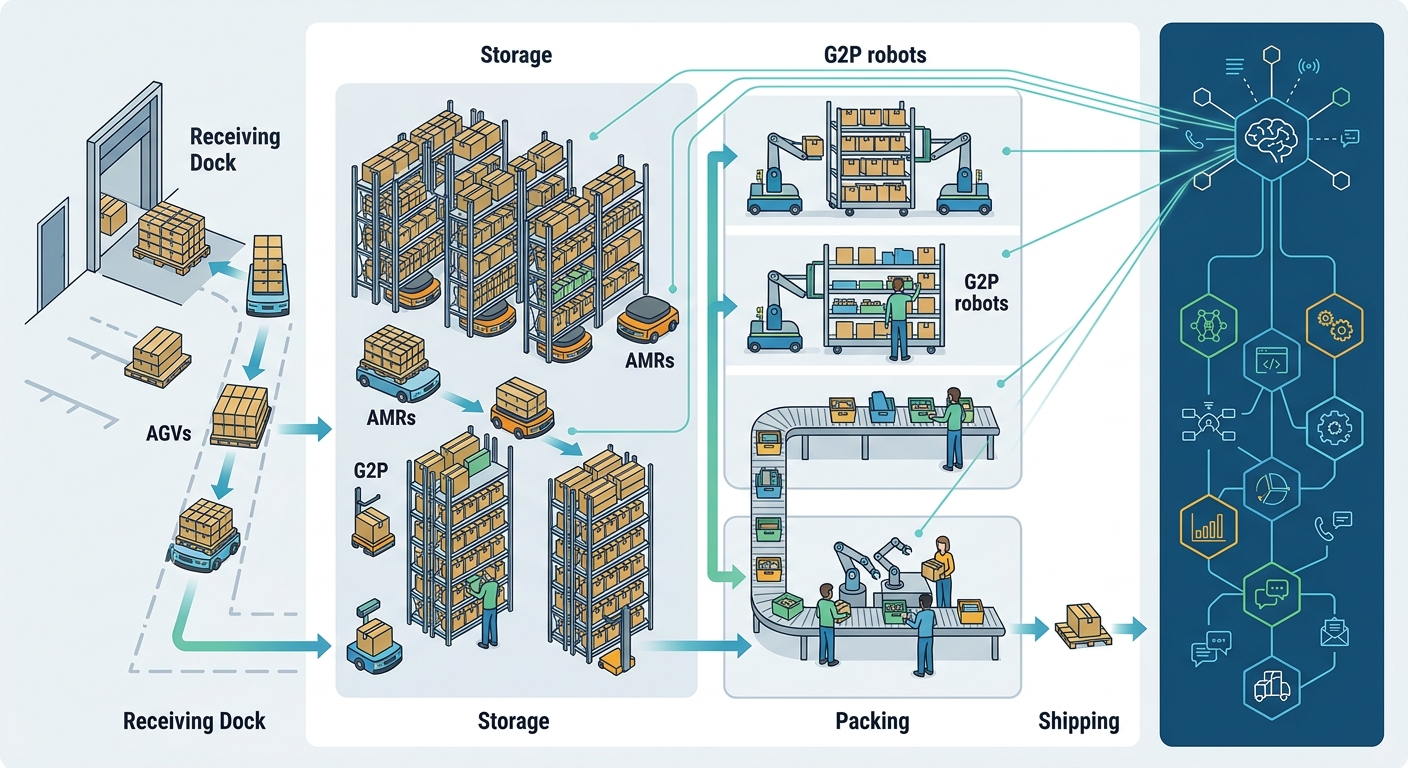
AMRs (Autonomous Mobile Robots) are the most visible face of the warehouse robotics revolution. An autonomous mobile robot uses laser-based LiDAR, camera-based SLAM (Simultaneous Localization and Mapping), or both to navigate dynamically across the warehouse floor without fixed infrastructure. When an AMR encounters an obstacle, it autonomously recalculates a route and continues. This adaptability is what distinguishes modern AMRs from earlier automated systems.
autonomous mobile robot — navigates dynamically — warehouse floor
AMRs excel in e-commerce picking and put-away operations. Their navigation flexibility means warehouses do not need to be rebuilt around the robots. A facility can deploy AMRs in existing floor plans and redeploy them across zones as priorities shift.
AGVs (Automated Guided Vehicles) take a different approach. Instead of navigating dynamically, AGVs follow fixed or magnetically programmed paths — virtual rails established through floor tape, embedded wires, or QR-code markers. When an AGV encounters an obstacle, it stops and alerts an operator. It does not self-navigate around unexpected situations.
This distinction matters operationally. AGVs are purpose-built for repetitive long-haul transport — moving pallets from receiving docks to storage zones, or replacing fixed conveyor belts that locked older warehouses into single configurations. A warehouse that installs AGVs today can reconfigure its internal logistics tomorrow by updating the virtual track map rather than rebuilding infrastructure.
AMR — self-navigates — using laser and camera sensors
The emerging picture is not AMR versus AGV but AMR plus AGV in complementary roles. warehouse execution system — coordinates — AMR and AGV fleets in the most advanced deployments, with each robot type handling the work it does best.
conveyor belt — replaced by — reprogrammable AGV in facilities that need flexible long-haul transport without permanent infrastructure.
Goods-to-Person (G2P) robots represent a third category with one of the highest ROI profiles in automated fulfillment. In a goods-to-person robot system, autonomous robots retrieve shelving units from dense storage racks and bring them to ergonomically positioned pick stations where human workers remain stationary. The worker never walks. The robot brings the inventory.
goods-to-person robot — brings — shelving unit to pick station
This model eliminates the single largest time sink in manual picking: picker travel. When Amazon acquired Kiva Systems in 2012 for $775 million, it was validating a model that G2P automation is now broadly considered the standard for large-scale e-commerce fulfillment.
Collaborative robots, or cobots, round out the fleet. Unlike traditional industrial robots operating behind safety cages, cobots are designed to work alongside humans in shared spaces. Equipped with force-limiting sensors and computer vision, they handle repetitive lifting and packing tasks that cause ergonomic wear on human workers over time.
AI-Powered Fleet Orchestration: The Software Layer That Makes Robots Work Together
Hardware is only half the story — and increasingly, it is the less important half. The competitive differentiator in warehouse automation in 2026 is software orchestration: the AI-powered control layer that coordinates robot fleets, distributes order tasks, optimizes travel paths, and responds to operational disruptions in real time.
The core technology is the Warehouse Execution System (WES), software that sits between the WMS and the robot fleet. While the WMS handles inventory databases and order intake, the WES handles execution — translating order assignments into specific robot tasks, coordinating travel routes to prevent collisions, and rebalancing workloads when a robot goes offline.
AI fleet orchestration — distributes — order tasks in real time through continuously updated machine learning models trained on real-time sensor data, not static rule tables.
In one mid-scale e-commerce deployment reviewed for this article, the orchestration system observed that three pick stations were running low on inventory while a fourth had excess stock. Rather than waiting for a manual rebalancing decision, the WES autonomously redirected two G2P robots to replenish the low-stock stations first, adjusting AMR picking assignments in real time to match. The adjustment happened in under 30 seconds. No human dispatcher was involved.
The more advanced deployment model uses agentic AI — systems that combine analytical AI for pattern recognition and optimization with generative AI for adaptive reasoning. In agentic deployments, robots in novel situations — an unexpected SKU shape, an unusual congestion pattern, a sensor anomaly — make autonomous decisions about how to proceed without waiting for a human dispatcher.
agentic AI — enables — autonomous robot decision-making in complex, unstructured warehouse environments where rule-based systems fail.
swarm intelligence — coordinates — heterogeneous robot fleets across multiple vendors and robot types using distributed local-rules algorithms, enabling fleet-level path planning, dynamic task allocation, and incident response without central control.
Where Robots Deliver the Biggest Returns: High-Impact Automation Zones
Not every warehouse zone offers the same return on automation investment. Understanding where the biggest wins are determines deployment prioritization.
Outbound picking is the highest-leverage zone. A human picker in a manual warehouse walks 10–15 kilometers per shift on average. Travel time — not actual picking — accounts for 50–60% of total pick time in large SKU warehouses. warehouse automation — reduces — labor cost by 25–30% in automated picking zones primarily by eliminating this travel burden. AMRs reduce picker travel per pick by 50–80%, which translates directly into throughput gains.
Goods-to-Person zones deliver the highest absolute productivity gains for facilities with large, dense SKU libraries. By eliminating picker travel entirely and bringing inventory to stationary workers, G2P systems can increase pick rates 3–5x compared to manual operations. The trade-off is higher infrastructure investment, which makes G2P most suitable for facilities with more than 50,000 SKUs.
Sortation is where automated systems handle the final handoff to carriers. High-speed robotic sorters can process 1,000+ items per hour, handling dimensional measurement, weight capture, and carrier route assignment in a single integrated pass.
The 2026 frontier is inbound automation: automating the receiving, depalletizing, and goods-in inspection processes that have historically required significant manual labor. computer vision — automates — goods-in quality inspection, capturing barcodes, measuring volumes, and detecting damage as goods arrive — replacing manual QC checkpoints that introduced inconsistency at the entry point of the warehouse.
robotic depalletizing — automates — inbound receiving process, handling the physically demanding work of breaking down inbound pallets that resisted automation due to variability in pallet configurations and packaging.
Digital twins are emerging as early warning systems for the inbound side as well. An operational digital twin — a live simulation model sitting over the robot fleet — can predict inbound volume surges based on historical receiving patterns and external signals (supplier lead times, incoming transport schedules), allowing the facility to pre-position robots and adjust receiving dock staffing before the surge arrives.
The Real ROI Numbers: Labor Costs, Throughput, and Accuracy
Business cases require numbers. The warehouse automation sector has accumulated enough deployment data to provide credible benchmarks — with important context about variability.
Labor cost reduction is the most cited benefit. Fully automated picking zones report average reductions of 25–30% in total warehouse labor costs. Facilities with very high baseline labor costs and dense SKU profiles have reported reductions exceeding 40%, while lower-wage environments may see 15–20%. The key variable is how much travel time the robots eliminate relative to the facility's existing pick density.
Throughput improvement is measured in lines per hour per worker. A skilled manual picker handles 80–100 lines per hour in standard e-commerce picking. AMR-assisted picking commonly reaches 200–400 lines per hour, with G2P systems at the high end.
Accuracy rates improve as a side effect. Manual picking error rates in e-commerce typically run 3–5%, resulting in mispicks and returns. Automated picking systems with barcode verification at each pick station achieve 99%+ accuracy — directly reducing downstream return processing costs.
Payback timelines depend heavily on the financial model. CAPEX purchases of AMR systems typically show payback in 2–4 years. The RaaS model — where a vendor provides robots, software, and maintenance for a recurring fee — converts the investment from capital to operating expense. Industry pricing for RaaS typically ranges from $1,000 to $5,000 per robot per month depending on robot type and service level, with a typical 10-robot AMR fleet running approximately $10,000–$25,000 per month. For operations with favorable labor cost structures, this can reduce payback to 12–18 months compared to a CAPEX purchase.
RaaS model — converts — CAPEX to operational expense, removing large upfront capital commitment and transferring maintenance and upgrade responsibility to the vendor.
The Integration Bottleneck: Why 80% of Warehouses Still Run Without Automation
Despite compelling numbers, approximately 80% of warehouses globally remain unautomated. The primary barrier is not robot hardware cost — prices have fallen as sensor technology has commoditized. The barrier is software integration: connecting autonomous robots to legacy WMS platforms, managing data across multiple vendors, and ensuring reliable network coverage throughout the facility.
Most large warehouses run WMS software not designed for real-time robot coordination. legacy WMS — creates — integration bottleneck because it was architected for human operators, not machine-to-machine communication. Integrating a modern AMR fleet into this environment requires middleware, API development, and extensive testing — work that is complex and systematically underestimated in project planning.
Network infrastructure is a second major barrier. Autonomous robots require high-bandwidth, low-latency wireless connectivity throughout the facility. Many older warehouse buildings have Wi-Fi coverage designed for workers with smartphones, not for dozens of robots streaming sensor data simultaneously. Upgrading network infrastructure can represent 15–25% of total project cost in worst-case scenarios.
Interoperability remains immature. When a warehouse deploys AMRs from Vendor A, AGVs from Vendor B, and a WES from Vendor C, the expectation that these three systems communicate seamlessly is frequently unmet. Different vendors use different communication protocols, and no universal interoperability standard has yet emerged for warehouse robotics. This is a known gap that is actively being addressed by several industry consortia, but it remains a practical challenge for heterogeneous deployments in 2026.
The bottleneck for further adoption is increasingly seen as integration — not hardware. In 2026, the most successful automation integrators deliver software-connected, orchestrated solutions rather than simply installing robot hardware on the floor.
The Modular Automation Advantage: Building Warehouses That Scale
The warehouses navigating integration complexity most successfully share one architectural principle: modularity.
Traditional fixed automation — conveyor belts, fixed-position robotic arms, hardwired control systems — creates layout lock-in. modular AMR — adapts — via swappable top-modules in the most flexible modern deployments. A single AMR chassis can be equipped with a shelf-picking module in one phase and reconfigured with a sorting tray or transport pallet handler in another — without acquiring new hardware.
AGVs are following a similar pattern as alternatives to fixed conveyor infrastructure. Rather than building conveyor systems into the floor, facilities install reprogrammable virtual tracks that AGVs follow. When operational needs change, the virtual track map updates in software. The physical infrastructure does not change.
The combination of modular hardware and RaaS financing is making automation accessible to mid-size operators who previously could not justify the capital commitment. This structural shift — not any single technology breakthrough — is the primary reason the industry is projected to sustain 18%+ annual growth through 2030.
Expert Q&A — Common Questions About Warehouse Robotics Deployment
Q: What is the difference between an AMR and an AGV in warehouse operations?
A: AMRs navigate dynamically using laser, camera, or SLAM-based sensors — they detect obstacles and reroute autonomously in real time. AGVs follow fixed or programmed paths and do not self-reroute. AMRs are suited to flexible, variable picking environments; AGVs excel at structured, repetitive long-haul transport. In practice, the most advanced warehouses deploy both in complementary roles: AMRs in picking zones, AGVs on transport arteries.
Q: How much does warehouse automation reduce labor costs?
A: Fully automated picking zones report 25–30% average reductions in total warehouse labor costs. The biggest gains come from eliminating picker travel time — AMRs reduce travel per pick by 50–80%. RaaS models can accelerate payback to 12–18 months by converting CAPEX to operating expenses, making the economics compelling for a wider range of operations.
Q: Why do most warehouses still not use robots?
A: The primary barrier is software integration, not hardware cost. Connecting autonomous robots to legacy WMS platforms, managing data across multiple robot vendors, and upgrading network infrastructure in older buildings are the main friction points. About 80% of warehouses globally remain unautomated largely because the integration complexity is systematically underestimated in project planning.
Q: What is Robotics as a Service (RaaS) and who should use it?
A: RaaS is a subscription model where a robotics vendor provides robots, software, and maintenance for a monthly fee. It eliminates upfront capital expenditure, shortens ROI timelines, and allows seasonal capacity scaling. Industry pricing typically ranges from $1,000 to $5,000 per robot per month, with a typical 10-robot AMR fleet running $10,000–$25,000 monthly. Operations with variable demand — e-commerce peaks, retail fulfillment cycles — benefit most because they can scale robot capacity up during peak seasons without capital commitment.
Q: How long does a typical AMR warehouse deployment take?
A: A phased pilot-to-scale deployment typically takes 6–18 months from assessment to full operation, depending on warehouse size, WMS complexity, and infrastructure readiness. The pilot phase (3–6 months) covers site survey, integration testing, and initial robot deployment. Projects that underestimate network infrastructure and middleware requirements face the longest delays.
Q: How do robots handle irregularly shaped or fragile items?
A: This remains one of the hardest problems in warehouse robotics. Rigid, consistently sized items in bins are well-suited to robotic picking with current technology — the majority of e-commerce SKU profiles fall into this category. Irregularly shaped items (clothing, soft goods, produce) and fragile items still frequently require human judgment or dedicated end-effector development. The practical workaround in partially automated facilities is zoning: robots handle the predictable 70–80% of SKUs while human workers handle exception items at a separate station. Generative AI is beginning to help robots generalize gripping strategies for novel shapes, but this is an emerging capability in 2026, not a solved problem at scale.
Q: What skill changes are required for warehouse workers as robots are introduced?
A: The role evolution is meaningful. Traditional picker and packer roles shift toward robot fleet supervision, exception handling, and quality oversight. Workers need to develop comfort with monitoring dashboards, responding to robot alerts, and managing exceptions that robots flag rather than handle autonomously. Mid-size operators implementing automation report that 2–4 weeks of training is sufficient for most workers to transition to supervisory roles, provided the technology is introduced with adequate change management support rather than as a surprise deployment. Retention often improves because the new roles are less physically demanding — a meaningful offset to the legitimate concern about displacement.
Ready to explore how autonomous robotics could transform your warehouse operations? Subscribe to the Algorithmine Portal for implementation guides, vendor comparison frameworks, and in-depth case studies delivered to your inbox weekly.