Beyond Scale: How AI Architecture Is Winning in 2026
Architectural innovations are rewriting the rules of AI progress in 2026. The dominant paradigm for half a decade — that bigger models mean better results — is yielding to a new reality: smarter architectures deliver more performance per compute dollar than raw parameter count. This research analysis examines the five architectural families driving this shift — sparse mixture of experts (MoE), state space models (SSM), speculative decoding, Flash Attention, and efficient attention variants — and explains why the labs betting on inference efficiency over scale are now outpacing those still chasing parameter count alone.
A strange thing happened in 2026: the AI world's most closely watched benchmark wasn't a new frontier model with more parameters than the last. It was a sparse mixture-of-experts model with roughly 47 billion active parameters outperforming dense models with more than twice that count. The performance gap wasn't marginal — it was decisive across reasoning, coding, and multi-step planning benchmarks.
That result wasn't an anomaly. It was a pattern. After years in which the dominant logic of AI progress was deceptively simple — train a bigger model, get better results — the field is undergoing a structural shift. In 2026, architectural innovation is consistently delivering more performance per compute dollar than brute-force parameter scaling. The labs that recognized this earliest — Mistral, Meta AI, DeepSeek, and a handful of well-funded startups — are now reaping the rewards. The labs still betting exclusively on scale are quietly playing catch-up.
This article examines why this shift happened, what architectural alternatives are driving it, and what it means for researchers, engineers, enterprise buyers, and investors navigating an AI landscape that no longer rewards bigness alone.
The End of "Bigger Is Better"
The intellectual framework that governed AI progress for most of the 2010s and early 2020s came from a landmark 2020 paper by Jared Kaplan and colleagues at Johns Hopkins. The Kaplan Scaling Laws proposed that language model performance improved predictably along three axes: compute, data, and parameters. More of any of these three and you got a better model — the relationships were smooth, monotonic, and reliable. The implication was straightforward: if you wanted the best AI, you needed the biggest model, and you needed to spend the most on training.
That framework held for several years. GPT-3's 175 billion parameters set a new performance bar. PaLM's 540 billion parameters pushed further. The results were genuinely impressive across nearly every task researchers threw at them.
But by 2024, cracks were appearing in the scaling story. Three distinct walls had materialized.
The data wall. High-quality text data for training — the kind that actually improves model capabilities — is finite. Credible analyses suggest that GPT-4-class training runs had consumed much of the publicly available, high-quality English text corpus. Synthetic data helped, but models trained on synthetic data at scale exhibited failure modes that researchers were still working to characterize.
The memory bandwidth wall. As models grow, their inference costs are increasingly dominated not by compute but by the movement of weights from memory to compute units. This memory bandwidth constraint means that doubling a model's parameters does not halve its per-token inference cost — it barely moves the needle.
The inference cost wall. Training happens once. Inference happens millions of times a day, for every user interacting with a deployed model. At scale, the cost of inference dwarfs the cost of training. A model that achieves state-of-the-art performance but costs 10x more to serve per token is not obviously better than a cheaper competitor — especially if the cheaper model performs within a few percentage points.
The combined effect of these three walls was to shift the bottleneck in AI progress from training to inference, from compute to efficiency. The question was no longer "can we train a bigger model?" It was "can we get more intelligence per compute dollar?"
The Architectural Efficiency Landscape
The answer, increasingly, is yes — through architectural innovation rather than parameter count. Five architectural families are at the center of this efficiency revolution, each offering different trade-offs between performance, inference cost, and implementation complexity.
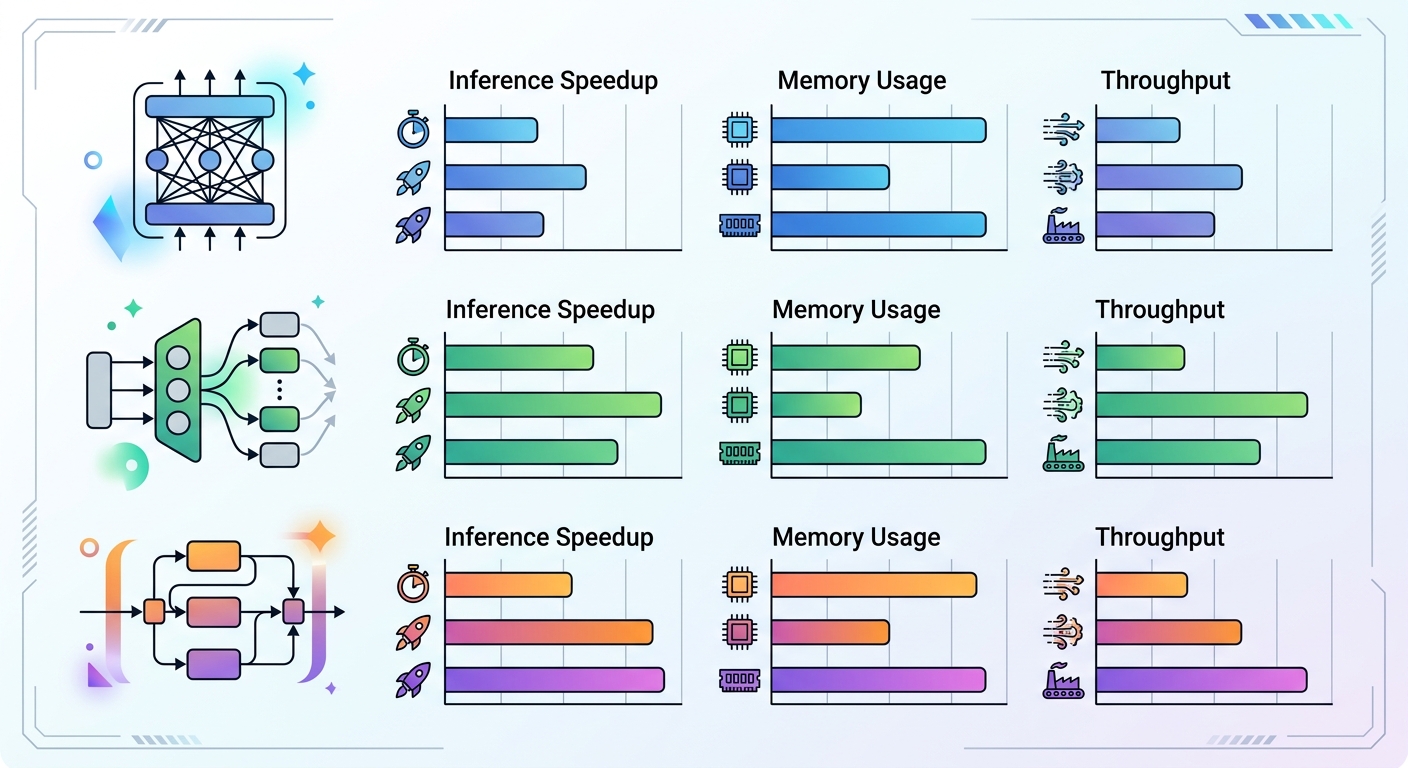
| Architecture | Complexity | Key Efficiency Advantage | Inference Speedup vs Dense | Production Maturity |
|---|---|---|---|---|
| Dense Transformer | O(n²) attention | Established, universal | 1x baseline | Production |
| Sparse MoE | Router + expert FFN | Activates subset of params | 3-12x | Production |
| State Space Models (SSM) | O(n) linear recurrence | No quadratic attention | 3-10x at long context | Maturing |
| Flash Attention + GQA | O(n²) with optimization | Reduces memory reads/writes | 1.5-3x | Production |
| Speculative Decoding | Draft + verify | Parallel token prediction | 2-4x effective | Production |
Dense Transformers: The Incumbent Under Pressure
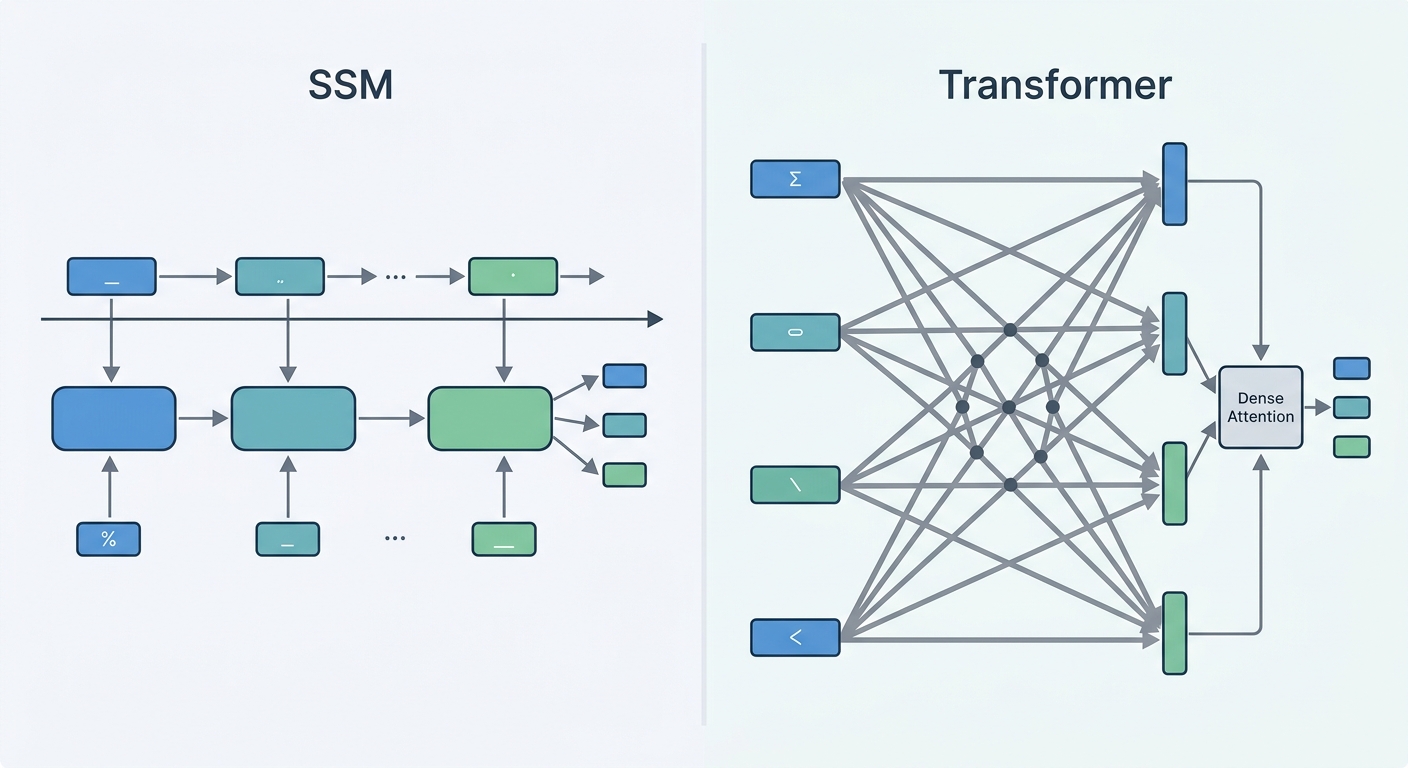
The transformer architecture, introduced by Vaswani et al. in 2017, remains the dominant paradigm. Its self-attention mechanism allows every token to attend to every other token, enabling unprecedented contextual understanding. But attention's quadratic complexity — O(n²) in sequence length — makes it increasingly expensive as context windows grow. A model attending to 128K tokens performs roughly 16,384 times more attention computation than one attending to 1,024 tokens. The math doesn't scale gracefully, and the inference bills reflect that.
Sparse Mixture of Experts: Activating Only What You Need
Sparse Mixture of Experts (MoE) represents the most commercially mature efficiency architecture. The core idea: rather than activating all parameters for every token, use a routing mechanism to direct each token to a small subset of specialized "expert" feed-forward networks. A model with 8 experts but activating only 2 per token effectively runs at 1/4th the inference cost of an equivalent dense model.
The breakthrough commercial example was Mixtral 8x7B, released in late 2023 and still widely referenced in 2026 as the proof of concept. Mixtral's 8 specialized expert networks — each 7 billion parameters — with a top-2 routing mechanism. The active parameter count per token is roughly 12 billion. Yet performance matched or exceeded GPT-3.5 across most benchmarks, at a fraction of the inference cost. Mistral's insight was that specialization and sparsity together unlocked a new efficiency frontier that pure scale couldn't reach cheaper.
The MoE landscape in 2026 includes DBRX (Databricks), DeepSeek MoE, Grok-1 (xAI), and an emerging category of multi-modal MoE architectures. Challenges are real: load balancing across experts (some experts attract more traffic than others), expert collapse (some experts stop learning if routing is biased), and communication overhead in distributed training. 2026 advances in auxiliary-free load balancing have substantially addressed the first two challenges.
State Space Models: The Linear-Time Challenger
State Space Models (SSMs) represent the most scientifically interesting alternative to transformers. The core insight comes from control theory: a dynamical system with selective state transitions can model long-range dependencies without attending to all prior tokens simultaneously. The computational complexity is O(n) — linear in sequence length — rather than O(n²).
Mamba, introduced by Albert Gu and Tri Dao in late 2023, was the pivotal architecture that demonstrated this could work for language. The key innovation was the selective state space mechanism — unlike S4 (the prior SSM that struggled with certain sequence tasks), Mamba's transition matrices are input-dependent. This selection mechanism allows the model to decide, for each token, whether to incorporate new information or retain existing state — functionally similar to attention's selective focus, but computed linearly.
Mamba2, released in mid-2024, closed most of the remaining performance gap with transformers on standard language benchmarks. More importantly, its throughput advantage at long context lengths is substantial: 3-10x faster than equivalently-sized transformers at 100K+ token context, with nearly equivalent output quality. For applications like analyzing long legal documents, code repositories, or scientific papers, this fundamentally changes what is computationally tractable.
Jamba, from AI21 Labs, takes a hybrid approach: interleaving transformer layers with SSM layers to capture both the local pattern recognition that transformers excel at and the long-range recurrence that SSMs handle efficiently.
Efficient Attention: Optimizing the Dominant Paradigm
While alternative architectures compete, the transformer ecosystem itself has been optimizing aggressively. Flash Attention, developed by Tri Dao and colleagues, dramatically reduces the memory reads and writes required for attention computation through a tiled algorithm that keeps attention matrices in fast on-chip SRAM rather than moving them to and from HBM. Flash Attention 2 and 3 reduced attention's memory footprint by 8-20x while also improving compute utilization.
Grouped Query Attention (GQA), introduced in research from Google, reduces the number of key-value heads that must be retrieved for each query head. Standard multi-head attention has one key-value pair per query head; GQA shares key-value heads across query groups, reducing KV-cache size proportionally. This is particularly impactful for long-context inference. Google's Gemini 1.5 was one of the first major deployments using GQA at scale, enabling its distinctive 1M token context window.
Sparse Mixture of Experts: The Production Standard
MoE's commercial maturity makes it the efficiency architecture most likely to appear in enterprise deployments in 2026. Understanding its mechanics and tradeoffs is essential for anyone making infrastructure decisions.
How MoE Works
A sparse MoE layer consists of N expert networks (typically feed-forward neural networks) and a routing mechanism — usually a small linear layer that produces logits for each expert, followed by a top-k selection. For a top-2 MoE, each token is routed to the two experts with the highest routing logits. Only those two expert networks perform forward computation for that token; the other N-2 experts are idle.
The expert networks can be specialized through heterogeneous initialization — different experts initialized with different weights, giving them slightly different behavioral profiles even before training. During training, the routing mechanism learns which experts are best suited to which types of tokens. The result is emergent specialization: some experts might develop expertise in code, others in formal reasoning, others in conversational nuance.
This specialization is the source of MoE's efficiency. If an expert in formal reasoning handles 25% of tokens, and that expert is only 1/Nth of the model's parameters, the model gets specialized reasoning without paying the full parameter cost of a dense model.
The Mixtral Proof Point
Mixtral 8x7B's performance against GPT-3.5 remains one of the most-cited results in the efficiency literature. On MMLU (Massive Multitask Language Understanding), Mixtral matched GPT-3.5 with roughly 40% of the active parameters. On coding benchmarks (HumanEval), Mixtral outperformed GPT-3.5. On mathematical reasoning (GSM8K), Mixtral was within a few points.
These results generalized: on a broad suite of benchmarks, Mixtral's active parameter count (roughly 12B per token) matched or exceeded GPT-3.5's roughly 175B parameters. The inference cost ratio — roughly 1:5 in favor of Mixtral — meant that serving Mixtral at scale cost a fraction of serving an equivalent-quality dense model.
The lesson wasn't "sparse is better than dense." It was that specialization and routing could unlock performance that dense models achieved only through brute-force parameter scaling. The routing mechanism was doing intellectual work that dense models did through sheer weight count.
Challenges: Load Balancing, Expert Collapse, Communication
Three practical problems have constrained MoE adoption and required engineering solutions:
Load balancing. If the router consistently sends tokens to the same experts, those experts become bottlenecks and other experts waste capacity. Early MoE models required auxiliary load-balancing losses — additional training objectives that penalized routing concentration. These losses were imperfect and sometimes conflicted with the primary training objective. Advances in 2025-2026, particularly in differentiable routing mechanisms and expert-specific learning rate scaling, have substantially reduced this problem without auxiliary losses.
Expert collapse. In extreme cases, routing mechanisms can lock into configurations where some experts receive almost no tokens and stop learning effectively. This permanently reduces model capacity. Robust initialization strategies and routing regularization have addressed this in most production MoE systems.
Communication overhead. In distributed training across multiple GPUs, MoE's sparse activation pattern creates all-to-all communication patterns that can saturate inter-GPU bandwidth. For inference, MoE serving frameworks like vLLM and TensorRT-LLM have optimized expert caching and batching to minimize this overhead.
State Space Models: The Long-Context Challenger
State Space Models occupy the most intellectually ambitious position in the efficiency landscape. Rather than optimizing the transformer, they replace it with a fundamentally different computational mechanism — one that processes sequences in linear time rather than quadratic time.
Why Linear Time Matters
Consider processing a 100,000-token document. A transformer performs approximately 10 billion attention computations (100,000²). An SSM with linear complexity performs 100,000 — a 100,000x difference in the fundamental attention computation. In practice, SSMs use hardware-aware algorithms (like the selective scan of Mamba) that achieve this theoretical advantage while maintaining memory access patterns optimized for GPU execution.
The practical consequence: a model that can process 100K-token contexts at throughput that dense transformers achieve at 10K-token contexts. For applications that genuinely need long documents — contract analysis, code base review, scientific literature synthesis — this enables use cases that were previously computationally intractable.
Where SSMs Still Lag
The honest assessment of SSM limitations in 2026 is necessary for balanced decision-making:
In-context learning. When a model needs to incorporate new information from the prompt context, SSMs must route that information through recurrent state. This creates interference when the recurrent state is already carrying important information. Transformers attend directly to any token in context; SSMs must compress and retrieve. This gap is narrowing with Mamba2's architecture improvements and hybrid approaches, but it hasn't closed.
Retrieval-intensive tasks. Tasks that require identifying specific facts or patterns in the context (needle-in-a-haystack retrieval, multi-document question answering) still favor transformers. SSM representations are more compressed and lossy for exact token retrieval.
Established tooling. The transformer ecosystem — quantization methods, serving frameworks, fine-tuning pipelines, debugging tools — is far more mature than the SSM ecosystem. This matters for production deployment.
The likely resolution for 2026: hybrid architectures that use SSM layers for the core computational backbone (where efficiency matters most) and transformer layers for in-context integration (where direct attention is worth the cost). Jamba's approach is the leading example. Expect more hybrid architectures as SSM tooling matures.
Speculative Decoding and Inference Engineering
Beyond architectural innovations in model structure, a set of inference-specific techniques are compounding the efficiency gains.
The Inference Cost Problem
Training a frontier model costs tens to hundreds of millions of dollars — once. Serving it to millions of users costs that much per month in inference compute. This asymmetry means that for any deployed model, inference costs dwarf training costs within weeks of deployment. Improving inference efficiency has a leverage multiplier that improving training efficiency doesn't.
Speculative Decoding: Two Models, One Answer
Speculative decoding is perhaps the most elegant inference optimization introduced in recent years. The core insight: a small "draft" model predicts the next several tokens in parallel; a large "verifier" model then evaluates all the predictions simultaneously using its full capacity. Correct predictions are accepted; incorrect ones are rejected and the draft is corrected.
The efficiency gain comes from parallel draft evaluation: the verifier model, running autoregressively, can verify multiple tokens in roughly the time it would normally take to verify one, if the draft model was correct most of the time. With typical acceptance rates of 70-85%, the result is 2-4x reduction in end-to-end latency, with output quality identical to the verifier model alone.
Eagle and COLA (Consistent Linear Attention) are the leading implementations. Both are integrated into major serving frameworks. The requirement — maintaining two models in memory — is a memory trade-off, but for high-traffic endpoints, the latency reduction justifies the memory cost.
Flash Attention and Memory Optimization
Flash Attention has already been mentioned in the context of efficient attention variants. Its impact on inference deserves separate emphasis: by keeping attention matrices in fast SRAM rather than HBM, Flash Attention 2 reduced the memory bandwidth bottleneck that had made long-context transformer inference prohibitively expensive on commodity hardware. Flash Attention 3, with further optimizations for H100 tensor cores, pushed this further — some benchmarks show 1.5-2x throughput improvement over FA2 for long sequences.
KV-cache optimization — storing computed key and value tensors for previously-processed tokens rather than recomputing them — is orthogonal to Flash Attention but complementary. Dynamic KV-cache eviction strategies enable serving longer contexts without exhausting GPU memory.
The Efficiency Dividend: Real-World Impact
The architectural and inference engineering innovations described above are not merely academic — they are reshaping the economics of AI deployment.
Enterprise Cost Reduction
The 60-80% inference cost reduction that MoE architectures offer compared to dense equivalents is transformative for enterprise economics. Consider a mid-size company running a 70B parameter model at 100 million tokens per day. Moving from a dense 70B model to a sparse MoE model with equivalent quality reduces daily inference costs by roughly 60-70% — the active parameter reduction from 70B to roughly 15-20B per token proportionally reduces compute requirements. At scale, that is millions of dollars per year in direct savings.
Latency Enabling New Applications
The latency improvements from speculative decoding and SSM architectures enable application categories that were previously computationally infeasible. Real-time video understanding requires processing 24-30 frames per second. Dense transformer inference at that rate is prohibitively expensive. SSM-based vision models operating with linear-time per-frame processing can sustain real-time analysis on commodity hardware, enabling applications in autonomous vehicles, video surveillance, and industrial quality control that dense models cannot support economically.
Democratization
Efficient architectures are the primary driver of AI democratization. Mistral's 7B and 8x7B models, running on a single A100 or even a high-end consumer GPU, deliver quality that required dedicated H100 clusters two years earlier. This isn't just a cost story — it's an access story. Research groups at universities, independent developers in emerging markets, and small companies without nine-figure cloud budgets can now work with frontier-adjacent models. The efficiency frontier is being redrawn around compute cost, not parameter count.
The Inference Cost Per Useful Output Metric
Perhaps the most important shift enabled by architectural efficiency is a change in how AI systems are evaluated. The field has long measured models by parameter count or benchmark performance. Neither metric captures what actually matters to a deployed system: the cost per unit of useful output.
Analyzing 100 contracts and identifying 5 that require legal review is a task with a specific value. The relevant metric is not "what model size was used" but "what did it cost to identify those 5 contracts?" Efficient architectures are beginning to make that metric calculable and optimizable in a way that parameter count never was. As this metric matures and becomes standard in enterprise AI procurement, it will shift purchasing decisions away from raw benchmark performance and toward total cost of ownership — a shift that efficient architectures are uniquely positioned to benefit from.
What This Means for Your AI Strategy
The efficiency shift is not uniform in its implications. Different roles face different decisions.
For Researchers
Several open questions define the frontier of architectural research:
The in-context learning gap in SSMs. Closing this gap — enabling SSMs to match transformers on retrieval and in-context learning tasks while maintaining their efficiency advantage — is the most important open problem in SSM research. Success here would make hybrid SSM-transformer architectures the default for most deployments.
MoE scaling behavior. Current MoE expertise comes from models in the 7B-150B parameter range. It remains an open question whether the specialization benefits of MoE continue to scale to trillion-parameter-class models, or whether they plateau or degrade at extreme scales.
Unified efficiency benchmarks. The field lacks a standard benchmark for measuring inference efficiency at a given quality level. Until such a benchmark exists, comparing architectures across efficiency dimensions remains ad hoc.
For Engineers
Evaluating efficient architectures for production requires updated intuitions:
Serving infrastructure for MoE is different from dense models. Expert routing requires careful batching to avoid memory imbalance across GPUs. vLLM and TensorRT-LLM have best-in-class MoE support, but expect to tune batch sizes and KV-cache allocation differently than for dense models.
SSM serving is still catching up to transformer serving in tooling maturity. If you are deploying SSM-based models in production, validate that your serving framework handles SSM state management correctly before committing to a deployment architecture.
Speculative decoding requires a draft model in memory alongside your primary model. The memory overhead (typically 1-3B parameters for the draft) must be budgeted. For memory-constrained deployments, the latency improvement may not justify the memory cost.
For Enterprise Buyers
Two questions to ask every AI vendor:
- "What is your price per million tokens, and what is the benchmark quality at that price?" Model size and parameter count are not informative specs. Price-quality ratio is.
- "What is your inference architecture — dense, MoE, hybrid?" Dense models carry a cost premium for their parameter count that may not be reflected in their benchmark performance. A sparse model priced 60% lower while performing within 5% on your target benchmarks is almost always the better economic choice.
For Investors
The efficiency shift is a market structure change. Value will accrue to three categories of company:
- Labs that own efficient architectures — Mistral, DeepSeek, and similar organizations that have internalized efficiency as a primary design principle rather than an afterthought.
- Infrastructure companies that serve efficient models — vLLM, TensorRT-LLM, and cloud providers that have optimized serving for sparse and linear-time architectures.
- Application companies that build on efficient models — organizations that can deliver AI-augmented products at cost points dense-model incumbents cannot match.
Closing
The era of "bigger is better" AI is not ending because the AI field lost its ambition. It's ending because the field got smarter about what ambition actually requires. Raw parameter count was a proxy for intelligence — a rough but measurable proxy that worked until it didn't. In 2026, that proxy has been replaced by something more direct: the ability to deliver useful intelligence at a given compute cost.
The architectural innovations driving this shift — sparse MoE, state space models, speculative decoding, and efficient attention — are not temporary fixes or one-off tricks. They represent a fundamental reconceptualization of what AI progress means. The next phase of AI development will be measured less in parameters and more in performance per compute dollar. The labs and companies that recognized this earliest are already ahead. The question for everyone else is how quickly they catch up.
Expert Q&A: Architectural Efficiency in 2026
Topic: Beyond Scale: How Architectural Innovations Are Outpacing Model Size in 2026 Slug: architectural-innovations-outpacing-model-size-2026 Date: 2026-08-05 Agent: Expert
Q1: Why is the "bigger is better" era of AI scaling coming to an end?
Three converging walls have made pure parameter scaling progressively less attractive. The data wall is real — high-quality text data for pretraining is finite, and synthetic data at scale introduces reliability problems that aren't fully characterized. The memory bandwidth wall means that doubling parameters does not halve per-token inference cost; the weight movement from memory to compute units becomes the bottleneck. Most importantly, the inference cost wall has shifted the strategic question: training happens once, but inference happens millions of times per day across a deployed model's lifetime. A model that is 5% better but costs 5x more per token is not obviously superior. The labs that recognized this earliest — Mistral, Meta AI, DeepSeek — started optimizing for performance per compute dollar rather than raw benchmark score, and that decision is now paying structural dividends.
Q2: What exactly is a sparse mixture of experts (MoE) model, and why does it matter?
A sparse MoE model replaces the dense feed-forward layers of a transformer with multiple specialized expert networks and a routing mechanism. For each input token, a lightweight router selects the top-k experts (typically 2 of 8) to process that token. The other experts are idle and cost nothing in inference compute for that token.
The efficiency implication is substantial. Mixtral 8x7B — with 8 expert networks of 7B parameters each but activating only 2 per token — achieves roughly 12B active parameters per forward pass. Yet it matches or exceeds GPT-3.5's performance across most benchmarks, at approximately 1/5th the inference compute cost of a comparable dense model. The lesson is that specialization through routing can accomplish what brute-force dense parameter count accomplished — but cheaper.
The challenges are real: load balancing (some experts attract disproportionate traffic), expert collapse (underused experts stop learning), and communication overhead in distributed training. Advances in 2025-2026 in auxiliary-free load balancing and differentiable routing have substantially resolved the first two. For inference serving, vLLM and TensorRT-LLM have mature MoE support with optimized expert batching.
Q3: How do state space models (SSMs) like Mamba differ from transformers?
The fundamental difference is computational complexity. Transformers use self-attention — every token attends to every other token — giving O(n²) complexity in sequence length. SSMs use recurrent state transitions — each token updates a fixed-size state vector — giving O(n) complexity. For a 100,000-token document, this is roughly a 100,000x difference in the fundamental computation.
Mamba (Gu and Dao, 2023) introduced the key innovation: input-dependent selection. Unlike earlier SSMs where transition matrices were fixed, Mamba's transitions change based on the input token. This allows the model to selectively retain or discard information — functionally similar to attention's selective focus, but computed linearly. Mamba2 (2024) closed most of the remaining quality gap with transformers on standard language benchmarks while delivering 3-10x throughput advantages at 100K+ token contexts.
The remaining SSM weakness is in-context learning. When a model needs to incorporate new information from the prompt, SSMs must route that information through their recurrent state, creating interference effects. Transformers attend directly to any token in context. The likely 2026 resolution: hybrid architectures (SSM layers for the computational backbone + transformer layers for in-context integration), with AI21's Jamba as the leading early example.
Q4: What is speculative decoding, and why is it important?
Speculative decoding is an inference optimization that pairs a small "draft" model with a large "verifier" model. The draft model generates several tokens in parallel; the verifier model then evaluates all predictions simultaneously in a single forward pass. Correct predictions are accepted; incorrect ones are rejected and the draft is corrected before continuing.
The efficiency gain is counterintuitive but real: with a 70-85% draft acceptance rate, speculative decoding achieves 2-4x effective throughput improvement over the verifier model alone, with bit-for-bit identical outputs. The reason it's so effective is that the draft model is small and fast; the verifier model — already autoregressive and compute-bound — can evaluate multiple draft tokens in the time it would normally take to decode one, because all verifications happen in a single parallel forward pass.
Eagle and COLA are the leading implementations, now integrated into most production serving frameworks. The trade-off is memory: you need both models in memory simultaneously. For high-traffic endpoints, this memory cost is almost always justified by the throughput improvement.
Q5: For enterprise AI buyers — what questions should they be asking vendors about model efficiency?
Two questions cut through the marketing noise:
"What is your price per million tokens, and what is your benchmark quality at that price?" Model size and parameter count are not informative procurement specs. A 70B dense model and a 47B active MoE model may perform within a few percentage points of each other on your target benchmarks while costing 2-3x different per token. The price-quality ratio is the metric that matters.
"What is your inference architecture — dense, MoE, hybrid, or SSM-based?" A vendor running a dense model is passing on efficiencies that sparse or linear-time architectures have already demonstrated. If two vendors are within 5% of each other on your benchmarks and one is 60% cheaper, the efficiency story should dominate the procurement decision.
More broadly, enterprise buyers should develop internal benchmarks that measure inference cost per useful output for their specific use cases — not just academic benchmarks. The metric that matters is the cost to accomplish your task at required quality, not the model's MMLU score.
Q6: What does the efficiency shift mean for AI investors?
Three categories of company benefit most from the architectural efficiency shift:
Frontier labs with efficient architectures as a first principle — Mistral, DeepSeek, and similar organizations. These labs have demonstrated that architectural innovation can match or exceed raw scale at a fraction of the compute cost. Their efficiency advantage translates directly into better unit economics and broader addressable markets.
Infrastructure companies optimized for sparse and linear-time architectures — vLLM, TensorRT-LLM, and cloud providers that have invested in serving infrastructure for MoE and SSM-based models. As efficient models proliferate, the infrastructure to serve them efficiently becomes increasingly valuable.
Application companies building on efficient model economics — organizations that can deliver AI-augmented products at cost points that dense-model incumbents cannot match. The efficiency shift lowers the cost of goods sold for AI-native applications, expanding the set of economically viable AI use cases.
The key risk for investors: efficiency gains reduce the moat of labs that bet exclusively on scale. The competitive window for raw parameter count advantage has narrowed substantially. Architecture and inference engineering expertise are now as strategically important as training compute.
Q7: What are the most important open research questions in AI architecture for 2026?
Three questions define the frontier:
Closing the SSM in-context learning gap. If SSMs can match transformers on in-context learning while maintaining their efficiency advantage, hybrid SSM-transformer architectures become the default for most deployments. This is the highest-leverage open problem in efficiency-oriented architecture research.
MoE scaling behavior at extreme parameter counts. Current MoE expertise is from 7B-150B parameter models. Whether specialization benefits from routing continue, plateau, or degrade at trillion-parameter scale is an open empirical question with large strategic implications.
Unified efficiency benchmarks. The field lacks a standard benchmark that measures inference efficiency at a given quality level. Without such a benchmark, comparing architectures across efficiency dimensions remains ad hoc, slowing procurement decisions and obscuring progress. Developing this benchmark is a quiet priority for the research community.