Speech Generation in 2026: Why Voice Agents Finally Work in the Enterprise
See why enterprise voice agents finally work in 2026—sub-second latency, expressive TTS, and LLM reasoning in the voice loop. What to evaluate before you buy.
The Shift From Demo to Deployment
For most of 2023 and 2024, enterprise voice agents were a punchline. The text-to-speech sounded like a GPS unit from 2009. Turn-taking was clumsy—callers either talked over the bot or waited in dead air while it "thought." And underneath it all sat brittle intent trees that broke the moment a customer said something off-script. Pilots launched, demos impressed, and deployments quietly stalled.
That story changed in 2025 and is now the defining enterprise AI narrative of 2026. Voice agents have crossed from novelty to production, handling real call volume in collections, scheduling, IT helpdesk, and claims intake. The reason isn't one breakthrough—it's the convergence of three: latency dropped below the threshold where conversation feels natural, speech generation became expressive and steerable, and LLM reasoning moved directly into the voice loop. This article breaks down what actually changed, where these systems work today, how the stack is architected, and what engineering leaders should evaluate before signing. (See also: [How to Evaluate a Voice AI Platform Before You Buy])
The Three Shifts That Made Voice Agents Production-Ready
Latency Fell Below the Conversational Threshold
Human turn-taking is fast. In natural conversation, people typically begin responding within roughly 200 milliseconds of the other person finishing, and gaps beyond about 700ms to a full second start to read as hesitation, distraction, or a dropped line. For years, voice bots ran 2–4 seconds end-to-end—speech-to-text, LLM inference, text-to-speech—which read as "broken" no matter how good the words were.
Streaming changed the math. Modern pipelines begin synthesizing audio before the LLM finishes its full response, and speech-to-speech models eliminate the discrete text bottleneck that serialized the old chain. The metric that matters is time-to-first-audio (TTFA)—how quickly the agent starts speaking after the caller stops. Well-architected deployments now target sub-500ms TTFA, with full turn completion under roughly 800ms. Treat those as engineering targets, not guarantees: they depend on model choice, network path, and telephony hop count.
Operationally, this matters more than any accuracy benchmark: callers who don't notice the delay don't hang up, don't repeat themselves, and don't ask for a human out of frustration. Latency is the difference between a tool people tolerate and one they use. (Related: [Reducing Voice Agent Latency: A Practical Architecture Guide])
Speech Generation Got Expressive and Steerable
Early neural TTS produced clean but flat audio—correct words, wrong emotion. The 2024–2026 generation of models accepts prosody, pacing, and emotional-style controls as first-class parameters. An agent can shift to a warmer register for a billing dispute, slow down for a spelled-out account number, or signal urgency in an outage notification.
This isn't cosmetic. Expressive, steerable speech is what makes an agent sound competent rather than uncanny, and it lets teams tune a single voice for multiple contexts instead of recording scripted prompts. What still fails: long-form narration drifts, and highly emotional or adversarial callers expose the seams quickly. Steerability helps; it doesn't fully solve. (See: [Prosody and Emotion Controls in Modern TTS Models])
LLM Reasoning Moved Into the Voice Loop
The final shift was architectural. Instead of mapping utterances to a fixed intent tree, modern agents pass transcribed (or natively processed) speech to an LLM that reasons about context, calls tools, and decides what to say next. A caller who says "actually, cancel that and move my appointment to Thursday" gets handled in one turn rather than three failed intent matches.
Reasoning inside the voice loop is what turned voice agents from script-followers into problem-solvers. The caveat: LLMs hallucinate, and a hallucinating voice agent is arguably more damaging than a hallucinating chatbot—it asserts wrong information in real time, in a human-sounding voice, to someone who may be in a stressful situation. Guardrails and deterministic tool boundaries are now mandatory, not optional. Note the tradeoff with speech-to-speech models: because they skip the text transcript, you lose the cleanest control surface for auditing and guardrailing. Many enterprises still prefer an explicit ASR→LLM→TTS chain precisely so they can log, filter, and block at the text layer. (Related: [Guardrails for LLM Voice Agents: Tool Boundaries and Fallbacks])
What Changed in TTS and Generative Audio
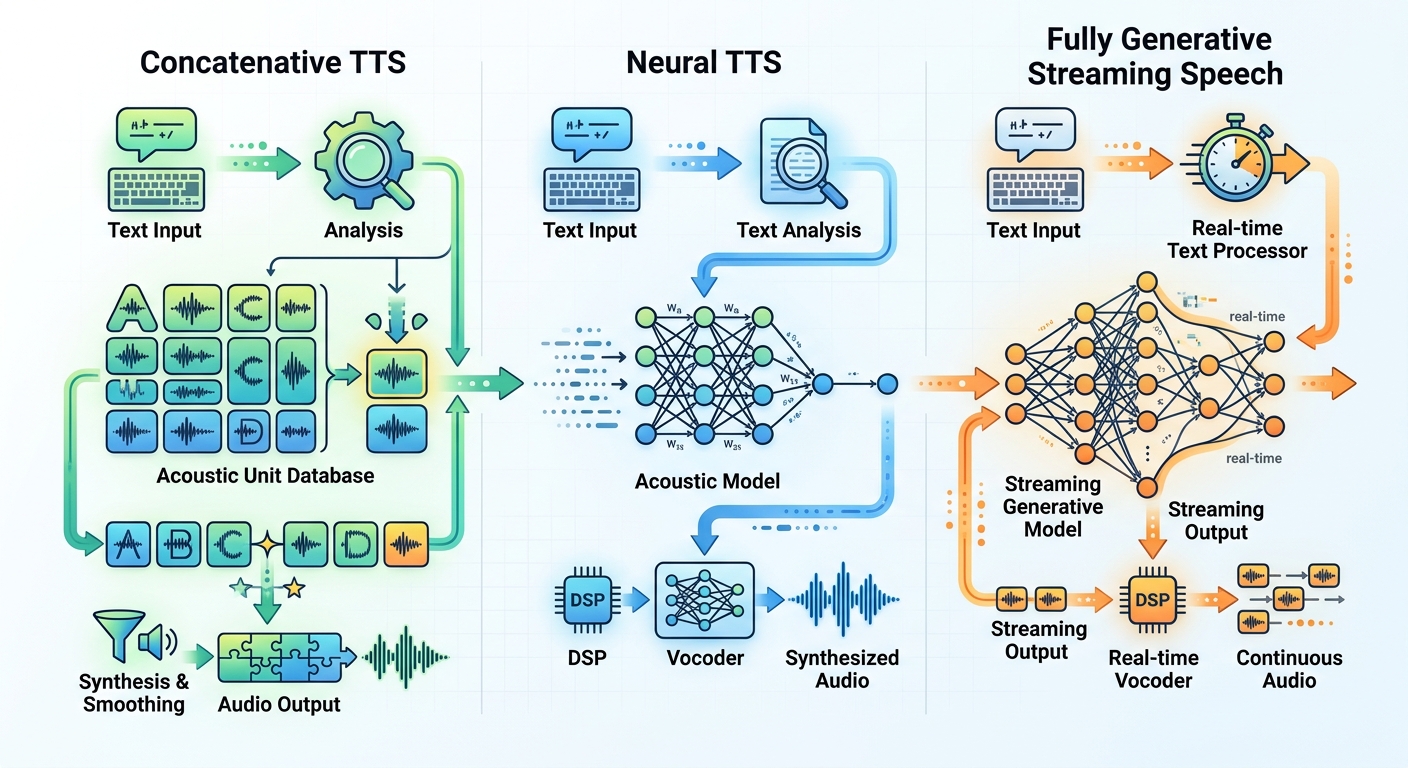
From Concatenative to Fully Generative Pipelines
The old approach stitched together recorded phonemes—hence the robotic cadence and the telltale mispronunciation of names. Neural TTS replaced that with learned acoustic models, and the current generation increasingly produces audio token by token, much like an LLM produces text. In practice, most production systems in 2026 are still hybrid—a learned acoustic model feeding a neural vocoder—with fully token-based end-to-end audio emerging at the frontier rather than as the default.
For practitioners, the practical consequences are: near-instant voice customization, natural handling of unusual words, and—on the better multilingual models—speech in dozens of languages from a shared model. The tradeoff is compute cost and the need for careful output monitoring: generative audio can produce artifacts under stress, and quality varies by language and domain. (See: [Generative TTS vs. Neural TTS: What Changed])
Streaming, Barge-In, and Turn-Taking
Streaming synthesis is table stakes now. The harder engineering problem is barge-in—detecting that a caller has started speaking, stopping playback mid-word, and re-entering the loop without losing context. Combined with voice activity detection and semantic turn-end prediction, this is what makes conversations feel human.
Teams that skip this work ship agents that talk over customers and feel deaf. Budget engineering time here; it's where most "almost working" deployments fail. (Related: [Barge-In and Turn-Taking: The Hard Part of Voice Agents])
Voice Cloning, Consent, and Provenance
Cloning a voice now takes seconds of reference audio. That's a powerful tool for brand consistency and accessibility—and a serious liability. Consent, watermarking, and provenance metadata are becoming baseline requirements, with several vendors embedding imperceptible watermarks and C2PA-style provenance metadata into generated audio. Adoption is uneven, so verify what your vendor actually ships. Enterprises should treat unwatermarked cloning as a compliance risk, not a feature. (See: [Voice Cloning Compliance: Watermarks, Consent, and Provenance])
How the Stack Is Architected
A production voice agent is a real-time system, not a chat app with a microphone. The canonical 2026 stack, from caller to model:
- Telephony / transport: SIP or WebRTC carrying the call, with jitter buffering and codec handling that quietly determine perceived latency.
- Voice activity detection (VAD) and turn-end prediction: decides when the caller has actually finished, which gates everything downstream.
- ASR (or native audio input): streaming transcription with partial results, or direct audio ingestion in a speech-to-speech model.
- Orchestration layer: manages state, barge-in, tool calls, fallbacks, and handoff to a human—the layer most homegrown pilots underinvest in.
- LLM reasoning: context assembly, tool invocation, and response planning, bounded by deterministic guardrails.
- TTS (or native audio output): streaming synthesis with prosody control, started before the full response is planned.
- Observability and guardrails: transcript logging, latency tracing per hop, redaction, and policy enforcement—non-negotiable for regulated industries.
The engineering insight: latency is a property of the whole chain, not any single model. A fast TTS model bolted onto a slow orchestration layer still produces a slow agent. Instrument every hop.
Where Enterprise Voice Agents Are Actually Working
High-Volume, Structured Workflows
The clearest ROI is in workflows that are high-volume, bounded, and measurable: appointment scheduling and rescheduling, payment reminders and collections, IT password resets and tier-1 helpdesk, claims intake, and order status. These share traits that make voice agents tractable—clear success criteria, tool-backed actions, and a human fallback that's cheap to invoke.
What these deployments have in common is not that the agent handles everything, but that it deflects the predictable majority and hands off cleanly. Teams that measure containment rate, handle time, and escalation quality—rather than demo impressiveness—are the ones reporting real savings.
Where It Still Breaks
Honesty matters here. Voice agents still struggle with emotionally charged or adversarial callers, complex multi-issue negotiations, heavy accents and noisy environments at the margins, and any workflow where a wrong answer carries legal or safety weight. The mature posture is to scope the agent to the tractable 70% and design the handoff as a first-class feature, not a failure.
What to Evaluate Before You Sign
- Latency, measured end to end. Demand per-hop latency tracing and test TTFA on your own telephony path, not the vendor's demo line.
- Barge-in and turn-taking quality. Test with interruptions, background noise, and fast talkers.
- Guardrail architecture. Ask how tool calls are bounded, how hallucinations are caught, and whether you get a full transcript for audit.
- Provenance and consent. Confirm watermarking and C2PA-style metadata, and get the compliance posture in writing.
- Handoff design. The human escalation path is a product feature—evaluate it as carefully as the AI.
- Observability. If you can't see per-turn latency, transcripts, and failure modes, you can't operate the agent in production.
The Bottom Line
Voice agents work in 2026 not because of a single model, but because latency, expressiveness, and reasoning finally converged into a system that feels like a conversation. The enterprises winning with them are the ones treating voice as a real-time engineering discipline—instrumenting every hop, scoping to tractable workflows, and designing the human handoff as a feature. The demo era is over; the operations era has begun.