NVIDIA Blackwell vs. Custom ASICs: The Emerging Infrastructure Battle for AI Supremacy
The AI chip market is fragmenting. For years, NVIDIA GPUs were the default answer to every AI compute question. In 2026, that answer is getting complicated. Inference now drives roughly two-thirds of all AI workloads. Hyperscalers are running billions of inference requests daily on stable models. And for that specific job, custom silicon is often cheaper, cooler, and more efficient than a general-purpose GPU. The result is a structural split in the AI chip landscape that no one can ignore.
NVIDIA's Blackwell architecture remains the standard for training and flexible workloads. Its upcoming Rubin platform promises another leap. But Google, Amazon, and Microsoft are no longer waiting on the sidelines. They are deploying their own chips—TPU 8i, Trainium 3, Maia 200—at massive scale. The battle for AI infrastructure supremacy is no longer a one-horse race.
The New AI Chip Landscape
The era of GPU monolithism is ending. Three forces are driving the split.
First, inference has become the dominant AI workload. Organizations are no longer just training models. They are serving them at scale, around the clock. Second, hyperscalers have the volume to justify custom silicon. Running inference for billions of users makes the economics of purpose-built chips work. Third, the software stack has matured enough to support non-NVIDIA accelerators in production.
NVIDIA still leads in overall AI chip market share at 70–86 percent. But the inference segment is shifting faster than the headline numbers suggest. ASIC-based AI server shipments are growing at 44.6 percent annually. NVIDIA's share of the inference market could drop from over 90 percent today to 20–30 percent by 2028. These are not projections from ASIC vendors trying to seed doubt. Analysts tracking semiconductor supply chains are reaching similar conclusions.
"The inference flip is real. The question is no longer whether custom silicon matters. It is which workloads it wins." — Semiconductor industry analyst, 2026
NVIDIA Blackwell — The General-Purpose Giant
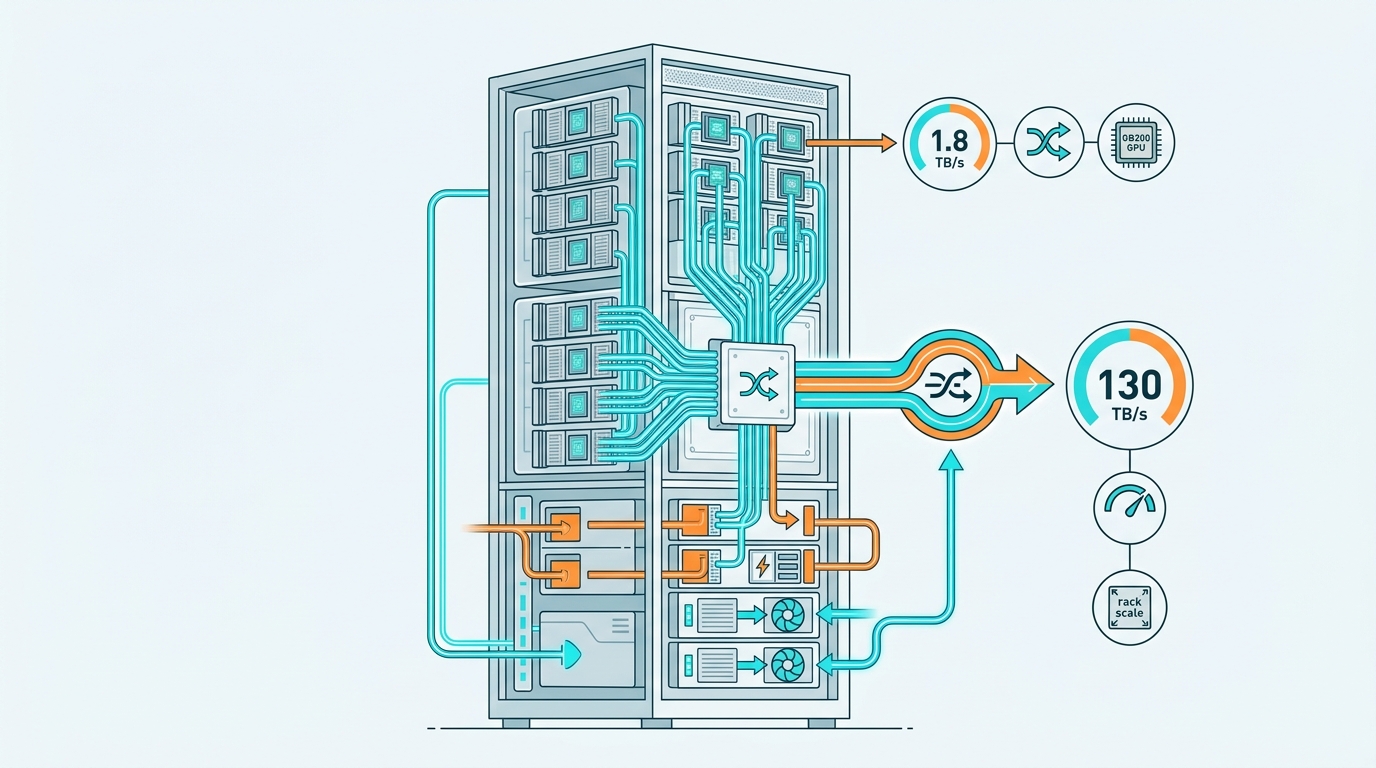
For large-scale deployment, the GB200 NVL72 is the reference system. It stacks 36 Grace Blackwell Superchips into a single rack. That is 72 Blackwell GPUs and 36 Grace CPUs, interconnected by fifth-generation NVLink. Each GPU gets 1.8 TB/s of bidirectional bandwidth. The system-wide GPU bandwidth reaches 130 TB/s. The result is that dozens of GPUs function as a single massive processor for AI workloads.
NVIDIA claims the GB200 NVL72 delivers 50 times the throughput per megawatt compared to the Hopper generation for agentic AI tasks. Cost per token drops by 15 times versus Hopper. Software optimizations alone cut cost per token by a factor of five within two months of the B200's launch. That is the NVIDIA moat in action: a mature software stack that extracts more value from the same hardware over time.
The Rubin architecture is already shipping in the second half of 2026. It promises five times the inference performance and 3.5 times the training performance of Blackwell. NVIDIA is moving to an annual architecture cadence. Rubin Ultra arrives in H2 2027, followed by Feynman in 2028. The pace is relentless.
For customers who need flexibility, research diversity, and the full CUDA ecosystem, Blackwell and Rubin remain the default choice. The software support is unmatched. The talent pool is deep. The compatibility with novel model architectures is proven.
The Custom ASIC Arsenal
Google, Amazon, and Microsoft are not building chips for prestige. They are building them to cut costs on workloads they run at planetary scale.
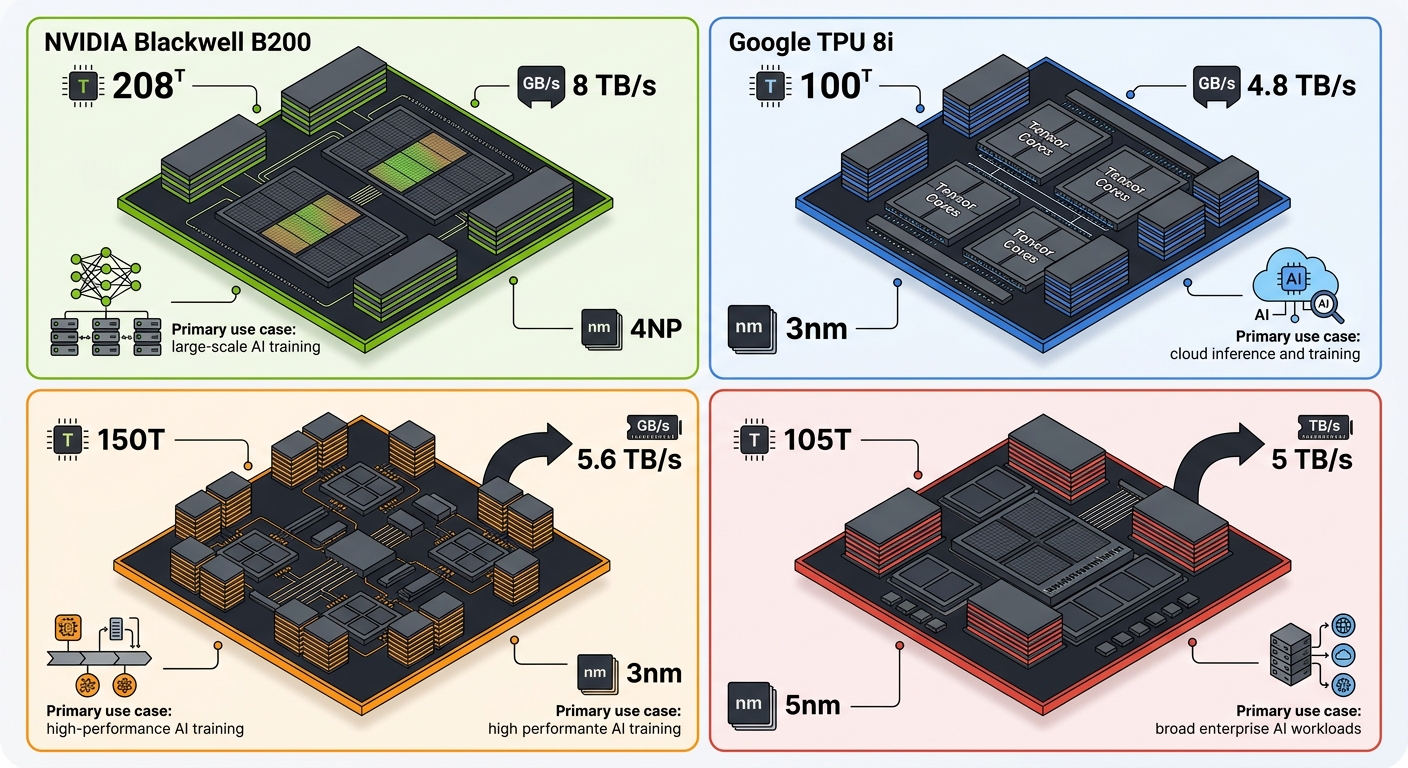
Google TPU 8i. Google split its TPU line in 2026, creating separate chips for training and inference. The TPU 8i is inference-optimized. It triples on-chip SRAM to 384 MB and adds 50 percent more HBM, reaching 288 GB. Google claims 80 percent better performance per dollar versus the prior generation. The TPU 8i's design prioritizes low-latency, interactive inference for large language models. Google has locked in a long-term supply agreement with Broadcom for custom TPU design through 2031.
Amazon Trainium 3. AWS launched Trainium 3 in 2026 on TSMC's 3nm process. Each chip delivers 2.52 petaFLOPS of MXFP8 performance. That represents a 30–40 percent improvement in price-performance versus Trainium 2. A Trainium 3 UltraServer stacks 144 chips into a single system, reaching 362 petaFLOPS. AWS claims this configuration reaches parity with NVIDIA's Blackwell NVL72 at rack scale, while delivering approximately 50 percent lower total cost of ownership. Trainium 4 is expected by early 2027, with at least triple the FP8 processing power of Trainium 3 and native FP4 support.
Microsoft Maia 200. Microsoft unveiled the Maia 200 in January 2026. Built on TSMC's 3nm process, it features 216 GB of HBM3e and 272 MB of on-chip SRAM. Microsoft says Maia 200 delivers 30 percent better performance per dollar than the prior generation of its internal accelerator fleet. The chip powers Microsoft 365 Copilot and runs OpenAI's GPT-5.2 model. Unlike NVIDIA and Amazon, Microsoft has not offered Maia 200 for external rental. It remains a captive Azure chip, optimized for the specific workloads Microsoft runs at scale.
The TCO Showdown
Total cost of ownership is where custom ASICs make their strongest case. For a hyperscaler running billions of inference tokens per day on stable models, purpose-built silicon can deliver dramatic savings.
Analyses suggest custom ASICs can reduce TCO by up to 65 percent compared to general-purpose GPUs for inference at scale. Google has stated that its Ironwood TPU (the seventh-generation predecessor to TPU 8i) offers approximately 44 percent lower TCO per chip than a GB200 server from its own procurement perspective. That is not a marketing claim from a startup. That is a hyperscaler justifying a capital expenditure decision internally.
The math works because ASICs sacrifice generality for efficiency. A GPU can run any AI model. An ASIC is optimized for a specific class of tasks, often delivering three to five times better performance per watt for those tasks. For an organization running the same inference task at scale every day, that efficiency gap compounds into billions of dollars over a chip's lifespan.
"The hyperscalers are not replacing NVIDIA. They are buying the right tool for each part of the job." — Infrastructure analyst, Wedbush Securities, January 2026
NVIDIA's counterweight is its software ecosystem. TensorRT-LLM and the Dynamo inference serving library continuously improve Blackwell's cost-per-token without hardware changes. A B200 that cost X dollars per token at launch may cost 0.2X dollars per token six months later through software alone. That is a compounding advantage that ASICs, purpose-built for today's models, cannot easily match when model architectures shift.
Market Share Reality Check
The headline numbers still favor NVIDIA. The company holds 70–86 percent of the overall AI chip market. Its dominance in AI training remains near total through at least 2028. No hyperscaler has announced plans to train frontier models entirely on custom silicon.
But the inference numbers tell a different story. ASIC-based AI server shipments are projected to represent 27.8 percent of the market in 2026. The segment is growing at 44.6 percent per year, nearly triple the 16.1 percent growth rate projected for merchant GPUs. Analysts expect hyperscalers to shift 60–70 percent of their internal inference workloads to custom ASICs by 2028. Some projections suggest NVIDIA's inference market share could decline to 20–30 percent within two years.
The AI inference chip market itself is expanding rapidly. Valued at $21.3 billion in 2026, it is projected to reach $67.8 billion by 2034. The total AI accelerator market could hit $604 billion by 2033. There is room for multiple winners. The question is which chips capture which workloads.
What's Next — The Road Ahead
The arms race is accelerating on all sides. NVIDIA's Vera Rubin NVL144 system, shipping in H2 2026, delivers 8 exaflops of NVFP4 performance per rack. It is specifically designed for million-token context windows, generative video, and agentic AI workflows—workloads that require massive memory bandwidth and low-latency interconnect.
Trainium 4 arrives in late 2026 or early 2027. It will double memory capacity to roughly 288 GB per chip and quadruple bandwidth versus Trainium 3, with native FP4 support. If AWS's claims hold, Trainium 4 will approach Vera Rubin's specifications on paper.
Groq introduced its third-generation LPU at GTC 2026. The Architecture Processing Unit targets the decode phase of inference with a large on-chip SRAM pool, delivering 35 times more inference throughput per megawatt than HBM-based GPUs. It is not a general-purpose AI chip. But for the specific bottleneck of token decoding in autoregressive models, it is a specialized weapon.
Heterogeneous computing is becoming the default architecture for large-scale AI deployments. The future is not ASIC versus GPU. It is the right accelerator for each layer of the AI stack. NVIDIA owns training and the full model serving stack. Custom ASICs own the stable, high-volume inference layer beneath it. The infrastructure battle for AI supremacy is not about one chip. It is about who controls each layer of an increasingly heterogeneous stack.
Expert Q&A: NVIDIA Blackwell vs. Custom ASICs
Article: nvidia-blackwell-vs-custom-asics-2026 Added by: Expert Review Agent Date: 2026-07-11
Q: Is NVIDIA Blackwell still worth it over custom ASICs for enterprise AI deployments?
A: It depends entirely on your workload profile. Blackwell and the upcoming Rubin architecture remain the strongest choice for organizations that need flexibility, frequent model changes, or cutting-edge training capability. The CUDA ecosystem, broad model support, and mature software stack (TensorRT-LLM, Dynamo) reduce operational risk. However, if you are running a fixed, high-volume inference workload on stable models—say, serving one or two large language models to millions of users around the clock—a custom ASIC from Google, Amazon, or your own silicon team could cut your infrastructure bill by 40–65 percent. The right answer is to audit your workload mix before signing any purchase order.
Q: Why are hyperscalers investing so heavily in custom silicon right now?
A: Scale. When you are running inference for billions of daily requests, even a 20 percent improvement in cost-per-token compounds into billions of dollars in savings over a chip's lifespan. Google, Amazon, and Microsoft each have the internal volume to justify the non-recurring engineering costs of custom silicon. They also have the software teams to port models and serving frameworks to their own accelerators. Add in supply chain risk mitigation—reducing dependence on a single merchant vendor—and the strategic calculus is clear. Custom ASICs are not a science project for these companies. They are a core infrastructure strategy.
Q: Can custom ASICs ever replace NVIDIA GPUs entirely?
A: Not for training, and probably not for serving frontier models with rapidly changing architectures. ASICs are optimized for specific computational patterns. When a new model architecture arrives—transformers gave way to mixture-of-experts, which is now being challenged by new attention variants—an ASIC built for the prior generation can become obsolete faster than a flexible GPU. NVIDIA's annual architecture cadence and its software stack's ability to absorb new model patterns are genuine competitive advantages. The future is heterogeneous: ASICs for stable inference at the bottom of the stack, GPUs for training and flexible serving above it.
Q: What is the realistic timeline for custom ASICs to take significant inference market share from NVIDIA?
A: The shift is already underway within the hyperscaler tier. By 2028, analysts project that 60–70 percent of hyperscaler internal inference will run on custom silicon. That is a massive reallocation, but it affects a specific segment of the market. For enterprises and smaller cloud customers who lack the scale to justify custom silicon, NVIDIA GPUs will remain the practical choice for years. The inference market share projections suggesting NVIDIA drops to 20–30 percent by 2028 are about total AI accelerator shipments—including the captive hyperscaler deployments. In merchant market terms, NVIDIA's position remains strong through at least 2027.
Q: How should enterprises approach chip procurement in 2026 given this fragmentation?
A: Avoid locking into a single architecture for all workloads. Evaluate your inference fleet by stability and volume. High-volume, stable inference workloads are candidates for ASIC migration or租赁 (rental of cloud-based ASIC instances). Novel model experimentation, fine-tuning, and any training workload still belong on CUDA-based GPUs. Over the next 12–18 months, watch the Trainium 4 and Vera Rubin rollouts closely. Both architectures arrive in late 2026 or early 2027 and will set new benchmarks for inference cost efficiency. The right strategy today is to preserve optionality, not commit prematurely to a single silicon path.