The 2026 Inference Economy: How AI Chips and Edge Hardware Are Reshaping Cloud Bills
How dedicated AI chips, edge hardware, and smarter sourcing are cutting the cost of serving models in the 2026 inference economy.
The Inference Economy Has Arrived
For years, the AI conversation centered on training. Teams raced to pretrain bigger models on massive GPU clusters, and the bill for that one giant job felt like the main event. That story has flipped. In 2026, the expensive part is no longer the single training run — it's the endless, always-on work of serving those models to real users. This shift is the inference economy: a world where recurring inference costs, not episodic training costs, define the AI budget.
The change is easy to miss because it happens quietly. A model trained once costs whatever the training run cost. But that same model, once in production, answers millions of queries a day. Every answer is a small, metered expense. Multiply that by the tens of thousands of models an enterprise runs, and the long tail dwarfs the head. Inference now outpaces training as the dominant line item in AI cloud bills.
There is a second force accelerating the trend: agents. Autonomous systems don't make one call — they chain many reasoning steps per task. Each step is an inference call. Agentic workloads multiply per-query cost several times over, which means the inference economy is growing faster than anyone priced in.
Key insight — Inference cost is now the dominant line item in AI cloud bills because a single production model serves millions of queries, and agentic workloads multiply calls per task. Hardware choice — accelerator type, edge vs. cloud — is the biggest lever an engineering team controls.
Why Inference Outgrew Training in Cloud Bills
Understanding why the cost flipped helps you budget correctly. The mechanics are simple once you see them.
Training is episodic spend. You run a finite job, the cluster finishes, and the meter stops. Inference is continuous spend. A production service runs around the clock, every day of the year. The unit economics are completely different.
The practical unit became the token — the atomic chunk of text a model reads or writes. Pricing is quoted in cost per million tokens. Larger, more capable models cost more per token. Smaller, specialized models cost less. This unit shift matters: you now think in micro-costs repeated billions of times, not in lump-sum jobs. As a rough 2026 reference, cloud providers quoted prices in a wide band — ranging from well under a dollar to several dollars per million tokens depending on model size, provider, and contract — and these figures fluctuate constantly, so treat any number as an estimate, not a quote.
The result is a mental model worth internalizing. Training is a capital expense you plan for. Inference is an operating expense that compounds with every user, every query, and every agent step. If your finance team still treats AI as a one-time project cost, the inference economy will surprise them every single month.
The Per-Token Math
Grounding in the unit helps you reason about the big picture. Here is the shape of the math in 2026:
- A query that needs a short answer uses fewer tokens than a long document generation.
- Cost per token is steadily dropping as hardware improves.
- But total volume is rising faster than prices are falling, so total spend keeps climbing.
That last point is the crux. Falling unit prices are real, but they are being overwhelmed by exploding usage. The team that wins is the one that manages both sides: the price per token and the number of tokens spent. Cost per token is dropping, but volume is rising faster.
AI Accelerators That Changed the Serving Game
If volume is one side of the equation, hardware is the other — and it is the lever you control most directly.
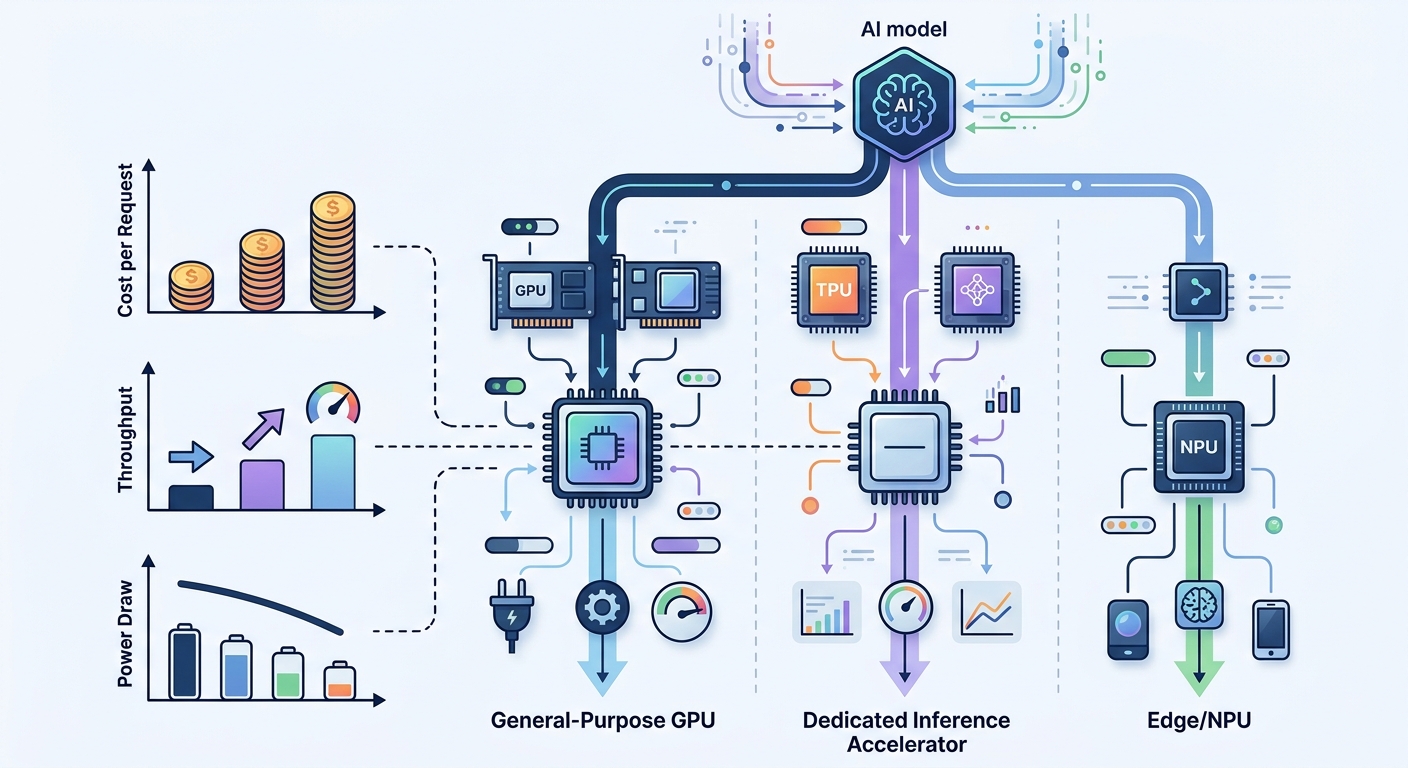
A general-purpose GPU was designed for many workloads, training included. It is powerful but heavy. Dedicated inference accelerators — chips built specifically to serve trained models — deliver more requests per dollar for steady serving workloads, tuned for throughput-per-dollar and power efficiency.
Two metrics matter when you evaluate them. TOPS per watt measures how much compute a chip delivers per unit of power; it drives the energy line of your bill. Cost per request captures the economics end-to-end, from hardware price to power to utilization. The second metric is the one that should drive purchase decisions.
There is also a quieter revolution: NPUs — neural processing units — now sit inside ordinary laptops, workstations, and servers. For lightweight inference, these coprocessors do the job for free, keeping work off the cloud entirely. That's not a toy. It is a real, growing source of "free" inference capacity inside hardware you already own.
When Edge Hardware Beats the Cloud
The instinct is to assume the cloud is always cheaper. It isn't. The decision framework comes down to workload shape.
Edge inference — running the model on hardware near the user — wins when three things are true:
- Latency matters. Going off-device adds a network round trip.
- Data should stay local. Privacy, compliance, and data-gravity rules push processing to the edge.
- The workload is steady. Predictable, always-on processing means you pay for your own hardware instead of a metered cloud meter that never stops.
The cloud wins on the opposite profile: spiky, bursty, unpredictable demand where elasticity saves you from buying for the peak. The disciplined approach is a split: keep steady, latency-sensitive, private workloads on edge or on-prem, and push elastic overflow to the cloud. Edge hardware reduces cloud inference bills by removing steady load from metered capacity.
The Cloud Bill Visibility Problem
The biggest hidden cost in the inference era is not bad pricing. It is invisible usage.
Idle GPUs are the classic example. Teams provision accelerator capacity for peak and leave it running through the night. Utilization averages are painfully low across the industry, and every idle core is a metered bill with zero output. Idle GPUs waste AI budgets. Capacity planning that matches supply to actual demand is the first fix.
The second problem is attribution. Many platforms meter inference so poorly that teams cannot tell which model, which team, or which feature generated the spend. Without that mapping, you cannot act. Metering each model and each call is a prerequisite for optimization. FinOps in the AI era starts with per-model cost visibility.
Once you can see it, you can control it. Autoscaling, spot capacity for interruptible loads, and aggressive utilization targets turn a runaway bill into a managed one. None of it is possible until the spend is visible.
Buying Compute Like a Portfolio
Experienced infrastructure teams don't bet everything on one purchasing mode. They buy compute like a portfolio.
On-demand pricing is flexible and expensive. Spot capacity is cheap and can be interrupted. Reserved capacity is discounted but commits you to a baseline. Portfolio buying blends on-demand and reserved capacity to match each workload:
- Reserved covers your predictable, steady baseline.
- Spot handles burst or interruptible batch inference.
- On-demand absorbs true unpredictability.
This is not just about unit price. It is also about leverage. If your models are portable to multiple providers and hardware types, you can negotiate from strength and avoid vendor lock-in. Portability protects against vendor lock-in — and it is a procurement weapon in the inference economy, not just an abstraction-layer luxury.
Measuring Cost Per Outcome, Not Per Token
Per-token cost is a metric of efficiency. It is not a metric of value. The question a business should ask is not "how much did this query cost" but "how much did this task cost, and what was it worth."
Cost per outcome reframes the conversation. Track the cost to complete a meaningful unit of work — an email drafted, a ticket resolved, a forecast generated. Optimization then protects quality instead of blindly slashing spend. A slightly more expensive model that finishes the task right the first time is cheaper than a cheap model that fails and forces retries.
This framing also protects you from the wrong kind of optimization. Cutting tokens aggressively can degrade output and push cost into human rework. Outcome-based budgeting keeps the tradeoff honest.
The Road Ahead
The inference economy is not a phase. It is the structural reality of AI in 2026 and beyond. Efficiency will keep improving and prices will keep falling, but usage — driven by agents and scale — will keep climbing. The teams that win are the ones that build the decision frameworks now: which workloads belong on which hardware, how to source capacity as a portfolio, and how to measure cost by outcome rather than by token.
Build those frameworks before scale forces you to panic-buy. The price of failure is not a bad quarter — it is a permanent, compounding line item that reshapes your cloud bills for years. Get the structure right now, and the inference economy becomes an advantage rather than a bill.
If you want to keep pace with how AI infrastructure, chips, and hardware are changing the economics of running AI, subscribe to the Algorithmine portal. We track these shifts so you don't have to.
Expert Q&A
Q: Why did inference overtake training as the biggest AI cost, and how fast did the flip happen? A: The flip happened because usage scales multiplicatively while training is finite. A training run is one big, bounded job. A deployed model serves continuously — millions of queries a day, every day. Once enterprises moved past pilots into production, the recurring serving cost quickly surpassed the one-time training cost. Agentic workloads accelerated the flip further, because a single agent task triggers several sequential inference calls instead of one. In practice, most mature AI organizations today spend far more monthly on inference than on all their training combined.
Q: What is the most common mistake teams make when they try to cut inference costs? A: The most common mistake is optimizing the wrong lever — aggressively pruning prompts or switching to a cheaper model and watching output quality collapse, which pushes cost into human rework and retries. The second mistake is ignoring idle capacity: massively over-provisioning GPUs or accelerators for the peak and running them near-idle the rest of the time. Fix visibility and utilization first, then tune model choice and hardware, then measure cost per outcome rather than raw tokens.
Q: How do I decide between renting cloud inference, buying my own accelerators, and moving to the edge? A: Match the sourcing mode to workload shape, the way you would build a portfolio. Use reserved cloud capacity for your predictable steady baseline, spot for bursty or interruptible batches, and on-demand only for true unpredictability. Own hardware or move to the edge when the workload is steady, latency-sensitive, or bound by data-privacy rules — that's where buying beats metering. The realistic answer for most enterprises is a hybrid: edge or on-prem for the stable, sensitive core, and the cloud for the elastic tail.
Q: Is edge inference genuinely cheaper than the cloud, or is that a myth? A: It depends entirely on utilization. Edge and on-prem look expensive on paper because you pay capital cost up front. But for a workload that runs constantly at high utilization, the per-request unit cost drops well below metered cloud pricing, and you eliminate round-trip latency and data-transfer fees. The cloud is cheaper only when your demand is spiky and you would otherwise buy hardware that sits idle. The disciplined question is not "which is cheaper" but "how predictable and latency-sensitive is this workload."