EU AI Act Compliance Guide for Engineering Teams: What You Need to Know Before August 2026
The EU AI Act is no longer a policy discussion. It's a production engineering problem.
The EU AI Act is no longer a policy discussion. It's a production engineering problem.
Starting August 2, 2026, most obligations for high-risk AI systems come into full enforcement. That means engineering teams — not just legal departments — own the technical work of compliance. Risk management systems, logging infrastructure, documentation artifacts, human oversight dashboards: these are engineering deliverables now.
Penalties for non-compliance reach up to €35 million or 7% of global annual turnover, whichever is higher. Prohibited practices — social scoring, real-time biometric identification in public spaces by law enforcement, AI that exploits vulnerabilities — have been banned since February 2, 2025 (Article 5). No conformity pathway exists for them.
This guide maps what engineering teams must build, starting with the most important question: is your system high-risk under the EU AI Act?
What "High-Risk" Means for Your System
The EU AI Act uses a risk-based framework to classify AI systems into prohibited, high-risk, limited-risk, and minimal-risk categories. The highest obligations apply to systems classified as high-risk.
Two paths lead to high-risk classification. First: the AI system acts as a safety component of a product — or is itself a product — covered by EU harmonization legislation listed in Annex I. These products include medical devices, machinery, toys, elevators, and radio equipment. If your AI ships inside any of these regulated product categories, you're likely high-risk.
Second: the system falls within one of eight use-case areas listed in Annex III of the Act:
- Biometric identification and categorization
- Critical infrastructure management (energy, water, transport)
- Education and vocational training (access, admission, assessment)
- Employment and workforce management (hiring, promotion, termination)
- Access to essential services (credit, insurance, social benefits)
- Law enforcement
- Migration, asylum, and border control
- Administration of justice and democratic processes
Engineering teams should audit their AI systems against both paths now. Classification determines every subsequent compliance decision. If your system falls under Annex III but genuinely poses no significant risk to health, safety, or fundamental rights, you must document that assessment — it's your evidence that the high-risk obligations don't apply.
Key deadline — August 2, 2026 is when Articles 8-15 obligations activate for standalone high-risk AI systems. High-risk systems embedded in Annex I regulated products get until August 2, 2027.
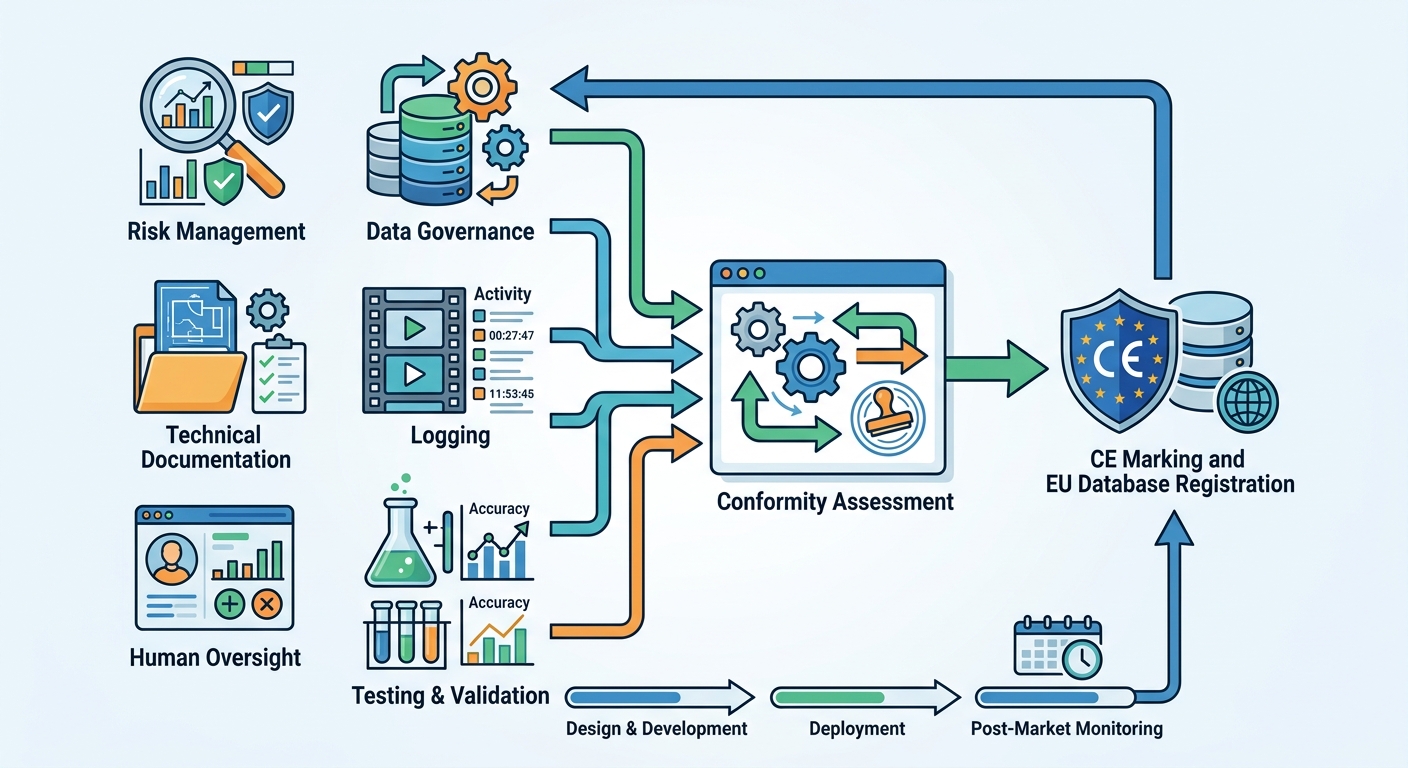
The Compliance Architecture — 6 Articles Engineering Teams Must Address
Six articles of the EU AI Act drive the bulk of technical engineering work. Understanding their scope is the first step toward building a compliance roadmap.
Article 9 mandates a continuous risk management system — identifying, analyzing, and evaluating known and foreseeable risks to health, safety, and fundamental rights throughout the entire AI system lifecycle. This isn't a one-time audit — it's an ongoing operational process.
Article 10 requires robust data governance. Training, validation, and testing datasets must be relevant, sufficiently representative, and free from errors. You must actively check for potential biases across protected demographic categories.
Article 11 requires detailed technical documentation specified in Annex IV of the Act — drawn up before a system enters service and kept current. It must demonstrate compliance and enable independent reproduction of results.
Article 12 mandates automatic event logging throughout the system lifecycle, retained for a minimum of six months. Logs must enable full traceability from user queries to data sources, including timestamps and user identity.
Article 14 requires human oversight measures — high-risk AI systems must be designed so humans can effectively monitor and intervene to prevent or minimize risks to health, safety, and fundamental rights.
Article 15 demands accuracy, robustness, and cybersecurity. High-risk AI systems must perform consistently, resist adversarial manipulation, and remain secure throughout their operational life.
Article 9 — Building a Risk Management System That Works
Risk management under Article 9 has four phases that repeat throughout your system's operational life: risk identification, risk analysis, risk evaluation, and risk reduction. Each phase produces documented outputs that feed into your compliance evidence.
Engineering teams must continuously monitor performance metrics, detect data drift and concept drift, identify outliers, and log anomalies for analysis. Your risk management system should automatically flag when error rates exceed defined thresholds or when input distributions shift beyond acceptable bounds.
For engineering teams, this means building monitoring infrastructure with drift detection — tracking KL divergence or Wasserstein distance between reference and production input distributions, and triggering alerts when thresholds are exceeded. This is standard MLOps practice, but under the Act it becomes a compliance artifact.
The European Commission's guidelines specify that risk management must address health, safety, and fundamental rights. For product teams, this means mapping AI features against the specific harms listed in Annex III. A hiring screening system must consider risks of discriminatory outcomes across protected characteristics like gender, age, and disability status.
Architecturally, your risk management system is a feedback loop. Monitoring data flows into regular risk reassessment, which flows into updates to your risk controls, which flows back into system design. The loop never closes — it runs for as long as the system operates.
Article 10 — Data Governance for Compliance
Data governance is where many teams will need to invest the most engineering effort. Article 10 requirements directly impact how you build and maintain training pipelines.
Training, validation, and testing datasets must be relevant, sufficiently representative, and free from errors to the best extent possible. The requirement isn't aspirational — your system must be designed to actively maintain data quality throughout its operational life.
This translates into specific engineering requirements. First, automated data quality checks at ingestion — schema validation, completeness checks, and anomaly detection before data enters your training pipeline. Second, bias detection frameworks that run statistical tests across demographic groups defined by the Act's protected categories — chi-square tests for disparate impact, equalized odds checks across protected attributes. Third, data provenance logs that record every transformation step, including data sources, collection methods, and preprocessing decisions.
Your data governance system should also track dataset versions. The Act requires traceability to specific training data — if a regulator asks which data influenced a specific decision, you need to answer with evidence.
Key requirement — data quality monitoring is not a one-time setup. Your pipelines must continuously assess data relevance and representativeness as real-world data distributions shift over time.
For teams using LLMs or foundation models, the data governance challenge extends to your training corpus. If you fine-tune or prompt-engineer a model for a high-risk use case, the Article 10 requirements follow the model into your product. Documenting your model's training data sources, filtering criteria, and decontamination procedures becomes part of your compliance documentation.
Article 11 — Technical Documentation That Passes Audit
Article 11 requires comprehensive technical documentation before your system enters service. The content requirements are specified in Annex IV of the Act — this isn't vague regulatory language, it's a detailed checklist.
Annex IV documentation must include:
- A general description of the AI system, its purpose, and the intended deployers
- The system architecture, including software components, hardware infrastructure, and data flows for training and inference
- A description of training data, validation data, and testing data — with statistical profiles including demographic breakdowns
- The design specifications for human oversight mechanisms and their rationale
- The design specifications for accuracy, robustness, and cybersecurity measures — including test methodologies and threshold criteria
- The risk management system documentation — risk registers, risk assessment reports, and mitigation records
- Change management procedures for substantial modifications — with version history and rationale for each change
The documentation must enable an independent third party to reproduce your system's results. This means recording not just what you built, but why each design decision was made and which alternatives were considered and rejected.
For engineering teams, this means your architecture decision records (ADRs) and design documents become compliance artifacts. Keep them current. Every substantial modification to your system requires updating the documentation and — if the modification is significant enough — a new conformity assessment under Article 43.
Article 12 — Logging Requirements for Full Traceability
Article 12 requires high-risk AI systems to automatically record events throughout their lifecycle. The logs serve two purposes: enabling post-market monitoring and providing audit evidence for national authorities.
Minimum logged data points per event — these are the specific fields your event schema should capture:
- User identity: authenticated user ID or system identifier for the requesting entity
- Timestamps: consistent with your system's synchronized time source (UTC, ISO 8601 format)
- Input data and parameters: the full request context including model inputs and configuration parameters
- Output decisions or generated content: the system's response and the confidence scores or alternative outputs considered
- Model version and dataset version: version identifiers that enable exact reproduction of the inference environment
- Human oversight actions: records of any human review, override, or intervention events
Log retention is minimum six months. National authorities may require longer retention periods depending on the use case and jurisdiction. For law enforcement or critical infrastructure systems, consult your legal team on jurisdiction-specific requirements.
Log integrity matters. Tamper-evident logging — cryptographic signatures on each log entry, or append-only storage with integrity checksums — prevents post-hoc modification of audit records. Regulators will scrutinize log authenticity during conformity assessments. Your logging architecture should support cryptographic verification of log integrity.
For teams using standard logging frameworks, Article 12 requires extending your existing infrastructure with AI-specific event types. A standard HTTP access log isn't sufficient. You need structured records that capture the decision context your AI system operated in — model confidence, input features that triggered specific decisions, and the AI-specific metadata needed to reconstruct why a particular output was produced.
Article 14 — Human Oversight Technical Implementation
Human oversight is one of the more design-intensive requirements under the EU AI Act. The goal isn't to add a human reviewer at the end of every decision — that would be operationally impossible at scale. The goal is to design systems where humans can effectively intervene when the AI system encounters edge cases, high-risk scenarios, or conditions outside its training distribution.
The Act implies three oversight approaches, and your system should specify which applies:
- Human disabling: the ability to fully shut down the AI system's function when conditions warrant
- Human intervention: the ability to stop, modify, or override specific AI decisions or processes before they're applied
- Human oversight: ongoing monitoring with the ability to guide the system through instructions, constraints, or calibration adjustments
For your system, the appropriate level depends on the risk profile and use context. A credit scoring system used for final lending decisions likely requires human intervention capability — a human must be able to override the score before it's applied to a customer account. A content moderation system might require ongoing monitoring with human disabling authority — human supervisors can shut down automated decisions if they detect a pattern of errors or adversarial manipulation.
Engineering teams building these mechanisms should document the rationale for their chosen oversight approach in their Annex IV documentation. The Act requires you to explain why your oversight design is appropriate for your system's risk level and intended use context.
Practically, implementing Article 14 oversight means building interpretation dashboards that surface AI decision context — feature importance scores, SHAP values or attention visualizations, alternative outputs considered, and uncertainty estimates. Your inference API needs to expose this metadata so human reviewers can interpret and potentially override a decision. For high-stakes decisions, consider building a two-stage system: the AI generates recommendations or candidates, and a human reviewer makes the final call.
Article 15 — Accuracy, Robustness, and Cybersecurity Testing
Article 15 requires that high-risk AI systems achieve appropriate levels of accuracy, robustness, and cybersecurity throughout their lifecycle. This article has the most direct overlap with existing engineering testing practices — but the documentation requirements are stricter.
Accuracy means your system performs consistently as specified. For classification systems, this includes maintaining precision, recall, and F1 scores above defined thresholds on real-world data distributions. Your testing should include longitudinal performance tracking — not just launch-day numbers.
Robustness means your system remains effective under perturbed inputs — adversarial examples, out-of-distribution data, and edge cases. For teams deploying ML models, this requires adversarial testing frameworks integrated into your continuous integration pipeline. Tools like the CleverHans library or adversarial attack libraries (FGSM, PGD, Carlini-Wagner) should be part of your standard testing suite for high-risk systems.
Cybersecurity means your AI model and its infrastructure resist attacks. This includes model extraction attacks (where an adversary queries your API to reconstruct your model), adversarial input attacks (where inputs are crafted to manipulate outputs), and data poisoning attacks (where training data is compromised to alter model behavior after deployment). Your security monitoring should include anomaly detection on inference patterns — sudden spikes in query volume or unusual input patterns may indicate model extraction attempts.
Testing is not a one-time gate — Article 15 requires ongoing validation. Your CI/CD pipeline should include regression tests that flag performance degradation when model versions change or when data distributions shift. Document test plans, test results, and the operational conditions tested.
The conformity assessment will examine your testing documentation. This includes test plans, test results, and evidence that tests cover the full range of operational conditions your system will encounter. For high-risk systems, maintain a test matrix that maps test scenarios to specific risks identified in your Article 9 risk register.
The Conformity Assessment — What Happens Before Launch
Before a high-risk AI system enters the EU market, it must undergo a conformity assessment under Article 43. An accredited third-party notified body evaluates whether your system meets all mandatory requirements in Articles 9 through 15.
The assessment covers your entire compliance package:
- Your risk management system (Article 9) — how risks are identified, analyzed, and mitigated
- Your data governance practices (Article 10) — dataset quality, bias detection, and provenance records
- Your technical documentation (Article 11) — completeness and accuracy of Annex IV records
- Your logging infrastructure (Article 12) — event capture completeness and traceability evidence
- Your human oversight mechanisms (Article 14) — effectiveness evidence and design rationale
- Your testing infrastructure (Article 15) — accuracy, robustness, and security test results and documentation
Engineering teams should treat the conformity assessment as a delivery milestone with a fixed deadline. Begin preparing your compliance artifacts at least three months before your target assessment date. Documentation gaps are the most common reason for assessment delays — regulators don't accept "we'll document this later."
After passing the conformity assessment, you must:
- Draw up an EU declaration of conformity
- Affix the CE marking to your system (and any product your AI is embedded in)
- Register the system in the EU database (EU Database for AI Systems) before market placement
Any substantial modification to your system — a new model version, a new training dataset, a change in intended use — triggers a reassessment obligation under Article 11. Document your change management process and define what constitutes a "substantial" modification for your system.
Post-Market Monitoring — Compliance Doesn't End at Launch
Compliance with the EU AI Act is a continuous obligation, not a one-time event.
Your post-market monitoring plan must systematically collect and analyze relevant data throughout your system's operational life. This includes performance metrics, incident reports, user feedback, and any evidence of the system failing to meet its specified requirements.
For serious incidents — anything that results in or could have resulted in death, injury, or significant property damage — you must report to market surveillance authorities within strict windows. The Act specifies:
- 72 hours: for incidents presenting a serious threat to the life or health of a person
- 15 days: for serious incidents that are not immediately life-threatening but may cause harm
The feedback from post-market monitoring flows back into your risk management system (Article 9). Performance degradation, emerging failure patterns, or new risk scenarios identified after deployment must be incorporated into your ongoing risk assessment and addressed through system updates.
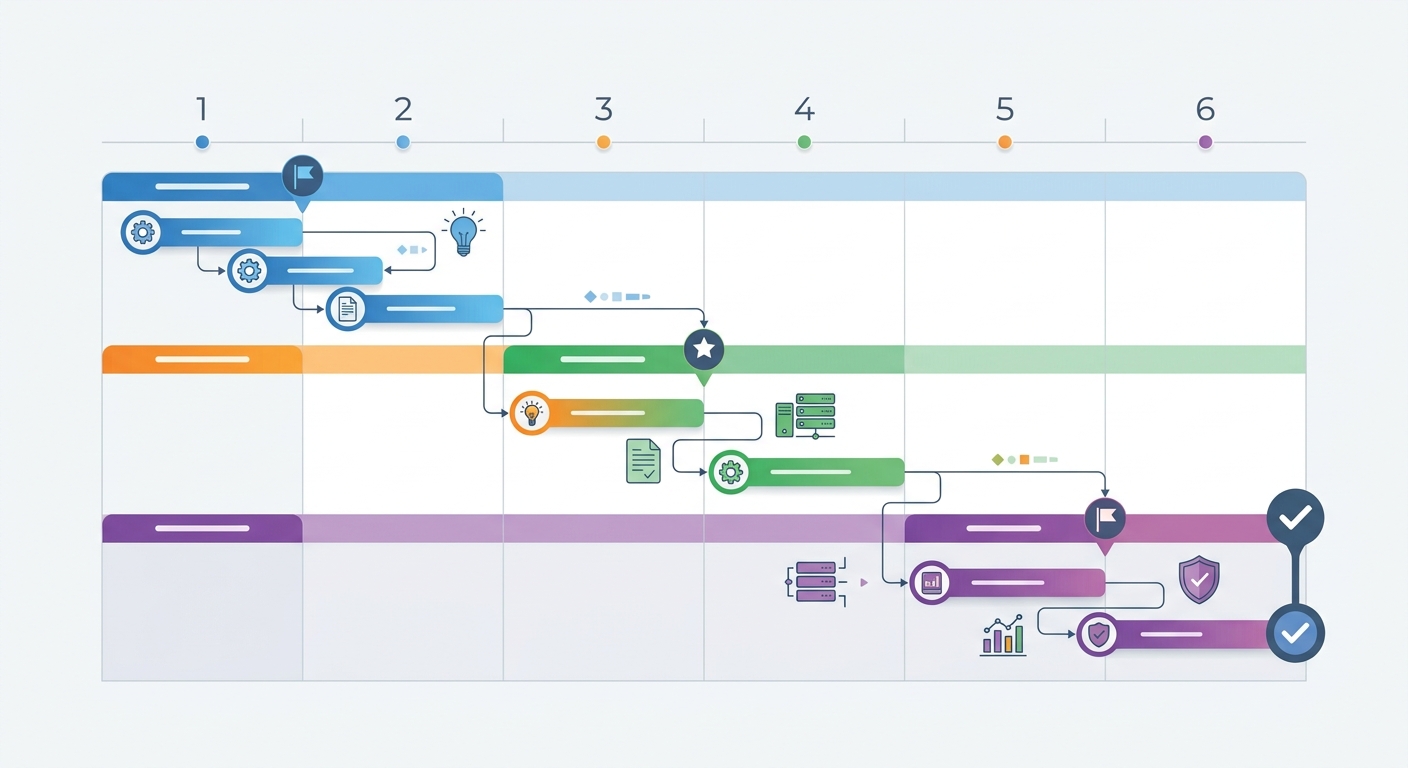
Your 6-Month Compliance Roadmap
With August 2026 as your deadline, here's a practical phased approach:
Months 1-2: Classification and Architecture
- Audit all AI systems against Annex I and Annex III classification criteria
- Determine which systems are high-risk and document classification rationale
- Review current system architectures for compliance gaps in logging, oversight, and testing infrastructure
- Establish cross-functional AI governance team (engineering, legal, product)
Months 3-4: Infrastructure and Documentation
- Implement Article 12 logging infrastructure with tamper-evident storage (schema, retention, integrity)
- Build data governance pipelines: automated quality checks, bias detection, provenance logs
- Begin Annex IV technical documentation for each high-risk system
- Define and implement human oversight mechanisms for each high-risk system
Months 5-6: Testing and Assessment Prep
- Establish CI/CD testing pipelines covering accuracy, robustness testing, adversarial scenarios
- Complete Annex IV documentation package — cross-reference with Article 9 risk register
- Conduct internal pre-assessment against all 6 articles
- Submit for external conformity assessment
The EU AI Act compliance work won't complete itself. But engineering teams that start now — classifying systems, building logging infrastructure, documenting architectures — will be ahead of those who wait until 2026. The deadline isn't when the work starts; it's when the work must be finished and validated.
The complexity of coordinating risk management, data governance, documentation, logging, oversight, and testing across engineering teams is real. Platforms that consolidate AI governance workflows can reduce the overhead of maintaining compliance artifacts across multiple systems. Explore how Algorithmine's governance tools help engineering teams maintain continuous EU AI Act compliance without slowing down delivery.
Expert Q&A
Q: Our AI system is used internally by our own employees, not sold as a product. Does the EU AI Act still apply? A: Yes, if your system falls within a high-risk Annex III category. The Act distinguishes between "providers" (those who place AI systems on the market or put them into service) and "deployers" (those who use AI systems in their organization). Deployers still have obligations — particularly around post-market monitoring and cooperation with authorities. Internal use does not automatically exempt you from compliance requirements. If you're building an AI system for internal use in hiring, employee assessment, or access to internal services, your system likely falls under Annex III high-risk categories.
Q: When exactly does the high-risk AI system enforcement deadline arrive? A: August 2, 2026 is when Articles 8-15 obligations activate for standalone high-risk AI systems generally. For high-risk AI systems embedded in products regulated by EU harmonization legislation (Annex I), the deadline is August 2, 2027. Prohibited practices (Article 5) have been enforceable since February 2, 2025, and GPAI model obligations since August 2, 2025.
Q: We have an existing AI system in production. Can we retrofit it for compliance, or do we need to rebuild? A: Retrofitting is possible in most cases, but the cost depends on your system's architecture. If your system has modular logging, data governance pipelines, and human oversight interfaces, compliance work is additive. If your system is a monolith with no audit trail capability, retrofitting could require significant refactoring. Start with a classification audit and gap analysis against all 6 articles — the results will tell you whether retrofit or rebuild is more cost-effective. Budget for documentation work regardless; even systems that seem close to compliant often lack the structured Annex IV documentation required.
Q: What's the most expensive compliance mistake engineering teams make? A: Treating documentation as an afterthought. Annex IV documentation must trace your entire design decision chain and enable independent reproduction of your system's results. Retroactive documentation is almost always incomplete — regulators can tell the difference. Build your documentation infrastructure as part of your development process, not after. Use architecture decision records (ADRs) as living documents from day one of a project's design phase.
Q: Who on the engineering team should own each compliance article? A: Compliance ownership spans multiple roles. ML engineers typically own Article 10 (data governance pipelines, bias detection frameworks) and Article 15 (testing, performance monitoring). Backend engineers build Article 12 logging infrastructure and data provenance systems. System architects design Article 9 (risk management architecture) and Article 14 (human oversight mechanisms). DevOps and SRE teams handle Article 15 performance monitoring, drift detection, and cybersecurity infrastructure. Assign a cross-functional AI governance lead to coordinate across these areas and serve as the interface with legal and compliance teams. This role is increasingly called an "AI Engineering Manager" or "ML Platform Lead" in organizations building at scale.
Q: Does the EU AI Act apply to AI systems built outside the EU but used by EU companies? A: Yes. The EU AI Act has extraterritorial scope. It applies to AI systems placed on the market or put into service in the EU, regardless of where the provider is based. If you're a US or Asian company selling AI-powered products or services to EU customers, and your system falls into a high-risk category, you must comply with the Act before offering it in the EU market. This includes registering in the EU database, passing conformity assessment by an accredited notified body, and maintaining a legal representative in the EU.