The 2026 AI Accountability Wave: Who Answers When an Agent Gets It Wrong?
Who answers when an autonomous AI agent errs? The 2026 accountability wave forces clarity on EU AI Act duties, vendor vs deployer liability, and practical governance.
AI accountability is the defining risk question of 2026. When an AI agent makes a costly mistake, enterprises need a clear answer about who is responsible. The 2026 AI accountability wave is shaping how IT teams govern agents, allocate AI agent liability, and meet EU AI Act obligations. Agents are shifting from suggestion tools to autonomous actors. Their errors carry real financial and legal weight. This guide covers the obligations, the liability split between vendor and deployer, and the governance practices that protect you.
Why AI Accountability Became the 2026 Flashpoint
Enterprise agents now act on your behalf. They qualify leads, draft contracts, and automate workflows. Each action carries risk. A single biased or erroneous output can trigger a dispute. Regulators now demand clear ownership of those outcomes. Buyers ask harder questions in procurement. Partners want proof of AI governance before they integrate.
The core shift is simple. A suggestion engine can be ignored. An autonomous agent cannot. When it makes a mistake, someone must answer. Companies now mitigate that liability through documentation and controls. This is the accountability wave.
The EU AI Act: What the August 2026 Deadline Means
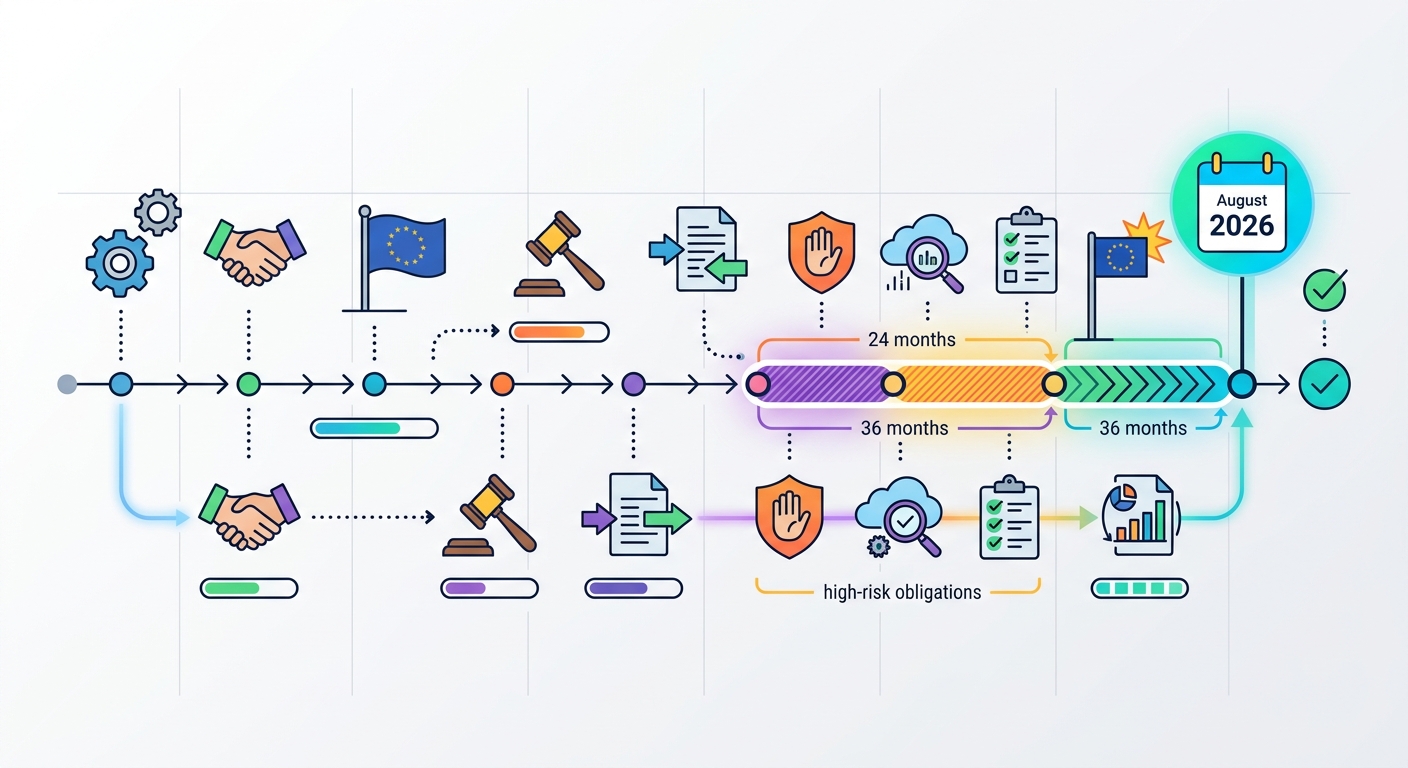
The EU AI Act began general application in August 2026. Its core obligations now bind many providers and deployers. The heaviest duties fall on high-risk AI systems. A high-risk AI system is one that poses significant risk to health, safety, or fundamental rights. Examples include systems used in hiring, credit scoring, and critical infrastructure.
For such systems, the rules require conformity assessment and registration. Providers must document training data and performance. Deployers must maintain oversight and monitoring. The framework is tiered. Low-risk tools carry light duties. High-risk tools carry substantial ones. You should map your systems to these tiers immediately.
Who Must Comply
The Act reaches beyond the EU. It applies to providers and deployers that serve EU markets. A US company is covered if it offers AI in the EU. It is also covered if its output is used there. This is why the wave touches US IT teams. Even operations without EU customers must prepare. Supply chains now ask for proof of compliance from partners.
Vendor vs Deployer: Allocating AI Agent Liability
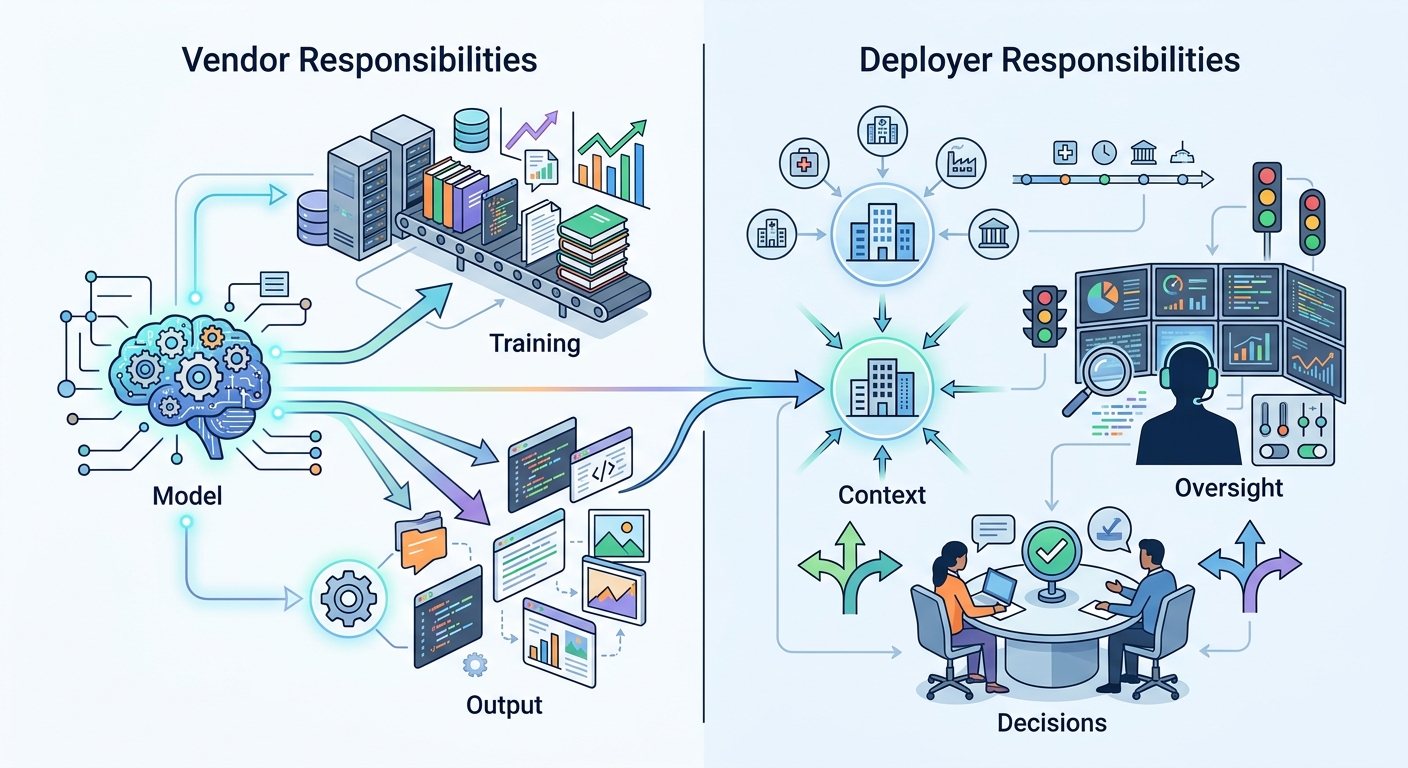
When an agent fails, fingers point in two directions. The vendor built the model and software. The deployer chose the context and the use case. Responsibility usually splits along that line.
The vendor owns the model, its training, and its base behavior. The deployer controls how the system is used, where it runs, and what decisions it may make. A model that returns biased outputs points to the vendor. A system applied to the wrong task points to the deployer. Neither party fully escapes.
Modern contracts formalize this split. Vendor agreements now include clear AI clauses. They state where model responsibility ends and where use responsibility begins. They define service levels for updates and incident support. As a buyer, review these clauses closely. They determine your exposure when an error occurs.
Shared Models of Responsibility
Some errors are genuinely shared. A deployer may feed biased data into a sound model. A vendor may ship an update that changes behavior without notice. In joint cases, responsibility allocation depends on evidence. That evidence comes from logs and documentation. Without them, blame becomes expensive to assign.
The AI Governance Stack That Protects You
Good governance does not eliminate errors. It makes them traceable and defensible. Logging is the foundation. Every agent action, input, and output should be recorded. An audit trail is a chronological record of these events. It shows who did what, when, and why. This is your first line of defense in any dispute.
Human oversight is now an operational requirement, not a checkbox. Regulators expect a human to validate consequential outputs. That means review queues for high-impact decisions. It means escalation paths when an agent is uncertain. A human reviewer validates agent outputs before they take effect. This is the practical meaning of oversight.
Incident response must exist before incidents. Define procedures for the moment an agent causes harm. Assign a response owner. Log every step you take. A documented response shows good faith and control. Governance frameworks tie all this together: logging, monitoring, and escalation working as one system.
Shadow AI: The Liability You Don't Own Yet
Shadow AI is the quiet threat in the accountability wave. It refers to unsanctioned tools that employees adopt without approval. A team member signs up for a personal AI assistant. They paste customer data into it. Your governance never sees it. Your logs never record it.
The risk compounds quickly. Shadow AI bypasses every control you built. It leaks data into systems you cannot audit. It creates decisions you cannot explain. When one of those tools fails, the company still answers. Liability does not disappear because IT never approved the tool. It simply becomes harder to manage.

Shadow tools are a symptom, not the disease. Employees adopt them because sanctioned options feel slow or weak. Fix the root cause. Offer approved tools that meet real needs. Make sanctioned AI as easy to use as the shadow alternative. Then enforce the boundary with clear policy.
Practical Steps for the Mid-Level IT Leader
You do not need to solve the full accountability question today. You need a practical path forward. Start with these steps.
Inventory every AI agent. Build a list of every tool, model, and agent in your environment. Classify each one by risk. High-risk systems get the most attention.
Assign a named owner. Every agent needs one accountable person. That person owns its decisions and its failures. Ownership cannot live in a committee.
Build oversight into architecture. Add review queues for high-impact outputs. Add logging at every integration point. Make monitoring a default, not an add-on.
Document your decisions. Record why you chose a model and how you tested it. A strong documentation trail supports a compliance defense. It also helps in procurement and audits.
Add AI clauses to vendor contracts. Define responsibility boundaries, update commitments, and incident support. Know exactly where vendor coverage ends.
Run incident-response drills. Simulate an agent failure. Time your response. Find the gaps before a real crisis exposes them.
Bring Shadow AI Into the Light
Map your shadow AI population. Survey teams for unsanctioned tools. Then migrate them to approved, governed options. You turn hidden risk into visible, manageable exposure.
Build for Monitoring
Post-deployment monitoring is a real obligation for high-risk systems. Track performance drift and error rates. Watch for behavior changes after updates. Monitoring is how you catch problems while they are still cheap to fix.
Frequently Asked Questions
Who is legally responsible when an AI agent makes a mistake? Responsibility is shared. The vendor owns model behavior. The deployer owns use and oversight. The exact split depends on evidence from logs and contracts.
Does the EU AI Act apply to US companies? Yes, in many cases. It applies to providers and deployers serving EU markets or whose output is used in the EU.
What counts as a high-risk AI system? A system posing significant risk to health, safety, or fundamental rights. Examples include hiring, credit scoring, and critical infrastructure tools.
How can my company reduce AI liability? Inventory your agents, assign ownership, log actions, add human oversight, and document decisions. Strong controls reduce exposure.
What is shadow AI and why is it risky? Shadow AI is unsanctioned tools employees adopt without approval. It bypasses governance and can leak sensitive data.
Do we need human oversight for all AI agents? Consequential, high-impact decisions should have human validation. High-risk systems under the EU AI Act require it by default.
Final Takeaway: Own Your AI Accountability Now
The accountability wave is not a threat to automation. It is the cost of maturity. Companies that govern their agents will win trust and avoid costly disputes. Companies that ignore accountability will pay for it later. Start with an inventory and an owner for every agent. Add logging, oversight, and incident response. Update your contracts and bring shadow tools into the light.
The question is not whether your agents will ever fail. The question is whether you can answer for it when they do. Prepare now. The wave is already here.
The Algorithmine portal keeps tracking this fast-moving story. Subscribe to the portal to get early analysis of AI regulation, governance, and enterprise practice. Join a community of IT professionals navigating the same wave. Subscribe today and stay ahead of the accountability curve.