Responsible AI in the Enterprise: Turning Compliance Into a Competitive Advantage
The EU AI Act's August 2026 high-risk deadline and the ISO 42001 wave make AI governance a deal-closing advantage. A practical playbook for turning compliance into competitive edge.
The 2026 Compliance Calendar Turned Into a Business Lever
For years, responsible AI lived in ethics decks and pilot programs. That changed. August 2, 2026 is the date the majority of high-risk AI obligations under the EU AI Act take effect. On that day, continuous risk management, data governance, technical documentation, record-keeping, transparency, human oversight, and post-market monitoring all become enforceable for in-scope systems.
The General Purpose AI (GPAI) transparency and systemic-risk rules already landed in August 2025. Models placed on the market before that date have until August 2027 to reach full compliance. Meanwhile, US state laws are stacking up: Colorado's AI Act, California's SB 53, and Utah's AI Policy Act each add enforceable duties. The FTC keeps signaling it will treat deceptive AI claims as an enforcement priority.
None of this is news to compliance teams. The shift is how leaders should frame it. Enterprises that operationalize AI governance now aren't merely avoiding fines — they are building the trust infrastructure that wins enterprise deals, shortens procurement cycles, and justifies premium pricing.
The key shift — compliance is no longer a cost center to minimize. It is a qualification gate that separates vendors enterprises trust with their data from those they quietly disqualify.
The New Procurement Reality: Governance Is a Qualification Criterion
Enterprise buying has changed faster than many sellers realize. From my work running AI governance programs, the most visible change is in the request-for-proposal (RFP) process. For high-stakes deployments, buyers now require evidence of responsible AI practices before they even shortlist a vendor. RFPs routinely include AI governance sections that did not exist three years ago.
Buyers ask for three things. They want a completed AI questionnaire covering risk, bias, documentation, and oversight. They want proof of a formal framework such as ISO 42001 certification or a mature AI risk program. And they want to see model documentation they can actually understand.
Certified vendors unlock faster enterprise procurement. A vendor with a clean, auditable governance posture moves through security review faster. A vendor with nothing but promises triggers deep diligence, slower cycles, and frequent disqualification. Governance has become a sales enablement asset, not a back-office chore.
ISO 42001 as the Common Denominator

The fragmentation of AI rules is the biggest obstacle to a coherent program. The EU AI Act is a regulation. The NIST AI Risk Management Framework is voluntary guidance. State laws differ from each other. Each alone leaves gaps.
ISO 42001 provides a consistent AI management framework that works across many of these regimes. ISO/IEC 42001:2023 defines a management system for AI, with an Annex A control framework that enterprises can implement, audit, and certify. Certification validates that a provider has repeatable processes for risk, testing, documentation, and oversight.
The adoption curve is steep and telling. Cloud providers and platform vendors certified early. Integrators and software vendors followed. In 2025 and 2026, a wave of enterprise-facing AI companies announced ISO 42001 certification, from automation vendors to contact-center, security, and simulation providers. The pattern is clear: certification has become a de facto entry ticket to serious enterprise deals.
The deeper value is consolidation. ISO 42001 maps onto both the EU AI Act and the NIST AI RMF, so one management system produces one evidence trail that satisfies multiple regimes. Enterprises stop duplicating effort across frameworks and build once, then reuse.
Building One Evidence Trail That Satisfies Every Framework
A durable governance program rests on five connected artifacts. They form a loop, not a checklist.
Start with an AI inventory. You cannot govern what you cannot list. A strong AI inventory enables auditable governance evidence — a living register of every AI system, its purpose, data flows, risk tier, owner, and lifecycle stage is the highest-leverage artifact in compliance. Auditors start here, and so should you.
Next, NIST AI RMF structures AI risk management activities into four functions: Govern, Map, Measure, and Manage. This gives you a repeatable way to identify and rate AI-specific risks such as bias, drift, hallucination, and misuse.
Then map controls. Align your risk responses to ISO 42001 Annex A controls. This traceability is what turns a risk register into an auditable control plan. Each control should name an owner, an implementation, and evidence of operation.
Fourth, model documentation builds auditor- and buyer-facing trust. Model cards and datasheets that name intended use, training data, limitations, and evaluation results build trust with both auditors and downstream teams. Documentation that is real, not boilerplate, is what survives scrutiny.
Fifth, human oversight requires real authority and escalation paths. Oversight must include escalation paths, override power, and named accountability. If the human can only rubber-stamp, the control fails the audit and the spirit of the rule.
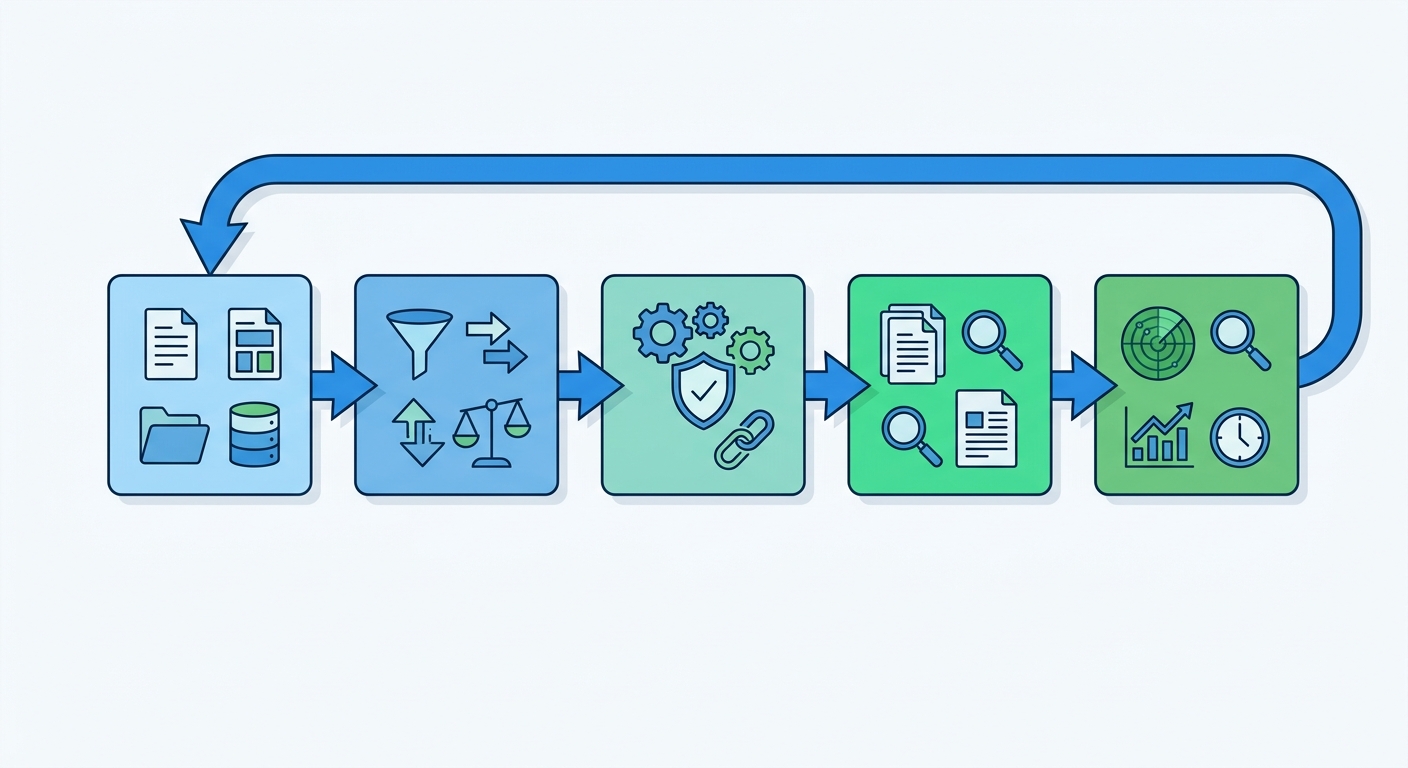
Close the loop with continuous monitoring. Post-market monitoring and incident response feed findings back into the risk register. Continuous monitoring feeds the AI risk register, keeping the system alive rather than a one-time deliverable.
The practical payoff — one inventory, one risk method, and one control set can satisfy ISO 42001 auditors, EU AI Act assessors, and NIST-based assessors alike. Build once, reuse everywhere.
Getting There Without Killing AI Velocity

The most common objection is speed. Governance that demands a 40-page document per model will throttle a team shipping weekly. The answer is tiering and automation, not friction.
Tier your controls by risk. Minimal-risk internal tooling needs lightweight documentation and oversight. High-risk use cases such as recruiting, lending, or biometrics require the full control set. Proportionality is built into the EU AI Act's logic, and it is the correct engineering answer too.
Automate evidence collection. Feed model card generation, evaluation results, and drift checks into the MLOps pipeline. If evidence is produced automatically as part of deployment, governance stops being a separate manual burden and becomes an output of normal work.
Keep a single source of truth. Centralize the inventory and risk register in one system. Decentralized spreadsheets create drift and force audit teams to chase inconsistencies. One authoritative store, with controlled write access, keeps the loop honest.
The Competitive Playbook: From Cost Center to Advantage
The opportunity is clear by now, but execution needs a plan. Four moves turn governance into leverage.
First, assess where you stand. Score your organization against a governance maturity ladder from ad hoc to continuously assured. Be honest about the gaps.
Second, pick a primary framework. ISO 42001 is the strongest common denominator for most enterprises. Map your other obligations, EU AI Act and NIST, onto it rather than building parallel programs.
Third, lead with evidence. Publish your governance posture, complete vendor questionnaires seriously, and bring model documentation to pre-sales conversations. Let trust be a feature you sell.
Fourth, keep the loop running. Governance is a continuous system, not a certification event. Monitoring, review, and improvement keep the advantage durable as rules evolve.
The closing argument — mature governance converts compliance into competitive advantage. The enterprises that treat responsible AI as an operating system, not a compliance filing, will be the ones still compounding trust when the next regulation arrives.
Enterprises that start now convert a looming deadline into a durable edge. The ones that wait will scramble to catch up at the worst possible moment. Responsible AI is finally a business case. If you want to keep building that case as the rules evolve, subscribe to Algorithmine for practical governance coverage delivered as it happens.