Liquid Cooling and the Power Density Wall: Redesigning AI Data Centers for 2026
AI racks now hit 60–130 kW and air cooling can't keep up. Compare DLC, immersion, and rear-door liquid cooling and plan a 2026-ready data center.
The Inflection Point for AI Infrastructure
AI accelerators have pushed rack power density past the point where conventional air cooling makes economic sense. A single rack of current-generation training GPUs can draw more power than an entire small data hall did a decade ago, and the thermal load arrives concentrated in a handful of packages rather than spread across a room. The result is a power density wall that is as much a budget problem as a physics problem.
The industry's response has been steady but incremental: rear-door heat exchangers as a stopgap, cold-plate pilots in hyperscale campuses, immersion experiments at the edge. That period is ending. In 2026, liquid cooling crosses from pilot project to default specification for any facility designed around serious AI workloads. The question for engineering leaders and procurement teams is no longer whether to adopt liquid cooling, but which architecture, at what density, and with which standards baked into the RFP.
This article examines the density trajectory, why air cooling runs out of headroom, how the major liquid cooling architectures compare, and what a credible 2026 facility design and procurement strategy looks like.
The Power Density Wall Is Here
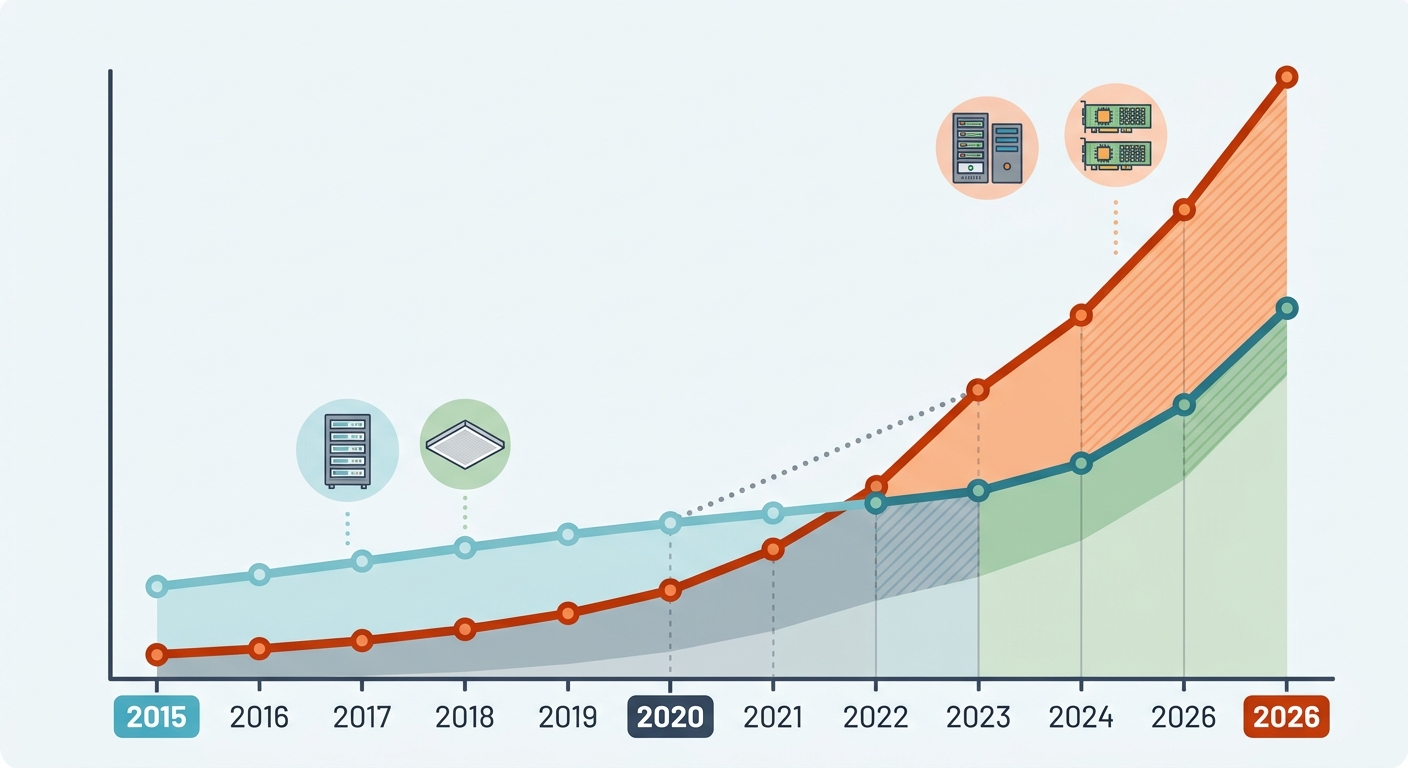
The numbers tell the story. Legacy enterprise racks ran at roughly 5 to 10 kW. Virtualization-era compute pushed some halls to 15–20 kW. Current AI training racks land at 60 to 130 kW of IT load per rack and climbing for GPU-dense configurations, with vendor roadmaps pointing higher. The high end reflects forward-looking, fully populated training racks rather than a typical deployment — production fleets still span a wide range — but the direction is unambiguous. This is not a gradual curve; it is a step change that invalidates assumptions baked into most existing data center designs.
The wall is thermal first. Heat flux per chip and per rack now exceeds what air can carry away within practical airflow limits. Air has low volumetric heat capacity, so moving enough of it demands enormous fan energy, large duct cross-sections, and acoustic mitigation that most halls were never built for. Beyond a certain density, the airflow required simply does not fit.
But the wall is also economic before it is physical. Air-based designs can technically be pushed further with more CRAC capacity, higher CFM, and aggressive hot-aisle containment — at a cost that stops making sense well before the physics fails. Air cooling remains viable in the roughly 20–40 kW range with disciplined containment and airflow management; the practical ceiling arrives when the capex and opex of an air solution exceed a liquid alternative, and for AI racks that crossover now happens early.
From 10 kW to 130 kW per Rack
The trajectory is worth internalizing because it drives every downstream decision. A rack designed for 10 kW tolerates sloppy airflow management. A 60 kW rack does not. A 130 kW rack concentrates heat into a footprint where air cooling's margin is essentially gone. Facility teams that sized power, cooling, and floor loading for the previous generation are now discovering that their newest hardware cannot be deployed at full utilization without stranding capacity elsewhere in the hall. (See also: [How to Calculate Rack Power Density Before You Buy GPUs])
Why Air Cooling Runs Out of Headroom
Air cooling's limitations compound. Because air carries relatively little heat per unit volume, high-density racks demand very high CFM. That translates into fan power penalties — fans themselves become a meaningful fraction of rack power — plus noise, vibration, and space consumed by air-handling equipment that could otherwise host compute.
Hot-spot management becomes a persistent operational tax. GPU workloads are bursty and unevenly distributed across a rack, so even a well-designed air hall faces localized hot spots that trigger thermal throttling on the most expensive silicon in the building. Throttling on a training cluster is not a minor inefficiency; it directly extends job completion times and inflates cost per training run.
Then there are the diminishing returns of the surrounding plant. CRAC and CRAH units, raised-floor plenum depth, and perimeter cooling architecture were all sized for a different era. Pushing them harder yields less and less, and existing halls end up with stranded capacity — power and space that exist on paper but cannot be used for high-density compute. Retrofitting air infrastructure to chase 60 kW racks is usually a bridge too far; the money is better spent on liquid cooling. (Related: [Air Cooling vs. Liquid Cooling: Where the Crossover Point Actually Is])
The uncomfortable truth for facility owners: an air-cooled hall built for 15 kW racks is not a 60 kW hall waiting to be unlocked. It is a 15 kW hall with a shrinking addressable market.
Liquid Cooling Architectures Compared
Three architecture families dominate the conversation, and they occupy different points on the density-versus-complexity curve. Most 2026 deployments will be direct-to-chip, with immersion reserved for specific density or siting requirements and rear-door hybrids serving transitional needs.
| Architecture | Practical Density Ceiling | Capex | Retrofit Fit | Ops Complexity |
|---|---|---|---|---|
| Direct-to-chip (DLC) | High (100 kW+ with tuned loops) | Moderate–high | Good | Moderate |
| Immersion (single/two-phase) | Very high | High | Poor | High |
| Rear-door heat exchanger | Moderate (~30–50 kW, higher when active/hybrid) | Low–moderate | Excellent | Low |
Direct-to-Chip (DLC) Cold Plates
DLC attaches cold plates to the highest-heat components — GPUs, CPUs, and increasingly memory and power modules — and circulates facility or CDU-conditioned coolant through them. It captures the majority of rack heat at the source while leaving the remainder (typically 10–30%, depending on how much of the rack is liquid-cooled) to conventional air. The ecosystem is the most mature of the liquid cooling options, with broad vendor support across server OEMs and cooling suppliers, and it retrofits reasonably well into existing halls because the rack footprint and service model stay familiar. For most AI builders in 2026, DLC is the pragmatic default. (Read more: [Direct-to-Chip Liquid Cooling: A Buyer's Guide])
Immersion Cooling
Immersion submerges servers in a dielectric fluid — single-phase (fluid stays liquid, pumped through a heat exchanger) or two-phase (fluid boils and condenses on a coil). It offers the highest density ceiling and excellent temperature uniformity, but it is a poor retrofit: tanks replace racks, service workflows change, and the fluid supply chain and materials compatibility become first-order concerns. Two-phase immersion additionally carries PFAS and regulatory exposure that single-phase does not, which is a real procurement risk in 2026. Reserve immersion for greenfield builds or sites with extreme density or environmental constraints.
Rear-Door Heat Exchangers
A rear-door heat exchanger mounts a coil at the back of the rack and rejects heat to a facility water loop. Passive units handle roughly 30–50 kW; active/pumped units push higher. RDHx is the easiest retrofit and the lowest-complexity option, which makes it attractive as a bridge — but at 100+ kW it is a supplement, not a solution. In 2026 the common pattern is DLC for the GPUs plus RDHx or room air for residual heat, not RDHx alone.
The Facility Side: What Actually Determines Success
Liquid cooling is often framed as a rack-level choice. In practice, most projects succeed or fail on facility-side decisions that the architecture comparison hides.
- Heat rejection and water. Liquid cooling moves heat from chips to a facility water loop — but it still has to be rejected. At 100+ kW/rack, sites need dry coolers or cooling towers sized for the load, and many lack the water budget or the space. Decide early whether you are designing for water-cooled (lower WUE, higher infrastructure) or air-cooled (higher WUE, lower capex) heat rejection, because it constrains everything downstream.
- Coolant chemistry and materials. Specify coolant (e.g., propylene-glycol-water blends vs. treated water), wetted materials, filtration, and biological-growth controls up front. Mismatched chemistry is a leading cause of fouling and corrosion in early DLC deployments.
- CDUs and loop design. Size the coolant distribution unit for peak load plus redundancy, and define supply/return temperatures, ΔT, flow rate, and pressure drop in the RFP. These parameters determine whether OEM cold plates and facility loops are actually compatible.
- Leak detection and serviceability. Require a documented leak-detection and containment protocol, quick-disconnect standards, and a service model that does not take down an entire rack for a single cold-plate swap.
A 2026 Design and Procurement Strategy
For engineering leaders and procurement teams, a defensible 2026 approach looks like this:
- Design to DLC as the default for any rack above ~40 kW, and specify liquid-ready racks (manifolds, quick-disconnects, CDU interfaces) even where the first deployment is air-cooled.
- Bake standards into the RFP. Reference OCP cooling and rack-manifold conventions, ASHRAE liquid-cooling and water-quality guidance, and Uptime Institute tier implications. Require vendors to state supply/return temperatures, ΔT, flow, pressure drop, and leak-detection behavior explicitly.
- Solve heat rejection before you buy cold plates. Confirm dry-cooler/tower capacity, water budget, and WUE targets against the target rack density.
- Plan the hybrid. Assume DLC for GPUs plus RDHx or room air for residual heat, and size the air side for the residual — not the full rack load.
- Treat coolant chemistry and CDU redundancy as first-class requirements, not afterthoughts.
The power density wall is real, but it is a design and procurement problem more than a physics one. Facilities that specify liquid cooling deliberately — with standards, heat rejection, and coolant chemistry settled up front — will deploy AI hardware at full utilization. Those that treat it as a rack-level add-on will keep discovering stranded capacity.