Custom ASICs vs GPUs for Inference: The 2026 Cost Crossover
Custom ASICs now beat GPUs on inference cost at lower volumes. See the 2026 cost crossover, TCO math per million inferences, and when to build custom silicon.
The Inference Cost Crossover Is No Longer a Hyperscaler Story
For the past decade, the question of custom AI silicon versus merchant GPUs for inference has had a predictable answer: GPUs win for almost everyone, and custom ASICs are a game for companies with tens of millions in non-recurring engineering (NRE) budget and a decade-long roadmap. That answer is now wrong at the margin, and the margin is widening.
The inference cost crossover is the sustained inference volume at which a custom accelerator beats a merchant GPU on fully loaded cost per inference—silicon, memory, power, software engineering, and amortized NRE, all divided across a three-year service life. In 2026, that crossover has dropped low enough to be reachable for well-capitalized mid-size players, not just the hyperscalers. This is an economics story, not a benchmark story, and it changes how engineering leaders should think about their inference roadmap. (See also: How to Build an Inference TCO Model.)
The shift is easy to miss because it doesn't show up in any single product launch. It shows up in spreadsheets: in the NRE line item that used to read $50M and now reads $20M, in the packaging quote that used to be "not available" and now has a lead time, and in the compiler team that used to be a bet-the-company hire and is now a normal budget line. Each of those changes is modest. Together they move the crossover point below the volume of a single successful product line at a mid-size SaaS or consumer company—a threshold that, five years ago, only a hyperscaler could clear.
Why 2026 Is the Inflection Year for Inference Economics
Three forces converged to move the crossover point.
First, inference demand has become durable and predictable. A generation ago, most teams were still guessing at serving volumes. Today, a company running a production assistant, a ranking stack, or a document pipeline has two to three years of demand data. Predictable volume is the precondition for amortizing NRE, and most serious AI operators now have it. The distinction matters: training demand is spiky and tied to research cycles, but inference demand tracks product usage, and product usage is something finance teams already forecast. If you can hand a silicon vendor a credible three-year token forecast with a defensible floor, you have the single most important input the amortization math requires.
Second, the barrier to building custom silicon has fallen—with caveats. Design services are mature and competitive. The chiplet ecosystem lets teams assemble proven dies—compute, I/O, memory controllers—instead of designing everything from scratch, though access to leading-edge nodes (5nm and below) and advanced packaging capacity (e.g., CoWoS-class interposers) remains allocation-constrained and should be contracted early. Advanced packaging is available through merchant foundries and OSATs in a way it wasn't five years ago, but availability is not the same as guaranteed capacity. The minimum viable team for a focused inference ASIC is smaller and cheaper than it has ever been—for a well-scoped design targeting a proven node. (Related: Chiplet Design for Custom AI Accelerators.)
Concretely, a scoped inference part on a 7nm or 6nm node with a fixed datapath for a small set of operators can be staffed with a core team in the low dozens of engineers: architecture, RTL, verification, physical design, and a small software group. That is still a serious commitment—think $15M–$25M in fully loaded engineering over two years before you count masks—but it is a commitment a company with a $500M revenue line can make, not just one with a $50B market cap. The caveats are real: standard-cell libraries, PHYs (PCIe, HBM, Ethernet), and memory controllers are licensable, but integration and verification of those IP blocks is where schedules slip. Teams that treat IP integration as a "just wire it up" task are the ones that miss tape-out.
Third, the software stack matured. The migration risk that used to kill custom silicon programs—immature compilers, missing kernels, fragile quantization paths—has shrunk. Mature compiler toolchains and a broader pool of engineers who have shipped accelerators mean the software tax on a custom program is now a budgeted line item rather than a program-ending risk. It is still a real cost: plan for sustained compiler, kernel, and driver engineering for the life of the platform, and treat multi-model support as a first-class requirement.
In practice, that means your software plan needs to name the stack up front: a graph compiler with a stable IR, a kernel library covering the operators your model family actually uses (attention variants, normalization, the usual matrix-multiply shapes), a quantization path that survives model updates, and a runtime that integrates with your existing serving layer—whether that's a vLLM-style scheduler, Triton, or an in-house system. The failure mode to avoid is discovering at month 14 that your compiler can't express a new attention pattern your model team adopted at month 10.
What Actually Changed
The headline change is not that custom chips got dramatically faster. It's that the fixed cost of entry dropped while the variable savings held. NRE that once ran $50M+ for a competitive inference part—driven by leading-edge mask sets, IP licensing, verification, and bring-up—can now land in the low tens of millions for a narrower, well-scoped design on a mature node. Meanwhile, the power and cost-per-token advantages of specialized datapaths have not gone away—they've just become accessible to more buyers.
The other half of the equation held steady: specialized silicon still delivers a meaningful advantage in perf-per-watt and cost-per-token for the workloads it targets, because a fixed datapath doesn't pay for generality it never uses. The point is that the fixed cost fell faster than the variable advantage eroded. That asymmetry is what moved the crossover.
The inflection is not about raw throughput. It's about the amortization math finally closing for companies that aren't named after a cloud.
The Real Math: TCO per Million Inferences
A credible comparison has to be built bottom-up. Here is the model that matters:
- Silicon cost: unit price of the accelerator, amortized over its service life.
- NRE: design, verification, masks, packaging development, and bring-up—spread across total units shipped.
- Memory and bandwidth: HBM or LPDDR cost, which often dominates the bill of materials.
- Power: watts per token times your electricity and cooling rate times utilization.
- Utilization: the fraction of provisioned capacity actually doing useful work.
- Software engineering: compiler, kernel, and driver maintenance over the life of the platform.
The GPU side has a different shape. Higher unit cost, near-zero NRE, faster redeployment, better liquidity. You pay a premium per unit, but you keep optionality, and you can offload idle capacity to a spot market or a flexible cloud contract—though current-generation accelerator spot capacity is itself constrained, so don't underwrite the model on it.
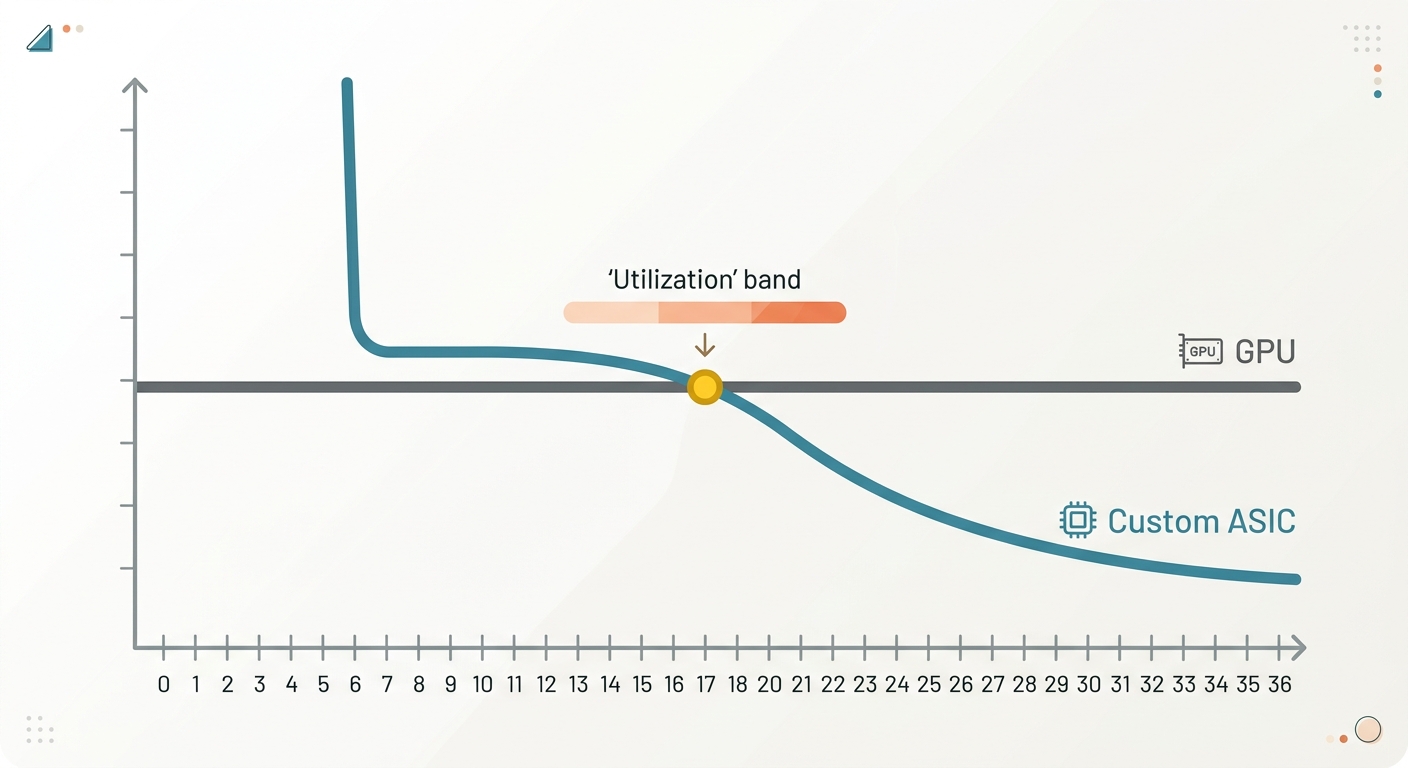
A worked example makes the crossover concrete. Take a fixed model family (a 7B–13B parameter model, FP8/INT8 inference, batch size 32–64) serving a steady 200 queries per second at 70% utilization over three years. That is roughly 6.6 billion inferences per year, or about 20 billion over the service life. On GPUs, the dominant cost is provisioned capacity times unit price, plus power—on the order of $1–$2 per thousand inferences depending on GPU SKU, power rates, and utilization, which annualizes to roughly $0.9M–$1.4M per million inferences at high volume. On a custom ASIC at the same utilization, per-unit cost drops sharply and power per token falls, but NRE (assume $20M–$40M for a scoped design) and software maintenance (assume 10–20% of NRE annually) add a fixed burden. The ASIC wins decisively at high, steady volume—and loses badly if volume disappoints. The arithmetic is illustrative; substitute your own SKU, node, and power inputs before making a decision.
Two sensitivity checks are worth running before you trust any crossover number. First, double your assumed NRE and see whether the crossover still clears your forecast floor—if it doesn't, the program is fragile. Second, halve your utilization assumption and re-run: at 35% utilization the ASIC's fixed costs spread across half as much work, and the crossover typically moves out past 3 billion inferences per month, which is a different class of commitment entirely.
Where the Crossover Lands
In our model, the crossover typically lands between roughly 500 million and 2 billion inferences per month for a stable model family, assuming 70%+ utilization, a two-to-three-year amortization window, and an NRE in the low tens of millions. Push utilization above 80% and the crossover moves lower. Drop utilization below 50% and it moves out of reach. Utilization and model stability are the two variables that move the crossover most—more than raw FLOPS, more than peak bandwidth. Model drift is the silent killer: if your production model family changes every six to nine months, the ASIC's fixed-function advantage erodes faster than the amortization schedule assumes.
Custom ASIC Advantages Beyond Raw Cost
The per-token savings are the headline, but the strategic advantages often matter more.
Power efficiency per token is the biggest lever. Specialized datapaths eliminate the general-purpose overhead that GPUs carry, and in power-constrained facilities—or anywhere electricity is a real line item—that translates directly into capacity you can deploy without new power contracts. (See: Power-Per-Token Benchmarks for Inference Accelerators.) For a colocation customer paying per kilowatt of provisioned power, the difference between a general-purpose accelerator and a specialized one can be the difference between fitting a new product line into an existing cage and signing a new lease.
Predictable latency is the second. A fixed-function pipeline has deterministic behavior; tail latency tightens, and SLOs get easier to hit without overprovisioning for worst-case variance. Note the qualifier: deterministic compute does not eliminate memory-bandwidth contention or queueing effects, so tail latency still depends on scheduling and batching discipline—but the variance budget is smaller and easier to engineer against. Teams that have fought p99 spikes on a shared GPU cluster know what this is worth: you stop buying headroom to cover a distribution's tail and start buying capacity for your actual throughput.
Deployment control is the third. A custom part is not subject to merchant-GPU allocation cycles, export-control shifts, or a single vendor's roadmap. For teams whose inference capacity is a competitive moat, supply-chain sovereignty has real option value. That value is hard to put in a TCO model, but it is not zero—ask anyone who spent 2023 and 2024 waiting in allocation queues while their competitor's capacity came online.
Where Custom ASICs Still Lose
Be clear-eyed about the other side of the ledger.
- Model drift. An ASIC is optimized for a model family. If your models change faster than your amortization window, the savings evaporate.
- Multi-model serving. Production stacks often serve many models. GPUs multiplex well; ASICs are narrower. Quantify your model portfolio before committing.
- NRE risk. Estimates overrun. Budget 30–50% contingency and stage-gate the program.
- Talent and vendor lock-in. You own the software stack for the platform's life. That is a permanent headcount commitment, not a one-time project.
- Time to capacity. Silicon takes 18–24 months from kickoff to production. If your demand curve is uncertain past that horizon, the GPU's optionality is worth its premium.
The failure modes are worth naming specifically, because they recur. The first is optimizing for a benchmark instead of a workload: a design tuned to peak matrix-multiply throughput that leaves memory bandwidth or host-interface throughput as the actual bottleneck in production. The second is underinvesting in the compiler: shipping silicon with a working kernel for the demo model and nothing else, then discovering that each new model variant costs months of kernel work. The third is treating the program as a hardware project: the hardware team tapes out on schedule, but the software and integration teams needed to make it serve production traffic were never staffed. Each of these is preventable with scope discipline, and each has killed real programs.
A Decision Framework
Run this checklist before committing NRE:
- Is demand durable? Two to three years of production volume data, with a credible floor.
- Is the model family stable? Six-to-nine-month drift is a red flag; multi-year stability is the green light.
- Is utilization high? Sustained 70%+ on provisioned capacity. Below 50%, sta