AI Startup Funding in H1 2026: Where the Money Actually Went
Record $510B poured into AI startups in H1 2026 — here's where it went, who got it, and what the concentration means for founders and investors.
The $510 Billion Half-Year: AI Funding's Record Start to 2026
The first half of 2026 produced the largest half-year for AI startup investment in history. Global venture funding directed at AI startups reached $510 billion between January and June 2026 — a figure that already exceeds the $440 billion invested across the entirety of 2025. The scale is unprecedented, and the pattern beneath the headline number reveals more than the total itself.
The first quarter delivered $305 billion in AI-focused venture investment, making it the single largest quarter ever recorded. The second quarter followed with $205 billion — the second largest quarter on record — suggesting that the pace did not let up even as scrutiny of AI valuations intensified. When the numbers are viewed together, H1 2026 represents a structural leap, not a spike.
Why 2026 Is Different From Previous Records
Past cycles of elevated AI investment — most notably 2021 — were characterized by broad deal activity across many companies and sectors. Investors were deploying capital widely, betting on the category broadly. The 2026 cycle is fundamentally different. This is not a boom in deal count; it is a boom in deal size concentrated in a small number of companies that investors believe represent a generational platform shift.
AI's share of the total venture market tells the story most clearly. Six months prior to H1 2026, AI startups captured roughly 50% of all global venture dollars deployed. By the end of Q2 2026, that share had climbed to 70–80%. In Q1 2026 alone, AI captured approximately $242 billion, representing around 80% of all global venture funding. The shift is structural — AI has become the dominant category in venture capital, not merely a significant one.
The Mega-Round Era: Four Companies, 65% of All VC in Q1
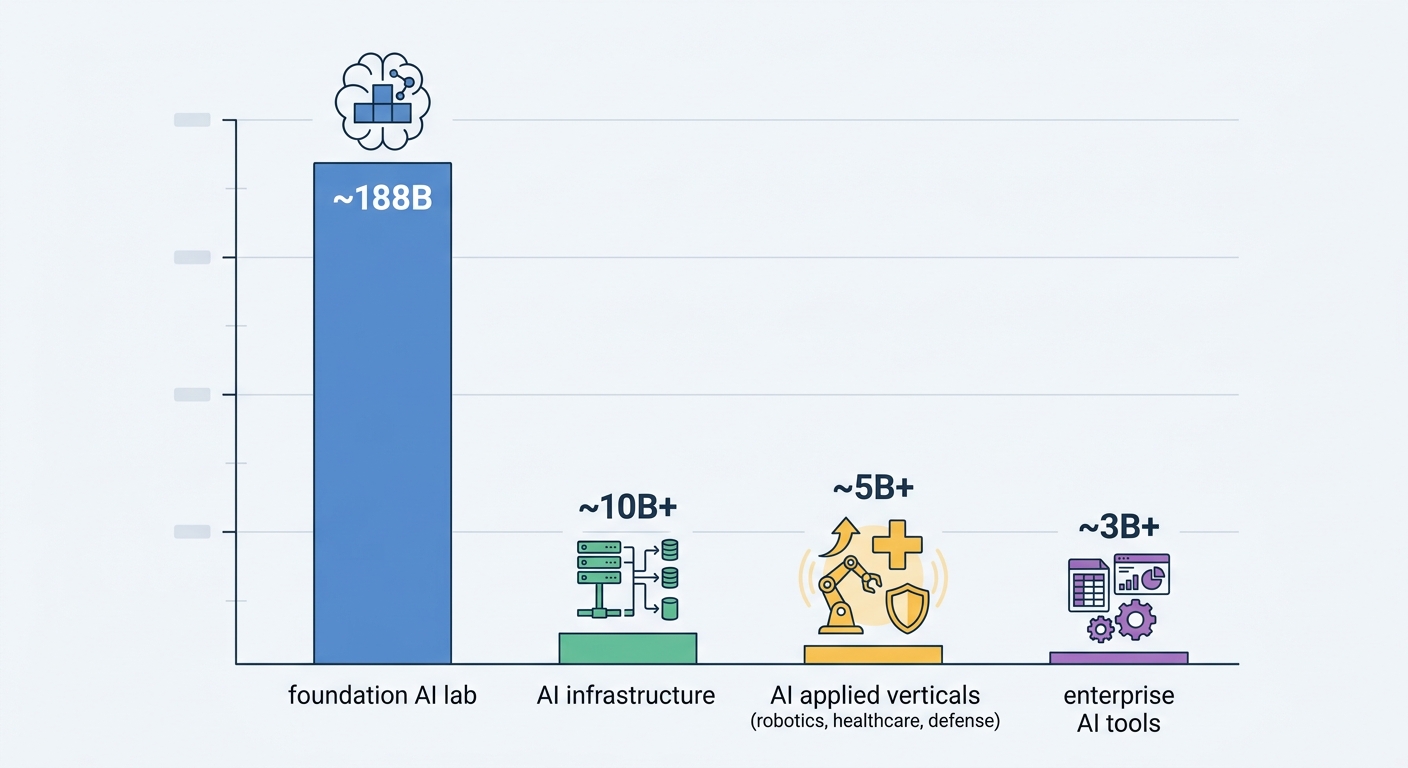
The 2026 funding landscape is defined by its extraordinary concentration. In Q1 2026, four companies collectively raised approximately $188 billion — roughly 65% of all global venture dollars deployed that quarter.
OpenAI secured the largest private funding round in history: $122 billion in a single raise, valuing the company at $852 billion. The investor syndicate included Amazon ($50 billion), Nvidia ($30 billion), and SoftBank ($30 billion), alongside additional participation from other investors and retail participants exceeding $3 billion.
Anthropic closed the second-largest private technology round ever — a $30 billion Series G — pushing its valuation to $380 billion. GIC and Coatue led the round.
xAI, Elon Musk's AI venture, closed a $20 billion Series E in Q1 2026, coinciding with a strategic alignment between xAI and SpaceX.
Waymo, Alphabet's autonomous driving company, raised $16 billion in a Series D round in February 2026, reaching a valuation of $126 billion.
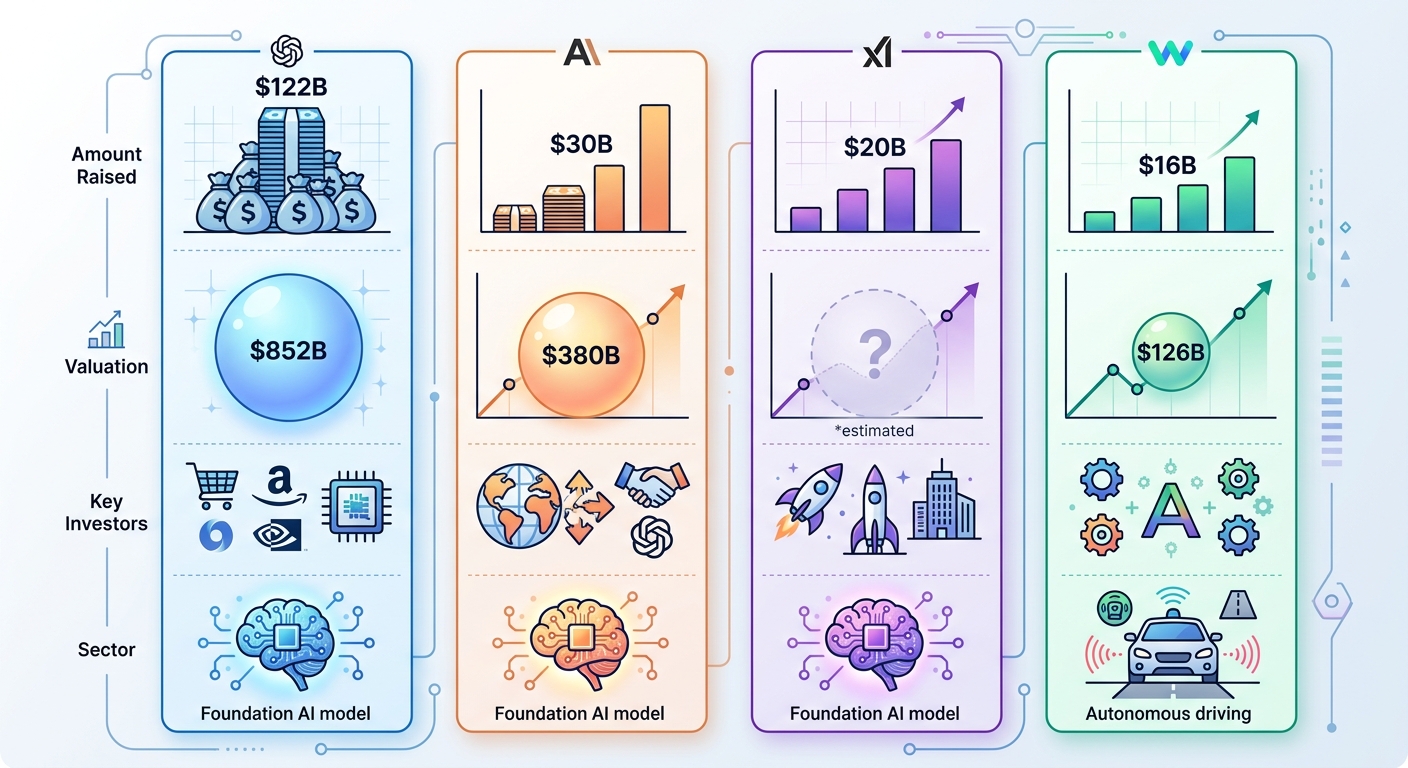
The pattern that emerges is not simply "AI got funded." It is that a specific tier of AI companies — those at the foundation model frontier, with access to compute and data at a scale few others can match — captured a disproportionate share of available capital. Investors are pricing in a winner-take-most dynamic at the infrastructure layer of the AI stack. AI startups raised $510B in H1 2026, but most of that went to a handful of companies operating at the foundation model layer.
Four companies captured 65% of Q1 global VC — a concentration level that introduces systemic risk even as it drives record totals. AI grew from 50% to 80% of total venture funding in just six months, creating a category dominance that outpaces any previous technology cycle.
The Deal Structure Shift: Fewer Checks, Dramatically Larger
Beyond the headline totals, the mechanics of AI investing shifted meaningfully in H1 2026. The change is best captured by a paradox: seed dollars deployed increased by approximately 30% year-over-year, while the number of seed deals fell by around 31% simultaneously.
This is not a contradiction. It reflects the same concentration logic visible at the top of the market. When investors find it harder to identify differentiated early-stage bets, they concentrate larger sums into fewer opportunities. The median Series A round across all sectors now sits at approximately $14 million — up from $8–10 million just a few years prior.
For AI startups specifically, the valuation premium relative to non-AI companies is stark. Foundation model labs and AI infrastructure companies command roughly 5x the valuation multiples of comparable non-AI peers. This is a premium that reflects expected moats, network effects, and the capital intensity required to compete at the frontier. AI startups command a 5x valuation premium versus non-AI peers, reflecting the platform-scale opportunity that investors are pricing in.
Investors in H1 2026 also began applying a new signal to evaluation: revenue per employee. The metric reflects a broader shift away from growth-at-all-costs toward sustainable unit economics. Lean, revenue-proven teams attracted disproportionate interest, even as overall deal count declined. Median Series A rounds increased to $14M across sectors, but the capital went to fewer, more capital-efficient teams.
Beyond the Frontier Labs: Applied AI Gets Its Check
While the foundation model companies dominated the headlines, H1 2026 also saw substantial capital flow into applied AI verticals. The billion-dollar rounds extended well beyond core AI labs.
Databricks, the enterprise data and AI infrastructure company, raised $7 billion in Q1 2026. The round reflects continued investor appetite for the data layer of AI — the pipelines, warehouses, and governance frameworks that underpin enterprise AI deployment at scale. Databricks raised $7B in Q1 2026, anchoring the AI infrastructure category as a distinct and well-funded investment thesis.
In July 2026, Fireworks AI, an enterprise AI tools developer, closed a $1.5 billion Series D at a $17.5 billion valuation. The round signals that applied AI tooling — platforms that help enterprises build, fine-tune, and deploy AI models — remains a well-funded category.
AI defense technology attracted meaningful checks from top-tier investors, as did AI robotics and AI healthcare. These applied verticals share a common trait: they sit downstream of foundation models, solving specific domain problems with AI as a core component rather than the entire product. Investors increasingly see applied AI as the layer where commercial traction is fastest and competitive differentiation is most durable.
North America vs Europe: Two Funding Philosophies
The geographic distribution of AI funding in H1 2026 tells a story of two very different markets.
North America — driven almost entirely by the United States — received an estimated $392 billion in AI venture investment during H1 2026. This figure is almost entirely the product of mega-rounds concentrated in a handful of frontier AI companies. The US market has chosen to bet big on a small number of foundation AI champions, with infrastructure and applied AI following behind. North America received $392B in H1 2026 AI funding, reflecting a high-concentration, frontier-first investment philosophy.
Europe presents a contrasting picture. After years of lagging behind the US in AI investment, European venture activity showed a meaningful recovery in H1 2026. For the first time, AI secured a majority share of European venture funding, and the continent saw a clear shift toward larger deals in deep tech and applied AI. The pattern in Europe is breadth over depth — more companies funded across more sectors, with less concentration in any single mega-round.
The geographic divergence has implications for global AI competition. The US approach concentrates compute and capital in a few frontier companies, while the European approach distributes investment more broadly across applied use cases and deep tech. Neither model is inherently superior — each carries different risk profiles and long-term competitive implications.
The Exit Market Turns: Q2 2026 and Liquidity Renewed
H1 2026 was not only about fundraises. The exit market for AI-backed companies showed significant renewed vitality, particularly in Q2 2026.
Q2 2026 marked the strongest exit quarter since 2021. The highlight was the SpaceX IPO, which valued the company at $1.77 trillion — the largest IPO ever for a venture-backed company. SpaceX IPO valued the company at $1.77T in Q2 2026, setting a new benchmark for venture-backed exits and signaling strong institutional appetite for large-scale technology companies.
AI startups also benefited from a record-setting acquisition environment. The combination of a strong exit market and renewed IPO activity creates a healthier feedback loop: successful exits return capital to investors, who redeploy it into the next generation of AI startups.
The liquidity environment matters for the overall AI funding ecosystem. When exits work, the venture flywheel turns. Capital recycled from successful AI exits in 2026 will become seed and Series A checks for the next cohort of AI startups.
Is the AI Funding Bubble at Risk?
Given the record figures, the question is unavoidable: is AI funding in 2026 a bubble?
The honest answer is that the question misframes the situation. AI funding in 2026 is concentrated at the frontier, not broad across the ecosystem. The systemic risk lies in that concentration. If OpenAI or Anthropic faces a significant setback — regulatory, technical, or competitive — the impact on overall AI venture figures would be outsized given how much capital is deployed in a small number of companies.
The real risk is not a broad AI funding collapse — it is a concentration event at the top of the market that ripples downward. — Unlike 2021, when speculative excess spread across many companies and sectors, 2026's AI funding is increasingly anchored by real revenue and improving unit economics.
Revenue-per-employee metrics across funded AI companies are improving. The companies raising the largest rounds — OpenAI, Anthropic, Waymo — have tangible products, real customers, and measurable enterprise adoption. This is structurally different from 2021, when many companies were funded on the basis ofTAM projections and narrative rather than revenue.
The risk is real but differentiated. Applied AI companies with proven revenue, lean team structures, and domain-specific moats are less exposed to a correction at the frontier than companies whose valuations depend entirely on foundation model race narrative.
How to Position Your AI Startup for 2026 Funding
For founders entering the AI fundraising market in 2026, the environment presents both opportunity and new expectations.
Lean teams with revenue signals win. Investors in H1 2026 showed a clear preference for capital-efficient teams with demonstrable revenue traction. The days of raising on headcount and narrative are not gone entirely, but they are harder. Revenue per employee has become a key metric.
Infrastructure and applied AI verticals are favored over pure foundation plays. The foundation model layer is effectively closed to new entrants without billions in committed capital. But the infrastructure layer — data pipelines, evaluation frameworks, fine-tuning platforms — and applied verticals — healthcare, robotics, defense, enterprise productivity — remain open and well-funded.
Geographic diversification matters. European investors are more active in applied AI than at any prior point. Founders who can demonstrate product-market fit in the European market may find more favorable term sheets and less competition for capital than in the saturated US foundation ecosystem.
The Algorithmine platform tracks AI funding trends, sector performance, and exit signals daily. Subscribe to receive the weekly AI funding digest and stay ahead of where the next billion dollars is flowing.
Key Data Summary
| Metric | H1 2026 Figure | Context |
|---|---|---|
| Total AI startup funding | $510B | Exceeds all of 2025 ($440B) |
| Q1 2026 AI funding | $305B | Largest quarter on record |
| Q2 2026 AI funding | $205B | Second largest quarter on record |
| AI share of total VC (Q1) | ~80% | Up from ~50% six months prior |
| AI share of total VC (Q2) | ~70%+ | Structural shift, not a spike |
| North America AI funding | $392B | Driven by mega-rounds |
| OpenAI raise | $122B | Largest private round in history |
| Anthropic raise | $30B | Second largest private tech round |
| Median Series A (all sectors) | ~$14M | Up from $8–10M |
| Seed dollars | Up ~30% YoY | But deal count down ~31% |
| AI valuation premium vs non-AI | ~5x | Foundation lab premium |
Sources: Crunchbase, KPMG Global Venture Pulse, gohub.vc, siliconcanals.com, digitalapplied.com. Figures marked as estimated based on available industry reports.
Expert Q&A
Q: The article mentions that four companies captured 65% of all Q1 2026 VC. Is this level of concentration historically unusual, and what does it mean for the broader startup ecosystem? A: Yes — this level of concentration is historically unusual and without direct precedent in the modern venture era. The closest comparison might be the dot-com cycle at its peak, but even then, capital was distributed more broadly. What makes 2026 distinct is that the concentration is not speculative excess but a rational response to the structure of foundation AI: building at the frontier requires billions in compute, data, and talent that only a handful of teams can access at scale. The implication for the broader ecosystem is that non-frontier AI startups — applied AI, tools, infrastructure — must compete for a smaller slice of available capital, potentially at higher valuation scrutiny. However, the applied AI segment is also where commercial traction materializes fastest, so the concentration risk at the frontier does not necessarily doom the broader AI startup landscape.
Q: You note that seed deal count fell 31% while seed dollars rose 30%. How does this paradox affect early-stage founders who are not building foundation models? A: The paradox reflects investor behavior at the seed stage mirroring what happens later: concentrating bets rather than diversifying. For early-stage founders not in the foundation model category, this creates a specific challenge — investors are spending more time evaluating fewer opportunities, which means the bar for conviction is higher. A seed-stage AI startup needs stronger evidence of product-market fit, a clearer differentiation story, and more concrete early revenue signals to get a check than in a lower-concentration environment. The bright side is that capital-efficient, lean early teams that do get funded tend to get meaningfully larger seed rounds than they would have two years ago.
Q: European AI funding took a majority share of VC in Europe for the first time. Is this a structural shift or a cyclical recovery? A: Both factors are at play. The structural element is genuine: Europe's AI ecosystem has matured significantly over the past three to four years, with strong applied AI companies emerging in healthcare, industrial automation, and enterprise software. The cyclical element is equally real — European VC had been in a post-2022 correction period, and the recovery in AI funding reflects both improved exit market conditions and renewed LP appetite for European venture. The key question is whether European AI funding maintains this majority share as the market evolves. The evidence from H1 2026 suggests it is structural enough to be durable, though the absolute dollar volumes will remain a fraction of North American levels given the difference in fund sizes.
Q: The exit market in Q2 2026 was called the strongest since 2021. How important is exit market health to the overall AI funding ecosystem? A: Exit market health is the connective tissue of the venture model. The mechanism works as follows: strong exits (IPOs, acquisitions) return capital to investors; those investors redeploy capital into new funds and new startups; new capital flows to the next generation of founders. In H1 2026, with SpaceX's $1.77T IPO and record M&A activity, that mechanism is functioning at a high level for the first time since 2021. For AI specifically, a healthy exit market is particularly important because several of the largest AI companies — OpenAI, Anthropic — remain private and their eventual exit paths (IPO or secondary sale) will define how institutional AI investors realize returns. If the exit window closes again, the willingness to write billion-dollar checks for frontier AI companies will diminish meaningfully.
Q: What are the most common mistakes founders make when pitching AI startups to VCs in 2026? A: Three patterns stand out from the current environment. First, leading with foundation model ambition without the capital base to back it — VCs in 2026 are deeply skeptical of "we're building the next GPT" pitches unless the team has a credible path to compute and data at the required scale. Second, overestimating the novelty of an AI feature without a clear commercial application — investors want to see domain-specific moats, not wrappers around existing APIs. Third, neglecting unit economics in the pitch narrative — given the shift toward revenue-per-employee and capital efficiency signals, founders who cannot articulate their path to profitability or meaningful revenue density will face a harder fundraising environment than those who can. Applied verticals with clear B2B revenue, specific industry moats, and lean team structures are currently the most compelling pitches in the AI category.
Image URLs
| # | Alt | URL |
|---|---|---|
| 1 | Comparison of OpenAI, Anthropic, xAI, and Waymo funding rounds in H1 2026 | /api/images/0dbd2a0bc10f40998b3e91f3f8b141f8 |
| 2 | Bar chart of AI sector funding in H1 2026 showing foundation labs dominance | /api/images/de1c57ea14ee45ff9b9b37c06ed48093 |
Total: 2 images uploaded