AI Governance Frameworks for Enterprises: SOC 2, ISO 42001, and What's Coming in 2027
Enterprise AI adoption has outpaced governance. Most organizations now deploy multiple AI systems across operations, customer service, and decision-making. Yet frameworks to govern these systems remai
Enterprise AI adoption has outpaced governance. Most organizations now deploy multiple AI systems across operations, customer service, and decision-making. Yet frameworks to govern these systems remain fragmented.
This gap creates risk. Regulators, customers, and partners increasingly demand proof of responsible AI use. The organizations that build governance infrastructure today will lead tomorrow.
This guide compares established frameworks like SOC 2 and ISO 42001 with emerging standards shaping 2027 compliance requirements.
Understanding the AI Governance Landscape
AI governance refers to the systems, policies, and controls organizations use to manage artificial intelligence responsibly. It covers model development, deployment, monitoring, and retirement.
Unlike traditional IT compliance, AI governance must address unique challenges. Models can drift (change behavior over time). They can inherit bias from training data. Their decisions can be difficult to explain.
Three factors drive urgency:
- Regulatory mandates are becoming mandatory rather than voluntary.
- Enterprise customers now require AI governance proof in procurement.
- Audit findings related to AI are increasing across industries.
"AI governance is no longer a nice-to-have. It is a prerequisite for enterprise contracts in 2025 and beyond." — Gartner, 2024 AI Governance Report
Organizations that delay building governance frameworks face two risks: regulatory penalties and lost business opportunities.
Executive Summary
This guide addresses three core questions:
-
How does SOC 2 apply to AI systems? SOC 2 evaluates AI controls within existing trust service criteria, with processing integrity becoming the primary focus for AI-specific audits.
-
What does ISO 42001 certification involve? ISO 42001 establishes a comprehensive AI management system following Plan-Do-Check-Act principles, requiring 12-18 months for initial certification.
-
What regulatory changes arrive in 2027? The EU AI Act, NIST AI RMF adoption, and sector-specific requirements will reshape compliance obligations for enterprises operating globally.
SOC 2: The Starting Point for AI Accountability
SOC 2 (Service Organization Control 2) is an auditing framework developed by the American Institute of Certified Public Accountants. It evaluates how organizations manage customer data and system security.
SOC 2 reports assess five trust service criteria: security, availability, processing integrity, confidentiality, and privacy. Until recently, AI systems fell under general security controls.
That is changing.
How SOC 2 Addresses AI Today
Auditors now examine AI-specific risks within existing trust service criteria. Processing integrity has become a focal point. Auditors ask whether AI outputs are complete, valid, and timely.
Common AI-related SOC 2 control gaps include:
- Inadequate model documentation (lacking training data, version history, or performance baselines)
- Missing change management processes for model updates
- Insufficient logging of model inputs and outputs
- Lack of bias testing procedures
- No defined process for model retirement or replacement
"Most organizations fail their first AI-related SOC 2 audit not because of bad AI, but because of missing documentation." — AICPA AI Working Group, 2024 Guidance
Preparing Your Organization for SOC 2 AI Controls
Start with a model inventory. Document every AI system in production, including its purpose, owner, training data sources, and performance metrics.
Establish a model lifecycle policy. Define who can deploy models, how changes are approved, and when models require retirement.
Implement automated logging for model inputs and outputs. This data supports both auditing and incident investigation.
Consider engaging a readiness assessment six months before your planned audit date. Pre-assessment identifies gaps and allows remediation without audit findings.
ISO 42001: The First AI-Specific Management Standard
ISO 42001 (Artificial Intelligence – Management System) is the world's first international standard for AI management systems. Published in December 2023, it provides a structured approach to responsible AI governance.
ISO 42001 follows the same high-level structure as other ISO management system standards. This makes integration with ISO 27001 (information security) and ISO 9001 (quality) straightforward.
Core Components of ISO 42001
The standard organizes requirements around several key areas:
AI Management System Structure
Organizations must establish, implement, maintain, and continuously improve an AI management system. This requires defined scope, policies, and objectives aligned with organizational strategy.
Leadership and Commitment
Top management must demonstrate active involvement in AI governance. This includes allocating resources, assigning responsibilities, and reviewing system performance.
Planning and Risk Assessment
ISO 42001 requires systematic identification of AI-related risks. These include technical risks (model failure, bias), operational risks (misuse, overreliance), and strategic risks (reputational damage, regulatory non-compliance).
Operational Planning and Control
Organizations must define and implement controls to address identified risks. The standard provides a non-exhaustive list of controls organizations can adapt to their context.
Performance Evaluation and Improvement
Regular audits, management reviews, and continuous monitoring form the feedback loop. Nonconformities must be addressed through corrective action processes.
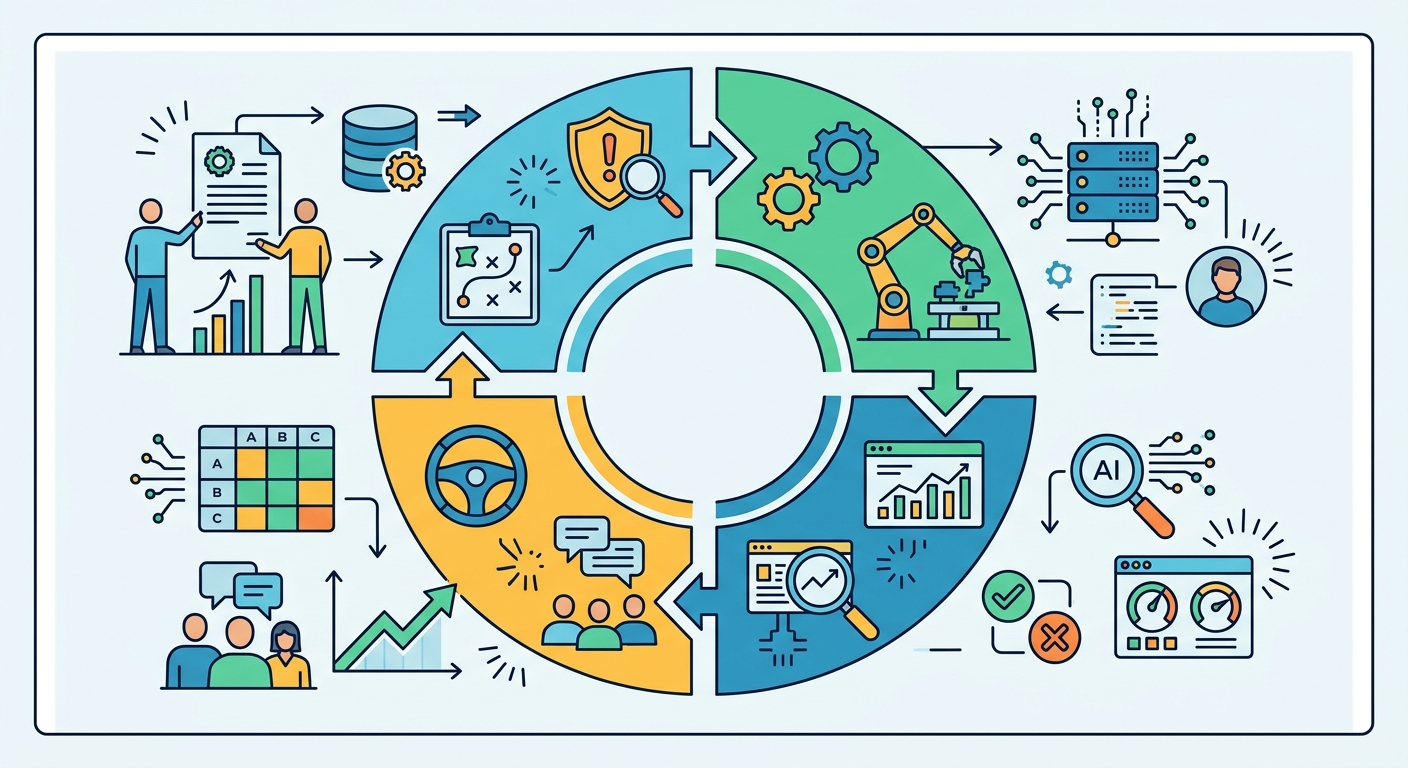
ISO 42001 PDCA Cycle for AI Governance:
- Plan: Establish AI objectives, identify risks, define controls
- Do: Implement governance policies, deploy controls, train personnel
- Check: Monitor AI systems, conduct internal audits, review metrics
- Act: Address nonconformities, update policies, improve processes
ISO 42001 Certification Process
Certification involves three stages:
- Document review: Auditors examine your AI management system documentation for compliance.
- Stage 1 audit: Auditors assess readiness and identify gaps before the main assessment.
- Stage 2 audit: Auditors evaluate implementation effectiveness through interviews, records review, and site visits.
Most organizations need 12 to 18 months to achieve certification from scratch. Organizations with existing management systems (ISO 27001, ISO 9001) often move faster due to integrated documentation and processes.
SOC 2 vs. ISO 42001: Key Differences
These frameworks serve different but complementary purposes.
| Aspect | SOC 2 | ISO 42001 |
|---|---|---|
| Purpose | Third-party assurance for customers | Internal management system for AI governance |
| Scope | AI controls within existing trust service criteria | Comprehensive AI management system |
| Output | Audit report (restricted use) | Certification (publicly claimable) |
| Frequency | Annual audits | Surveillance audits every 1-3 years |
| Focus | Controls effectiveness | System maturity and improvement |
| Geographic relevance | Primarily North American | Global recognition |
"Think of SOC 2 as proving your AI controls work. Think of ISO 42001 as building the system that ensures they always do."
Most enterprises pursue both. SOC 2 addresses customer due diligence requirements. ISO 42001 builds internal capability and demonstrates commitment to responsible AI.
The 2027 Regulatory Horizon
Several regulatory developments will reshape AI governance requirements by 2027.
EU AI Act: Extraterritorial Impact
The EU AI Act (Artificial Intelligence Act) establishes a risk-based regulatory framework for AI systems. While it applies to organizations operating in the European Union, its impact extends globally.
High-risk AI systems face strict requirements including conformity assessments, technical documentation, and human oversight mandates. Non-compliance penalties reach 35 million euros or 7% of global annual turnover, whichever is higher.
US enterprises serving EU customers or processing EU resident data must prepare for these requirements. The Act's high-risk classifications cover AI in employment decisions, credit scoring, critical infrastructure, and law enforcement.
The Act's provisions phase in progressively, with high-risk system requirements becoming fully applicable by 2027.
NIST AI Risk Management Framework
The National Institute of Standards and Technology published its AI Risk Management Framework in 2023. Unlike SOC 2 or ISO 42001, it is not a certification standard.
NIST AI RMF provides voluntary guidance organized around four functions: Govern, Map, Measure, and Manage. It has become influential in US federal contracting and increasingly in private sector procurement.
Expect NIST AI RMF to become a de facto requirement for federal contractors and organizations seeking government AI contracts. The framework's flexibility makes it adaptable across industries and AI use cases.
Emerging Sector-Specific Requirements
Financial services, healthcare, and critical infrastructure sectors are developing AI governance requirements beyond general frameworks. Organizations in these industries should monitor sector-specific guidance from regulators.
Compliance Roadmap for 2025-2027
Organizations should sequence their compliance efforts strategically:
Phase 1 (2025): Foundation
- Conduct AI system inventory and risk assessment
- Implement model documentation and logging standards
- Address SOC 2 AI control gaps
- Begin ISO 42001 gap analysis
Phase 2 (2026): Implementation
- Establish AI governance committee and policies
- Pursue SOC 2 audit with AI-specific scope
- Begin ISO 42001 implementation
- Assess EU AI Act applicability
Phase 3 (2027): Certification
- Complete ISO 42001 certification
- Align with EU AI Act requirements
- Integrate NIST AI RMF practices
- Establish continuous monitoring processes
Frequently Asked Questions
Can we use SOC 2 to meet all our AI governance needs?
SOC 2 provides customer assurance but does not establish a comprehensive management system. Most enterprises need both SOC 2 (for customer requirements) and ISO 42001 (for internal governance maturity).
How long does ISO 42001 certification take?
Organizations with existing management systems typically need 12-18 months. Organizations starting from scratch may need 18-24 months for documentation, implementation, and audit preparation.
Does the EU AI Act apply to US companies?
Yes, if you serve EU customers, process EU resident data, or offer AI systems in the EU market. The regulation applies extraterritorially to organizations outside the EU that meet these criteria.
Is NIST AI RMF certification available?
No. NIST AI RMF provides guidance, not certification. However, federal contractors increasingly must demonstrate alignment with its principles.
Conclusion
The AI governance landscape is evolving rapidly. Organizations that establish robust frameworks today will adapt more easily to tomorrow's requirements.
Start with SOC 2 if customers are requesting AI governance evidence. Build toward ISO 42001 if you need comprehensive internal governance capability. Monitor regulatory developments closely, particularly the EU AI Act's 2027 implementation timeline.
The investment made now in governance infrastructure pays dividends: reduced audit findings, stronger customer relationships, and readiness for emerging compliance requirements.
Sarah Mitchell, CIPP/US, CISM, is a privacy and security consultant specializing in enterprise AI governance and regulatory compliance. She advises Fortune 500 companies on SOC 2, ISO 42001, and international data protection frameworks.
Expert Q&A
Q: How does SOC 2 Type II differ from SOC 2 Type I for AI systems, and which should enterprises pursue?
A: SOC 2 Type I assesses the design and implementation of controls at a specific point in time—essentially asking, "Are our controls properly designed?" Type II evaluates both design and operating effectiveness over a period of time (typically 6-12 months), asking, "Do these controls actually work consistently?"
For AI systems, Type II is substantially more valuable and increasingly expected. AI models evolve—training data shifts, performance degrades, and behavior changes. A Type I report captures a snapshot that may become outdated within weeks of model updates. Type II demonstrates that your organization maintains governance discipline continuously: that logging remains consistent, that bias testing occurs regularly, that change management processes are followed.
The tradeoff is time. Type II requires 6-12 months of operating history before your first report. Most enterprises pursuing AI-specific SOC 2 reports should plan for Type II from the outset, using the observation period to build robust operational controls. Requesting a Type I initially with plans to transition to Type II can create gaps in your compliance documentation.
Q: What is a realistic timeline for ISO 42001 certification, and when should enterprises begin preparation?
A: Organizations should budget 12-18 months from initiation to certification for initial ISO 42001 certification. This assumes starting from scratch without pre-existing management systems.
The timeline breaks down as follows:
- Months 1-3: Gap analysis, scope definition, and leadership commitment
- Months 4-6: Documentation development (policies, procedures, risk assessments)
- Months 7-9: Implementation and internal training
- Months 10-12: Internal audit and corrective actions
- Months 12-15: Stage 1 audit and remediation
- Months 15-18: Stage 2 audit and certification
Enterprises with existing ISO 27001 or ISO 9001 certifications can accelerate significantly—often reducing timeline by 3-6 months—because integrated management system structures, documentation templates, and internal audit capabilities are already in place.
The critical path item is often risk assessment development. ISO 42001 requires AI-specific risk identification that goes beyond traditional information security. Organizations that underestimate this effort experience the longest delays.
Given that ISO 42001 certification bodies are currently building capacity and backlogs are forming, enterprises should begin gap assessments now to position for certification by late 2026 or early 2027.
Q: What specific regulatory requirements will likely take effect in 2027, and how should enterprises prepare?
A: Three regulatory developments converge in the 2026-2027 timeframe:
EU AI Act (Full Enforcement): The Act's provisions for high-risk AI systems become applicable in August 2026, with prohibited practices already in effect since February 2025. Organizations deploying AI in hiring, credit scoring, biometric identification, or critical infrastructure face mandatory conformity assessments, technical documentation requirements, and human oversight obligations. Penalties reach up to €35 million or 7% of global turnover.
NIST AI RMF Adoption: While the NIST AI Risk Management Framework remains voluntary, expect federal contractors and financial services firms to face contractor requirements referencing it in 2027. The framework's four functions—Govern, Map, Measure, Manage—provide a structure that audits increasingly reference.
Sector-Specific Requirements: The FDA's AI/ML-based Software as a Medical Device framework and financial services guidance from OCC/FRB will likely formalize into examination requirements. Healthcare organizations should prepare for OCR guidance updates on AI in protected health information contexts.
Preparation priorities: Conduct AI inventory and risk classification now; map existing controls to these frameworks; establish documentation standards that satisfy multiple regimes simultaneously.
Q: What are the most significant gaps in current enterprise AI governance implementations?
A: Based on audit findings and readiness assessments, five gaps dominate:
1. Model inventory completeness. Most organizations cannot produce a comprehensive, accurate inventory of AI systems in production. Shadow AI—systems deployed without IT or governance awareness—compounds this problem. Without complete inventory, no other governance activity is reliable.
2. Training data lineage. Organizations struggle to document what data trained which models, when, and under what quality standards. This gap directly undermines bias assessment and regulatory defensibility.
3. Performance monitoring continuity. AI systems degrade over time (model drift), but most enterprises lack automated monitoring that triggers review when performance thresholds are breached. Monitoring exists but isn't integrated into governance workflows.
4. Third-party AI risk management. Vendor AI systems are governed by supplier contracts that don't address AI-specific risks: output reliability, bias potential, or drift management. The enterprise bears risk it hasn't assessed.
5. Governance ownership clarity. Accountability for AI governance remains diffuse—spread across data science, IT, legal, and risk functions without clear ownership. This produces coverage gaps where no function feels responsible for controls that span multiple domains.
Addressing these gaps requires dedicated AI governance resources, not just policy documents.
Q: What are the most effective preparation strategies for passing an AI-related SOC 2 audit?
A: Five preparation strategies consistently differentiate successful audit outcomes:
1. Conduct a pre-assessment 6-9 months before target audit date. Use a qualified firm to assess your AI controls against current trust service criteria expectations. Prioritize findings by audit risk, not just severity.
2. Build documentation incrementally, not retrospectively. Auditors can detect when controls were documented after-the-fact versus maintained contemporaneously. Implement documentation practices now, even if incomplete, rather than attempting to reconstruct records before the audit.
3. Automate logging wherever possible. Manual logging processes fail under audit scrutiny—consistency breaks down, and auditors question completeness. Automated capture of model inputs, outputs, and system events provides defensible evidence.
4. Establish a model lifecycle policy with explicit criteria. Define objective thresholds for model review, retraining, and retirement. Auditors want to see that your organization has thought through what happens when models degrade—not just that you have a policy document.
5. Practice auditor interviews. Many organizations have adequate controls but fail to communicate them effectively. Conduct mock interviews where personnel explain AI governance processes to skeptical questioners. The gap between "we have a process" and "here's how it works in practice with specific examples" determines many audit outcomes.