AI Copyright Wars 2026: Who Owns AI-Generated Content After the Latest Court Rulings
The Supreme Court refused to hear Thaler v. Perlmutter in 2026, locking in the ruling that AI cannot own copyright. Here's what businesses and creators need to
Introduction
The legal reckoning for artificial intelligence-generated content has arrived — and it favors human creators. In a pair of rulings that will shape the AI industry for years to come, U.S. courts have made clear that works produced solely by AI systems cannot receive copyright protection. The Supreme Court's decision in March 2026 to let a lower court ruling stand without intervention has set the boundary: machines create, but only humans can own what they make.
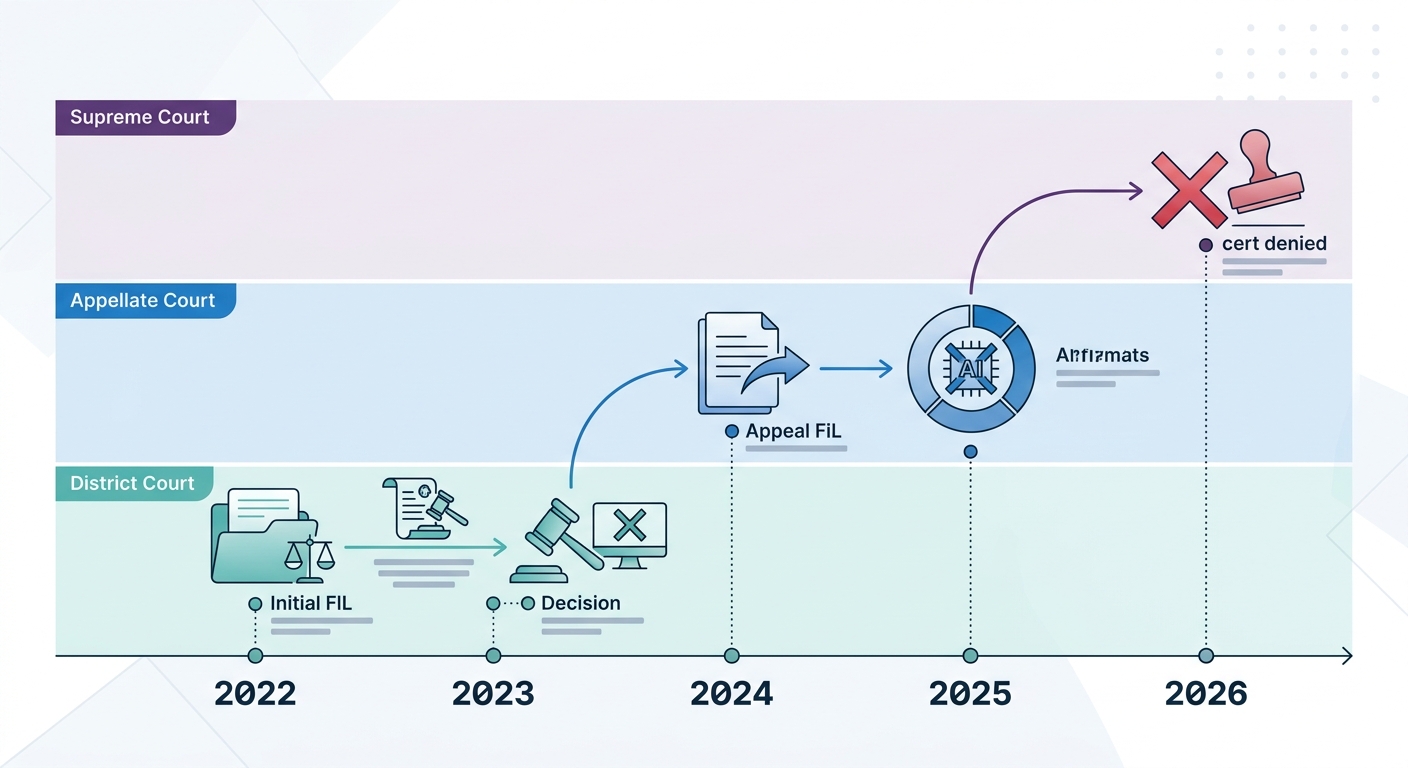
The case at the center of this storm is Thaler v. Perlmutter, which began when computer scientist Dr. Stephen Thaler attempted to copyright an image titled "A Recent Entrance to Paradise." The image was created entirely by his AI system, the "Creativity Machine," with no human involvement. The U.S. Copyright Office denied the application. A district court upheld that denial. And on March 18, 2025, the D.C. Circuit Court of Appeals affirmed — establishing that human authorship is not just a policy preference but a legal requirement under the Copyright Act of 1976.
When the Supreme Court declined to hear the case on March 2, 2026, the ruling became the de facto law of the land. For businesses deploying AI writing, image generation, code completion, or video synthesis tools, understanding what these decisions mean for ownership and liability is now essential.
What the Courts Actually Said
The D.C. Circuit's opinion in Thaler v. Perlmutter did more than reject one AI scientist's copyright claim. It articulated a coherent theory of what copyright requires and why machines cannot fulfill that requirement.
The court's reasoning drew on the Copyright Act's structure. The Act contemplates authors who can hold property, transfer rights through inheritance, and whose lifespans determine copyright terms. None of these concepts apply to a machine. As the opinion noted, "machines serve as tools, not authors" — a distinction with significant practical consequences.
"The Copyright Act does not convey its protections to non-human entities. While AI systems may produce output that resembles creative human expression, the legal framework for protecting that output requires a human author who made expressive choices."
The court acknowledged the real-world stakes. Amicus briefs in the case came from major technology companies, creative industry trade groups, and academic institutions, all wrestling with how AI-generated works should be treated under existing law. The ruling did not answer every question — notably, it left open the situation of works created with substantial AI assistance, where a human made creative choices about prompts, parameters, or post-processing.
The Gap the Ruling Left Open: Human-AI Collaboration
The Thaler decision addressed only the simplest case: fully autonomous AI output with no human author. But in practice, almost no one uses AI that way. Most AI-generated content involves a human who typed a prompt, selected among options, edited the output, or combined AI generation with traditional creation.
This gray zone is where most legal uncertainty now concentrates.
The Copyright Office's position has been consistent: human authors must have made "intellectual creation" — not merely selected a prompt. A one-sentence text prompt to an image generator, resulting in a complex illustration, may not constitute the kind of authorship the Copyright Act protects. On the other hand, a human who extensively curates, modifies, and combines AI-generated elements may have sufficient creative involvement.
In practice, courts will likely examine whether the human exercised meaningful creative control over the specific output, whether there were multiple iterations and selections made by a person, and whether the human determined the expressive elements — composition, style, narrative — rather than delegating them entirely to the AI.
Global Implications and the EU AI Act
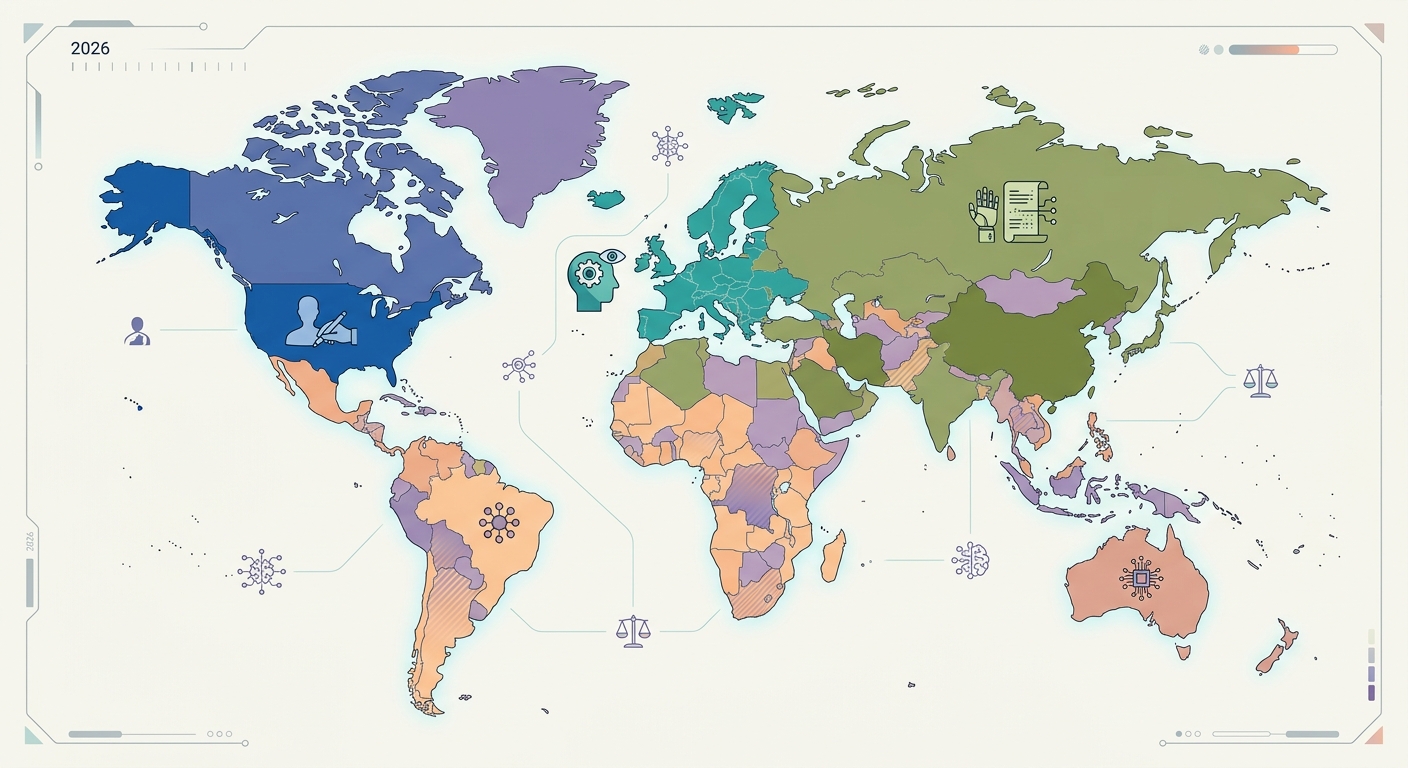
The U.S. ruling is significant but not isolated. Courts and legislatures worldwide are grappling with the same questions, often reaching different conclusions.
The European Union's AI Act, which began phased implementation in 2024, takes a different approach by focusing on transparency rather than authorship. Under EU rules, AI-generated content must be labeled as such, but copyright treatment follows existing EU copyright directives — which require human authorship for protection. The practical effect is similar to the U.S. outcome, but the mechanism differs.
Other jurisdictions have taken more permissive approaches. Some countries have explored sui generis protections that cover AI output without requiring human authorship, though the scope and duration of such protections vary widely.
For multinational companies using AI tools, this patchwork creates compliance complexity. A work created in the U.S. by an AI with no human authorship falls into the public domain globally. But a work created with meaningful human direction in the U.S. may be protectable in the U.S. while raising questions in other jurisdictions. Content that travels across borders — virtually every web page, marketing asset, or software component — needs careful legal mapping.
What Businesses Should Do Now
The legal landscape is clearer than it was, but still far from certain. For organizations using AI generation tools, several practical steps reduce risk and establish defensible positions.
Document human creative involvement. Keep records of who created prompts, selected outputs, made revisions, and combined AI-generated elements with other content. This documentation becomes critical if copyright ownership is challenged. A well-maintained creative workflow log showing human decision-making at each stage can establish the human authorship the law requires.
Audit AI tool usage across teams. Many organizations have AI tools in use across marketing, product, engineering, and content teams without centralized visibility. Understanding where AI generation is happening — and whether it has been relied upon for commercially significant content — is the prerequisite for managing the associated legal exposure.
Review content contracts carefully. Licensing agreements, work-for-hire arrangements, and IP assignments should explicitly address AI-generated components. Third parties acquiring or licensing content will increasingly ask about AI involvement, and ambiguous language creates dispute risk.
Stay close to Copyright Office guidance. The Office has signaled it will issue additional guidance on AI-assisted works, and its examination guidelines influence how courts think about the issue. Businesses with significant AI content portfolios should monitor these developments closely and adjust practices as the guidance evolves.
The Road Ahead
Several questions remain open and will likely be tested in court within the next two to three years.
The most significant is what level of human involvement transforms AI output from uncopyrightable machine product into protectable human-AI collaboration. The Copyright Office has proposed a "short prompt" test — if a human does no more than enter a brief descriptive prompt, the result lacks the human authorship required for protection. But courts have not formally adopted this standard, and practitioners disagree about where the line falls.
A related question involves infringement liability for AI training data. If AI systems trained on copyrighted works produce output that resembles that training data, can rights holders claim infringement? Early cases are making their way through courts, with implications for every AI company that trained on unlicensed data.
The international dimension will also require attention. As AI-generated content becomes a larger share of global creative output, pressure to harmonize copyright approaches across jurisdictions will grow. Whether that harmonization arrives through treaties, litigation, or legislative reform, it will reshape the global AI content market.
For now, the Thaler v. Perlmutter framework stands: AI can generate, but only humans can own. The practical challenge for every business is making sure that when AI generates something valuable, there is a human who can legitimately claim it.
Expert Q&A: AI Copyright Wars 2026
Q: Can a company own the copyright to content created by an AI tool they paid for? A: Ownership of AI-generated content depends on human creative involvement, not payment. If employees or contractors used the AI tool as a tool — making meaningful creative choices about prompts, selecting among outputs, revising, and curating — the company may hold copyright through work-for-hire arrangements. But if the AI operated autonomously with no human making expressive choices, the output is not protectable under current law, regardless of who paid for the tool.
Q: What's the risk of using AI-generated content commercially without securing copyright? A: Unprotected AI content is in the public domain, meaning competitors can copy, modify, and use it without permission or payment. For businesses, this means AI-generated marketing copy, images, or code that lacks human authorship provides no competitive advantage — rivals can simply replicate it. Additionally, if the content inadvertently resembles copyrighted training data, there may be separate infringement exposure that copyright protection would not necessarily shield against.
Q: How should businesses prepare for future AI copyright developments? A: The safest approach is establishing robust documentation of human creative processes whenever AI tools are used. Maintain records of prompt development, version histories, human selections and edits, and the reasoning behind creative decisions. This creates a defensible record of human authorship if challenged. Businesses should also monitor Copyright Office guidance on AI-assisted works and review content contracts to ensure AI involvement is explicitly addressed. Given the pace of litigation in this area, revisiting AI content practices annually is prudent.