AI Content Labeling Is Becoming Law: What Enterprises Must Change by 2027
AI content labeling becomes enforceable by 2027. See what EU AI Act and US state rules require—and the operational changes enterprises must make now.
AI Content Labeling: From Voluntary Best Practice to Enforceable Law
For years, labeling AI-generated content was a voluntary best practice. Vendors published content credentials, coalitions promoted watermarking standards, and forward-leaning enterprises added disclosure language to their own style guides. That era is ending.
By 2027, AI content labeling becomes an enforceable compliance requirement across major markets. The EU AI Act's Article 50 transparency obligations apply from 2 August 2026, a growing patchwork of US state AI disclosure laws takes effect on rolling dates through 2026–2027, and enterprise procurement teams are already writing labeling attestations into contracts. Provenance, disclosure, and auditability are no longer branding decisions—they are compliance surfaces with legal exposure, financial penalties, and contractual liability attached.
The organizations that treat this as a legal problem to be delegated will fall behind. The ones that treat it as an engineering and process problem—something to be designed into pipelines, governed centrally, and evidenced on demand—will absorb the change with minimal disruption.
This article maps what the 2026–2027 regulatory wave actually requires, where most enterprises currently stand, and the five operational changes to make before the deadlines arrive. (Related: [Building an AI Governance Framework That Survives an Audit])
What the 2026–2027 AI Transparency Regulations Actually Require
The regulatory landscape is not converging on a single standard. It is fragmenting across jurisdictions, each with different definitions, different scopes, and different enforcement mechanisms. That fragmentation is the defining challenge for multinational enterprises.
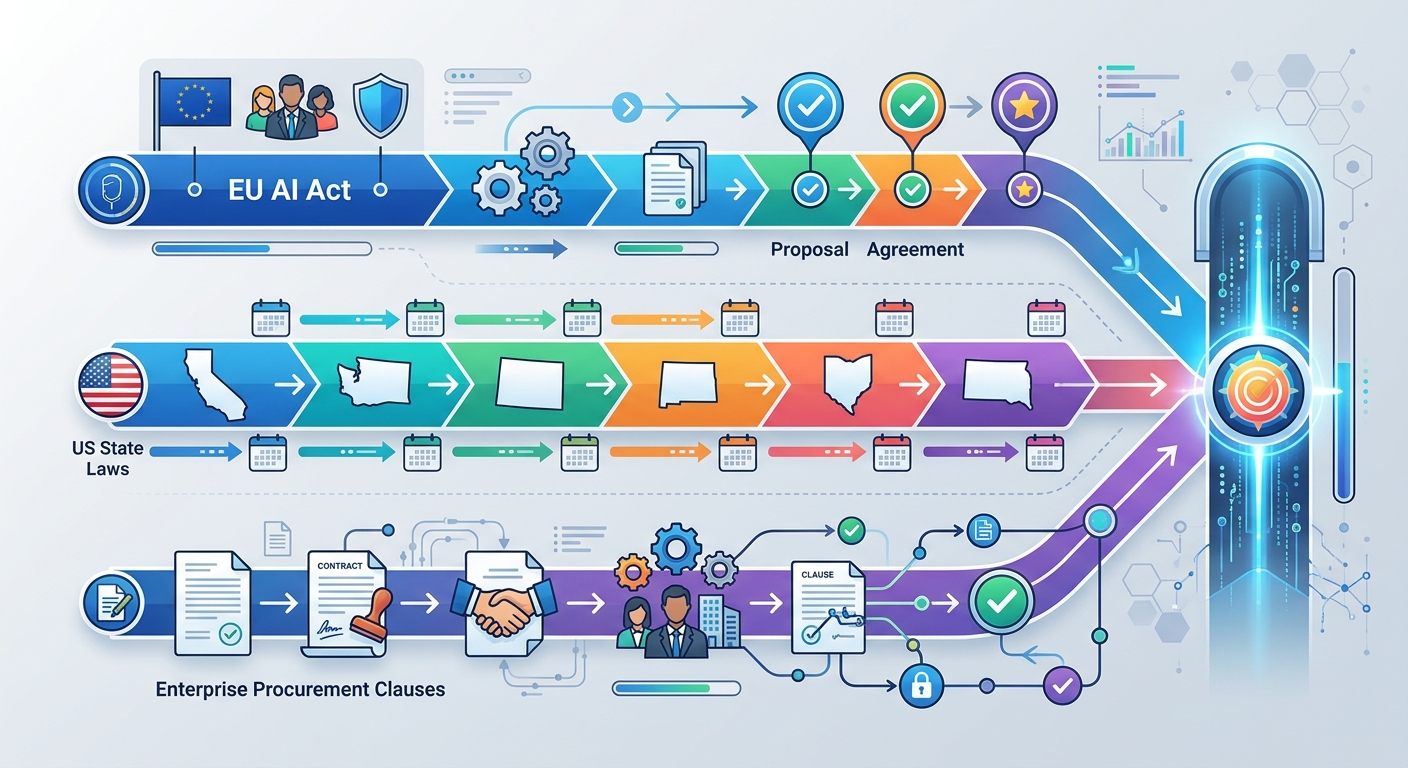
Three fronts matter most right now: EU transparency obligations, US state-level labeling rules, and contractual disclosure requirements in enterprise procurement. (See also: [The Enterprise Guide to AI Provenance and Content Credentials])
EU AI Act Transparency Obligations
The EU AI Act establishes the most comprehensive AI content transparency regime to date. Article 50 sets out the core transparency duties, and they bind both providers and deployers. For generative systems, the obligations include:
- Disclosing that content is AI-generated in a clear and distinguishable manner, at the latest at the point of first interaction or exposure
- Marking synthetic audio, image, video, and text in a machine-readable format so it can be detected by automated systems—the Act explicitly contemplates technical solutions such as watermarking, metadata, and cryptographic provenance
- Documenting compliance in technical documentation and instructions for use, and for deployers, maintaining the information needed to demonstrate the disclosure was made
Critically, the Act distinguishes between providers (those developing a system or placing it on the market under their own name or trademark) and deployers (those using a system in the course of their professional activity). Deployers carry their own Article 50 duties, particularly for deepfakes and for AI-generated text published to inform the public on matters of public interest. That distinction matters for enterprises that both build internal models and consume third-party AI services—they may sit on both sides of the obligation simultaneously.
The provider/deployer line is the most common source of exposure for B2B buyers. Using a third-party foundation model through an API generally makes you a deployer, not a provider. But if you fine-tune, rebrand, or distribute the model under your own name, you can cross into provider territory and inherit the full Article 50 marking obligation—including the machine-readable provenance requirement. Legal should classify every AI system in your inventory against this test before engineering builds to it.
The machine-readable marking expectation is the most technically demanding element. It implies embedded provenance metadata, not just a visible caption. Organizations relying on post-hoc human labeling will struggle to demonstrate compliance.
A technical caveat that trips up most first-pass implementations: embedded provenance metadata (C2PA Content Credentials, the leading open standard, now at C2PA 2.x and aligned with ISO 22144) is strippable. Re-encoding, screenshotting, format conversion, and most ad-platform transcoding pipelines drop the manifest. C2PA is necessary but not sufficient. Robust watermarking (e.g., SynthID, Digimarc) survives more transformations but is not a substitute for a signed manifest—it is a complementary control. Design for both, and test survival through your actual distribution pipeline, not a lab.
The penalties raise the stakes further. Non-compliance with Article 50 transparency obligations falls under Article 99(4): administrative fines reaching up to €15 million or 3% of total worldwide annual turnover, whichever is higher. That tier sits below the prohibited-practices tier (Article 99(3): €35 million or 7%) and above the misleading-information tier (Article 99(5): €7.5 million or 1%). Note the turnover basis: it is the worldwide annual turnover of the undertaking, so a €1 billion-revenue subsidiary of a larger group is exposed on group turnover—which can turn a "€30 million problem" into a materially larger one before remediation costs. Article 50 obligations apply from 2 August 2026; GPAI obligations have applied since 2 August 2025; high-risk system obligations apply from 2 August 2027. The design window for Article 50 is closing now, not in 2027.
US State-Level AI Content Labeling Rules
In the United States, no federal labeling standard exists. Instead, a patchwork of state laws has emerged, and the laws do different things—which is why "state AI labeling law" is a misleading category:
- Election and political deepfake statutes (e.g., California AB 2839 and AB 2655, Utah, and a growing list of others) impose disclosure and, in some cases, takedown duties for synthetic media depicting candidates or election officials within defined windows.
- Provenance and transparency statutes (e.g., California SB 942, the AI Transparency Act, effective 1 January 2026) require large generative-AI providers to offer AI-detection tools and disclose provenance for certain generated content—aimed at providers, not deployers.
- Algorithmic and consumer-protection regimes (e.g., Colorado's SB 24-205 AI Act) regulate consequential decisions and discrimination, not content labeling per se—do not conflate them with labeling law when scoping your program.
The variance is significant. Some statutes require visible disclosure; others mandate embedded metadata or detection tooling. Some apply only to political content; others extend to commercial media. Enforcement dates and penalty structures differ state by state, and federal preemption remains an open question that could reshape the landscape again.
For enterprises, this means compliance is use-case and jurisdiction-specific. A single national policy will not suffice. You need a framework that can apply different disclosure rules based on where content is distributed and what it depicts.
The practical failure mode here is rule stacking: a single asset—say, a product video with an AI-generated spokesperson—may need a visible on-screen disclosure under one state's consumer-protection or election statute, embedded C2PA metadata to satisfy a provenance requirement or a contractual attestation, and a platform-level AI-disclosure toggle under the major ad networks' own synthetic-media policies. Each requirement attaches at a different layer of the stack. Enterprises that model disclosure as a single toggle will miss the layered obligations, and the miss will surface in a state attorney general inquiry rather than an internal audit. (Related: [Mapping US State AI Disclosure Laws: A Compliance Matrix])
Disclosure Rules in Procurement and Contracts
Perhaps the fastest-moving front is not statutory at all—it is contractual. Enterprise buyers are increasingly requiring vendors to attest that AI-generated deliverables are labeled, disclose which models were used, and accept liability for misrepresentation.
These clauses are appearing in master services agreements, SaaS contracts, and procurement questionnaires. Some shift indemnity obligations; others grant audit rights. For organizations that generate AI content on behalf of clients—agencies, consultancies, software vendors—the contractual exposure frequently arrives before the statutory one, and it arrives with no phase-in period.
The practical consequence is that contract review can no longer be decoupled from content operations. A standard marketing services agreement that once turned on deliverables and payment terms now frequently carries a synthetic-media warranty: the vendor represents that any AI-generated asset was labeled in accordance with applicable law and the buyer's policy, and agrees to indemnify the buyer for claims arising from unlabeled or mislabeled content. Signing that warranty without the pipeline to honor it converts a routine sales contract into an open-ended liability. Before signing, legal and content operations should confirm three things: that the labeling method named in the contract (visible disclosure, embedded metadata, or both) is one the production pipeline can actually emit; that the vendor can produce evidence of labeling on demand, not just assert it; and that subprocessors and downstream agencies are bound by the same warranty, since the obligation typically flows through the entire content supply chain.
Audit rights compound the risk. A buyer who can demand labeling evidence within a defined window is effectively imposing a recordkeeping requirement that most content teams have never been designed to meet. If your organization cannot reconstruct, months later, which assets were AI-generated, which model produced them, and what disclosure accompanied each, an audit clause becomes a finding waiting to happen. Treat contractual attestations as a compliance surface with the same evidentiary standard as the statute—because in practice, the buyer's auditor will apply it that way.
Where Most Enterprises Stand Today
Most enterprises are further from compliance than their leadership believes. The gap is rarely one of intent; it is one of instrumentation. Three patterns recur across organizations of every size.
First, AI use is inventoried at the tool level, not the asset level. Security teams know which AI vendors have been approved. Almost no one can answer, for a given piece of published content, whether AI was involved, which model was used, and what disclosure accompanied it. The inventory exists for procurement and access control; it does not exist for provenance.
Second, labeling is manual and retrospective. Disclosure, where it happens, is a step a human remembers to take before publishing—a checkbox in a CMS, a line in a caption, a note in a brand guide. Manual steps fail at scale and fail silently. They also produce no evidence trail, which is precisely what regulators and auditors request.
Third, ownership is ambiguous. Legal assumes marketing owns disclosure. Marketing assumes the platform or the model vendor handles it. Engineering assumes the policy team defines the requirement. The result is that no function owns the end-to-end control, and the first serious inquiry—from a customer, a regulator, or a counterparty's auditor—exposes the gap.
None of these failures is unusual, and none is fatal if addressed early. What makes them dangerous is the timeline: the controls take longer to build than the regulations take to arrive.
Five Operational Changes to Make Before the Deadlines
The organizations that close the gap do so through five concrete changes. Each is an engineering and process problem, and each produces evidence as a byproduct.
1. Build an asset-level provenance inventory. Extend your AI system inventory downward to the content layer. For every published asset, record whether generative AI was used, which model and version, what disclosure was applied, and where the provenance record lives. This is the foundation for every other control, and it is the artifact auditors ask for first. Start with the highest-risk content classes—customer-facing marketing, investor communications, and anything depicting real people—rather than attempting a comprehensive sweep.
2. Move labeling into the pipeline, not the publish button. Disclosure should be emitted by the systems that produce and distribute content, not remembered by the people who publish it. That means generating visible disclosures and embedded provenance metadata at the point of creation, carrying them through the CMS and distribution stack, and testing survival through each transformation the content actually undergoes. A control that works in a lab but strips out in the ad platform's transcoder is not a control.
3. Classify every AI system against the provider/deployer test. Legal should review the inventory and assign each system a regulatory posture: provider, deployer, or both, under each applicable jurisdiction. Fine-tuning a third-party model, white-labeling a vendor's system, or distributing a model under your own brand can move an organization across the line and trigger obligations it never planned for. This classification should be revisited whenever a model is customized or rebranded.
4. Adopt a layered disclosure standard and document the rationale. Because no single mechanism survives every distribution path, define a standard that pairs visible disclosure with embedded provenance and, where feasible, robust watermarking. Document why each layer was chosen and what it is expected to survive. That rationale is itself compliance evidence—it demonstrates a designed control rather than an ad hoc response—and it protects the organization when a manifest is stripped downstream through no fault of its own.
5. Instrument evidence collection from day one. Every control should emit a record: what was labeled, when, by which system, and under which rule. Evidence collected at the point of action is cheap; evidence reconstructed after an inquiry is expensive and often incomplete. Build the audit trail into the pipeline rather than bolting it on when a counterparty asks.
The Window Is Closing
The 2026–2027 wave does not arrive all at once, but its design window is already open. Article 50 obligations apply from August 2026, California's provenance statute from January 2026, and contractual attestations are being signed today. The organizations that treat labeling as a pipeline property—inventoried, automated, layered, and evidenced—will meet each deadline as a routine release. The ones that treat it as a legal problem to be delegated will discover, at the point of first inquiry, that they cannot answer the simplest question a regulator or auditor will ask: show me how you knew.
The work is unglamorous and largely invisible when done well. That is the nature of compliance infrastructure. The enterprises that build it now will spend 2027 shipping content, not remediating it.