AI Hiring Tools Need Audit Trails: What Employers Must Document Now
Employers must document AI hiring decisions. Learn the 7 records to capture, what a real audit trail requires, and how to stay compliant.
The Documentation Demand Has Arrived
For years, guidance on AI in hiring was exactly that — guidance. Voluntary frameworks, best-practice whitepapers, and conference panels urging employers to "be thoughtful" about automated screening. That era is closing. Enforcement posture has shifted from asking whether you used AI responsibly to demanding that you prove it, in writing, with dates, versions, and named human reviewers attached.
The practical consequence is blunt: if you cannot produce a record of how an AI hiring tool influenced a hiring decision, you are exposed — legally, in litigation and agency inquiries, and reputationally, the moment a candidate, journalist, or regulator asks a question you can't answer. A defensible hiring process is now an evidence-producing process.
This article covers what that evidence looks like: the seven records every employer should capture, where AI hiring audit trails break down in real deployments, and how to build documentation into the hiring workflow instead of bolting it on after a complaint lands. It is written for the people who actually own this problem — HR technology leaders, engineering managers integrating screening tools, and procurement teams signing the contracts. (Related: AI hiring compliance checklist for HR teams)
Why AI Hiring Audit Trails Are Now a Compliance Requirement, Not a Nice-to-Have
Algorithmic accountability is, at bottom, an evidence problem, not a policy problem. Most employers already have a policy stating that AI tools are used fairly and with human oversight. Very few can demonstrate, for a specific candidate rejected last spring, which model scored them, on what inputs, with what human review, and against what documented criteria.
That gap is where liability lives. Three streams of scrutiny are converging on the same demand:
- AI regulation increasingly imposes documentation, risk-assessment, and record-keeping obligations on systems used in employment decisions. The EU AI Act classifies employment and worker-management systems as high-risk (Article 6 and Annex III), which triggers obligations around risk management, technical documentation, logging, and human oversight for providers and deployers. In the US, Colorado's AI Act (SB 24-205, with obligations now phased to June 30, 2026) requires developers and deployers of high-risk AI systems to maintain risk-management and impact-assessment records, and Illinois HB 3773 (effective January 1, 2026) extends the state Human Rights Act to AI-enabled employment decisions.
- Employment law has always required employers to explain adverse decisions; automated screening raises the bar because the "reason" may be buried in a vendor's model. New York City Local Law 144, in effect since July 5, 2023, requires annual independent bias audits of automated employment decision tools, publication of summary results, and advance notice to candidates — a direct documentation mandate with an enforcement record.
- Civil rights enforcement has focused for years on disparate impact in hiring. The EEOC's May 2023 guidance on Title VII and AI makes clear that automated tools can produce disparate impact liability and that employers are expected to be able to assess and explain their tools' effects — which requires records.
Regulators and plaintiffs' attorneys are no longer satisfied with outcome statistics alone. They want the decision trail: what the tool did, what the humans did with its output, and whether anyone was watching for drift after deployment. (See also: How to conduct a bias audit of your hiring algorithm)
"The question is no longer whether your AI hiring tool is biased. It's whether you can prove, six months later, exactly how it was configured, what it recommended, and who overrode it. Employers who can't answer that are defending a process they can't describe."
The Regulatory Shift in Plain Terms
You don't need to memorize statute numbers to understand the direction of travel. The consistent theme across jurisdictions and agencies is documentation as the price of deployment. NYC requires bias audits and candidate notice; Colorado and Illinois are layering risk-management and anti-discrimination records onto employment AI; the EU requires logging and oversight for high-risk systems; and US civil rights agencies treat the ability to assess disparate impact as a baseline expectation. The specifics vary by jurisdiction and effective date — and they are moving — but the expectation doesn't: treat documentation as a condition of using the tool at all, not a compliance chore to schedule later.
The Record-Keeping Standard: What "Documented" Actually Means
Most organizations believe they have an audit trail because their applicant tracking system keeps logs. They usually don't. Logs are raw system data; audit trails are decision-grade evidence. The difference matters enormously when someone asks why a candidate was rejected.
A real audit trail is:
- Time-stamped — every event carries a date and time, in a consistent timezone, ideally UTC with local rendering.
- Attributable — every action is tied to a named system, version, or human reviewer. "The algorithm" is not an attributable actor.
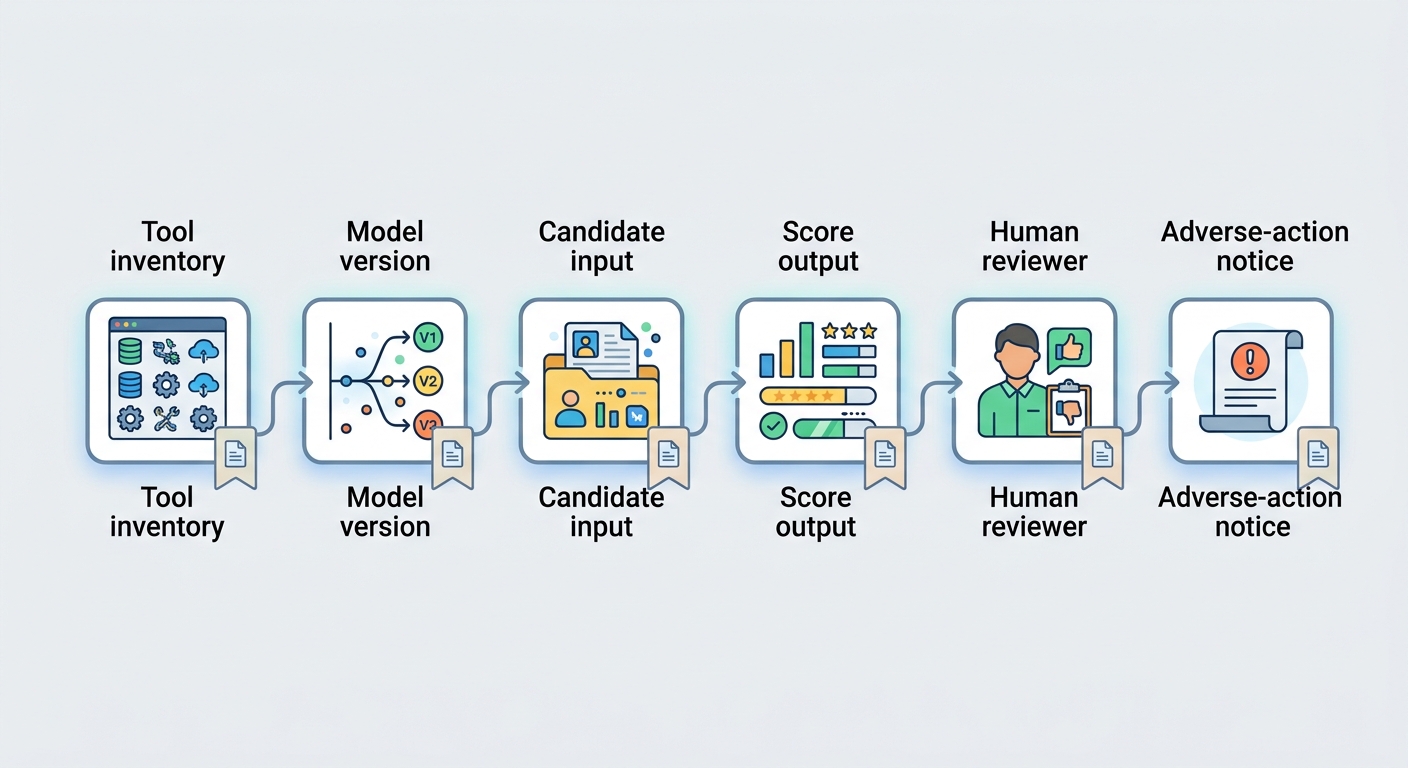
- Reproducible — you can reconstruct the decision path well enough to explain it: the model version (or a stable artifact hash), the input the model saw (or a faithful, retained copy), the score or recommendation, and the configuration/threshold in force at inference time.
- Linked — tool, input, output, and human decision are connected in one chain, not scattered across four systems and a shared drive.
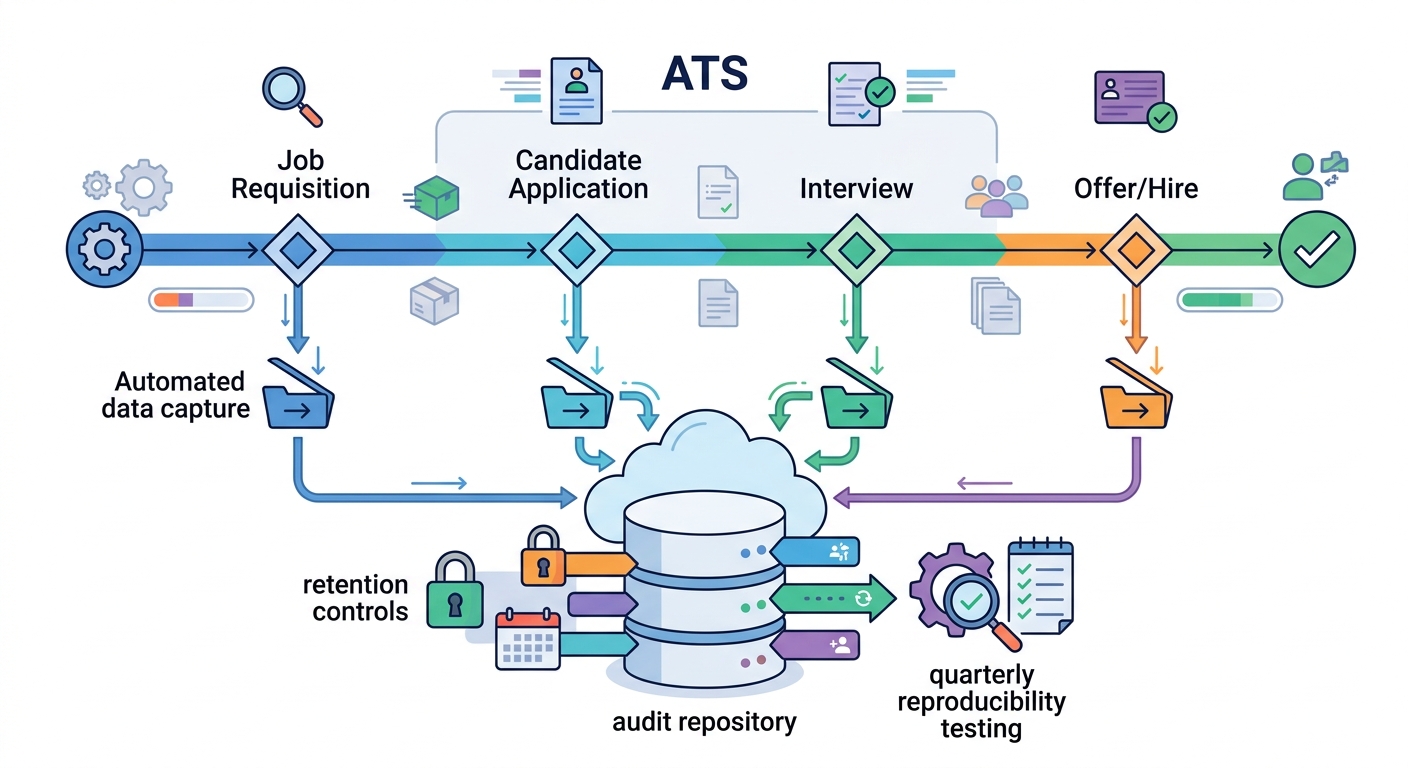
The reproducibility test is the one that separates mature programs from wishful ones. Could you reconstruct why a specific candidate was rejected six months ago? Which model version scored them? What data did it see? Did a recruiter review the output, and did they document why they agreed or overrode it? If the honest answer is "we'd have to ask the vendor" or "those logs rolled off," you have a gap, not a trail.
Two hard cases deserve honesty. First, proprietary models: when you can't access weights or internals, reproducibility depends on retained inputs, outputs, version identifiers, and vendor-supplied model cards and change logs — secured contractually, not assumed. Second, retention conflicts: routine deletion schedules do not survive a litigation hold. Once a dispute or agency inquiry is reasonably anticipated, US discovery duties (including FRCP preservation obligations) require you to stop purging screening records. A 90-day auto-purge that keeps running after a charge is filed is a spoliation problem. The resolution is a documented retention schedule tied to a legal basis — long enough to defend, controlled enough to satisfy data-minimization principles — with a tested process to suspend deletion on hold.
Minimum Viable Audit Trail
If you're starting from nothing, build toward this baseline before expanding:
- Tool and version inventory — what's deployed, by whom, for which roles, since when.
- Model documentation — vendor-provided purpose, known limitations, and validation evidence.
- Decision points — where in the workflow the tool's output influences a human choice.
- Human override records — who reviewed, what they changed, and why.
- Retention and legal-hold policy — how long records persist, who can access them, how deletion is controlled, and how deletion is suspended on hold.
That's the floor. The next section is the fuller standard.
The Seven Records Every Employer Should Capture
This is the working checklist. For each record, the question isn't "do we have something like this?" but "could we hand this to an examiner tomorrow, for a specific candidate, without scrambling?"
1. Tool and model inventory. A living register of every AI hiring tool: vendor, model version, purpose, date deployed, business owner, and roles it touches. Why it matters: you cannot govern or audit a tool you haven't inventoried, and version drift silently changes decisions. What good looks like: updated at deployment and on every model or configuration change, with a change log.
2. Model documentation and validation evidence. Vendor model cards, intended use, known limitations, validation methodology, and any bias-testing results. Why it matters: it establishes what the tool was supposed to do and whether it was fit for your use; NYC LL144 bias audits and Colorado impact assessments both depend on this. What good looks like: current documentation on file, with the audit or assessment dated and tied to the specific tool version.
3. Decision-point map. A diagram or table showing exactly where the tool's output enters the workflow and what human or downstream step it influences. Why it matters: you can't document influence you haven't located. What good looks like: one map per hiring stage, reviewed when the workflow changes.
4. Per-candidate decision record. The core artifact: candidate identifier, tool and version used, timestamp, score or recommendation, the input retained or reconstructable, and the human decision that followed. Why it matters: this is the record an examiner or plaintiff will ask for first. What good looks like: exportable for a single candidate in minutes, linked end to end.
5. Human review and override records. Who reviewed the output, when, what they changed, and a documented rationale — including cases where they agreed. Why it matters: oversight must be meaningful; a reviewer with no information, authority, or time to disagree provides no defense, and regulators and plaintiffs attack rubber-stamping directly. What good looks like: rationale fields that are required, not optional, and reviewer identity tied to an authenticated account.
6. Monitoring and drift records. Post-deployment checks: periodic outcome reviews, disparate-impact monitoring, and logs of model or configuration changes. Why it matters: a tool that was fair at launch can drift; documentation must show someone was watching. What good looks like: scheduled reviews with owners, thresholds, and recorded findings.
7. Retention, access, and legal-hold records. The retention schedule, access controls, audit logs of who viewed or exported decision records, and evidence that holds were applied when required. Why it matters: records you can't produce, or can't prove weren't tampered with, fail the test; and uncontrolled purging creates spoliation exposure. What good looks like: documented schedule, role-based access, and a tested hold process.
What a Decision Record Looks Like in Practice
For one rejected candidate, a defensible record reads like a chain: "Candidate #4471; tool: [vendor] screening v3.2 (artifact hash recorded); inference 2025-03-14T14:02Z; inputs: resume parse + structured application fields (retained copy); output: rank 61/200, score 0.34; threshold for review: 0.50; human reviewer: J. Rivera, 2025-03-15, reviewed output and agreed — rationale: required certification absent from application; no override." That is reproducible, attributable, and linked. If any element is missing, that's the gap to close.
Contract Terms Procurement Should Negotiate
Because much of the evidence lives with the vendor, the audit trail is partly a procurement problem. Insist on: decision-log export in a usable format; model-change notification with version identifiers; audit rights and cooperation with bias audits or impact assessments; model documentation (cards, validation, known limitations) delivered and kept current; and retention and portability of decision records on contract termination. If a vendor won't commit to these in writing, you cannot build the trail regardless of what your ATS logs.
Where Audit Trails Break Down in Real Deployments
- Logs roll off before anyone asks. Default retention windows in vendor and ATS systems are often shorter than the dispute timeline. Fix: set retention to match legal exposure and suspend on hold.
- Version drift goes unrecorded. The model changes; the record doesn't. Fix: capture version/artifact hash at inference and log every change.
- Oversight is nominal. Reviewers click "agree" without information or authority. Fix: require rationale, give reviewers the output and context, and audit override rates.
- The chain is split across systems. ATS, vendor portal, and spreadsheets don't link. Fix: define one candidate-level record and make systems export into it.
- Nobody owns monitoring. Fair at launch, unmonitored after. Fix: assign owners, schedules, and thresholds for drift and disparate-impact review.
Building Documentation Into the Workflow
Bolt-on documentation fails because it depends on someone remembering after the fact. Build it into the pipeline: make the decision record a required output of the hiring step, not a separate task; require rationale fields at the point of review; automate version capture and change logging; and test the trail periodically by reconstructing a real (anonymized) past decision. If you can't reconstruct it, you've found your next fix. Documentation that's produced by the process is defensible; documentation produced in a panic is not.
The direction is clear across jurisdictions: documentation is the price of deployment. Employers who treat the audit trail as infrastructure — inventoried, versioned, linked, retained, and contractually secured — will be able to answer the question that matters: not whether the tool was perfect, but whether you can prove exactly how it was used and who was watching.