AI Disclosure Labeling Becomes Mandatory: What Compliance Teams Need Now
AI disclosure labeling is now an enforceable requirement. See what US compliance teams must do in 90 days—labels, provenance, audit trails, and rules.
AI disclosure labeling has crossed the line from voluntary best practice to enforceable obligation. Organizations deploying generative AI in customer-facing products, marketing content, and published media now face a growing stack of transparency rules—some already in force, others phasing in over the next several quarters. The change lands on compliance teams first, but it cannot be satisfied by legal review alone. AI disclosure is now an engineering and operational requirement, and the organizations that treat it that way will avoid the scramble that follows every enforcement wave.
Here is what changed, what the rules actually demand, and how to get ready in the next 90 days.
The AI Disclosure Deadline Nobody Can Ignore
For the past two years, AI transparency lived in the world of guidance, frameworks, and voluntary commitments. Vendors published model cards. Enterprises added "AI-generated" footnotes when they remembered. Nobody audited the footnotes.
That era is closing. Regulators have converted disclosure expectations into binding requirements, and the enforcement posture is hardening in parallel. The EU AI Act's Article 50 transparency obligations apply from August 2, 2026, with penalties for breach reaching €15 million or 3% of global annual turnover, whichever is higher. California's AI Transparency Act (SB 942) requires covered generative-AI providers to offer provenance disclosure tools and latent-disclosure capabilities, with obligations taking effect August 2, 2026. The federal TAKE IT DOWN Act, signed in May 2025, criminalizes publishing non-consensual intimate deepfakes and requires platforms to remove them on notice. The FTC continues to apply its Section 5 deception authority to AI claims, and state attorneys general are enforcing their own consumer-protection statutes against misleading synthetic media.
Penalties vary by jurisdiction and are still being tested in practice, but the exposure is broader than fines: audit rights, contractual warranties, and procurement questionnaires now routinely ask for evidence of AI disclosure controls. A vendor that cannot produce that evidence gets flagged in diligence—or dropped.
One caveat worth stating plainly: effective dates and scope are still moving. The EU's proposed "Digital Omnibus" simplification package could shift some compliance dates, and US federal preemption efforts could reshape the state patchwork. Compliance leaders should verify current obligations against primary sources—regulatory texts, official guidance, and their own counsel—before building a timeline. What is unlikely to reverse is the direction of travel: disclosure is becoming a baseline expectation, not a differentiator. (Suggested internal link: AI governance framework for compliance teams)
The practical consequence is that AI disclosure has become a process requirement, not a one-time checkbox. You cannot label your way to compliance with a single project. You need an inventory, a labeling standard, a review workflow, and an audit trail that survives scrutiny months after the fact.
What "Mandatory AI Disclosure" Actually Requires
Strip away the jargon and the core requirement is simple: people must be told when content is AI-generated or AI-modified. That is disclosure. It answers a human question—"was this made by a machine?"—at the point of interaction.
Provenance is different. Provenance records where content came from in metadata, so that machines and downstream systems can verify origin. A photo can carry signed content credentials and a visible caption. A chatbot can display an "AI assistant" badge and log its model version in an audit record. Mature programs do both.
The distinction matters because regulators increasingly reference both. Visible labels address consumer deception. Machine-readable provenance addresses traceability, authenticity, and platform-level detection. Treating them as substitutes is one of the most common—and most expensive—mistakes.
AI labeling requirements by content type
Obligations scale with the risk of deception. A few patterns are emerging across regimes:
- Text: Disclosure typically required where AI-generated text could be mistaken for human authorship or editorial judgment—news, reviews, advice, and published reports. Under the EU AI Act, AI-generated text published to inform the public on matters of public interest must be disclosed unless it has undergone human review and editorial responsibility. Routine internal drafts generally carry lighter burdens.
- Images: Realistic synthetic imagery faces the strictest labeling expectations. Clearly stylized or obviously generated images often qualify for lighter treatment.
- Audio and video (deepfakes): The highest-risk category. Realistic synthetic media depicting people, events, or statements typically requires prominent disclosure, and in some jurisdictions, embedded provenance as well. The EU AI Act requires deployers of deepfakes to disclose that content is artificially generated or manipulated.
- Chatbots and conversational interfaces: Users must know they are interacting with an AI system, not a human—usually at first interaction, not buried in terms of service. This is an explicit Article 50 duty.
- Synthetic customer communications: Personalized AI-generated emails, offers, and support responses fall into scope when they could mislead recipients about their origin.
The through-line: "obvious" AI content may have lighter labeling burdens than realistic synthetic media. Build your classification rules around deception risk, not around which tool generated the asset.
Machine-readable provenance vs. human-visible labels
C2PA content credentials—the open standard maintained by the Coalition for Content Provenance and Authenticity—along with watermarking and embedded metadata, are becoming the technical backbone of AI disclosure. They let platforms and downstream tools verify origin automatically—something a visible label can never do at scale. (Suggested internal link: content provenance and C2PA credentials explained)
But provenance is not a silver bullet, and it is worth being precise about what it proves. C2PA credentials are cryptographically signed attestations: they record what a signer asserted about a piece of content, not ground truth about how it was made. They can be verified when present, but they can also be absent—removed by screenshotting, stripped by platform re-encodes, or never applied in the first place. Watermarks, meanwhile, can be cropped, re-encoded, or degraded by format conversion. Robustness varies by modality and by adversary, and a determined bad actor can defeat most marking schemes.
The defensible posture is layered: visible labels for humans, provenance for machines, and logging for auditors. If one layer fails, the others still tell the story.
The audit test: Successful programs can show where AI touched content, what label was applied, and who approved it—not just that a policy exists. Build to that standard.
The AI Disclosure Regulatory Patchwork: EU, US, and Beyond
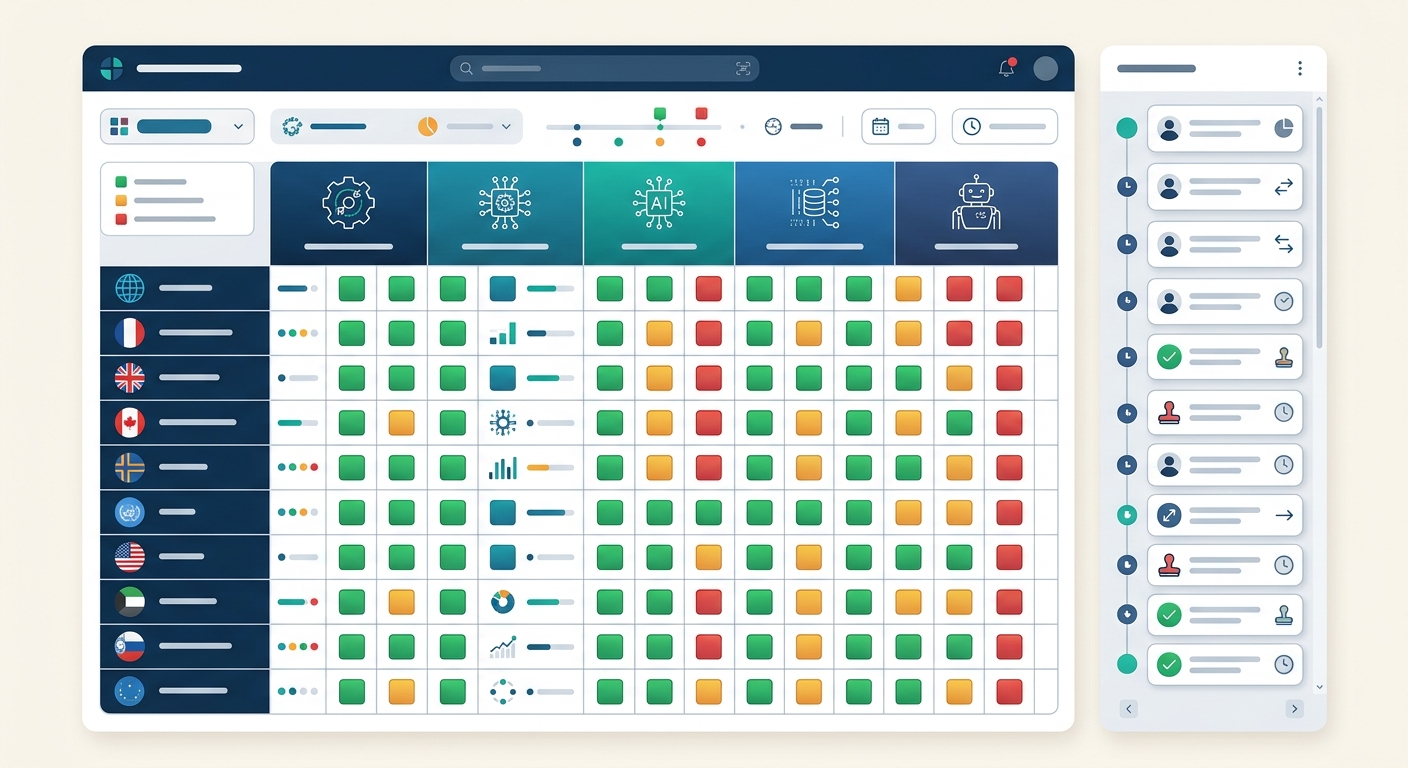
There is no single global AI disclosure standard, and there will not be one soon. Compliance teams must map obligations by jurisdiction and by use case, because the same chatbot can trigger different duties depending on where it is deployed and what it does. The practical approach is a matrix: rows for content types and use cases, columns for jurisdictions, cells for the specific obligation and its effective date.
European Union. The AI Act is the most comprehensive regime. Article 50 imposes transparency duties on providers and deployers of AI systems that interact with people, generate synthetic content, or produce deepfakes. GPAI obligations have applied since August 2, 2025; the Article 50 transparency duties apply from August 2, 2026. Enforcement runs through national market-surveillance authorities, with the penalty ceiling noted above.
United States. No single federal AI disclosure statute exists, but the landscape is denser than headlines suggest. California leads with SB 942 (provenance tools and latent disclosure for covered providers) and its deepfake election laws (AB 2655, AB 2839). Other states—including Colorado, Texas, and Tennessee—have enacted or proposed disclosure and deepfake rules. Federal exposure comes through the FTC's deception authority and the TAKE IT DOWN Act. Federal preemption proposals could compress this patchwork, but teams should plan as if state rules survive.
Beyond. The UK takes a principles-based, regulator-led approach. Canada, Brazil, and several Asia-Pacific jurisdictions are advancing their own transparency frameworks. For multinationals, the EU AI Act is the de facto baseline; building to it usually satisfies or exceeds most other regimes.
Building a 90-Day AI Disclosure Readiness Program
The gap between "we have a policy" and "we can prove compliance" is where audits are won and lost. A workable sequence:
Days 1–30: Inventory and classify. Build an AI use-case register covering every customer-facing and published-content workflow where generative AI is used. For each, record the content type, the model or tool, the deployment jurisdiction, and a deception-risk rating. Classify by risk, not by tool.
Days 31–60: Define the labeling standard and workflow. Publish a label taxonomy that maps each risk tier to required disclosures (visible label text, placement, and any provenance requirement). Wire an approval step into the content workflow so every AI-touched asset has a recorded reviewer and disposition. Define the audit-log schema now—fields for asset ID, model/version, label applied, approver, timestamp, and jurisdiction.
Days 61–90: Integrate provenance and test. Adopt C2PA signing where your tooling supports it, and document where it does not. Run a tabletop audit: pick ten published assets and try to reconstruct, from records alone, where AI touched them and who approved the label. Fix the gaps the exercise exposes. Then brief procurement and legal so they can answer diligence questionnaires with evidence rather than assurances.
The organizations that will pass their first real audit are not the ones with the longest policy. They are the ones that can produce a clean, timestamped record of every decision—and that treat disclosure as an operating discipline rather than a legal formality.