Vector Databases in Production: Choosing Between Pinecone, Weaviate, Qdrant, and Milvus for RAG Systems
title: "Vector Databases in Production: Choosing Between Pinecone, Weaviate, Qdrant, and Milvus for RAG Systems" description: "A comprehensive vector database comparison for RAG in 2026. Detailed analysis of Pinecone, Weaviate, Qdrant, and Milvus covering latency, hybrid search capabilities, indexing algorithms, and pricing models to find the best vector DB for your LLM application." keywords: "vector database comparison, best vector database for RAG, Pinecone vs Weaviate vs Qdrant vs Milvus, HNSW, hybrid search, RAG latency, vector DB pricing, vector search, ANN search" slug: vector-databases-rag-comparison-2026 date: 2026-07-18 category: 10 section: learn
Vector Databases in Production: Choosing Between Pinecone, Weaviate, Qdrant, and Milvus for RAG Systems
Last updated: July 2026 — Covers Pinecone Serverless, Weaviate 1.24, Qdrant 1.7, Milvus 2.4
Introduction: The RAG Infrastructure Bottleneck
In the rush to deploy Generative AI, the industry has shifted from "Can LLMs do this?" to "How do we make LLMs reliable in production?" The answer for most enterprises is Retrieval-Augmented Generation (RAG). By grounding an LLM in proprietary, real-time data, RAG mitigates hallucinations and provides a verifiable audit trail for AI responses.
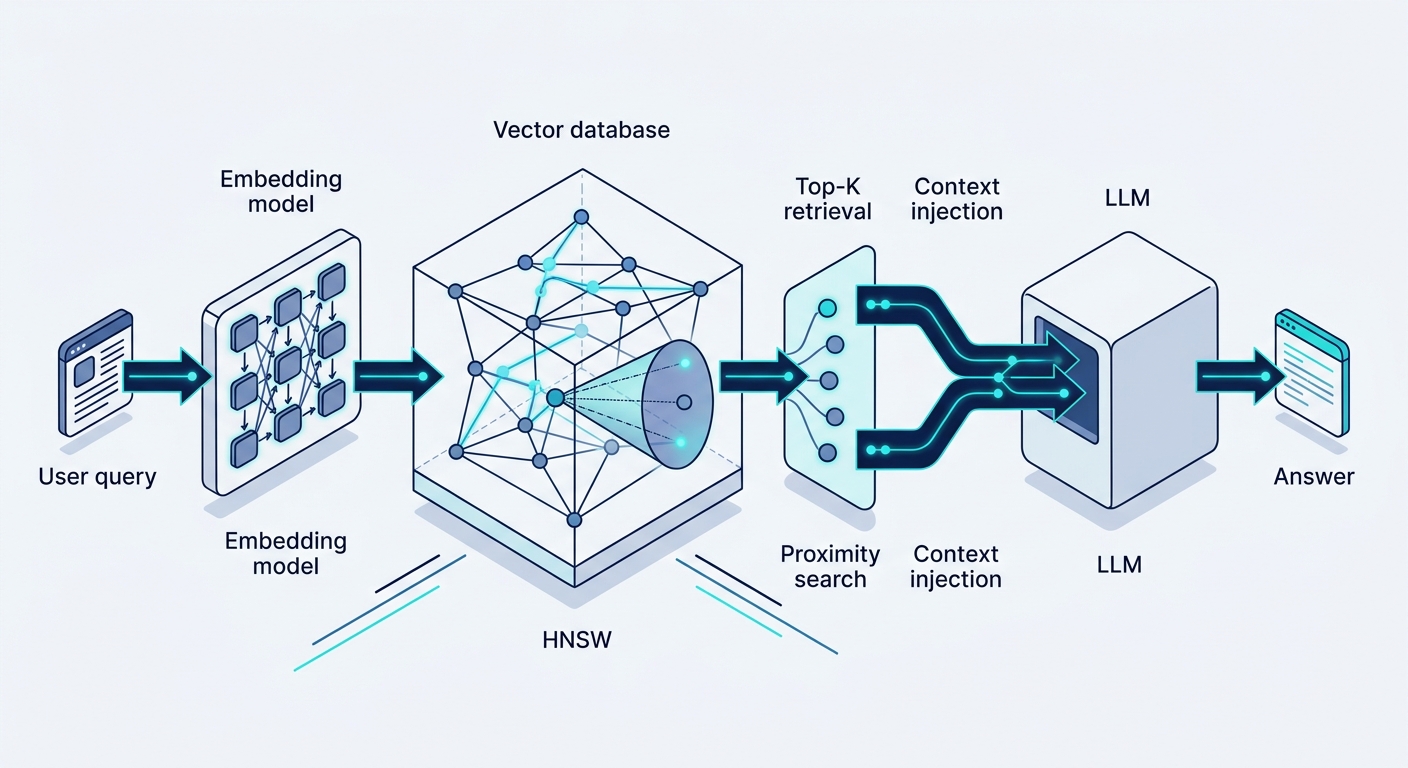
However, as RAG moves from a weekend PoC to a production-grade service, the primary bottleneck is no longer the LLM—it is the retrieval infrastructure. The vector database is the heart of the RAG pipeline. It is responsible for converting massive datasets into high-dimensional embeddings and retrieving the most relevant context in milliseconds.
Choosing the wrong vector database leads to a "performance wall": latency spikes as the dataset grows, prohibitive costs associated with memory-heavy indexing, or a complete lack of flexibility when business requirements shift from simple semantic search to complex hybrid filtering. In 2026, the market has matured beyond simple "vector stores" into sophisticated database engines. The decision now hinges on the trade-off between operational simplicity (Managed SaaS) and granular control (Self-hosted/Open Source), and the ability to handle hybrid search at scale.
In this vector database comparison, we analyze the four dominant players—Pinecone, Weaviate, Qdrant, and Milvus—to determine which is the best vector database for RAG based on your specific technical constraints.
Core Technical Fundamentals for Decision Makers
Before evaluating specific vendors, architects must understand the underlying mechanics that drive performance and cost. A vector database is not a traditional relational database; it is an optimization engine for Approximate Nearest Neighbor (ANN) search.
Indexing Algorithms: HNSW vs. IVF
The most critical decision in vector indexing is the trade-off between speed, memory, and recall.
HNSW (Hierarchical Navigable Small World): The gold standard for low-latency retrieval. HNSW creates a multi-layered graph structure. The top layers allow for "long jumps" across the dataset, while bottom layers provide fine-grained local searches.
- Pros: Extremely fast query speeds and high recall.
- Cons: High RAM consumption because the graph must reside in memory to be performant.
IVF (Inverted File Index): IVF partitions the vector space into clusters (Voronoi cells). During a query, the system only searches the clusters closest to the query vector.
- Pros: Significantly lower memory footprint than HNSW.
- Cons: Slower query speeds and a higher risk of missing the absolute nearest neighbor (lower recall).
Distance Metrics
The "closeness" of two vectors is measured via distance metrics. The choice depends entirely on the embedding model used:
- Cosine Similarity: Measures the angle between vectors. Ideal for text embeddings where the magnitude of the vector is less important than the direction.
- Euclidean Distance (L2): Measures the straight-line distance. Best for image processing or when the magnitude of the embedding carries critical information.
- Dot Product: Measures both angle and magnitude. Used primarily in recommendation systems.
The Necessity of Hybrid Search
Pure semantic search (vector-only) often fails in production. For example, if a user searches for "Invoice #4402," a vector search might return "invoices" generally, but it may miss the specific ID because IDs are not "semantically" similar to other numbers.
Hybrid Search combines dense vectors (semantic) with sparse vectors (keyword/BM25). By merging these results using algorithms like Reciprocal Rank Fusion (RRF), systems can provide the intuition of AI with the precision of traditional search.
Deep Dive: The Contenders
Selecting a vector database requires balancing the "Developer Experience" (DX) against "Operational Control." Here is a deep dive into the four dominant players in the RAG ecosystem.
1. Pinecone: The Serverless Pioneer
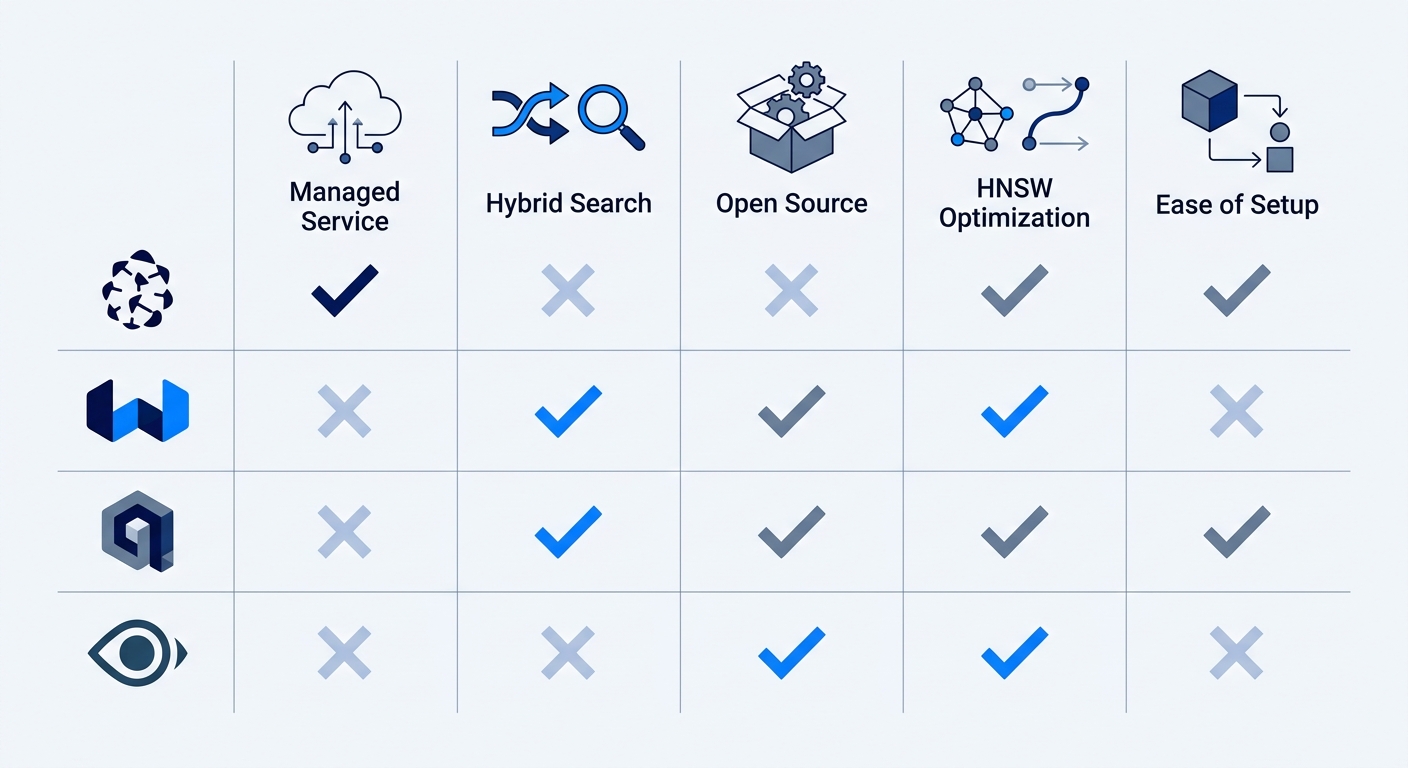
Pinecone is designed for teams that want to treat their vector database as an API. It is a fully managed, cloud-native service that removes the burden of infrastructure management.
- Architecture: Pinecone has evolved from a pod-based model to a serverless architecture. This decouples storage from compute, allowing users to store billions of vectors in S3-like storage while scaling compute resources up or down instantly.
- Strengths: Unrivaled speed of deployment. There is no cluster to manage, no shards to balance, and no index tuning required for most use cases. Their "serverless" offering significantly reduces the TCO (Total Cost of Ownership) for sporadic workloads.
- Weaknesses: Vendor lock-in is the primary concern. Because it is closed-source, you cannot run Pinecone on-premises or in a private VPC for extreme security requirements.
- Best For: Startups and enterprises prioritizing time-to-market and minimal DevOps overhead.
2. Weaviate: The Knowledge Graph Approach
Weaviate positions itself as an "AI-native" database. Unlike Pinecone, which focuses on vectors, Weaviate treats vectors as a first-class citizen alongside structured data objects.
- Architecture: Weaviate is open-source and can be deployed via Docker, Kubernetes, or as a managed service. It uses HNSW for indexing and allows for "modular" integrations, meaning you can plug in your embedding model (OpenAI, Cohere, HuggingFace) directly into the database.
- Strengths: Superior hybrid search capabilities. Weaviate's ability to combine keyword search and vector search natively makes it a powerhouse for complex RAG pipelines. Its schema-based approach allows for sophisticated filtering of metadata.
- Weaknesses: The learning curve is steeper than Pinecone. Managing a self-hosted Weaviate cluster requires a dedicated understanding of Kubernetes and memory management.
- Best For: Complex RAG systems requiring a mix of structured data, keyword search, and semantic retrieval.
3. Qdrant: The Performance Specialist
Qdrant is written in Rust, which gives it a significant edge in memory efficiency and raw execution speed. It is designed for high-load production environments where latency is the primary KPI.
- Architecture: Qdrant is open-source and offers both managed cloud and self-hosted options. It implements HNSW but provides advanced "quantization" options (Scalar and Product Quantization), which compress vectors to reduce RAM usage without significantly sacrificing recall.
- Strengths: Efficiency. Qdrant often outperforms competitors in "vectors-per-GB" of RAM. Its API is highly intuitive, and the filtering system is exceptionally fast, allowing users to slice datasets by metadata before performing vector search.
- Weaknesses: While growing rapidly, its ecosystem of third-party integrations is slightly smaller than Weaviate's or Milvus's.
- Best For: High-performance applications where latency and hardware efficiency are critical.
4. Milvus: The Enterprise Heavyweight
Milvus is built for massive scale. It is the "industrial" choice, designed to handle billions of vectors across distributed clusters.
- Architecture: Milvus utilizes a decoupled, distributed architecture. It separates data ingestion, indexing, and querying into different microservices. This allows you to scale your "query nodes" independently from your "index nodes."
- Strengths: Unmatched scalability. Milvus supports a wide array of indexing algorithms beyond HNSW, including IVF-Flat and IVF-PQ, giving architects granular control over the latency-recall trade-off. It is the most "database-like" in terms of enterprise features (RBAC, multi-tenancy).
- Weaknesses: Extreme operational complexity. Deploying Milvus on-premises is a significant undertaking, requiring a robust Kubernetes setup and several supporting components (MinIO, Pulsar/Kafka, etcd).
- Best For: Fortune 500 companies with massive datasets (100M+ vectors) and dedicated platform engineering teams.
Production Benchmarks & Trade-offs
When moving to production, theoretical benchmarks rarely match reality. Three factors dominate the actual performance of a RAG system:
1. Latency vs. Recall
In vector search, there is no "perfect" answer—only an "approximate" one. Increasing recall (the percentage of the true nearest neighbors found) typically increases latency.
- HNSW provides high recall at low latency but consumes massive RAM.
- Quantization (available in Qdrant and Milvus) reduces RAM by 4x-10x but may drop recall by 1-5%.
For most RAG systems, a 2% drop in recall is an acceptable trade-off for a 70% reduction in infrastructure costs.
2. Total Cost of Ownership (TCO)
The cost of a vector database is primarily driven by RAM.
- SaaS (Pinecone): Predictable monthly costs, but can become expensive as the dataset grows if you aren't using a serverless tier.
- Self-Hosted (Milvus/Weaviate): No licensing fees for open-source versions, but high "hidden" costs in the form of DevOps salaries and cloud compute (EC2/GKE) bills.
3. The "Cold Start" and Indexing Latency
RAG systems often require real-time data updates. Some databases struggle with "index lag"—the time between inserting a vector and it becoming searchable.
- Pinecone and Qdrant generally offer very low indexing latency.
- Milvus, due to its distributed nature, may have higher latency for small, frequent updates but excels at massive bulk uploads.
Decision Framework: Which One to Choose?
To simplify the selection process, map your project to one of these four common production scenarios:
Scenario A: The "Speed-to-Market" Startup
- Requirements: Minimal DevOps, rapid iteration, unpredictable growth.
- Choice: Pinecone.
- Reasoning: You cannot afford to spend two weeks configuring a Kubernetes cluster. Pinecone's serverless offering allows you to start for pennies and scale instantly.
Scenario B: The "Knowledge-Intensive" Enterprise
- Requirements: Complex data relationships, heavy reliance on both keyword and semantic search, hybrid data types.
- Choice: Weaviate.
- Reasoning: Weaviate's hybrid search and schema-first approach make it the best tool for building a "corporate brain" where precision is as important as intuition.
Scenario C: The "Latency-Critical" Application
- Requirements: Sub-50ms retrieval, high throughput, strict hardware budget.
- Choice: Qdrant.
- Reasoning: The Rust-based core and aggressive quantization options allow you to squeeze maximum performance out of minimum hardware.
Scenario D: The "Hyper-Scale" Data Lake
- Requirements: Billions of vectors, multi-region deployment, strict internal compliance (on-prem).
- Choice: Milvus.
- Reasoning: When you hit the billion-vector mark, the distributed architecture of Milvus becomes a necessity, not a luxury. Its ability to scale query and index nodes independently is the only way to maintain performance at this scale.
Conclusion & Future Outlook
The vector database landscape is rapidly consolidating. We are seeing a convergence where "pure" vector stores are adding traditional database features (like ACID compliance and complex filtering) and traditional databases (like pgvector for PostgreSQL) are adding vector capabilities.
However, for production RAG systems, the specialized engines—Pinecone, Weaviate, Qdrant, and Milvus—still hold the advantage in performance and scalability. The trend for 2026 is moving toward "Serverless Vectorization," where the developer no longer worries about indexes or shards, but simply manages a data stream.
The winning strategy for architects is to prioritize flexibility. Start with a managed service to prove the value, but ensure your embedding pipeline is decoupled from the database so you can migrate as your scale evolves from thousands to billions of vectors.
Schema Markup (JSON-LD)
{
  "@context": "https://schema.org",
  "@type": "TechArticle",
  "headline": "Vector Databases in Production: Choosing Between Pinecone, Weaviate, Qdrant, and Milvus for RAG Systems",
  "description": "A comprehensive vector database comparison for RAG in 2026. Detailed analysis of Pinecone, Weaviate, Qdrant, and Milvus covering latency, hybrid search, indexing algorithms, and pricing to find the best vector DB for LLM applications.",
  "keywords": ["vector database comparison", "best vector database for RAG", "Pinecone vs Weaviate vs Qdrant vs Milvus", "HNSW", "hybrid search", "RAG latency", "vector DB pricing", "vector search"],
  "articleSection": "AI Infrastructure / MLOps",
  "proficiencyLevel": "Intermediate to Advanced",
  "datePublished": "2026-07-18",
  "about": {
    "@type": "Thing",
    "name": "Vector Databases"
  }
}