LLM Cost Chargeback: Building a Showback Model That Survives Finance Review
Build an LLM cost chargeback and showback model that survives finance review. Attribute token spend to teams via a gateway and pick the right billing unit.
LLM spend behaves nothing like the infrastructure budgets finance is used to. It is variable, generated at inference time, shared across teams through common gateways, and invisible unless you instrument it deliberately. Finance wants accountability and a defensible number. Engineering wants to ship features without a spreadsheet review before every API call. Both are reasonable, and both lose when nobody owns the translation layer between tokens and dollars.
That translation layer is a showback model. Showback gives you visibility and attribution without moving money; chargeback actually reallocates budget between cost centers. Most organizations should start with showback, prove the numbers reconcile against provider invoices, and only then decide whether to graduate to LLM cost chargeback.
The stakes are concrete. Consider a mid-sized company running a customer support assistant, an internal search tool, and a document summarization pipeline. It is easy for a setup like this to cross $40,000–$80,000 a month in inference spend, with individual teams varying by an order of magnitude in cost per active user. When that bill lands as a single line item on the cloud invoice, the first budget conversation becomes a finger-pointing exercise. The model described here maps tokens to teams, holds up under audit, and keeps working when you swap models or providers mid-quarter.
Why LLM Costs Break Traditional Chargeback Models
Cloud cost allocation has a well-worn playbook: tag resources, group by tag, distribute the bill. LLM spend breaks that playbook in three specific ways.
Non-deterministic, usage-based spend
A single logical request can cost a fraction of a cent or several dollars depending on prompt length, model tier, retry behavior, and whether tokens hit a cache. Cost is a function of runtime behavior, not a provisioned resource. Two teams running "the same" feature can produce wildly different bills because one passes long context and the other summarizes first. You cannot forecast LLM spend from seat count or instance type.
The variance is not marginal. Take an illustrative frontier-model rate of $3 per million input tokens and $15 per million output tokens (pull your actual rates from the versioned price book — this is for arithmetic, not a quote):
- A classification call with 500 input and 50 output tokens costs about $0.0023 — a fraction of a cent.
- A 100,000-token document analysis with a 4,000-token reasoning trace costs about $0.36 per call from tokens alone, and several times that once you account for retries.
- A timeout loop that retries a 50,000-token prompt three times triples the bill for a single user action, because failed and retried calls are still billed.
That is a cost surface that looks nothing like a reserved instance. Traditional FinOps tools that rely on resource tags and billing exports have no tag to read. (See our guide to LLM cost observability and token-level monitoring.)
Shared infrastructure and multi-tenant calls
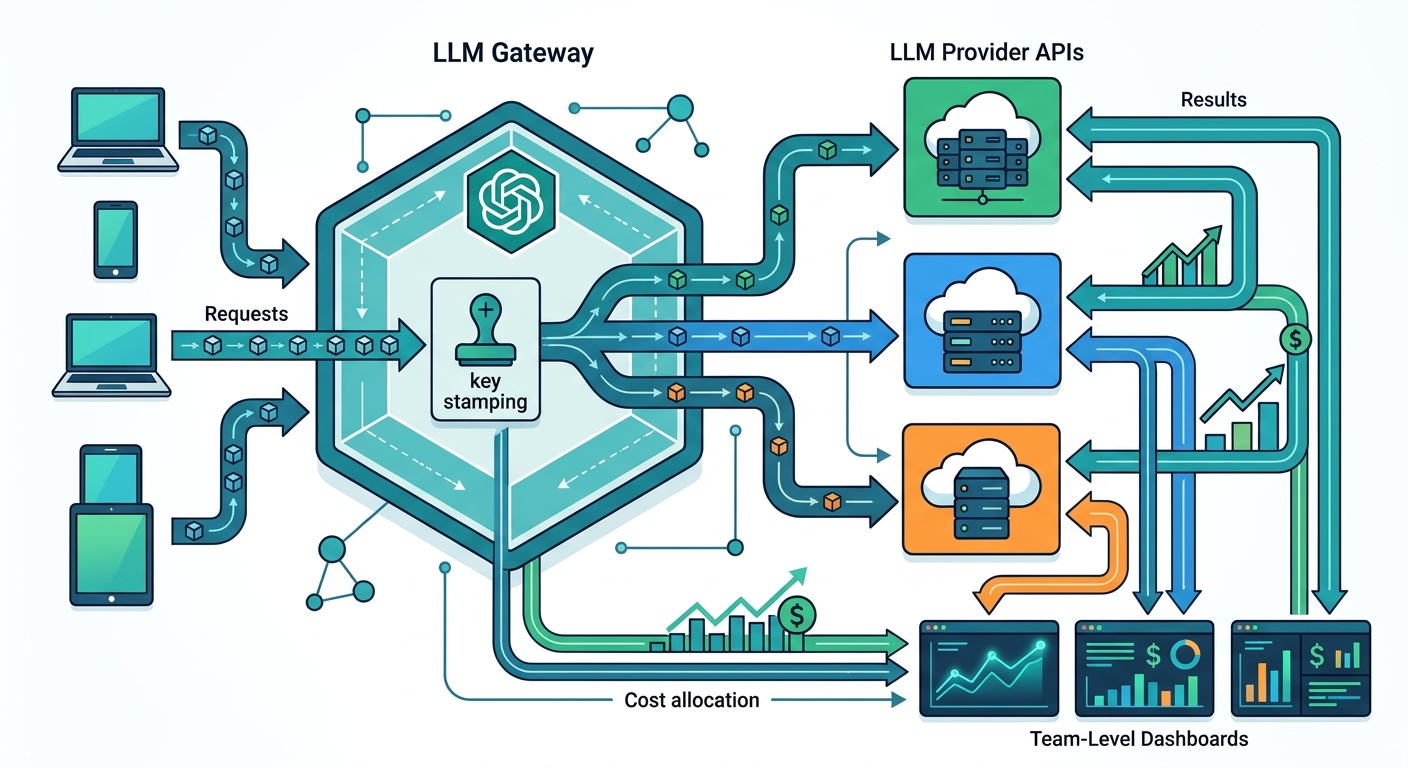
Most mature setups route traffic through an LLM gateway. That gateway, the embedding store, the RAG pipeline, and the agent orchestration layer all serve many teams from one endpoint. The provider invoice arrives as a single line item. Without per-request attribution at the gateway, you have no way to split it.
This is the same problem multi-tenant SaaS solved years ago, and the same solution applies: stamp identity at the chokepoint. If every request passes through one gateway — LiteLLM, Kong AI Gateway, Portkey, or an in-house proxy — that gateway is the only place where you can reliably know who made the call. Application-side logging fragments across services, drifts out of date, and disappears when a service is rewritten. (Related: attributing shared LLM gateway costs across teams.)
Two design rules follow:
- The attribution key is a first-class field, not an afterthought. Every request must carry team, cost center, application/feature, environment, and requesting user or tenant, plus a request ID for audit. Requests that arrive without a key go into an explicit
unattributedbucket that is reported on dashboards — never silently absorbed into a "shared" line. - Routing-around the gateway is a control problem, not a reporting problem. Enforce it: provider keys are issued only to the gateway, and egress to provider APIs is restricted to gateway egress. If teams can mint their own keys, your attribution model is advisory at best.
The unit problem
You cannot bill "a request" — requests vary by two orders of magnitude in cost. You must bill on a normalized unit: tokens (input, output, cached, reasoning), model-minutes for hosted endpoints, or a cost unit you derive from provider pricing. Pick your billing unit before you pick your tooling, because the unit determines what you must meter.
The unit also determines your reporting grain. Token counts are auditable and provider-verifiable; dollar figures are derived and change when prices change. The cleanest design meters in tokens, stores the raw counts immutably, and derives dollars through a separate, versioned price book. That way a mid-quarter price cut from a provider doesn't retroactively rewrite history — it creates a new rate row with an effective date. (More on versioned price books for LLM cost allocation.)
The core failure: traditional cloud tagging attaches cost at provisioning time. LLM cost is generated at inference time, inside application code, often by a developer who never thinks about tags.
Showback vs. Chargeback: Choosing the Right Model
These are different products with different political costs.
Showback produces attribution and reporting. Teams see what they spent and why. No journal entries, no budget transfers, no disputes over who owes whom. It ships in weeks, not quarters, and it surfaces the behavioral changes — right-sizing models, trimming prompts — that actually reduce spend. In practice, the first two months of showback commonly drive 10–20% savings before any policy is enforced, simply because teams can finally see their own numbers. Treat that figure as a directional expectation tied to the visibility mechanism, not a guaranteed outcome; measure your own baseline.
Chargeback moves real money between cost centers. It requires finance sign-off on allocation keys, a dispute-resolution process, a monthly close cadence, and a written tolerance for the fact that your numbers will not match the invoice to the penny. It also changes behavior in ways you may not want: teams start hoarding API keys, routing around the gateway to avoid attribution, or blocking legitimate experiments to protect their budget line.
The maturity ladder
Treat this as a staged rollout with explicit exit criteria. Do not skip a stage; each one de-risks the next.
Stage 1 — Meter. Instrument the gateway, store raw token counts immutably, and stand up the versioned price book. Exit criterion: you can reproduce the provider invoice from your own meter within an agreed tolerance (see reconciliation, below) for two consecutive months.
Stage 2 — Showback. Publish team-level dashboards with the unattributed bucket visible. Drive right-sizing through visibility alone. Exit criterion: the unattributed share is below a threshold you set (e.g., 5% of spend), teams are actively using their dashboards, and at least one round of savings has been realized without enforcement.
Stage 3 — Guardrails. Add budgets, alerts, and soft limits — per-team quotas, model-tier allowlists, and retry caps at the gateway. Exit criterion: spend is predictable enough to forecast within a band finance accepts, and policy prevents the largest variance sources (retry storms, runaway agents).
Stage 4 — Chargeback. Only now move money. Requires signed-off allocation keys, a defined dispute window, a variance-tolerance policy, and a named owner for the residual. Exit criterion for staying in chargeback: the monthly close reconciles within tolerance and disputes stay within the process.
Making It Reconcile: The Question Finance Will Actually Ask
Attribution is worthless to finance until it ties back to the invoice. The gap between what your gateway meters and what the provider bills comes from a known set of sources, and you should name them rather than hide them:
- Retries and failed calls. Providers bill tokens for requests that error or time out after generation. Your meter must count billed attempts, not successful responses.
- Cached tokens. Prompt caching is billed at a different (usually lower) rate. Meter cached and uncached input separately or your dollar derivation will drift high.
- Batch and off-peak discounts. Batch API calls can be billed at roughly half the standard rate. If you apply standard rates to batch traffic, you overstate cost.
- Embeddings and other endpoints. Embedding and reranking calls are billed separately and often omitted from token meters built for chat completions.
- Streaming truncation and max-token cutoffs. Output that is generated but not streamed to the user is still billed.
Set a reconciliation tolerance and a close procedure. A defensible default is ±2–5% of monthly provider spend, with the residual assigned to a named shared/platform cost center rather than smeared across teams. Run reconciliation monthly as part of close: compare gateway-metered cost to the provider invoice line by line, log every variance source, and investigate anything outside the band before publishing that month's showback or chargeback. Document the tolerance in the allocation policy so it is a decision, not an argument.
What Survives Finance Review
A model that holds up has four properties: it meters in an auditable unit (tokens), derives dollars through a versioned price book, attributes at a single chokepoint with an explicit unattributed bucket, and reconciles to the provider invoice within a stated tolerance with a named owner for the residual. Get those four right and you can start with showback, prove it, and graduate to chargeback — or stop at guardrails — on evidence rather than optimism.