Shadow Deployment for LLM Features: Testing Models on Live Traffic Safely
Learn how shadow deployment tests LLM models on real live traffic with zero user exposure. Compare shadow vs. canary vs. A/B and architect a safe pipeline.
Shadow Deployment for LLM Features
Swapping a model, rewriting a prompt, or changing a retrieval pipeline can quietly break an LLM feature. A new model version may refuse more often, drift on token cost, or produce subtly malformed JSON that your parser chokes on—and you won't know until users hit it. Offline evals help, but they run on stale datasets that never quite match what production actually sends.
Shadow deployment closes that gap. You run your candidate model or pipeline in parallel on mirrored live traffic, while users continue to see only the incumbent's output. You get production-grounded evidence—real inputs, real load, real latency—with no user-visible output exposure. This guide covers how shadow deployment works for LLM features, how it compares to canary and A/B rollouts, how to architect the pipeline, and how to gate promotion on metrics that actually matter.
What Shadow Deployment Means for LLM Features
Shadow deployment runs a candidate model or pipeline alongside your production system on a copy of live requests. The primary path serves users as usual; the shadow path processes the same inputs asynchronously and logs its outputs for comparison. Users never see shadow output, so a broken candidate can't degrade the user experience.
One caveat up front: "no user exposure" refers to output, not resources. Shadow traffic still consumes inference capacity, provider rate-limit budget, and database connections. A misconfigured shadow path can starve the primary through shared quotas, so isolation (covered below) is a hard requirement, not a nicety. Consider a concrete failure mode: if the incumbent and the candidate share a single provider API key, and the candidate version has a runaway retry loop or a longer max-token setting, the shadow calls will burn through the shared tokens-per-minute limit and the primary starts returning 429s to real users. The user-visible symptom looks like a production outage, but the cause lives entirely in the shadow path.
This differs from offline evaluation in one critical way: the inputs are real. You're testing against the actual distribution of production traffic—the messy prompts, the edge cases, the load spikes—not a curated benchmark set. (See how this fits into a broader LLM evaluation strategy.)
LLMs add wrinkles that traditional shadowing doesn't face:
- Non-determinism. With temperature above zero, the same input yields different outputs across runs, so per-request exact-match diffing is near-useless. You compare distributions and paired outcomes instead: refusal rate, JSON-parse success rate, token-count percentiles, and similarity between incumbent and candidate outputs on the same input. A practical trick: run the candidate at temperature 0 for the shadow path even when production runs at 0.7. You lose some fidelity to production sampling behavior, but you gain a stable comparison baseline and cheaper, more reproducible scoring. Document the choice so reviewers understand what the shadow run does and doesn't prove.
- No single correct answer. Generative output resists pass/fail scoring, so you lean on judge models, embedding-similarity metrics, and rubric-based checks. (Related: LLM-as-judge evaluation.)
- Cost per shadow call. Every mirrored request adds inference spend on the mirrored fraction of traffic—and if you score outputs with a judge model, evaluation cost can exceed the shadow inference cost itself. Sampling and budget caps are mandatory, not optional. As a rough rule of thumb, a judge-based scoring pass can cost 1.5–3× the shadow inference itself for chat-style features with long outputs, because the judge reads both incumbent and candidate responses plus a rubric prompt. Budget the total, not just the inference line item.
Treat shadowing as a pre-launch gate: it proves a candidate is safe and operationally sound before any user sees it.
Why Live Traffic Beats Offline Evals for LLM Rollouts
Offline benchmarks are necessary but insufficient. They miss distribution shift—the gap between your eval set and what users actually type. They miss adversarial inputs, malformed requests, and the long-tail prompts that only appear at production scale. A model that scores 94% on your golden set can still fail on the 6% your benchmark never captured.
Shadowing surfaces problems that offline testing can't:
- Latency regressions under real concurrency, not a quiet test environment. A candidate that looks fast on a single sequential test can show p95 latency two to three times higher once it contends with real request volume, especially if it routes to a different provider region or a model with a larger context window.
- Token-cost drift when a new model is more verbose or reasons longer. Reasoning-tuned models are a common offender: a version bump that adds internal reasoning steps can triple output-token counts on multi-step prompts while producing near-identical final answers, quietly multiplying your per-request cost.
- Refusal-rate changes when safety tuning shifts between versions. A model update that tightens safety filters can start refusing benign-but-borderline requests—medical questions, security-adjacent coding tasks, anything with unusual phrasing—that the incumbent handled fine.
- Format breakage when output structure degrades on unusual inputs. A model that reliably emits valid JSON on clean prompts may wrap output in markdown fences or add a conversational preamble when the input contains nested quotes or non-English text. Your parser handles the 99% case and throws on the 1% that matters.
Offline evals tell you whether a model can perform. Shadow deployment tells you whether it does perform on your traffic, at your load, at your cost.
The result is production-grounded evidence you can put in front of reviewers before anyone is exposed. When you promote a model, you're promoting measured behavior, not a benchmark score.
Shadow vs. Canary vs. A/B: Choosing the Right Rollout Pattern
These three patterns answer different questions. Use them in sequence for high-risk changes—model swaps, retrieval-pipeline rewrites, anything touching safety tuning—and skip stages only when the blast radius justifies it.
- Shadow exposes no users. It observes full or sampled traffic and answers: Is the candidate operationally and qualitatively safe? Best as a pre-launch gate.
- Canary routes a small percentage of real users to the new model. It answers: Do users perceive a difference, and is it acceptable? It catches UX issues shadowing can't—tone, perceived helpfulness, trust. (More on canary releases for LLM features.)
- A/B splits traffic to statistically compare business outcomes. It answers: Does the change move the metric we care about? Use it when you need causal evidence on engagement, conversion, or task success—and only when you have enough traffic for statistical power. A canary that sends 2% of traffic to a new model for a day usually can't resolve a two-point difference in task success; an A/B test with a pre-computed sample size can.
| Pattern | User exposure | Primary risk | Signal type | Best for |
|---|---|---|---|---|
| Shadow | None (output) | Cost, data handling, shared-resource contention | Quality proxies, latency, cost, safety | Pre-launch safety gate |
| Canary | Small % | UX regressions | Perceived quality, error rates | Early user feedback |
| A/B | Split cohort | Business metric harm | Statistical outcome deltas | Proving business impact |
The default sequence for a high-risk change is shadow → canary → A/B → full rollout. Shadow proves the candidate won't break things. Canary proves users tolerate it. A/B proves it's worth shipping. Skipping straight to canary means your first real signal is also your first user exposure—an avoidable risk. For low-risk edits like prompt copy tweaks, a lighter path (offline evals plus a short canary) may be proportionate; calibrate to the blast radius.
Architecting a Shadow Deployment Pipeline
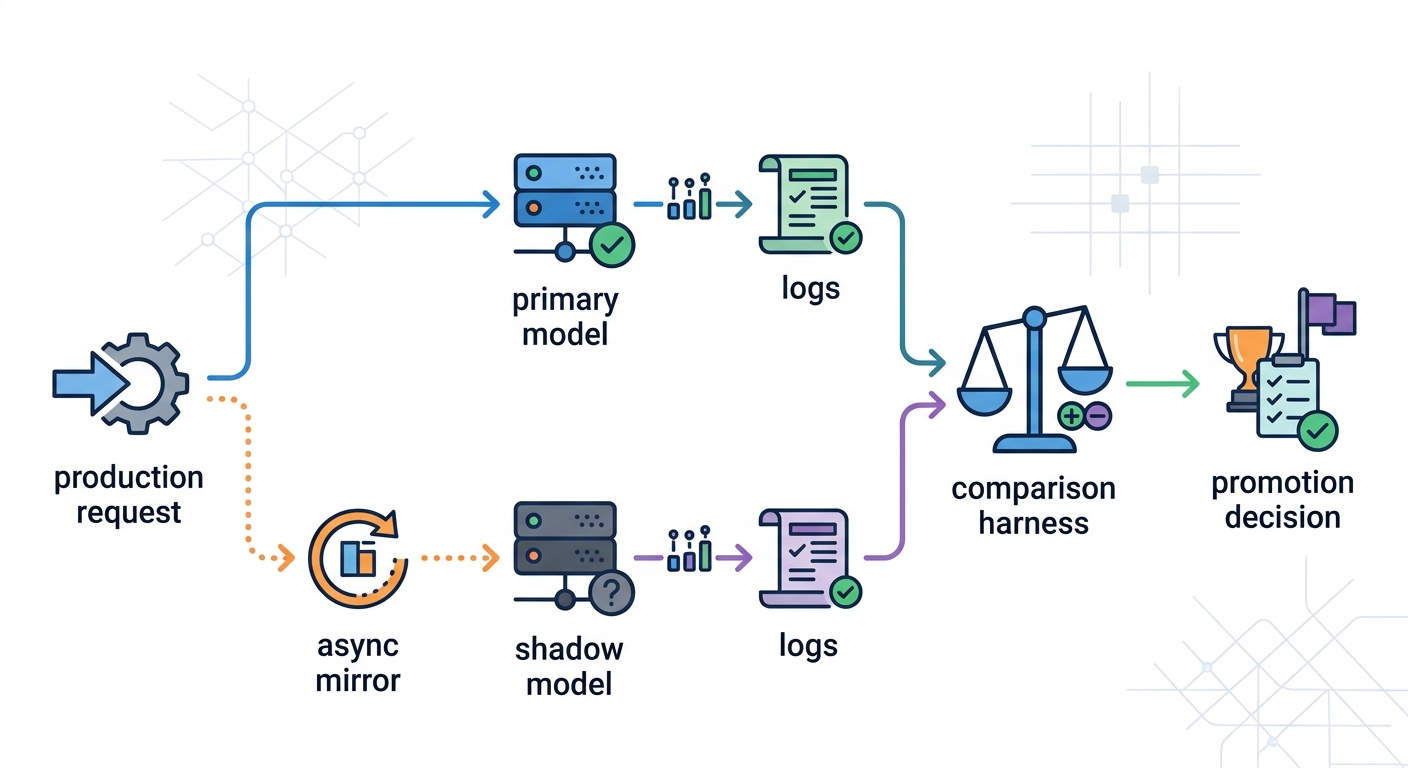
A reliable shadow pipeline has four parts: traffic mirroring, path isolation, correlated logging, and a comparison harness. Get isolation and correlation right, and the rest follows.
Traffic mirroring and the shadow path
Mirroring must be asynchronous and non-blocking. Copy the request, hand it to the shadow path, and let the primary response return immediately. The shadow path must never add latency or introduce a new failure mode to production. The standard implementation is a queue: the primary handler serializes the request (minus anything the shadow doesn't need) onto a message bus—SQS, Kafka, Redis Streams, or whatever you already operate—and a separate worker pool drains it and calls the candidate. The primary never awaits the shadow. If the queue backs up, you drop shadow messages, not user requests.
Practical controls:
- Sample aggressively. Mirror 1–10% of traffic to start; scale up only as budget allows. Stratified sampling by endpoint or user segment keeps coverage meaningful—if 80% of your traffic hits a simple lookup path and 20% hits the complex generation path, uniform sampling overweights the easy case. Sample each stratum at a rate you can afford, and report coverage per segment.
- Isolate quotas and timeouts. Give the shadow path its own rate limits, shorter timeouts, and circuit breakers. If the shadow model stalls, it should fail silently—never cascade into the primary path. Use separate provider API keys or projects so a shadow-side 429 doesn't consume the primary's quota. The same applies to downstream dependencies: if the candidate pipeline calls a new vector database, give it its own connection pool so a shadow-side connection leak can't exhaust the primary's.
- Correlate every pair. Stamp each request with a trace ID propagated to both paths so incumbent and candidate outputs join cleanly in the comparison store. OpenTelemetry trace context works well here if you already run it; otherwise a UUID stamped at the edge and carried in both log records is sufficient. The comparison harness joins on that ID and nothing else—never on timestamps or user IDs, which collide under load and skew results.
Data handling and governance
Shadowing sends production inputs—often including user PII—to a candidate model that may be a different provider or a new data processor. Resolve this before you mirror a single request:
- Redact or tokenize PII fields before the shadow call when the evaluation doesn't require them. A regex-plus-entity-model pass on emails, phone numbers, and account identifiers is cheap relative to the inference call and removes most of the exposure.
- Confirm provider data-retention terms and that your DPA covers the candidate provider. Some providers train on inputs by default; opt out or pick a provider that doesn't. If the candidate is a self-hosted model, the data-governance question shifts to your own infrastructure and logging retention, but it doesn't disappear.
- Bound log retention. Shadow logs contain raw prompts and outputs; apply the same retention and access controls as production data, and set a TTL on the comparison store. Thirty days is a common default—long enough to investigate a promotion decision, short enough to limit blast radius if the store is misconfigured.
The comparison harness and promotion gate
The harness joins incumbent and candidate records by trace ID and computes gate metrics. Define pass/fail thresholds before the run to avoid post-hoc rationalization. A workable gate:
| Metric | Gate |
|---|---|
| JSON/format parse success | ≥ incumbent − 0.5pp |
| Refusal rate | Within ±X pp of incumbent (set by product) |
| p95 latency (shadow path) | Within the candidate's own SLO |
| Token cost per request | Within budget delta |
| Judge win/tie/loss rate | Not statistically worse than incumbent |
Run the shadow long enough to clear sampling noise—days, not hours, for low-volume endpoints—then make the promotion decision against the pre-registered thresholds. As a sanity check on duration: if you're sampling 2% of a low-volume endpoint that receives 500 requests a day, you collect 10 samples daily, and a refusal-rate gate needs hundreds of samples before the confidence interval is narrow enough to act on. Either raise the sampling rate for that endpoint or extend the run; don't decide on a handful of observations just because the calendar says the window closed.
Two failure modes are worth calling out because they're common and easy to miss. First, silent shadow death: the shadow worker crashes or the queue consumer stalls, and the harness keeps computing metrics on a shrinking sample without anyone noticing. Alert on shadow request volume relative to mirrored volume, not just on errors. Second, gate drift: thresholds get adjusted after the results come in to let a favored candidate through. Freeze the gate definition in version control alongside the rollout, and require a reviewer to approve any change to it. The shadow run's value depends entirely on the gate meaning what it meant before the data arrived.