Synthetic Data Pipelines at Scale: Quality Gates, Collapse, and Contamination
Build synthetic data pipelines that hold up at scale. Learn quality gates, model collapse prevention, and contamination control for LLM training.
Why Synthetic Data Pipelines Break at Scale
Synthetic data has moved from a stopgap to a first-class input in modern LLM training and fine-tuning. Teams generate instruction sets, reasoning traces, preference pairs, and domain-specific corpora to fill gaps real data cannot cover—rare edge cases, privacy-restricted records, long-tail languages. The economics are compelling, and the tooling has matured enough that generation is no longer the hard part.
The hard part is everything after generation.
Synthetic data pipelines fail silently. Unlike a crashed training job or a schema mismatch, quality degradation produces no error code. The pipeline runs green, the dataset grows, and the model gets quietly worse. By the time anyone notices, months of training compute have been spent reinforcing the wrong distribution.
Three distinct risks drive this, and they are easy to conflate—so keep them separate:
- Quality erosion / model collapse — recursive training that progressively strips distributional tails and homogenizes output.
- Contamination — synthetic or scraped examples that overlap evaluation benchmarks, inflating metrics and masking true capability. Contamination corrupts your measurement, not necessarily the model.
- Adversarial poisoning — deliberate or accidental insertion of biased, harmful, or backdoored examples into the corpus. Poisoning corrupts the model.
Scale amplifies each. A 0.1% contamination rate sounds negligible until you apply it to a corpus of 10 million training examples—that is ten thousand leaked benchmark items, enough to move a headline eval score by points and make a regression invisible. (The unit matters: contamination is a property of examples, not tokens; a single leaked example can span thousands of tokens.) The rest of this article covers the control points that catch these failures before they reach training. (Related: data contamination in LLM evaluation)
Quality Gates: The Control Points That Keep Synthetic Data Usable
A quality gate is an automated, blocking checkpoint—not a dashboard someone might check. If a batch fails a gate, it does not proceed. The distinction matters: observability tells you what happened; a gate prevents it from happening. Every gate below should have a defined threshold, an owner, and a failure path. (See also: building automated data validation pipelines)
Gate 1 — Source and Seed Provenance
Before a single token is generated, you need to know what you are generating from. Provenance tracking answers:
- Lineage — which real datasets seeded this generation batch, and under what license or consent terms.
- Generator identity — exact model name, version, and decoding parameters. A silent generator upgrade is a data distribution change.
- Transform history — every filter, dedup pass, and rewrite applied between seed and output.
Provenance is what makes a dataset reproducible and auditable. Without it, you cannot answer the first question any serious buyer or auditor will ask: where did this data come from? It is also your primary defense against poisoning: signed, versioned seeds let you trace a bad example back to its source. (Related: data provenance and lineage tracking for AI datasets)
Gate 2 — Statistical Fidelity and Diversity Checks
Synthetic data must resemble real data statistically without collapsing into it. Gate 2 measures both:
- Distributional distance from a held-out real baseline—token frequency divergence, embedding-space distance, length and complexity distributions.
- Deduplication at exact, near-duplicate (MinHash/LSH), and semantic (embedding) levels. Synthetic generation is prone to producing thousands of paraphrases of the same idea.
- Diversity metrics—n-gram diversity, embedding dispersion, distinct-cluster counts.
- Tail coverage — explicit checks that rare classes and long-tail phenomena survive generation. This is the metric most pipelines miss, and in practice it is one of the strongest early warnings of collapse.
Set thresholds against a real-data reference, not against the previous synthetic batch. Comparing synthetic to synthetic hides drift. (Related: deduplication strategies for training data)
Gate 3 — Downstream Task Validation
A synthetic corpus can pass every statistical check and still teach nothing useful. Validate on held-out real data, never synthetic-only benchmarks. Train a small proxy model on the batch, evaluate on a frozen real evaluation set, and compare against the current production baseline. If the batch does not improve or hold the line on real tasks, it does not ship. Budget for this: proxy training adds latency and compute to every batch, so size the proxy to the decision it informs—a 100M–1B parameter proxy on a fixed token budget is usually enough to detect a directional regression, though it carries its own noise floor and should be run with a fixed seed and eval harness.
Supplement automated evaluation with human spot audits on a stratified, prevalence-aware sample. Auditors should score factual accuracy, instruction adherence, and toxicity. Sample size depends on the failure rate you need to detect: catching a 1% systematic defect with reasonable confidence requires on the order of hundreds of examples per stratum, so stratify by source and generator version rather than sampling uniformly from the whole batch. (Related: LLM evaluation best practices)
Gate 4 — Drift and Distribution Monitoring
Gates are point-in-time. Drift monitoring is continuous. Track gate pass rates over time across batches. A gradual decline in pass rate—even while every batch technically clears threshold—signals generator regression, upstream seed contamination, or creeping distribution shift.
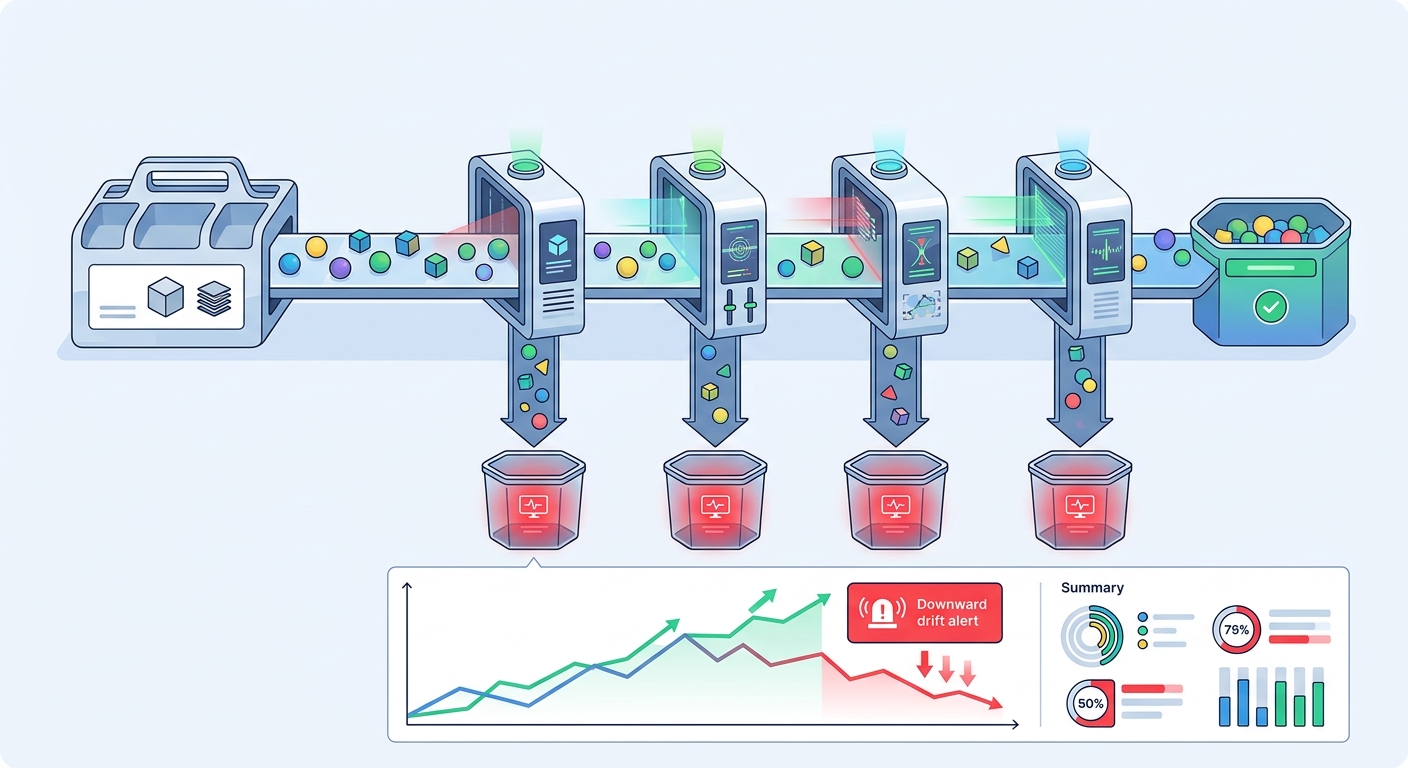
Alert on rate-of-change, not just absolute values. As an illustrative pattern, a pass rate drifting from 98% to 91% over ten batches is a stronger signal than a single batch landing at 90%—the former suggests a systematic cause, the latter could be noise. Calibrate the threshold to your own variance.
Decontamination and Poisoning Defense (Cross-Cutting)
Two checks do not fit neatly into the four gates because they must run across them:
- Decontamination. Before any batch reaches Gate 3, screen it against your evaluation sets using n-gram overlap (e.g., 13-gram matching, the GPT-3-era standard), MinHash/LSH for fuzzy matches, and embedding near-duplicate search. Insert canary strings into eval sets so leakage is detectable. Decontaminate both synthetic and scraped data—the risk is identical.
- Poisoning defense. Combine provenance signing (Gate 1) with statistical anomaly detection on the batch and, for high-stakes corpora, influence-function or gradient-based attribution to flag examples that disproportionately move the proxy model.
Gates that only report are not gates. If a failing batch can still reach training, you have observability, not quality control.
Model Collapse: How Recursive Training Degrades Models
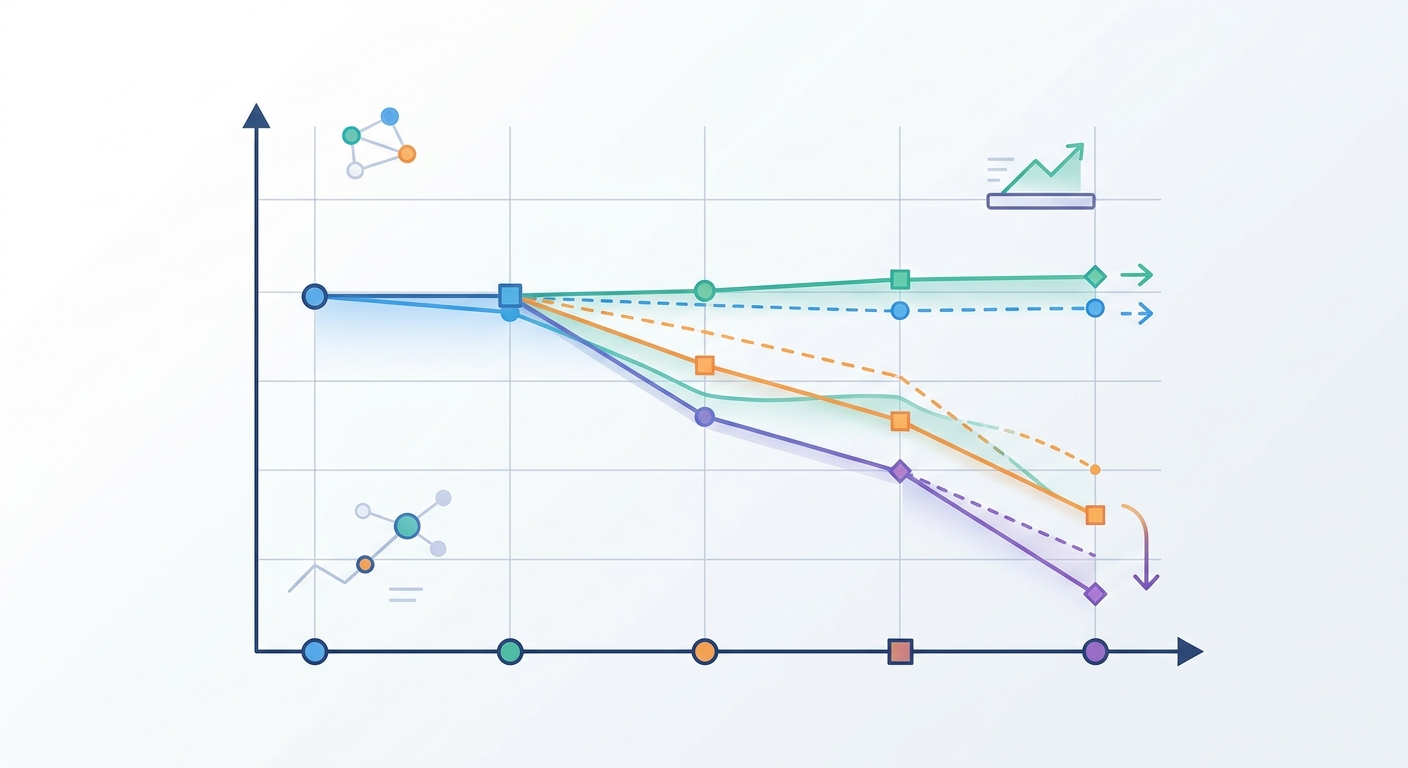
Model collapse is the progressive loss of distributional tails and fidelity that occurs when generative models are trained on their own output across successive generations. It is not a sudden failure; it is erosion—and, importantly, it is not inevitable. The controlling variable is how much fresh real data enters each generation.
The Mechanism: Error Accumulation Across Generations
Each generation introduces sampling error. The generator underrepresents rare events, the next model learns that thinner distribution, and the following generation thins it further, so errors compound across generations. The formal account (Shumailov et al., Nature, 2024) shows two effects: early collapse, where the tails of the original distribution are lost, and late collapse, where the model's output converges toward a low-variance, mean-seeking distribution that no longer resembles real data.
Early collapse shows up as tail loss—rare tokens, minority classes, and long-tail phenomena quietly disappear from the corpus. Late collapse shows up as homogenization: outputs become fluent, repetitive, and confidently wrong on anything outside the narrowed distribution. Because aggregate metrics often improve on the narrowed distribution, collapse can look like progress on a dashboard.
The Critical Nuance: Accumulation and Real-Data Mixing
The most important practical finding for builders is that collapse is largely a function of data accumulation strategy, not recursion per se. Two mitigations are well-supported:
- Accumulate, don't replace. Training each generation on the union of prior synthetic data plus fresh real data (Gerstgrasser et al., 2024) preserves distributional fidelity far better than replacing the corpus each round.
- Maintain a real-data floor. Keep a fixed minimum fraction of human-authored data in every training mix; treat it as non-negotiable infrastructure, not a nice-to-have.
Teams that skip these and train purely on the latest synthetic batch are the ones that collapse.
Detecting Collapse Before It Reaches Weights
Collapse is cheap to detect in data and expensive to detect in a trained model. Instrument the data:
- Tail-coverage trend across generations (Gate 2)—the earliest signal.
- Distributional distance to the original real baseline, tracked per generation, not per batch.
- Held-out real-task regression on the proxy model (Gate 3), which catches late collapse that statistical checks miss.
Operationalizing Gates at Scale
Gates only work if they are wired into the pipeline, owned, and reversible:
- Tier the gates. Make provenance and decontamination hard-blocking; make statistical and diversity gates blocking-with-override that requires a named owner to sign off. Advisory-only gates should not exist for anything that reaches training.
- Assign an owner and a failure path to every gate. A gate with no owner is a dashboard.
- Keep a rollback corpus. Version every accepted batch so a poisoned or collapsing batch can be excised and the training mix rebuilt without a full re-run.
- Log gate decisions as data. Pass/fail rates, thresholds, and overrides are themselves a dataset—the one that tells you when the pipeline is drifting.
The teams that get synthetic data right are not the ones with the best generators. They are the ones whose pipelines refuse to ship bad data, and who keep enough real data in the mix that recursion never gets the chance to erode the distribution in the first place.
References: Shumailov et al., "AI models collapse when trained on recursively generated data," Nature (2024); Gerstgrasser et al., "Is Model Collapse Inevitable? Breaking the Curse of Recursion by Accumulating Real and Synthetic Data" (2024); Alemohammad et al., "Self-Consuming Generative Models Go MAD" (2023); Brown et al., "Language Models are Few-Shot Learners" (2020) for n-gram decontamination methodology.