Synthetic Data Pipelines That Passed Compliance: A Practical Playbook
A practical playbook for building synthetic data pipelines that clear compliance review: provenance, privacy testing, lineage, and audit-ready evidence.
Synthetic data is easy to generate. Getting a synthetic data pipeline through compliance review is the hard part.
Teams rarely stall at the modeling stage. They stall in the room where legal, privacy, and risk sit across the table and ask a simple question: prove this dataset can't be traced back to a person. Synthetic data promises to break the tradeoff between privacy and utility, and adoption is climbing — Gartner projects that by 2030 the majority of data used to train AI models will be synthetically generated. Yet a large share of synthetic data initiatives that work in a notebook never reach production, because the compliance artifact isn't the model — it's the pipeline.
This playbook is drawn from synthetic data pipelines that cleared real enterprise reviews: a financial services fraud program, a healthcare analytics environment under HIPAA controls, and an EU customer analytics initiative scoped by GDPR. Each one passed because the team treated compliance as an engineering deliverable, not a memo written after the fact. (See also: synthetic data privacy metrics explained.)
Scope note: this guidance covers tabular and structured data — the kind that dominates fraud, risk, and operational analytics. Unstructured data (text, images, audio) introduces additional concerns around memorization and verbatim leakage that warrant a separate review track. (Related: synthetic data for unstructured data compliance.)
A framing point that resolves most early confusion: synthetic data is not automatically de-identified data. Under HIPAA, data derived from protected health information remains PHI unless it satisfies the Safe Harbor or Expert Determination standard (45 CFR 164.514(b)). Under GDPR, synthetic records may fall outside the definition of personal data, but the generation process still processes personal data and requires a lawful basis and a documented purpose. Reviewers know this. Say it before they do.
Why Compliance Teams Reject Synthetic Data Pipelines
Synthetic data is generated, not collected. That single fact breaks the mental model most privacy frameworks were built on. Consent records, retention schedules, and data-processing agreements all assume a lineage that starts with a real person and a real collection event. When you generate records that never belonged to anyone, the existing controls don't map cleanly to the artifact in front of the reviewer.
So reviewers fall back on three questions, asked in roughly this order:
- Where did the source data come from, and were you allowed to use it for this purpose?
- Can any individual be re-identified from the synthetic output — alone or by linkage?
- Can you prove both of the above later, when we audit?
Notice that none of these are questions about your generative model's architecture. They're questions about provenance, measurable privacy, and durable evidence. That's why the winning move is to treat the pipeline as the compliance artifact. A model is a component; a pipeline is a system you can inspect, version, and defend. (Related: what compliance reviewers look for in synthetic data.)
The Four Failure Modes
Across the reviews that failed, the same four problems recurred:
- Undocumented provenance. The team couldn't say which source tables fed the generator, under what consent, or whether purpose limitation was honored. Review ends here.
- No quantitative privacy testing. The defense was "it looks fake" or "it's statistically similar but not identical." Neither is a measurement. Reviewers want numbers, thresholds, and the reference population each number was computed against.
- Silent quality regressions. The synthetic data passed privacy review but degraded the downstream model — and nobody caught it because no parity gate existed. This surfaces later as a production incident, which is worse.
- Missing lineage and versioning. At audit time, no one could reproduce the exact dataset that was approved. An unversioned dataset is an unapprovable dataset.
The pattern: every failure was an evidence gap, not a mathematics gap. The generators worked. The documentation didn't.
The Compliance-Ready Synthetic Data Pipeline Architecture
The pipelines that passed shared a four-stage structure. The defining principle: each stage produces evidence, not just data. By the time a reviewer opens the file, every claim is backed by an artifact — a mapping, a test report, a metric, a signed version.
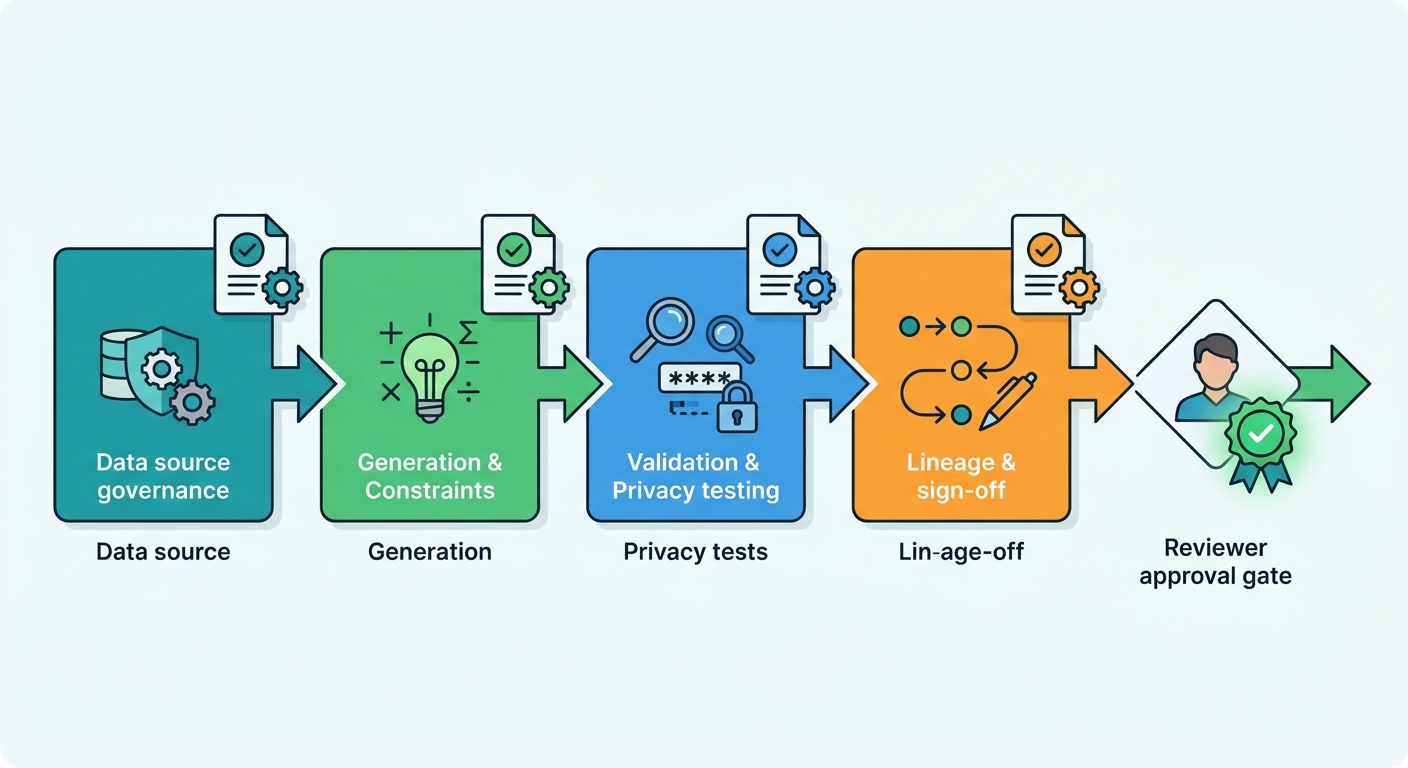
Stage 1 — Source Governance and Consent Mapping
Before a single synthetic row is generated, the team maps every source table to its consent basis, purpose, and retention rule. This stage answers reviewer question one. It produces a source classification matrix: which fields are direct identifiers, quasi-identifiers, or sensitive attributes, and which processing purposes each source is cleared for. Purpose limitation is enforced here — if the source data was collected for billing, it doesn't silently become training data for a marketing model. Retention rules are applied to the source extract before generation, so you're not synthesizing data you shouldn't still hold. (See also: data provenance tracking for synthetic datasets.)
Stage 2 — Generation and Constraint Enforcement
Generation is where utility is won or lost, and where reproducibility gets locked in. Constraints are enforced explicitly: schema conformance, value ranges, referential integrity across related tables, and business rules (a claim date can't precede a policy start). Every run is seeded and the seed is stored, so the exact dataset can be regenerated on demand — a requirement that surfaces in almost every audit.
Privacy mechanisms belong in this stage, but they are not "settings." Be precise about which one you're using, because reviewers will be:
- Differential privacy is a formal guarantee provided by a specific mechanism — DP-SGD during model training, or a DP synthesizer (e.g., MST, PGM, AIM). The guarantee is parameterized by a privacy budget ε and a definition of neighboring datasets. An ε value is meaningless without the mechanism and the neighboring relation it was computed under. A "DP setting" on a generator that is not DP provides no guarantee, and claiming otherwise is the fastest way to lose the review.
- k-anonymity and its extensions (l-diversity, t-closeness) are properties of a released dataset, achieved through generalization and suppression, not properties of a generative model. They protect against linkage on the published quasi-identifier set — and only that set.
- Record-level memorization controls are the third leg, and the one most often skipped. Generative models overfit rare real records. Detect it by comparing each synthetic row to a held-out set of real records and flagging any synthetic row whose nearest real neighbor is closer than that real record's nearest real neighbor in the training data. Rare-combination flagging (rows with attribute combinations appearing once or twice in the source) catches the same failure earlier.
Record the mechanism, its parameters, and the neighboring relation in the generation config. If you cannot state all three, you do not have a privacy guarantee — you have a hope. (Related: differential privacy vs. k-anonymity for synthetic data.)
Stage 3 — Validation and Privacy Testing
This is the stage that separates passing pipelines from failing ones, because it replaces assurances with measurements. Privacy testing is run against a held-out set of real records, never against other synthetic rows — a synthetic-only reference population produces flattering, meaningless numbers.
Three tests, each with a defined threshold and a named reference population:
- Membership inference. Train an attacker model to distinguish records that were in the generator's training set from held-out real records. Report attack AUC; a value near 0.5 indicates the attacker cannot distinguish membership. Set a threshold (commonly ≤ 0.55–0.60 AUC) and record it in the review file.
- Nearest-neighbor distance ratio (NNDR). For each synthetic record, compute the distance to its nearest real neighbor and divide by the distance from that real neighbor to its nearest other real record. Values at or above 1.0 indicate the synthetic record is no closer to a real person than real people are to each other. Report the distribution, not just the mean — the minimum is what matters.
- Attribute-disclosure checks. For each sensitive attribute and each combination of quasi-identifiers, compare the conditional distribution in the synthetic data to the real data on the held-out set. Flag any quasi-identifier combination where the synthetic conditional probability is materially higher than the real one, since that is where an attacker gains information.
State the limitation plainly in the report: passing a fixed suite of attacks is evidence of privacy, not proof. Adversaries change; the suite must be versioned and re-run when the data distribution or generator changes. Reviewers respect a team that names the boundary of its evidence.
Pair privacy testing with a utility parity gate so quality regressions surface here rather than in production: compare downstream model performance trained on synthetic versus real data, and block release if the gap exceeds a pre-agreed tolerance.
Stage 4 — Lineage, Versioning, and Sign-Off
The final stage answers reviewer question three and makes the approval durable. The approved artifact must be content-addressed — identified by a hash of the data, not a filename — and accompanied by a manifest that lets any auditor reproduce it. A minimal manifest:
- Dataset hash and row count
- Generator name and version
- Full generation config, including seed and privacy mechanism parameters
- Source classification matrix reference (Stage 1)
- Privacy and utility test report with thresholds and results (Stage 3)
- Approver identity, role, and timestamp
- Retention and re-review dates
Sign-off is a gate, not a formality: the pipeline should refuse to emit data without a complete manifest. When the source data, generator version, or privacy parameters change, the manifest invalidates and the dataset returns to review. That single rule is what turns a one-time approval into a control that holds.
Reviewed for technical accuracy against HIPAA 45 CFR 164.514, GDPR Art. 5–6, and current differential privacy practice for tabular synthesis.