Feature Stores in the LLM Era: Still Worth the Infrastructure?
Are feature stores still worth it in the LLM era? A practical decision framework for platform leads weighing hybrid ML systems vs. pure RAG workloads.
Is a Feature Store Still Worth It in the LLM Era?
Every few years, a piece of infrastructure that once felt mandatory gets quietly re-litigated. Teams building LLM-centric products are looking at their feature-store line item and asking a fair question: if most of our intelligence now comes from prompts, retrieval, and embeddings, why are we still running a governed tabular feature pipeline?
The honest answer is conditional. Feature stores remain genuinely valuable for hybrid systems that blend real-time tabular signals with generative components — recommendation, ranking, fraud detection, and personalization. For pure prompt-and-RAG workloads, a dedicated feature store is often overbuilt infrastructure with a real operational tax.
This article is for platform leads, ML engineers, and architects deciding whether to buy, build, or skip. We'll trace what feature stores solved, where they strain under LLM workloads, where they still earn their keep, and how they fit into a converging ML platform (see our guide to ML platform architecture for generative AI). Then we'll give you a decision framework you can actually apply.
The Feature Store's Original Promise — and Why It's Being Questioned
The feature store emerged to solve a specific, painful class of problems in tabular machine learning. It promised a single definition of a feature, computed once and served consistently to both training and inference. That promise held up for years. It's now being tested by a fundamentally different workload profile.
What a Feature Store Actually Solved
A feature store centralized three things that used to be duplicated and drift apart: feature definitions, feature computation, and feature serving. Teams could register a feature once — say, "user's 30-day purchase count" — and consume it in batch training jobs and low-latency online serving from the same governed source.
The wins were concrete: reuse across models, reduced training-serving skew, point-in-time correctness for backfills, and a catalog that made features discoverable. For organizations running dozens of tabular models, this was real leverage. (For background, see what a feature store is and how it works.)
The LLM Era's New Defaults: Embeddings, Prompts, and RAG
LLM applications shifted where engineering time goes. The new primitives are embeddings, prompt templates, retrieval indexes, and conversation state — not tabular aggregates. A team building a support assistant spends its effort on chunking strategy, retrieval quality (see our RAG architecture guide), and prompt evaluation, not on a feature registry.
That shift doesn't make feature stores obsolete. It changes the mix of what needs governing. The question is whether the store's abstractions fit the new primitives — and often, they don't cleanly.
The Boundary That Matters: Feature Stores vs. Vector Stores
Before going further, clear up the most common architectural confusion. A vector database (or vector index) handles approximate nearest-neighbor retrieval over embeddings — it answers "which chunks are semantically closest to this query?" A feature store handles point-in-time-correct, entity-keyed attributes — it answers "what was this user's purchase count as of this timestamp?"
These are different problems with different correctness guarantees. A vector index does not give you point-in-time correctness for training; a feature store does not give you semantic search. Many LLM-era "feature store is dead" arguments are really arguments that the vector store absorbed the retrieval role — which is true, and which is not the same as the feature store's job disappearing. Understanding this boundary is the prerequisite for the rest of this article.
Where Traditional Feature Stores Fall Short in LLM Workloads
Feature stores were designed around tabular rows keyed by entity IDs. LLM workloads bring unstructured, high-dimensional, and ephemeral data that strains those abstractions. Let's be precise about the gaps — and fair about which ones are closing.
Unstructured Inputs and Embedding Churn
Embeddings are high-dimensional vectors that get regenerated frequently — every time you swap an embedding model, adjust chunking, or re-index a corpus. A feature store's tabular feature abstraction doesn't model a float vector of arbitrary dimension (768, 1,024, 1,536, 3,072 — it varies by model) as a first-class citizen well.
Versioning an embedding "feature" across model upgrades, tracking which index version served which request, and backfilling regenerated vectors are all awkward in a system built for scalar and categorical features. Some platforms have added vector support, but maturity varies widely and the semantics are frequently a thin wrapper over a separate vector index rather than a native, versioned embedding primitive. Treat any vendor's "we support embeddings" claim as a question to probe, not a checkbox.
High-Cardinality, Streaming Context
Conversation state and session context are high-cardinality and short-lived. A user's current conversation, the last five turns, retrieved document IDs — these are keyed by session or request IDs whose cardinality grows with every active session, and they're read once and written once per turn.
The mismatch is structural, not just about TTL. Traditional feature stores excel at features with stable entity keys and meaningful TTLs measured in hours or days, read many times per entity. Chat context has unbounded key cardinality and a single-request access pattern. Storing it in a feature store is possible but rarely the right tool — an in-memory store, a session cache, or the application's own state layer is usually the better fit. (Compare approaches in our real-time feature serving vs. session state guide.)
Training-Serving Skew in a Generative Pipeline
The classic skew problem — training data computed differently than serving data — now spans retrieval, prompt assembly, and model calls, not just tabular transforms. Skew can creep in from a changed chunking strategy, a different retrieval cutoff, or an updated prompt template. A model evaluated against one retrieval snapshot and served against another is a skew bug, even if every tabular feature is perfectly point-in-time correct.
A feature store governs the tabular slice of that pipeline but is blind to the retrieval and prompt layers where generative skew actually lives. Point-in-time correctness, the feature store's strongest guarantee, must now extend to retrieval snapshots and prompt versions — and that's a lineage problem a feature store alone doesn't solve. Teams need lineage across the whole chain. (See managing training-serving skew in LLM pipelines.)
The feature store didn't fail the LLM era. It was built for a different failure mode — and that failure mode still exists, just alongside new ones it never claimed to solve.
Where Feature Stores Still Earn Their Keep
Here's the counterweight. The workloads that made feature stores valuable haven't disappeared — they've multiplied. Most mature AI products are hybrid systems: a generative layer on top of a ranking, retrieval, or decision layer that still depends on real-time tabular signals.
Feature stores remain the right tool when you have:
- Real-time entity features with strict latency budgets. Fraud scoring, dynamic pricing, and personalization all need sub-100ms lookups of precomputed aggregates keyed by user, account, or item. That's the feature store's home turf.
- Point-in-time correctness across many models. If you retrain frequently and must reproduce exactly what the model saw at training time, a governed store with point-in-time joins is still the most reliable way to get it.
- Feature reuse across a model portfolio. Ten ranking models sharing the same 200 user and item features benefit from one definition and one serving path. Duplicating that logic per service is how skew and cost creep in.
- Governance and auditability. Regulated environments need a catalog of what data fed which model, with lineage. A feature store provides that for the tabular slice, and that requirement hasn't gone away because the model is now an LLM.
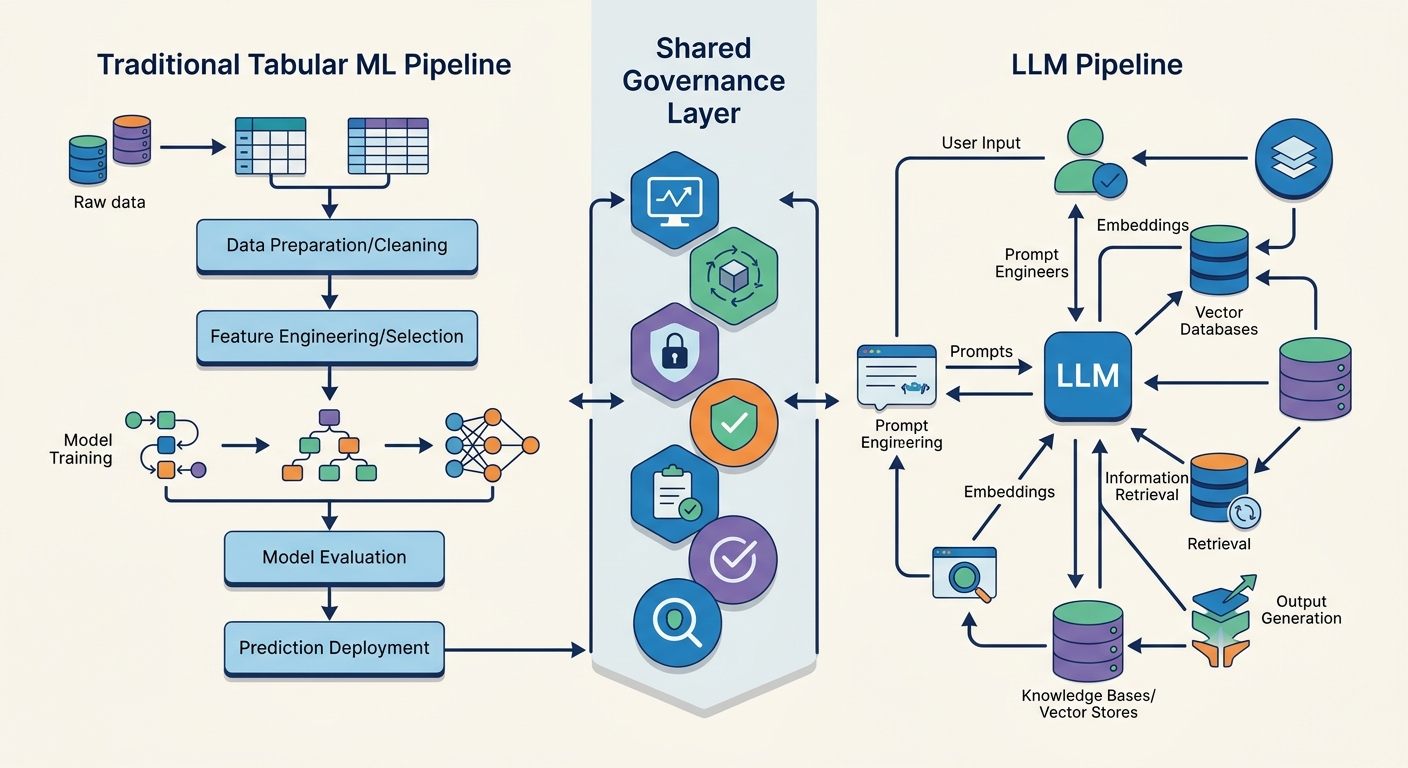
The pattern: the feature store didn't lose its job — it lost its monopoly. It's now one component in a platform that also needs vector retrieval, prompt/version management, and end-to-end lineage.
A Decision Framework: Buy, Build, or Skip
Apply this to each workload, not to the org as a whole. Most teams will land on "skip for the RAG service, keep for the ranking service."
| Question | If yes → | If no → |
|---|---|---|
| Does the workload serve entity-keyed real-time features (user/item/account) at low latency? | Feature store earns its keep | Lean toward skip |
| Do you need point-in-time-correct training data reproduced across retrains? | Feature store (or equivalent) is required | Evaluate lighter options |
| Is the core of the workload prompt + retrieval + embeddings only? | Skip the feature store; invest in vector retrieval and prompt versioning | — |
| Do you have many models sharing features? | Centralize in a feature store | Per-service feature code may be fine |
| Do you need auditable lineage for regulated data? | Feature store provides the tabular slice; pair with pipeline lineage | — |
Buy when you need point-in-time correctness, low-latency serving, and a catalog, and you don't want to build and operate that yourself. Build only if your feature semantics are unusual enough that off-the-shelf abstractions fight you — and budget for the operational tax honestly. Skip for pure generative services; a feature store there is a line item buying guarantees you don't use.
The convergence to watch: platforms that unify tabular feature governance with vector retrieval and prompt/version lineage under one lineage graph. That's the architecture that actually matches hybrid LLM products — and it's where the "feature store" concept is heading, rather than disappearing. (See our guide to ML platform architecture for generative AI.)
The Bottom Line
A feature store is worth the infrastructure when you have real-time, entity-keyed, point-in-time-correct tabular signals feeding models that share them. It's overbuilt when your intelligence lives entirely in prompts and retrieval. The mistake in 2026 isn't keeping the feature store or dropping it — it's treating the decision as org-wide when it's workload-by-workload, and treating the feature store as a substitute for the retrieval and prompt lineage you now also need.